menu_book
Caravan Library Towns
Chinguetti, Ouadane, Tichitt, and Oualata are not romantic ruins dressed up for visitors. They are former trans-Saharan hubs where scholarship, trade, and desert survival once depended on the same streets.
Mauritania is where the Sahara stops being backdrop and becomes the main character: a place of caravan towns, manuscript libraries, Atlantic shallows, and distances that still feel enormous.
EntryE-visa required for many travelers; Schengen does not apply
MMauritania travel guide starts with a surprise: this is not empty desert but a country of library towns, Atlantic birdbanks, and caravan routes.
Mauritania rewards travelers who want scale, silence, and places that still feel earned. In Nouakchott, the capital spreads between ocean and sand, a modern city built against the logic of the Sahara itself. Head north and the mood changes fast: Nouadhibou gives you Atlantic fog, fishing ports, and the raw edge of the mining corridor, while Atar opens the door to the Adrar Plateau, where cliffs, palm groves, and old caravan tracks still shape the map. This is a country better read through distance than density.
The headline sights are old, but they do not feel museum-still. Chinguetti, Ouadane, Tichitt, and Oualata were once stations in a trade network that moved salt, manuscripts, and belief across the Sahara; now they stand as stone evidence that the desert was never empty. Chinguetti matters for its manuscript heritage and scholarly memory. Ouadane sits near the Richat Structure, the great circular scar in the earth visible from space. Tichitt and Oualata feel farther out in every sense, not polished, not easy, and all the more memorable for it.
The Green Sahara and the Stone Enclosures, c. 8000 BCE-300 BCE
A wall of sandstone, a line cut by an ancient hand, the curve of a horn: that is where Mauritanian history begins. Long before the great dunes, the land that now looks pitiless held grass, lakes, and herds. On the rocks of the Adrar, near today's Atar, people carved cattle, giraffes, and hippopotami with the calm assurance of those who assumed water would always return.
Then the sky changed its mind. Between roughly 3000 and 2500 BCE, the Sahara dried, and families who had lived beside pasture and shallow water were pushed south or forced to invent new ways of staying put. Ce que l'on ignore souvent, c'est que this was not only a disaster; it was a stern tutor. Scarcity taught storage, walls, and rank.
That lesson appears with particular force at Tichitt. On the edge of the Hodh, archaeologists found stone settlements with compounds, lanes, and granaries, a place planned rather than improvised. One can almost see the evening light on the dry-stone walls, hear grain being poured into storage, and understand that city life in this part of Africa did not wait for foreign permission to exist.
The silence is frustrating. No royal chronicle survives, no queen writes to us from a palace. Yet the stones speak clearly enough: cattle were wealth, grain was security, and order mattered. From those enclosures came habits of exchange and hierarchy that would feed the caravan worlds of Tichitt and Oualata many centuries later.
The emblematic figures of this era are anonymous builders, people who left no names yet laid out Tichitt with the logic of seasoned urban planners.
Some scholars suspect the Tichitt tradition helped shape the later Soninke world; in oral memory collected far to the south, traders still spoke of ancestors from the northern stone enclosures.
Wagadu and the Almoravid Shock, c. 300-1200 CE
Imagine a salt caravan arriving from the north: white slabs, exhausted animals, dust in every fold of cloth. South of today's Mauritania, the empire of Wagadu, known in Arabic sources as Ghana, grew rich not by magic but by position. The desert routes that crossed Tichitt and the northern salt districts linked Saharan mines to the gold fields farther south, and kings learned that taxing movement can be more profitable than owning the mine itself.
The most vivid court portrait comes from al-Bakri in 1067, writing in Cordoba from travelers' reports. He describes a ruler seated in splendor, dogs with bells of gold and silver, courtiers glittering at the threshold, and a ceremonial gravity that made merchants understand exactly where power sat. It is a magnificent scene, but the real secret lies in the ledger: salt in, salt out, tax both ways.
Then comes one of the great reversals in desert history. A Sanhaja notable, Yahya ibn Ibrahim, returned from pilgrimage embarrassed by the thinness of religious learning among his people. He brought back the jurist Abdallah ibn Yasin, who found the tribes unruly, withdrew to a ribat, and forged from discipline what comfort never could. A reform circle on the edge of the Mauritanian desert became the Almoravid movement.
From there, events accelerate with almost indecent speed. Abu Bakr ibn Umar campaigned in the south, Yusuf ibn Tashfin built power in Morocco, and the movement born in the Sahara crossed into al-Andalus. Mauritania was not a remote backdrop in this story; it was the furnace. The moral severity learned in the desert changed the balance of power across the western Islamic world, and the caravan corridors of Chinguetti's wider region would soon inherit that prestige.
Abdallah ibn Yasin was less a marble saint than an exasperated teacher whose frustration with lax students helped set an empire in motion.
Chronicles remember early Almoravid severity so starkly that even chess and music could fall under suspicion, a reminder that this imperial adventure began as a reformist retreat, not a plan for conquest.
Ksour, Manuscripts, and the Learned Desert, 1200-1800
A manuscript chest, a reed pen, a page rubbed by fingers and wind: this is the Mauritania many visitors remember longest. After the age of imperial expansion, the desert towns of Chinguetti, Ouadane, Tichitt, and Oualata took on another kind of authority. They were caravan stations, yes, but also places where law, grammar, astronomy, trade, and piety traveled together.
Chinguetti has acquired a near-mythic aura, and for once the reputation is earned. Founded in its present form around the 13th century, it grew into a center of Islamic scholarship where families preserved private libraries across generations. Ce que l'on ignore souvent, c'est que these manuscripts were not museum trophies. They were working books, carried, copied, glossed, argued over, and taught under conditions that would make any modern archivist faint.
Ouadane looked north and west, Tichitt and Oualata opened toward the Sahel, and together the ksour formed a chain of intelligence across emptiness. One town dealt in salt, another in books, another in cloth or dates, but none lived by commerce alone. Reputation mattered. A lineage of scholars could dignify a quarter as surely as a prosperous caravan.
This learned world had its own fragility. Drought, shifting routes, tribal conflict, and later Atlantic commerce all thinned the old trans-Saharan system. Yet the memory remained, which is why Chinguetti still occupies such a disproportionate place in Mauritanian identity. The modern state, when it emerged in Nouakchott, inherited not only frontiers and ministries but also the prestige of these manuscript towns scattered across the interior.
Sidi Yahya, the revered scholar associated with Chinguetti's intellectual lineages, survives less as a single biography than as the model of the desert teacher whose authority rested on memory, discipline, and trust.
Families in Chinguetti still keep manuscript libraries in private houses, and some volumes bear the stains of travel, smoke, and handling that prove they lived a harder life than most books in European collections.
Colonial Lines on a Nomad Map, 1800-1960
A French officer unfolds a map on a camp table and draws a line across spaces he barely controls. That image captures the colonial chapter rather well. Mauritania entered the French imperial system later and more unevenly than coastal West Africa, because nomadic confederations, distance, and the sheer indifference of the desert made tidy administration difficult.
The key figure is Xavier Coppolani, the so-called peaceful conqueror, who worked from 1901 to 1905 through alliances, pressure, and selective force. He understood that maraboutic authority mattered as much as rifles, and he tried to fold the territory into French West Africa without triggering a war he could not finish. It nearly worked. Then he was assassinated at Tidjikja in 1905, and the illusion of an easy submission died with him.
Colonial rule did leave marks that lasted: administrative centers, census habits, school networks in French, and a harsher integration into Atlantic economic logic. The Senegal River valley and Rosso became more legible to the administration than the deep interior, while caravan life declined as maritime routes and colonial borders redirected trade. The old ksour were not erased, but they were pushed from the center of the map.
And yet empire never fully solved the question of what Mauritania was. Arabophone desert lineages, Haratin communities, Pulaar, Soninke, and Wolof populations in the south, clerical prestige, tribal power, and French bureaucracy coexisted in an arrangement no decree could simplify. By the time independence arrived, Nouakchott had to be built almost from scratch because no inherited city could comfortably symbolize the whole country.
Xavier Coppolani was an empire-builder who preferred negotiation to spectacle, and he died in Tidjikja before he could discover whether his method had any durable future.
Nouakchott was chosen as the future capital before it was much of a city at all, little more than a coastal settlement selected because no older center seemed politically neutral enough.
Independence, Drought, and the Search for a State, 1960-present
On 28 November 1960, Mauritania became independent, and the new republic faced a peculiar task: it had to invent state ceremony in a place where the capital itself, Nouakchott, was barely formed. Moktar Ould Daddah, the first president, spoke the language of sovereignty, but he governed a country still negotiating what its social contract might be. Desert, river valley, tribal loyalties, former servile communities, and competing linguistic worlds did not merge because a flag was raised.
Then came drought. The great Sahelian crises of the 1970s and 1980s struck pastoral life with terrible force, driving people toward Nouakchott and Nouadhibou, swelling quarters that had neither the water nor the planning for such growth. Ce que l'on ignore souvent, c'est que modern Mauritania was built as much by displacement as by policy. Camps became neighborhoods; temporary survival became urban destiny.
Politics did not calm the picture. The Western Sahara war weakened the first republic, military rule followed in 1978, and coups became part of the national grammar. Iron ore from Zouerate, shipped through Nouadhibou, kept its economic weight; fisheries and later gold added new stakes. But the unresolved questions stayed stubbornly human: who speaks for the nation, who benefits from the state, and who remains outside the photograph.
Mauritania in the 21st century is more urban, more connected, and more self-aware than the caricature of empty desert suggests. Musicians such as Dimi Mint Abba and Malouma carried old forms into modern sound, anti-slavery activists forced buried truths into public speech, and the manuscript towns regained symbolic force in a heritage economy that is also a struggle over memory. The bridge to the next chapter of Mauritanian history is already visible: a country long defined by routes must now decide what, exactly, it wants to preserve when movement accelerates.
Moktar Ould Daddah appears in official portraits as the father of the nation, yet in private he was a lawyer of constant balancing acts, trying to hold together a state whose pieces did not naturally fit.
The iron-ore train linking Zouerate and Nouadhibou became so outsized in the global imagination that many outsiders know the country first through wagons and dust, not through the libraries of Chinguetti or the political laboratory of Nouakchott.
In Mauritania, speech does not open the door to society. Speech is the door. A meeting in Nouakchott may begin with questions about your sleep, your health, your family, the heat, the wind, and only then, much later, the matter you imagined was urgent. Impatience sounds barbaric here. The desert has trained people to respect preliminaries, because a life can depend on the quality of the first exchange.
Hassaniya Arabic carries this code with elegant economy. A few words do the work of whole moral systems: attaya for tea and the time tea creates, baraka for blessing that clings like perfume, karama for hospitality with honor attached to it. Then French enters, practical and administrative, while Pulaar, Soninke, and Wolof remind you that Mauritania is not one tongue with ornaments attached, but a pact between several memories.
Names themselves refuse anonymity. Ould means son of. Mint means daughter of. A person introduces himself and hands you a lineage. I like countries that distrust the isolated individual. Mauritania does.
And then comes the masterpiece: inshallah. Prayer, hope, postponement, refusal, kindness, all tucked into one expression. A language that can decline without brutalizing the listener has already understood civilization.
Mauritanian politeness has the rigor of liturgy. You do not lunge toward the point as though speech were a taxi meter. You arrive, you greet, you ask, you wait. Men shake hands slowly, sometimes for longer than a European wrist can morally endure, and the slowness is not softness but attention. With women, intelligence begins with restraint: wait, observe, follow the cue offered.
Hospitality is serious business. Tea appears. More tea appears. A tray, small glasses, sugar with the confidence of empire. The first glass bites, the second settles, the third flatters. Attaya is never only a drink; it is a machine for producing patience, gossip, hierarchy, and the subtle testing of character. A country is a table set for strangers.
Communal eating follows the same law. You wash your hands. You use the right hand. You work in the section in front of you rather than mounting a campaign across the platter. The host may push the best piece of fish or meat toward you, and refusing from modesty is foolish. Generosity likes to be accepted.
What outsiders call looseness often hides an exact code. Time stretches, yes, but the rules do not. Mauritania can forgive ignorance more easily than hurry.
Mauritanian food tastes like intelligence under pressure. Millet, rice, dates, fish, lamb, camel milk, peanut, a handful of leaves, a little tomato, a great deal of memory. The ingredient list is short. The human ingenuity is not. In Nouadhibou, the Atlantic gives fish with cold, metallic flesh; in the Adrar around Atar and Chinguetti, dates arrive with the gravity of inheritance.
The great dishes are communal and unsentimental. Thieboudienne stains rice red with tomato and fish broth, while maru lahm gives the same architecture to meat. Mechoui at a feast is less a recipe than a public event: roasted lamb, torn apart by hand, silence for one minute, then praise. Scarcity has taught Mauritania that flavor is not excess. Flavor is precision.
Milk matters here in a way city people forget possible. Zrig, made from fermented camel or goat milk thinned with water, lands sour first and then cold, and the body understands before the mind does. Lakh, with millet and fermented milk, comforts without performing sweetness. Dates with fresh cream in Ouadane or Oualata are not dessert. They are agriculture made intimate.
And tea rules everything. Tea after food, tea before leaving, tea because the day is too hot, tea because a guest has arrived, tea because language requires a scaffold of steam and sugar. The desert discovered what salons merely suspected: conversation needs ritual to become art.
Mauritanian music has the proud oddity of a place that belongs fully to no single map. Arab modes travel through it. Sahelian pulse answers back. The tidinit and the ardin do not sound like compromise; they sound like two ancestries deciding to sit at the same fire. That is rarer.
The griot world still matters. Praise, genealogy, memory, satire, all carried by voices trained to hold history without paper. A song can bless a family, tease a rival, or fix a reputation more efficiently than any archive. In a country where names already come with lineage attached, music becomes a second registry office.
Then electricity enters the room and behaves badly. Mauritanian guitar styles can turn trance into velocity, especially in urban circles shaped by Nouakchott nights and long road journeys. The sound can be spare, then suddenly feverish, as if the desert had found an amplifier and no reason to apologize.
I distrust music that asks to be admired. Mauritanian music asks for something harder: surrender to repetition, attention to micro-shifts, acceptance that the same phrase heard twelve times is no longer the same phrase. Sand teaches that lesson. So do strings.
Islam in Mauritania is not a decorative identity marker. It structures hours, gestures, learning, law, greetings, and the atmosphere of ordinary life. You hear it in formulas that punctuate speech, in the call to prayer crossing a neighborhood in Nouakchott, in the deference shown to teachers, saints, and families associated with knowledge. Piety here often looks less theatrical than disciplined.
The image that explains the country best may be the mahadra: scholarship under tents, Qur'an memorized in movement, grammar and law carried across distances that would make a sedentary civilization weep. Chinguetti became famous for manuscripts, but the deeper fact is not old paper. It is the social prestige granted to learning itself. A manuscript matters because a teacher mattered first.
Baraka hovers over places and people with unnerving persistence. A library in Chinguetti, a tomb, an old scholar, a lineage known for teaching: each may attract a respect that is emotional, intellectual, and practical at once. The sacred is not neatly boxed. It leaks into etiquette, into architecture, into the way one enters a room.
This produces one of Mauritania's most beautiful paradoxes. The desert suggests emptiness to foreigners. For Mauritanians, it can suggest concentration. Fewer distractions. More God.
Mauritanian architecture begins with an argument against climate. Thick walls, small openings, courtyards, stone, mud brick, shade held like treasure. In the old ksour of Chinguetti, Ouadane, Tichitt, and Oualata, beauty does not announce itself with flourish. It waits for your eye to adjust. Then a carved wooden door, a line of red ochre, a passage narrowed by design, a wall the color of bread crust after fire.
These caravan towns were not built to flatter visitors. They were built to survive trade, heat, scholarship, storage, prayer, and long intervals of absence. That gives them a moral severity I admire. A house says what it needs to say and then falls silent. So many modern buildings could learn manners from a ksar.
Chinguetti's libraries make everyone sentimental, but the streets deserve equal attention: compact, defensive, porous in the right places, stubbornly adapted to sand and time. Ouadane has the stern geometry of a place that knew commerce could vanish. Oualata, with its painted facades, offers ornament without vulgarity. Even ruin has hierarchy here.
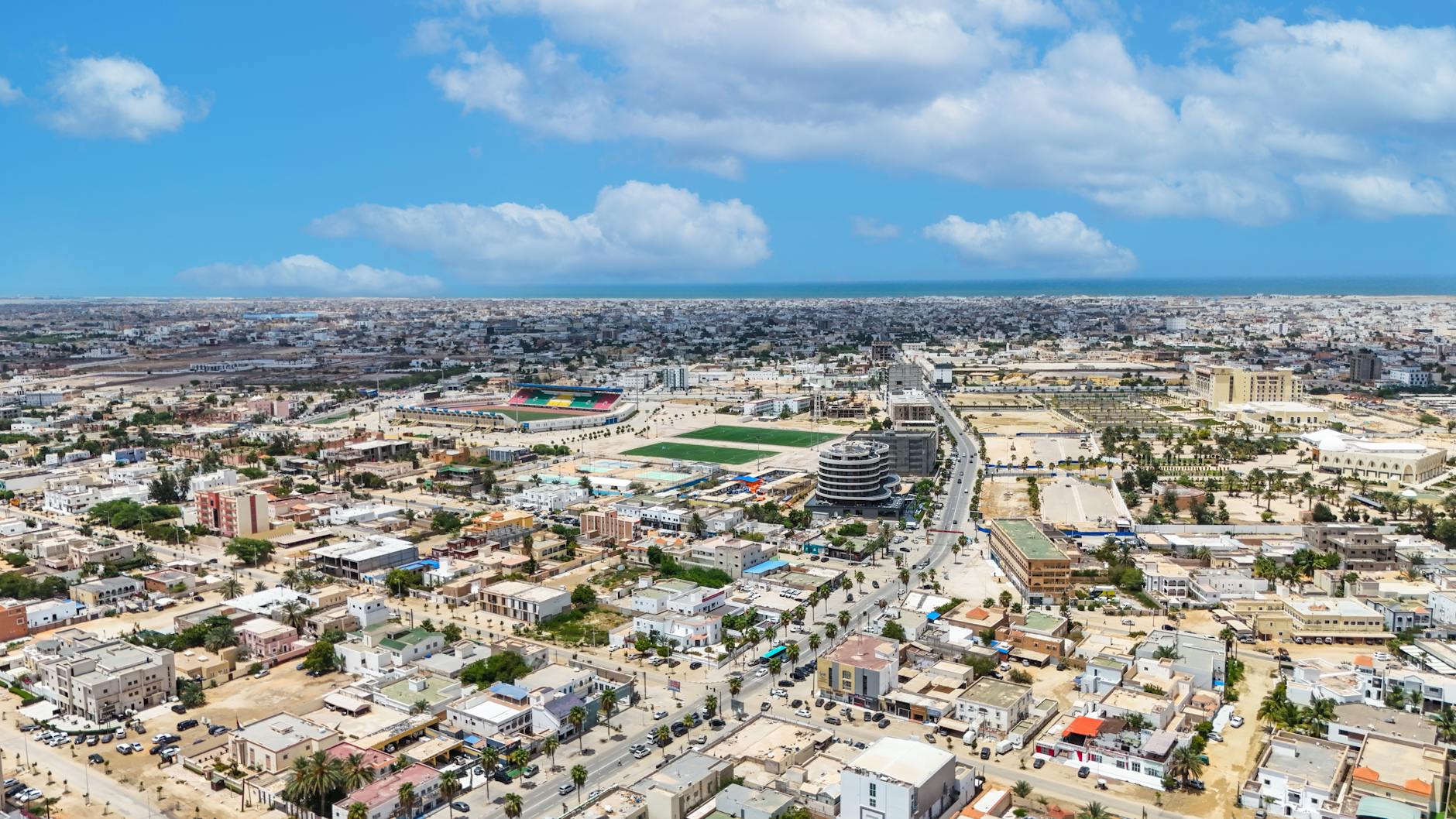
In Nouakchott, newer construction tells another story, faster and less composed, a capital assembled by necessity after independence in 1960 and still negotiating with wind and expansion. Mauritania's architecture is not one style. It is one obsession: how to make a human settlement hold its dignity in the face of sun, dust, and distance.
Chinguetti, Ouadane, Tichitt, and Oualata are not romantic ruins dressed up for visitors. They are former trans-Saharan hubs where scholarship, trade, and desert survival once depended on the same streets.
The country delivers the kind of desert geography maps flatten: escarpments, plateaus, wadis, dunes, and oasis settlements spread across immense distances. Around Atar, the Adrar Plateau shows why Mauritania has such a hold on overland travelers.
Near Ouadane, the Richat Structure forms a circular geologic dome roughly 45 to 50 kilometers across. It is one of the few landmarks on earth that looks almost designed for astronauts.
Nouadhibou and Banc d’Arguin give Mauritania a rare meeting of sea fog, sand, fisheries, and migratory birds. Few countries place a UNESCO-listed coastal ecosystem beside such stark desert country.
The railway between Zouerate and Nouadhibou is built for ore, not nostalgia, which is exactly why it stays in travelers' heads. It ties together mining towns, Atlantic industry, and some of the hardest landscapes in northwest Africa.
Daily life lands in small, precise rituals: attaya poured slowly, dates from oasis regions, camel milk, and long greetings before business begins. Mauritania can feel severe from a distance; up close, it is deeply social.
12 cities — start with the ones we'd send you to first.
A capital that materialized from open desert in 1958 and still feels like it is negotiating its own existence — Atlantic wind, sand streets, and the Marché Capitale selling everything from live goats to Chinese phone cas
Once Islam's seventh-holiest city and the mustering point for West African Hajj caravans, it now holds perhaps 15,000 ancient manuscripts slowly losing the battle against encroaching dunes.
Perched on Cap Blanc peninsula, this industrial fishing port harbors the world's largest ship graveyard — rusting hulls beached in the bay like a fleet that simply gave up.
A UNESCO-listed caravan town where 12th-century stone streets climb a cliff above a palm grove, and the silence is broken mainly by wind and the occasional call to prayer.
One of sub-Saharan Africa's oldest proto-urban settlements, its walled compounds date to 2000 BCE, and the drive in across the Hodh plateau is itself a lesson in how completely a landscape can erase human ambition.
The most remote of Mauritania's four UNESCO ksour, famous for the geometric red-and-white mural paintings that women apply to interior walls — a living decorative tradition with no exact parallel in the Sahara.
The functional gateway to the Adrar plateau, a market town where you stock provisions, hire a 4x4, and eat the best grilled meat you will find before three days of canyon and dune.
Capital of the Tagant region and a quiet oasis of date palms and crumbling ksour that most itineraries skip, which is precisely why the handful of travelers who stop feel like they found something real.
An iron-ore mining town in the far north connected to the coast by the Mauritania Railway, whose 2.5-kilometer ore trains are among the longest in the world and carry passengers in an open wagon if you ask.
Mauritania’s coast is not a beach holiday in disguise. Around Nouadhibou, the Atlantic cuts the desert heat, fishing harbors smell of salt and diesel, and Banc d’Arguin turns the shoreline into mudflats, islands, bird colonies, and one of the country’s strongest arguments for coming this far in the first place. Nouakchott belongs to the same broad coastal belt, but Nouadhibou has the sharper edge.
Adrar is the Mauritania most travelers picture before they arrive, though the reality is harsher and more interesting than the postcard version. Atar is the staging post, Chinguetti carries the manuscript legend, and Ouadane stands out for its ruined stone fabric and access toward the Richat Structure. This is where caravan history stops sounding abstract.
The north runs on iron ore, rail logistics, and endurance. Zouerate and Bir Moghrein sit inside a landscape that feels engineered against emptiness rather than settled within it, and the famous ore train to Nouadhibou gives the region its rough mythology. Come here for scale, not comfort.
Southern Mauritania has more water, more cultivation, and a different social rhythm from the dune country farther north. Rosso and Aleg make sense if you want to see the river-fed edge of the country, where cross-border trade, agriculture, and Sahelian influences matter as much as desert lineage. It is less dramatic at first glance, then more revealing the longer you stay.
The east is the long game: fewer travelers, harder logistics, and some of the most intellectually satisfying historic settlements in the country. Oualata still carries the memory of manuscript culture and painted architecture, while Tichitt and Tidjikja make clear that Mauritania’s past was never only about one caravan road or one desert town. Distances are severe, but so is the payoff.
Mauritania's history runs from early urban life at Tichitt to modern power struggles in Nouakchott, with caravans, manuscripts, reformers, and soldiers in between.
Communities on the Tichitt escarpment build planned stone settlements with storage areas and livestock enclosures. Long before the later empires, this part of Mauritania already knows what fixed settlement, hierarchy, and grain management look like.
Climate shifts turn grassland and lakes into a harsher desert world. That slow catastrophe pushes populations, trade habits, and survival strategies toward the Sahel and leaves the Mauritanian interior permanently transformed.
The Soninke state later known as Ghana grows powerful by sitting between Saharan salt and southern gold. Mauritanian caravan corridors become part of the commercial skeleton that makes the kingdom wealthy.
The Sanhaja notable who will spark the Almoravid reform movement comes from the western Saharan milieu tied to present-day Mauritania. His later religious embarrassment after pilgrimage will have startling consequences.
After the hajj, Yahya ibn Ibrahim seeks a scholar capable of reforming religious life among his people. He brings back Abdallah ibn Yasin, and a local problem begins to turn into a transregional revolution.
Abdallah ibn Yasin gathers committed followers in a ribat, a disciplined retreat on the edge of the Sahara. What looks at first like a severe study circle becomes the engine of empire.
Writing from al-Andalus, al-Bakri records travelers' accounts of royal pomp, gold, and taxation in the kingdom tied to Mauritania's caravan routes. His pages give the medieval western Sahara one of its great set pieces.
Campaigns associated with Abu Bakr ibn Umar strike the Ghana Empire and alter the political balance of the western Sahel. The reformist energy born in the Mauritanian desert now acts like imperial force.
Yusuf ibn Tashfin defeats Alfonso VI at Sagrajas after crossing into al-Andalus. The chain of events that started with Saharan reform now reshapes the wider western Mediterranean world.
Chinguetti develops into one of the great ksour of the western Sahara. Pilgrims, merchants, and scholars make it a place where books matter almost as much as salt.
European Atlantic power begins to touch the Mauritanian coast in harder form. The fort at Arguin signals a new commercial logic that will weaken older trans-Saharan monopolies over time.
A long conflict between Arab warrior groups and Berber religious communities helps reorder power in the region. The social consequences echo for centuries in hierarchy, lineage prestige, and tribal politics.
Xavier Coppolani launches the French advance into Mauritania through negotiation, pressure, and selective force. Colonial authority arrives late here, and even then it remains patchy and contested.
The assassination of Xavier Coppolani reveals how brittle the colonial project remains. Mauritania will be governed by France, but never as easily as the planners hoped.
As the French empire loosens, Mauritania moves toward statehood under a new constitutional arrangement. Independence is now a matter of timing rather than speculation.
Mauritania becomes independent on 28 November 1960, with Moktar Ould Daddah as its first president. Nouakchott begins its extraordinary career as a capital built almost from nothing.
The move confirms one axis of the country's diplomatic identity even as internal society remains linguistically and culturally plural. Foreign policy becomes one more mirror of the national balancing act.
Mauritania enters the conflict after Spain withdraws from Western Sahara. The war strains the young state, drains resources, and helps bring the first republic to the brink.
A coup ends the founding presidency and opens a long era in which uniforms regularly interrupt civilian politics. The republic survives, but rarely in tranquil form.
The decree is historically important and morally insufficient. Social realities outlast legal formulae, and later activists will spend decades forcing the country to confront that gap.
Mauritania adopts a constitution that restores formal pluralism after years of military dominance. Elections return, though power remains heavily managed.
President Maaouya Ould Sid'Ahmed Taya is overthrown while abroad. By now coups have become a grim rhythm in Mauritanian political life rather than an exception.
A fresh military takeover places General Mohamed Ould Abdel Aziz at the center of public life. Stability returns in some sectors, but not without deeper arguments about legitimacy.
Mohamed Ould Ghazouani succeeds Abdel Aziz after elections, marking a rare transfer between elected presidents in Mauritanian history. The moment is modest by global standards, but by local standards it matters.
Chinguetti, Ouadane, Tichitt, and Oualata continue to anchor Mauritania's historical imagination. In a country often described through ore trains and geopolitics, the manuscript towns still whisper the longer story.
The Green Sahara and the Stone Enclosures
The emblematic figures of this era are anonymous builders, people who left no names yet laid out Tichitt with the logic of seasoned urban planners.
A wall of sandstone, a line cut by an ancient hand, the curve of a horn: that is where Mauritanian history begins. Long before the great dunes, the land that now looks pitiless held grass, lakes, and herds. On the rocks of the Adrar, near today's Atar, people carved cattle, giraffes, and hippopotami with the calm assurance of those who assumed water would always return.
Then the sky changed its mind. Between roughly 3000 and 2500 BCE, the Sahara dried, and families who had lived beside pasture and shallow water were pushed south or forced to invent new ways of staying put. Ce que l'on ignore souvent, c'est que this was not only a disaster; it was a stern tutor. Scarcity taught storage, walls, and rank.
That lesson appears with particular force at Tichitt. On the edge of the Hodh, archaeologists found stone settlements with compounds, lanes, and granaries, a place planned rather than improvised. One can almost see the evening light on the dry-stone walls, hear grain being poured into storage, and understand that city life in this part of Africa did not wait for foreign permission to exist.
The silence is frustrating. No royal chronicle survives, no queen writes to us from a palace. Yet the stones speak clearly enough: cattle were wealth, grain was security, and order mattered. From those enclosures came habits of exchange and hierarchy that would feed the caravan worlds of Tichitt and Oualata many centuries later.
Some scholars suspect the Tichitt tradition helped shape the later Soninke world; in oral memory collected far to the south, traders still spoke of ancestors from the northern stone enclosures.
Wagadu and the Almoravid Shock
Abdallah ibn Yasin was less a marble saint than an exasperated teacher whose frustration with lax students helped set an empire in motion.
Imagine a salt caravan arriving from the north: white slabs, exhausted animals, dust in every fold of cloth. South of today's Mauritania, the empire of Wagadu, known in Arabic sources as Ghana, grew rich not by magic but by position. The desert routes that crossed Tichitt and the northern salt districts linked Saharan mines to the gold fields farther south, and kings learned that taxing movement can be more profitable than owning the mine itself.
The most vivid court portrait comes from al-Bakri in 1067, writing in Cordoba from travelers' reports. He describes a ruler seated in splendor, dogs with bells of gold and silver, courtiers glittering at the threshold, and a ceremonial gravity that made merchants understand exactly where power sat. It is a magnificent scene, but the real secret lies in the ledger: salt in, salt out, tax both ways.
Then comes one of the great reversals in desert history. A Sanhaja notable, Yahya ibn Ibrahim, returned from pilgrimage embarrassed by the thinness of religious learning among his people. He brought back the jurist Abdallah ibn Yasin, who found the tribes unruly, withdrew to a ribat, and forged from discipline what comfort never could. A reform circle on the edge of the Mauritanian desert became the Almoravid movement.
From there, events accelerate with almost indecent speed. Abu Bakr ibn Umar campaigned in the south, Yusuf ibn Tashfin built power in Morocco, and the movement born in the Sahara crossed into al-Andalus. Mauritania was not a remote backdrop in this story; it was the furnace. The moral severity learned in the desert changed the balance of power across the western Islamic world, and the caravan corridors of Chinguetti's wider region would soon inherit that prestige.
Chronicles remember early Almoravid severity so starkly that even chess and music could fall under suspicion, a reminder that this imperial adventure began as a reformist retreat, not a plan for conquest.
Ksour, Manuscripts, and the Learned Desert
Sidi Yahya, the revered scholar associated with Chinguetti's intellectual lineages, survives less as a single biography than as the model of the desert teacher whose authority rested on memory, discipline, and trust.
A manuscript chest, a reed pen, a page rubbed by fingers and wind: this is the Mauritania many visitors remember longest. After the age of imperial expansion, the desert towns of Chinguetti, Ouadane, Tichitt, and Oualata took on another kind of authority. They were caravan stations, yes, but also places where law, grammar, astronomy, trade, and piety traveled together.
Chinguetti has acquired a near-mythic aura, and for once the reputation is earned. Founded in its present form around the 13th century, it grew into a center of Islamic scholarship where families preserved private libraries across generations. Ce que l'on ignore souvent, c'est que these manuscripts were not museum trophies. They were working books, carried, copied, glossed, argued over, and taught under conditions that would make any modern archivist faint.
Ouadane looked north and west, Tichitt and Oualata opened toward the Sahel, and together the ksour formed a chain of intelligence across emptiness. One town dealt in salt, another in books, another in cloth or dates, but none lived by commerce alone. Reputation mattered. A lineage of scholars could dignify a quarter as surely as a prosperous caravan.
This learned world had its own fragility. Drought, shifting routes, tribal conflict, and later Atlantic commerce all thinned the old trans-Saharan system. Yet the memory remained, which is why Chinguetti still occupies such a disproportionate place in Mauritanian identity. The modern state, when it emerged in Nouakchott, inherited not only frontiers and ministries but also the prestige of these manuscript towns scattered across the interior.
Families in Chinguetti still keep manuscript libraries in private houses, and some volumes bear the stains of travel, smoke, and handling that prove they lived a harder life than most books in European collections.
Colonial Lines on a Nomad Map
Xavier Coppolani was an empire-builder who preferred negotiation to spectacle, and he died in Tidjikja before he could discover whether his method had any durable future.
A French officer unfolds a map on a camp table and draws a line across spaces he barely controls. That image captures the colonial chapter rather well. Mauritania entered the French imperial system later and more unevenly than coastal West Africa, because nomadic confederations, distance, and the sheer indifference of the desert made tidy administration difficult.
The key figure is Xavier Coppolani, the so-called peaceful conqueror, who worked from 1901 to 1905 through alliances, pressure, and selective force. He understood that maraboutic authority mattered as much as rifles, and he tried to fold the territory into French West Africa without triggering a war he could not finish. It nearly worked. Then he was assassinated at Tidjikja in 1905, and the illusion of an easy submission died with him.
Colonial rule did leave marks that lasted: administrative centers, census habits, school networks in French, and a harsher integration into Atlantic economic logic. The Senegal River valley and Rosso became more legible to the administration than the deep interior, while caravan life declined as maritime routes and colonial borders redirected trade. The old ksour were not erased, but they were pushed from the center of the map.
And yet empire never fully solved the question of what Mauritania was. Arabophone desert lineages, Haratin communities, Pulaar, Soninke, and Wolof populations in the south, clerical prestige, tribal power, and French bureaucracy coexisted in an arrangement no decree could simplify. By the time independence arrived, Nouakchott had to be built almost from scratch because no inherited city could comfortably symbolize the whole country.
Nouakchott was chosen as the future capital before it was much of a city at all, little more than a coastal settlement selected because no older center seemed politically neutral enough.
Independence, Drought, and the Search for a State
Moktar Ould Daddah appears in official portraits as the father of the nation, yet in private he was a lawyer of constant balancing acts, trying to hold together a state whose pieces did not naturally fit.
On 28 November 1960, Mauritania became independent, and the new republic faced a peculiar task: it had to invent state ceremony in a place where the capital itself, Nouakchott, was barely formed. Moktar Ould Daddah, the first president, spoke the language of sovereignty, but he governed a country still negotiating what its social contract might be. Desert, river valley, tribal loyalties, former servile communities, and competing linguistic worlds did not merge because a flag was raised.
Then came drought. The great Sahelian crises of the 1970s and 1980s struck pastoral life with terrible force, driving people toward Nouakchott and Nouadhibou, swelling quarters that had neither the water nor the planning for such growth. Ce que l'on ignore souvent, c'est que modern Mauritania was built as much by displacement as by policy. Camps became neighborhoods; temporary survival became urban destiny.
Politics did not calm the picture. The Western Sahara war weakened the first republic, military rule followed in 1978, and coups became part of the national grammar. Iron ore from Zouerate, shipped through Nouadhibou, kept its economic weight; fisheries and later gold added new stakes. But the unresolved questions stayed stubbornly human: who speaks for the nation, who benefits from the state, and who remains outside the photograph.
Mauritania in the 21st century is more urban, more connected, and more self-aware than the caricature of empty desert suggests. Musicians such as Dimi Mint Abba and Malouma carried old forms into modern sound, anti-slavery activists forced buried truths into public speech, and the manuscript towns regained symbolic force in a heritage economy that is also a struggle over memory. The bridge to the next chapter of Mauritanian history is already visible: a country long defined by routes must now decide what, exactly, it wants to preserve when movement accelerates.
The iron-ore train linking Zouerate and Nouadhibou became so outsized in the global imagination that many outsiders know the country first through wagons and dust, not through the libraries of Chinguetti or the political laboratory of Nouakchott.
In Mauritania, speech does not open the door to society. Speech is the door. A meeting in Nouakchott may begin with questions about your sleep, your health, your family, the heat, the wind, and only then, much later, the matter you imagined was urgent. Impatience sounds barbaric here. The desert has trained people to respect preliminaries, because a life can depend on the quality of the first exchange.
Hassaniya Arabic carries this code with elegant economy. A few words do the work of whole moral systems: attaya for tea and the time tea creates, baraka for blessing that clings like perfume, karama for hospitality with honor attached to it. Then French enters, practical and administrative, while Pulaar, Soninke, and Wolof remind you that Mauritania is not one tongue with ornaments attached, but a pact between several memories.
Names themselves refuse anonymity. Ould means son of. Mint means daughter of. A person introduces himself and hands you a lineage. I like countries that distrust the isolated individual. Mauritania does.
And then comes the masterpiece: inshallah. Prayer, hope, postponement, refusal, kindness, all tucked into one expression. A language that can decline without brutalizing the listener has already understood civilization.
Mauritanian politeness has the rigor of liturgy. You do not lunge toward the point as though speech were a taxi meter. You arrive, you greet, you ask, you wait. Men shake hands slowly, sometimes for longer than a European wrist can morally endure, and the slowness is not softness but attention. With women, intelligence begins with restraint: wait, observe, follow the cue offered.
Hospitality is serious business. Tea appears. More tea appears. A tray, small glasses, sugar with the confidence of empire. The first glass bites, the second settles, the third flatters. Attaya is never only a drink; it is a machine for producing patience, gossip, hierarchy, and the subtle testing of character. A country is a table set for strangers.
Communal eating follows the same law. You wash your hands. You use the right hand. You work in the section in front of you rather than mounting a campaign across the platter. The host may push the best piece of fish or meat toward you, and refusing from modesty is foolish. Generosity likes to be accepted.
What outsiders call looseness often hides an exact code. Time stretches, yes, but the rules do not. Mauritania can forgive ignorance more easily than hurry.
Mauritanian food tastes like intelligence under pressure. Millet, rice, dates, fish, lamb, camel milk, peanut, a handful of leaves, a little tomato, a great deal of memory. The ingredient list is short. The human ingenuity is not. In Nouadhibou, the Atlantic gives fish with cold, metallic flesh; in the Adrar around Atar and Chinguetti, dates arrive with the gravity of inheritance.
The great dishes are communal and unsentimental. Thieboudienne stains rice red with tomato and fish broth, while maru lahm gives the same architecture to meat. Mechoui at a feast is less a recipe than a public event: roasted lamb, torn apart by hand, silence for one minute, then praise. Scarcity has taught Mauritania that flavor is not excess. Flavor is precision.
Milk matters here in a way city people forget possible. Zrig, made from fermented camel or goat milk thinned with water, lands sour first and then cold, and the body understands before the mind does. Lakh, with millet and fermented milk, comforts without performing sweetness. Dates with fresh cream in Ouadane or Oualata are not dessert. They are agriculture made intimate.
And tea rules everything. Tea after food, tea before leaving, tea because the day is too hot, tea because a guest has arrived, tea because language requires a scaffold of steam and sugar. The desert discovered what salons merely suspected: conversation needs ritual to become art.
Mauritanian music has the proud oddity of a place that belongs fully to no single map. Arab modes travel through it. Sahelian pulse answers back. The tidinit and the ardin do not sound like compromise; they sound like two ancestries deciding to sit at the same fire. That is rarer.
The griot world still matters. Praise, genealogy, memory, satire, all carried by voices trained to hold history without paper. A song can bless a family, tease a rival, or fix a reputation more efficiently than any archive. In a country where names already come with lineage attached, music becomes a second registry office.
Then electricity enters the room and behaves badly. Mauritanian guitar styles can turn trance into velocity, especially in urban circles shaped by Nouakchott nights and long road journeys. The sound can be spare, then suddenly feverish, as if the desert had found an amplifier and no reason to apologize.
I distrust music that asks to be admired. Mauritanian music asks for something harder: surrender to repetition, attention to micro-shifts, acceptance that the same phrase heard twelve times is no longer the same phrase. Sand teaches that lesson. So do strings.
Islam in Mauritania is not a decorative identity marker. It structures hours, gestures, learning, law, greetings, and the atmosphere of ordinary life. You hear it in formulas that punctuate speech, in the call to prayer crossing a neighborhood in Nouakchott, in the deference shown to teachers, saints, and families associated with knowledge. Piety here often looks less theatrical than disciplined.
The image that explains the country best may be the mahadra: scholarship under tents, Qur'an memorized in movement, grammar and law carried across distances that would make a sedentary civilization weep. Chinguetti became famous for manuscripts, but the deeper fact is not old paper. It is the social prestige granted to learning itself. A manuscript matters because a teacher mattered first.
Baraka hovers over places and people with unnerving persistence. A library in Chinguetti, a tomb, an old scholar, a lineage known for teaching: each may attract a respect that is emotional, intellectual, and practical at once. The sacred is not neatly boxed. It leaks into etiquette, into architecture, into the way one enters a room.
This produces one of Mauritania's most beautiful paradoxes. The desert suggests emptiness to foreigners. For Mauritanians, it can suggest concentration. Fewer distractions. More God.
Mauritanian architecture begins with an argument against climate. Thick walls, small openings, courtyards, stone, mud brick, shade held like treasure. In the old ksour of Chinguetti, Ouadane, Tichitt, and Oualata, beauty does not announce itself with flourish. It waits for your eye to adjust. Then a carved wooden door, a line of red ochre, a passage narrowed by design, a wall the color of bread crust after fire.
These caravan towns were not built to flatter visitors. They were built to survive trade, heat, scholarship, storage, prayer, and long intervals of absence. That gives them a moral severity I admire. A house says what it needs to say and then falls silent. So many modern buildings could learn manners from a ksar.
Chinguetti's libraries make everyone sentimental, but the streets deserve equal attention: compact, defensive, porous in the right places, stubbornly adapted to sand and time. Ouadane has the stern geometry of a place that knew commerce could vanish. Oualata, with its painted facades, offers ornament without vulgarity. Even ruin has hierarchy here.
In Nouakchott, newer construction tells another story, faster and less composed, a capital assembled by necessity after independence in 1960 and still negotiating with wind and expansion. Mauritania's architecture is not one style. It is one obsession: how to make a human settlement hold its dignity in the face of sun, dust, and distance.
He arrived as a religious teacher and discovered, to his horror, that piety in the desert was far less orderly than the textbooks promised. From that irritation he built a disciplined movement whose Mauritanian beginnings would reshape Morocco and al-Andalus.
Abu Bakr is one of those desert conquerors who seems almost too austere to be real. Chronicles present him as a warrior of wool and dust, a man who carried Mauritanian reformist zeal into the lands of Wagadu and died in campaign rather than in comfort.
He is usually claimed by Moroccan history, yet the family and tribal matrix that made him possible runs deep into the Mauritanian desert. His career is proof that what happened among the Sanhaja was never provincial; it set the stage for one of the great western Islamic dynasties.
Coppolani tried to win Mauritania through alliances, clerical diplomacy, and selective force rather than pure military theater. His assassination at Tidjikja gave the colonial story its proper ending: the desert would not be arranged as neatly as Paris imagined.
He had the thankless role of founding a republic before the capital had even become a true city. Ould Daddah spent his years in power balancing rival identities, regional pressures, and the burden of inventing national institutions almost from sand.
Her voice carried the authority of hereditary musical lineages and the intimacy of a private lament. If you want to hear how Mauritania remembers itself beyond speeches and constitutions, start with Dimi Mint Abba.
She could sing in classical modes and then turn, with no warning, toward modern arrangements and political provocation. Malouma matters because she made culture argue with power instead of decorating it.
He forced one of Mauritania's most painful truths into the center of public debate when many preferred euphemism or silence. Whatever one thinks of his politics, he changed the moral vocabulary of the republic.
His authority does not come from glamour but from endurance. Ould Boulkheir spent decades insisting that social hierarchy, servitude, and citizenship be discussed as facts of lived Mauritanian history, not as embarrassing footnotes.
This is the shortest route that still feels like Mauritania rather than an airport transfer with better weather. Start in Nouakchott for markets and logistics, then head north to Nouadhibou for the desert-meets-ocean edge and the singular geography of Banc d’Arguin.
The classic first overland route through the Adrar region links airport reality with old caravan geography. Atar handles the transport mechanics, Chinguetti brings manuscripts and stone alleys, and Ouadane opens the door to the Richat Structure and the wider plateau.
Northern Mauritania feels stripped to essentials: freight wagons, mining settlements, and distances large enough to reset your sense of scale. This route pairs the practical drama of the Zouerate to Nouadhibou corridor with the deeper isolation of Bir Moghrein.
This is the long way across the country, and the one that best explains how Mauritania changes from Senegal River agriculture to stone-built Saharan settlements. Rosso and Aleg show the greener south, Tidjikja marks the interior transition, and Tichitt and Oualata deliver the old caravan-world finale.
Three pours. Small glasses. Embers, sugar, talk. Late afternoon, after dinner, during waiting, with hosts who respect time.
Fish, tomato rice, vegetables, one wide platter. Right hand or spoon. Family table, coastal lunch, Nouakchott and Nouadhibou, bones watched with care.
Rice, meat, broth, shared bowl. Fingers pull lamb or goat apart. Noon meal, road stop, household table, appetite first.
Roasted lamb or goat, torn by hand. Weddings, feast days, honored guests. Bread nearby, chatter paused.
Fermented camel or goat milk, water, sugar. Iftar, heat, arrival, departure. Guest cup, fast swallow, cold relief.
Millet, fermented milk, spoon. Breakfast, evening, comfort, children, elders, anyone needing calm.
Dates, cream or butter, fingers. Oasis hospitality in Atar, Chinguetti, Ouadane. Slow eating, small talk, pride.



Mauritania requires most travelers, including US, UK, Canadian, Australian, and standard EU passport holders, to apply through the official e-visa portal before boarding. Since 5 January 2025, the old visa-on-arrival routine has largely been replaced by online pre-approval, though the fee is still commonly paid on arrival in exact cash, usually in EUR or USD. Carry a passport valid for at least 6 months beyond entry, and bring a yellow-fever certificate if your route passes through a risk country.
The local currency is the Mauritanian ouguiya, abbreviated MRU. Cash still runs the country: cards work in some higher-end hotels in Nouakchott and Nouadhibou, but outside those pockets you should expect to pay in notes for taxis, meals, and desert logistics. Official guidance also says you cannot legally import or export MRU, so avoid leaving with a thick stack in your pocket.
Most travelers arrive through Nouakchott–Oumtounsy International Airport, with Nouadhibou International Airport serving the north coast and mining corridor. Current air links commonly run from Casablanca, Tunis, Istanbul, Dakar, Las Palmas, Bamako, Abidjan, and Paris, while Mauritania Airlines also operates domestic flights including Nouadhibou and Zouerate. Overland entry from Senegal or the Western Sahara corridor is possible, but border formalities are rarely quick.
Mauritania is a country of long distances, loose schedules, and expensive certainty. Shared taxis and bush taxis connect towns, domestic flights can save a full day on the Nouakchott to Nouadhibou axis, and the SNIM iron-ore line links Zouerate with Nouadhibou, though it is not a normal passenger rail network. For Chinguetti, Ouadane, Tichitt, Oualata, or deep desert sites, a private 4x4 with driver is usually the difference between a trip and a problem.
Most of Mauritania is hard Sahara, with brutal inland heat, very low rainfall, and dust-laden winds. The coast around Nouadhibou and Banc d’Arguin feels milder thanks to the Atlantic, while the south near Rosso and Aleg has a more meaningful rainy season from roughly July to October. For most routes, November to February is the easiest window; April to June can feel punishing inland by late morning.
Mobile coverage is workable in Nouakchott, Nouadhibou, Atar, and other main towns, then fades fast once you leave the paved network. Hotel Wi-Fi exists, but speed and uptime are inconsistent enough that you should treat it as a bonus, not infrastructure. Buy a local SIM in Nouakchott if you need data, and warn people before you head toward Chinguetti, Ouadane, or the eastern ksour.
Mauritania rewards preparation more than improvisation. The main travel risks are not petty crime so much as road accidents, desert breakdowns, heat, dehydration, and shifting security conditions near some remote border zones. Check current government travel advice before departure, use registered guides for off-road travel, and do not plan ambitious cross-country drives after dark.
Visa fees are commonly paid on arrival in EUR or USD, and official advice warns that change may not be available. Small notes also save arguments in taxis and hotel check-ins.
On the Zouerate to Nouadhibou iron-ore train, use the official passenger carriage rather than the open ore wagons. The wagons made the route famous, but enforcement tightened and the romance is weaker when it ends in a police conversation.
A room in Nouakchott can wait; a reliable 4x4 for Chinguetti, Ouadane, Tichitt, or Oualata should not. In peak cool-season months, the best drivers and guides are often spoken for well before arrival.
Do it in Nouakchott or Nouadhibou, where setup is easier and stock is better. Once you leave the main urban corridor, coverage becomes intermittent enough that offline maps are not optional.
If someone offers attaya, they are offering time as much as tea. Do not treat the first cup as a formality and rush off unless you actively want to look rude.
Daily costs look modest on paper until you add private road transfers. One serious desert leg can cost more than several nights of food and lodging combined.
Road hazards rise sharply after dark because lighting is poor, animals stray onto the road, and breakdown support is thin. If a driver suggests leaving at 2am to save time, ask what exactly you are saving.
Explore Mauritania with a personal guide in your pocket
Audio guides for 1,100+ cities across 96 countries. History, stories, and local insight — offline ready.

Probably yes. Travelers from the US, UK, Canada, Australia, and standard EU passports are generally expected to obtain a Mauritanian e-visa before travel, using the official portal, and the old airport visa-on-arrival routine is no longer the standard system.
It can be, if you plan conservatively and stay current on official travel advice. The biggest risks for most travelers are long road journeys, heat, dehydration, desert isolation, and changing security conditions near remote border areas rather than classic street crime in the center of Nouakchott.
Yes, but use the official passenger carriage. Riding on top of the ore wagons is widely treated as unauthorized, and recent enforcement has become less tolerant of the old backpacker stunt.
November to February is the easiest season for most routes. Inland desert towns such as Atar, Chinguetti, and Ouadane are far more manageable then, while the south becomes harder during the July to October rains.
Basic city travel is not especially expensive, but organized desert travel is. Guesthouses, shared taxis, and local meals can keep daily costs moderate, yet a private 4x4 with driver quickly pushes the budget into a different category.
Sometimes in Nouakchott and some higher-end hotels, but do not build your trip around that assumption. Mauritania remains heavily cash-based, and ATM reliability for foreign cards is too inconsistent for remote travel.
Usually by road via Atar, with a private driver or an arranged shared vehicle. It is not a casual hop: distances are long, road conditions can vary, and onward travel from Chinguetti to places such as Ouadane often needs a proper 4x4.
Yes, if you want scale, history, and fewer crowds, and no if you need easy logistics. Mauritania gives you caravan towns like Chinguetti and Ouadane, big geological drama, and a strong sense of remoteness, but it asks for more planning than Morocco or Tunisia.
Last reviewed