Introduction
The first thing that hits you in Malé is the smell of diesel and brine, a cocktail that drifts from the harbor where neon-painted dhonis unload yellowfin tuna before dawn. This mile-long slab of concrete holds 200,000 people—one of the highest population densities on earth—yet the call to prayer still drowns out the traffic at sunset. Forget the Maldives of overwater villas; the republic’s real capital is a vertical city where buildings rise like coral formations and every alley ends in seawall.
Walk ten minutes and you’ll pass a 17th-century coral-stone mosque whose walls are knitted together like reef, then bump into a café serving mas huni out of plastic tubs while kids stream past on electric scooters. Friday afternoons shut the ferries down, so the waterfront promenade becomes a slow-motion parade of families eating ice-cream under the tsunami monument’s steel orbs. There’s no alcohol, no bikinis, no beach inside the city limits—just the roar of outboard engines and the slap of wavelets against armor stone.
What keeps travelers longer than the layover schedule is the compression of the entire archipelago into six square kilometers: fish markets that smell of iron and ocean, a museum sultan’s throne wedged between mobile-phone shops, and a bridge you can cycle in eight minutes yet still feel open-atoll wind on your face. Arrive with time to spare, not merely to transit, and Malé will trade its concrete skin for something looser, salt-stained, and alive.
What Makes This City Special
Coral-Stone Friday Mosques
Hukuru Miskiiy (1658) is built from interlocking coral blocks sawn underwater—no mortar, just gravity and carvings of sunflowers and chrysanthemums. Next door, the golden-domed Grand Friday Mosque lets non-Muslims step inside outside prayer times, provided shoulders, knees and shoes stay covered.
Fish Market at 05:30
Yellowfin tuna the size of seven-year-olds slide across the floor still thrashing; knives flash, scales fly, and the whole pier smells like iodine and salt. Arrive before sunrise to watch the auction bell ring—afterwards, reward yourself with mas huni and roshi for $2 at the stall with the plastic stools.
Sinamalé Bridge Dawn
The 2.1 km China-Maldives Friendship Bridge is the only place in Malé where you can see horizon without paying resort rates. Walk the pedestrian deck at 06:00; fishing dhonis cut V-wakes through glass-calm water and the city’s high-rises glow peach.
Historical Timeline
A City That Refuses to Sink
From coral sandbank to concrete battlement against the sea
Tamil Fishermen Land
Dravidian sailors beach their boats on a tuna-cleaning reef they call 'maha-lei'—great blood. They plant coconuts, build palm-thatch huts, and found what locals still call Athamana Huraa. DNA of the Giraavaru people traces straight to these first settlers.
The Sultanate Begins
A Buddhist king converts, changes his name to Muhammad al-Adil, and makes Malé the permanent seat of 93 future sultans. Friday prayers replace temple drums; coral stone replaces timber. The city’s footprint is still only 600 by 400 meters—eight football pitches end to end.
Ibn Battuta Sleeps Here
The Moroccan judge arrives, marries into the royal family, and writes the only eyewitness account of medieval Malé: raised coral foundations, smells of curing tuna, mosques ‘beautiful beyond description.’ His diary becomes the city’s first travel guide—written 400 years before the next.
Portuguese Storm the Island
Captain Andreas de Sylveira lands at dawn, executes Sultan Ali VI, and builds a timber fort where children now play tag. Catholic bells ring over the lagoon for eight years. The invaders tax every coconut; resentment ferments faster than toddy.
Night of Liberation
Muhammad Thakurufaanu slips past the fort with 200 men in three odi boats, kills the garrison commander, and hoists the red-and-green flag again. Portuguese cannon are dumped into the harbor; fishermen still net rusted iron shot after storms. The date becomes National Day.
Coral-Carved Mosque Rises
Craftmen haul 2,600 blocks of porite coral, chisel them like wood, and fit them without mortar. The result—Hukuru Miskiiy—still smells of salt and old incense. UNESCO calls it the finest pre-modern coral structure on earth; locals simply call it the ‘Friday Mosque.’
British Flag, Maldivian Throne
A treaty signed in Colombo lets London handle foreign policy while the sultan keeps his palace keys. Malé gets its first telegraph cable; gossip travels faster than dhows for the first time in history. The Union Jack never flies here, but British gunboats patrol the atoll.
Ibrahim Nasir Born
In a cramped coral-stone house near the jetty, the boy who will abolish the monarchy learns arithmetic by lamplight. As president he dredges the airport reef, opens the first tourist bungalow, and fills in the sultan’s polo ground to make room for traffic.
Independence at Midnight
The Union Jack is lowered inside a silent customs office; no crowds, no fireworks—just the harbor master and a clerk. Malé wakes up owning its own foreign policy for the first time since 1153. Population: 11,000, squeezed onto less than one square mile.
Republic by Bulldozer
Voters choose a president over a sultan, 81 % to 19. Within weeks the royal palace—Gan’duvaru—is demolished to widen Majeedhee Magu. Its teak beams become doorframes; its throne disappears into a storeroom. The last sultan leaves on a cargo boat, suitcase in hand.
Golden Dome Crowns the City
The Grand Friday Mosque opens: 5,000 worshippers under a 24-carat gold-plated roof visible 15 km out to sea. Italian marble floors stay cool even at noon; the air-conditioning bill rivals a school’s annual budget. The mosque becomes the postcard silhouette that replaces the old harbor lighthouse.
Gunfire at the Presidential Pier
Forty Tamil mercenaries storm the pier at 4 a.m., aiming to sell Malé to the highest bidder. Indian paratroopers land at Hulhulé by dusk—Operation Cactus. The fighting ends in 24 hours, leaving bullet scars on the customs warehouse and a new monument: white, green, red rings for invasion, nation, blood.
The Sea Finally Breaks In
The Indian Ocean tsunami surges over 2-meter seawalls at 9:20 a.m., flooding 30 % of the island in 12 minutes. Cars float past the fish market; salt water soaks the national archives. Recovery begins the same afternoon—sandbags, brooms, and borrowed generators humming in the dark.
First Democratic Handover
Mohamed Nasheed beats the man who once jailed him. Crowds pack Republic Square until 3 a.m., waving pink ballot slips like victory flags. For the first time a Maldivian president takes oath without a gun at his back—then drives his own scooter home through cheering traffic.
Bridge at Sunrise
The Sinamale Bridge opens at dawn: 2.1 km of Chinese steel and Maldivian asphalt linking Malé to the airport and the new city of Hulhumalé. For the first time you can leave the capital on wheels instead of waves. Commuters cycle the span at sunset, phones out, catching the exact moment the dome of the Grand Mosque turns gold.
Notable Figures
Mohamed Thakurufaanu
died 1585 · National Hero & SultanHe slipped into Malé harbour at night with his band, lit signal fires on the ramparts and broke a 15-year colonial grip. Today his tomb sits quietly behind the Old Friday Mosque; taxi drivers still tap their horns twice when they pass, a low-tech salute to the original resistance leader.
Aminath Didi
1915–1996 · First Lady of the MaldivesAs wife of President Mohamed Amin Didi she turned the palace courtyard into an open-air classroom for girls in the 1950s, defying clerics who opposed female education. Walk past the gated gardens on a weekday morning and you’ll hear schoolgirls rehearsing English poems—her ghost nods in approval.
Photo Gallery
Explore Malé in Pictures
An elevated perspective of the iconic China-Maldives Friendship Bridge connecting the vibrant urban landscape of Malé to the surrounding islands.
Maahid Photos on Pexels · Pexels License
A vibrant street scene in the heart of Malé, Maldives, capturing the daily hustle of local markets, motorbikes, and urban architecture under a clear blue sky.
Asad Photo Maldives on Pexels · Pexels License
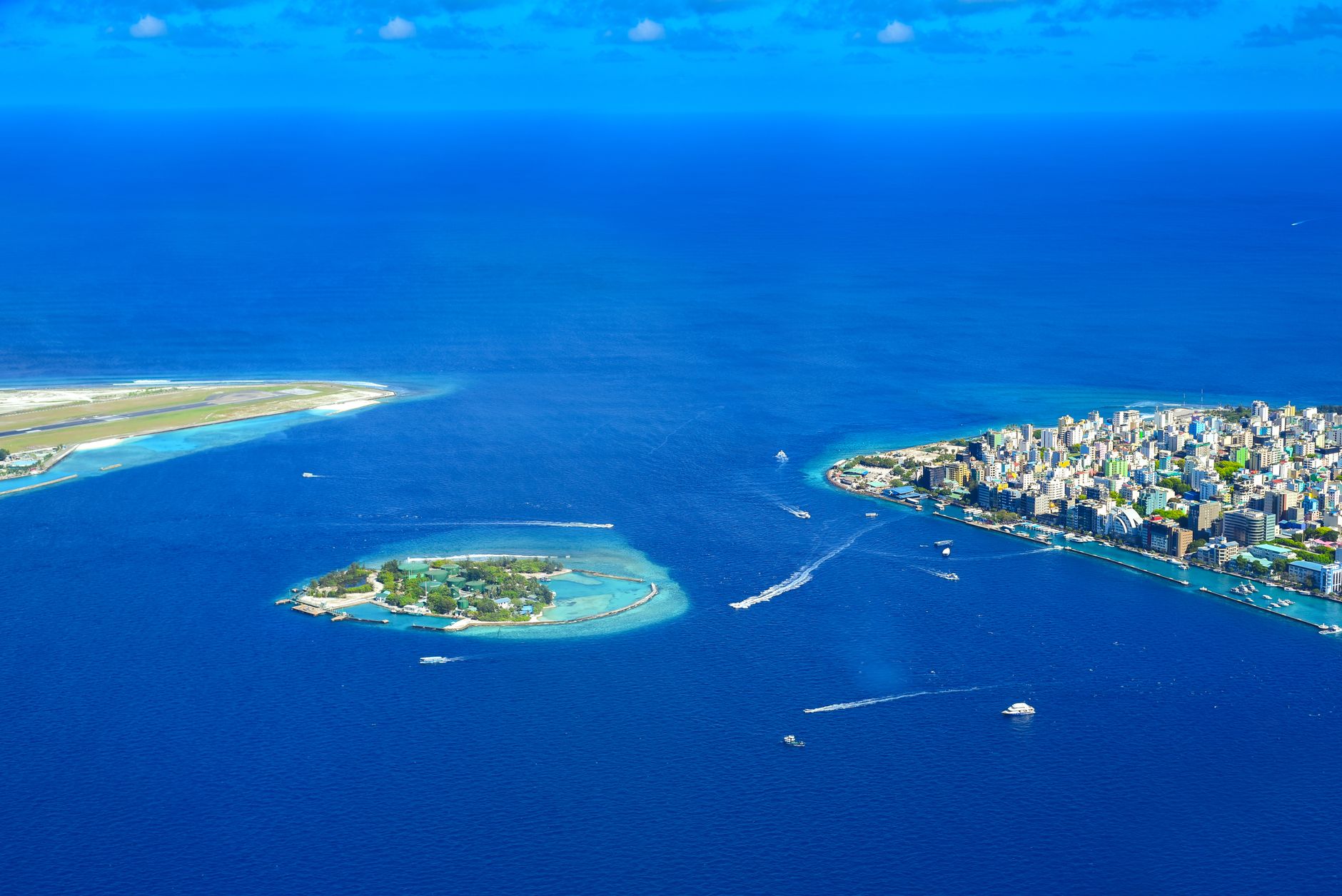
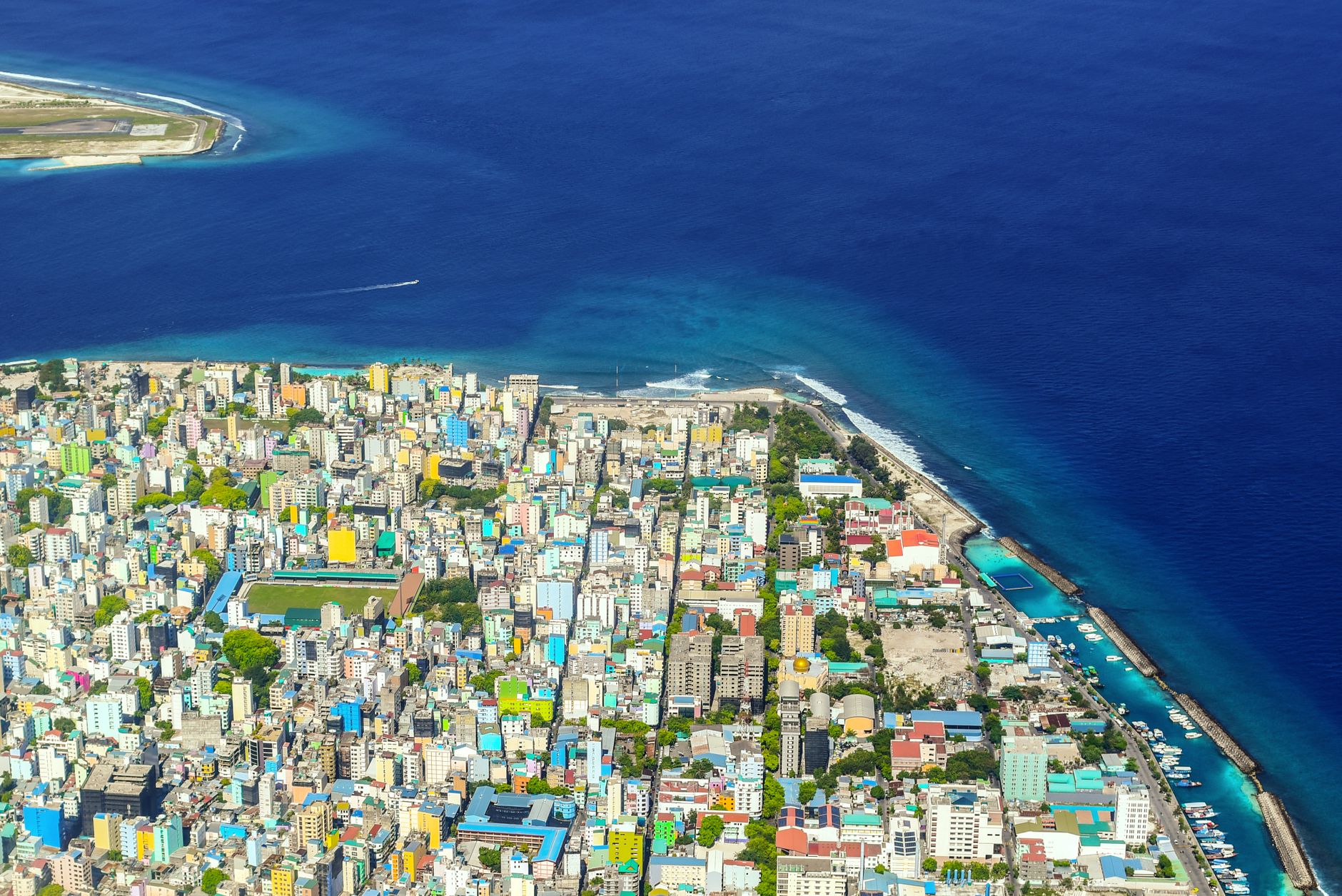
A stunning aerial perspective of Malé, Maldives, showcasing its unique urban density surrounded by the vibrant blue waters of the Indian Ocean.
Asad Photo Maldives on Pexels · Pexels License
An aerial perspective of Malé, Maldives, capturing the contrast between dense urban residential blocks and ongoing construction projects near the coast.
Maahid Photos on Pexels · Pexels License
An stunning aerial perspective of Malé, the capital of the Maldives, showcasing its unique urban density alongside the nearby international airport island.
Asad Photo Maldives on Pexels · Pexels License
An aerial perspective of Malé, the vibrant capital city of the Maldives, showcasing its unique urban density surrounded by the deep blue Indian Ocean.
Asad Photo Maldives on Pexels · Pexels License
Practical Information
Getting There
Velana International Airport (MLE) sits on neighbouring Hulhulé Island. MTCC public ferries run every 15 min, 24/7, to Malé ferry terminal (10 MVR / $0.65, 10 min). Private speedboats ($15–40) drop at hotel jetties. No rail; seaplanes serve resorts only.
Getting Around
No metro, trams or tourist pass. Malé is 1.7 km²—walkable in 25 min end-to-end. MTCC buses reach Hulhumalé and Villingili for 10 MVR. Sinamalé Bridge has a 2.1 km protected walkway; rent bikes at the Malé end for sunset rides.
Climate & Best Time
Year-round 29–31 °C. Dry season Dec–Apr (43–86 mm rain, calm seas, 30 m dive viz). Wet season May–Nov (140–203 mm, plankton blooms = manta rays). Visit Jan–Mar for glass water; June–Oct for cheaper rooms and feeding megafauna.
Language & Currency
Dhivehi (Thaana script) is official, but English runs the airport, ferries, cafés and every street sign. Currency is Maldivian Rufiyaa (MVR); USD accepted everywhere, change given in MVR. Tourist SIMs (Ooredoo/Dhiraagu) $10–25 at arrivals.
Tips for Visitors
Use MTCC Ferry
The 10-minute public ferry from the airport to Malé costs 15 MVR and runs every 15 min, 24/7—skip the $30 speedboat unless you're hauling boards.
Mosque Dress Code
At the Grand Friday Mosque men need long trousers, women a full-length dress and headscarf; both remove shoes and visit only outside prayer times.
No Alcohol in Malé
Alcohol is illegal on the capital island—finish that duty-free bottle before you leave the airport or save it for your resort transfer.
Beat the Rain
January–March gives the driest skies and calmest lagoon; May–October is cheaper but plan morning walks before 14:00 downpours.
Sunrise on the Bridge
Walk the 2.1 km Sinamalé Bridge at 06:00—no traffic, gold light on the lagoon, and the only place in Malé where you can legally cycle.
Eat Like a Local
Breakfast of mas huni and roshi at a hotaa café costs 30 MVR; look for the crowd of taxi drivers—if they’re waiting, the tuna is fresh.
Explore the city with a personal guide in your pocket
Your Personal Curator, in Your Pocket.
Audio guides for 1,100+ cities across 96 countries. History, stories, and local insight — offline ready.
Audiala App
Available on iOS & Android
Join 50k+ Curators
Frequently Asked
Is Malé worth visiting or should I go straight to a resort? add
Malé rewards curious travelers: you’ll see 17th-century coral-stone mosques, smell tuna being auctioned at dawn, and ride a public ferry with school kids—experiences no resort can replicate. One full day is enough before you hop onward.
How many days do I need in Malé? add
Budget one intensive day to cover the Friday Mosque, Sultan Park, fish market and sunset walk on the bridge. Add a second day only if you want a cooking class or a ferry trip to nearby Villingili.
Can I wear a bikini on Malé? add
No—local law requires shoulders and knees covered in public. Swimwear is restricted to designated tourist beaches on other islands like Hulhumalé or Maafushi. Pack a light sarong to slip on the moment you exit the water.
How do I get from the airport to Malé city center? add
Ride the MTCC public ferry: 15 MVR ($1), 10 minutes, leaves every 15 minutes opposite the arrivals hall. Taxis on the airport island are for Hulhumalé only; there’s no car bridge to Malé.
Is Malé safe for solo female travelers? add
Violent crime is rare, but petty theft happens at the ferry terminal and markets. Dress modestly, avoid isolated alleys after midnight, and you’ll find locals unusually helpful—many will walk you to your gate if you look lost.
Why is everything closed on Friday mornings? add
Friday is the Muslim Sabbath; shops shutter for 11:30–13:30 prayers and public ferries pause. Plan a late breakfast and use the quiet streets for architecture photos—then join the post-prayer coffee rush around 14:00.
Sources
- verified Silly Suitcase – Malé Landmarks & Bridge Details — Verified opening hours, ratings and pedestrian access for Victory Monument, Sinamalé Bridge, Muliaage Palace and Tourist Beach.
- verified Live More Travel More – Mosque & Museum Guide — Dress codes for Grand Friday Mosque, Sultan Park layout, and National Museum collection highlights.
- verified The Travel – Coral-Stone Architecture & Art Spaces — Details on Hukuru Miskiy coral masonry, Esjehi Gallery admission ($1.30) and Friday closure times.
- verified MTCC & MaleAirport.com – Ferry Schedules & Fares — Official 24/7 MTCC ferry frequency and 15 MVR fare between Velana International Airport and Malé.
- verified HIDMC – Coffee Culture & Hotaa Meal Times — Local breakfast prices, café operating hours and shift from sai to third-wave coffee in Malé.
Last reviewed: