waves
Reef-Made Geography
The beaches here come from coral, not rivers, and that changes everything. Lagoons, reef flats, channels, and house reefs create the water colors, the calm shallows, and the diving that people cross oceans for.
The Maldives is not one dream island. It is a whole nation built on coral, tide, prayer, and transit, where the sea shapes almost every hour of the day.
EntryFree visa on arrival for many nationalities
MA Maldives travel guide should start with the real surprise: this is not one island but 1,200 coral fragments spread across 820 kilometers of Indian Ocean.
Most travelers picture a private deck and a blue lagoon. The country is stranger, and better. The Maldives is a chain of reef rims, channels, harbors, sandbanks, ferry routes, prayer calls, tuna boats, and runway islands, with Malé packed tight beside the sea and Hulhumalé pushing outward on reclaimed land. You arrive thinking in postcards and quickly learn to think in transfers: speedboat, domestic flight, seaplane, then a jetty above water so clear it looks lit from below. Geography runs the show here. Coral made the beaches, reefs break the swell, and the ocean decides whether your day belongs to a calm lagoon, a surf break, or a channel full of current.
The other surprise is cultural. Leave the resort cocoon and the Maldives shifts scale completely: scooters and tea shops in Malé, guesthouses and dive boards in Maafushi, surf culture on Thulusdhoo, tidy local-island rhythms in Ukulhas, and a slower southern logic in Addu City and Hithadhoo. You hear Dhivehi in shops, smell curry leaves and grilled tuna near the harbor, and notice how close everything sits to the waterline because nowhere rises very high above it. This is one of the lowest-lying countries on earth. That fact is not abstract here; it shapes the architecture, the politics, the drinking water, and the uneasy beauty of every beach.
Buddhist Kingdom and Sea Routes, c. 300 BCE-1153 CE
A diver rises from a lagoon with a fistful of cowries, each shell no bigger than a thumbnail, each one already halfway to becoming money in Bengal or West Africa. That is where the Maldivian story begins: not with armies, not with marble, but with white shells gathered from shallow water and counted like treasure on the sand.
Ce que l'on ignore souvent, c'est que these islands mattered because they sat in the path of the Indian Ocean trade, between Arabia, India and Sri Lanka. Long before the skyline of Malé became a thicket of concrete and glass, the archipelago was a chain of Buddhist communities linked by monks, sailors and traders, with coral-stone stupas rising where palms now lean over guesthouses.
Archaeology gives us the mood more than the names. Havitta mounds, monastic remains and carved stones suggest a Buddhist kingdom that lasted well over a thousand years, and the chronicles later wrapped that memory in legend, especially around Koimala, the stranger-prince said to have arrived by sea and founded the first royal line.
The most moving detail is also the most material. When later builders raised Islamic monuments, some reused older Buddhist stones in their foundations, so the new faith quite literally stood on the old one. Under the polished story of conversion, the Maldives kept its habit of layering one world over another, and that habit would define everything that followed.
Koimala survives half as ruler, half as legend: a ship-borne founder whose political usefulness mattered as much as his biography.
Maldivian cowries once circulated so widely as currency that the islands exported money itself, not merely goods.
Conversion and the Medieval Sultanate, 1153-1558
Picture a dark prayer hall by the sea in Malé, a frightened community outside, and a stranger inside reciting Quranic verses until dawn. According to Maldivian tradition, that was the night the sea spirit Rannamaari was defeated, the monthly sacrifice ended, and the ruler embraced Islam in 1153.
Legend is never innocent. A conversion of this scale also suited the logic of the Indian Ocean, because a Muslim sultan could deal more easily with Arab merchants and enter a wider commercial world with prestige rather than apology. Faith arrived with conviction, yes, but also with ports, contracts and rank.
Then came one of the great gossips of world travel: Ibn Battuta, who landed in the 1340s and promptly tried to reform local manners as chief judge. He was scandalized by Maldivian women, who did not dress according to his liking, and even more scandalized when powerful women ignored him. His pages are delicious because they reveal what irritated him most: the islands were Muslim, but they were not prepared to become his version of Muslim.
This was also an age of queens, court factions and maritime scholarship, all in a kingdom outsiders liked to imagine as remote. Ce que l'on ignore souvent, c'est que the medieval Maldives was not a passive dot on the map but a court society with its own etiquette, its own power struggles and its own sense of rank. What began as a conversion story soon turned into a sultanate with opinions, and foreign visitors discovered that distance does not make a people submissive.
Abu al-Barakat Yusuf al-Barbari, whether Moroccan or Maghrebi in origin, became the man one night of courage turned into a national patriarch.
Ibn Battuta left furious that elite Maldivian women would not accept the dress code he tried to impose, and he recorded the defeat with remarkable self-pity.
Resistance, Raids and Ocean Power, 1558-1887
The Portuguese occupation began not with trumpets but with intrusion: foreign power installed in Malé, local rule bent, resentment growing house by house. From 1558, the islands learned a lesson every small state learns sooner or later: paradise has never discouraged empire.
The hero who answered was Muhammad Thakurufaanu al-Auzam, and his story has exactly the texture one hopes for in island history. By tradition he and his companions struck at night from their vessel, moving from island to island, gathering support, killing collaborators and making the occupiers feel that nowhere in the archipelago was truly safe.
In 1573 he retook Malé and entered the national imagination not as an abstract liberator but as a man of nerve, timing and saltwater endurance. One can almost hear the scrape of hull against jetty, the whispers before dawn, the relief of a capital that had discovered the difference between submission and patience.
But the islands did not become serene after that. South Indian raids, palace intrigues and shifting foreign pressure kept the sultanate on alert, and each century reminded the Maldives that the sea brings creditors as easily as merchants. By the time European influence thickened in the nineteenth century, the monarchy had prestige, memory and ceremony, but less room to maneuver than before.
Muhammad Thakurufaanu is remembered not as a distant bronze hero but as a commander who won back a kingdom by mastering the geography of fear.
Maldivian memory preserves Thakurufaanu's campaign as a sequence of night attacks launched from a single vessel, a guerrilla war written on water.
Protectorate, Constitutions and the End of the Sultan, 1887-1968
By 1887, sovereignty still had its rituals in Malé, but Britain held the strategic upper hand. The Maldives became a British protectorate, which meant the sultans kept their throne and ceremonies while foreign policy moved under imperial supervision, a familiar arrangement in the age when empire preferred accountants to conquerors.
The twentieth century brought paperwork, constitutions and impatience. A first constitution appeared in 1932, modern education widened expectations, and the old court order began to look less eternal than it pretended. Ce que l'on ignore souvent, c'est que monarchies rarely fall in a single dramatic collapse; they fray, compromise, recover, then fray again.
The most curious episode came in the far south. In 1959, islands around what is now Addu City, including Hithadhoo, joined with nearby atolls in the short-lived United Suvadive Republic, a secessionist challenge born from regional grievance and the distortions of the Cold War, with the British base at Gan in the background like an inconvenient uncle at a family dinner.
Then the curtain finally came down. Independence from Britain arrived in 1965, and three years later the sultanate was abolished in a referendum, making way for the Second Republic in 1968. The palace world did not vanish without leaving perfume in the room, but power had changed costume.
Ibrahim Nasir began inside the late sultanate's machinery and ended by supervising the burial of the monarchy itself.
The British military presence in the deep south helped make Gan and Addu feel politically distinct from Malé, which fed the United Suvadive breakaway experiment.
Republic, Strongmen and the Climate Age, 1968-present
A republic was proclaimed, but republican calm did not follow at once. Ibrahim Nasir pushed modernization and secured full independence, yet he also ruled hard, and when he left for Singapore in 1978 under a cloud of accusation, the country passed into the extraordinarily long era of Maumoon Abdul Gayoom.
Gayoom governed for three decades, surviving coup attempts, shaping institutions and perfecting the small-state habit of balancing control with the image of order. Resorts multiplied, aircraft brought in the world, and the Maldives became rich in postcard fantasies just as ordinary island life remained far more modest in Malé, Maafushi and beyond.
Then nature struck with pitiless clarity. The 2004 Indian Ocean tsunami flooded islands across the country, wrecked infrastructure and reminded everyone that the map itself is fragile here. That fragility later became political language under Mohamed Nasheed, who turned the Maldives into a global symbol of climate vulnerability and staged the famous underwater cabinet meeting to force the world to look.
Today the story stretches in two directions at once. Hulhumalé rises from reclaimed land as an answer to crowding and sea-level anxiety, while old island communities still live by tuna, prayer times and harbor weather. The modern Maldives sells dreamlike stillness to outsiders, but its real drama lies in how a nation barely higher than the tide intends to outlast the century.
Mohamed Nasheed understood before most leaders that the Maldives could turn its own precarity into diplomatic theater without trivializing the danger.
Hulhumalé is not simply a suburb but a man-made extension of the national future, built because the capital region had run out of room and time.
Dhivehi does not greet you first by sound but by direction. Thaana runs right to left, like a tide with private intentions, and in Malé the shop signs look as if the island has decided that even writing should move by current rather than by road.
English works perfectly well for hotels, ferries, invoices, and polite transactions. Dhivehi handles the rest: teasing, prayer, impatience, affection, family rank, the small changes of tone that decide whether a sentence lands like silk or like a slap. A country is a table set for strangers; its language decides who may sit and who must wait by the door.
Listen in a harbor in Hithadhoo or on a side street in Hulhumalé at dusk. You will hear greetings soften the air before business begins, and names placed with care, and laughter arrive sideways rather than head-on. The speech has the courtesy of people who live close together and cannot afford verbal vandalism.
Maldivian food is built on a severe quartet: tuna, coconut, starch, chili. Severity, however, can produce tenderness. Mas huni at breakfast tastes of salt, lime, raw onion, and the strange generosity of an island that knows sweetness is not required at eight in the morning.
On inhabited islands, food does not pose for anyone. In Maafushi a pot of garudhiya can appear almost monastic, clear broth and rice and cut lime, until the first spoonful releases the full doctrine of the sea. Rihaakuru goes further. It reduces tuna broth into a dark paste with the moral force of an argument. Spread it on roshi and you understand that concentration is one of the great pleasures.
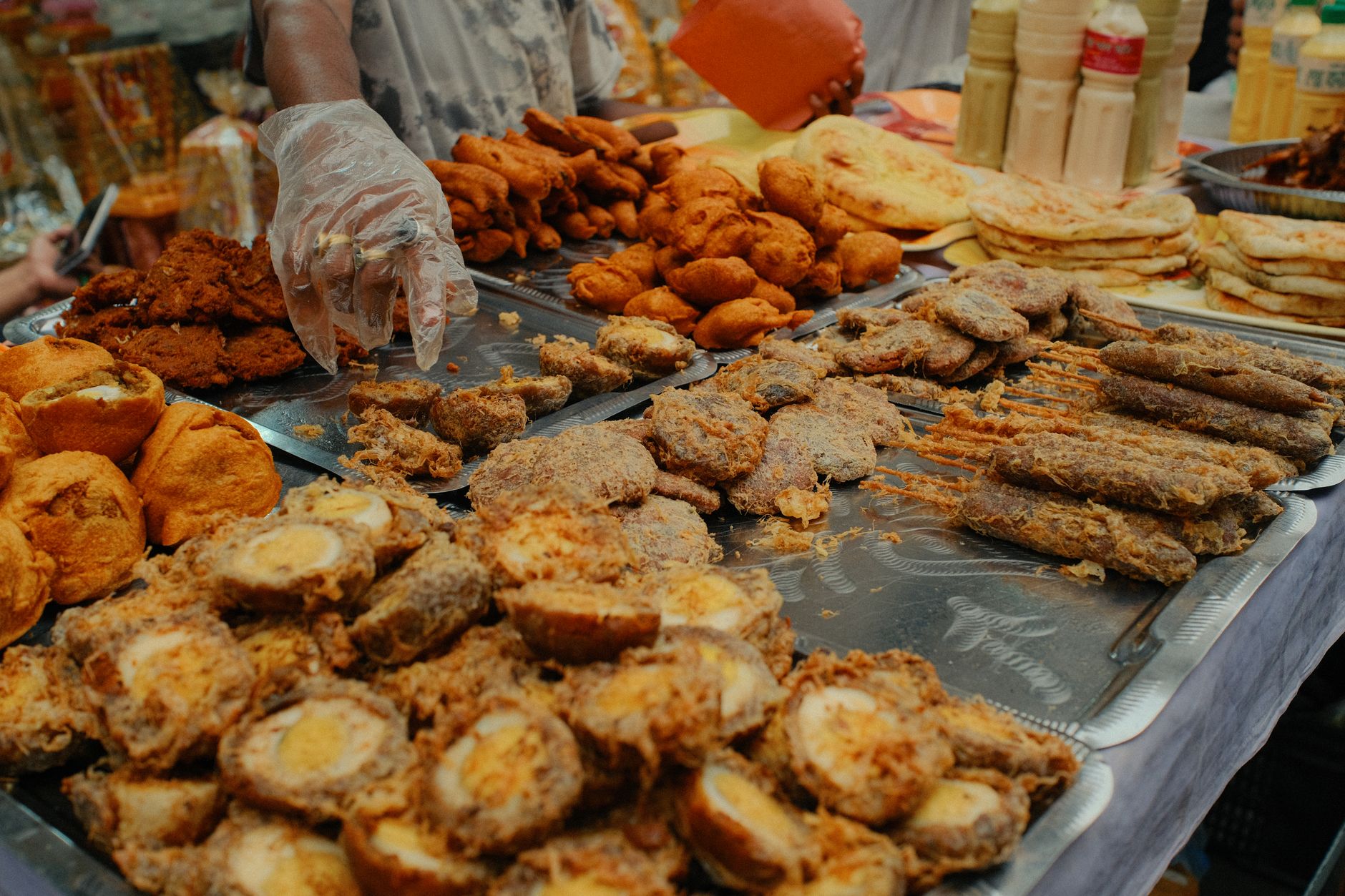
Then comes hedhikaa, the late-afternoon rite of fried things and black tea, where bajiya, gulha, and bis keemiya vanish from plates faster than dignity permits. Luxury resorts sell silence. Local islands sell appetite. I know which world feels more civilized.
Maldivian politeness is not theatrical. It is spatial. You lower your voice near a mosque, use the right hand to eat or pass an object, and let the other person decide whether a greeting becomes a handshake, a nod, or only words. Civilization often begins with the management of elbows.
Because islands are small, conduct has acoustics. Doors stand close to one another, courtyards breathe into lanes, and everybody knows roughly who returned on which boat. In Malé this creates a compressed urban alertness; in Fonadhoo or Naifaru it becomes a form of social weather. People notice. That is not hostility. That is proximity doing its work.
Visitors from loud countries should treat restraint as intelligence rather than shyness. Covering shoulders and knees on inhabited islands, especially outside beach zones, is not costume compliance but basic literacy. The Maldives may trade in fantasy abroad; at home it still prefers good manners to performance.
Islam in the Maldives does not feel imported. It feels absorbed, salted, made local by centuries of repetition. The call to prayer over a harbor in Addu City or Fuvahmulah has a different authority from the same sound in a continental city: water receives it, walls do not, and the note seems to travel farther because the horizon offers no objection.
The country converted in 1153, and the founding legend still carries the clean architecture of myth: a sea spirit, a learned stranger, a night of Quranic recitation, a ruler convinced by dawn. Legends survive because they explain temperament as much as events. In the Maldives, faith and the sea remain in conversation.
For a traveler, the practical lesson is simple and not negotiable. Friday has weight. Ramadan changes the cadence of public life on inhabited islands. Modesty matters more off the resort stage than many outsiders expect, and that difference between polished seclusion and lived society is one of the first serious facts the country teaches.
Bodu beru means big drum, which is accurate in the same way that calling the monsoon wet is accurate. The name states the object and omits the event. What begins as percussion becomes escalation: beat, answer, faster beat, bodies entering the argument one by one until the circle admits that rhythm has won.
The form arrived centuries ago by sea, with African traces carried along Indian Ocean routes, then settled so completely into Maldivian life that it now sounds native in the deepest sense of the word. On a local island the performance often starts with composure and ends with sweat, grins, and the useful collapse of self-consciousness. Ceremony first. Surrender after.
If you hear bodu beru in Thulusdhoo or Eydhafushi, stand close enough to feel the drum in your ribs. Ears can lie. The sternum is more honest. Music in the Maldives is rarely about private introspection; it is about pulse becoming public property.
Maldivian architecture had to negotiate with scarcity before it could dream of beauty. No mountains, no great forests, no inland quarries: only coral stone, timber brought by trade, lime, lacquer, rope, and human patience. The result is a building tradition of low silhouettes, deep practical intelligence, and moments of startling delicacy.
The old coral stone mosques are the clearest proof. Their carved surfaces look less constructed than grown, as if the reef had accepted a second life as scripture and wall. Scholars have found Buddhist remains beneath some Islamic foundations, which gives the whole landscape a grave, almost intimate continuity: one devotion standing on the shoulders of another.
Modern Maldives often appears in photographs as teak decks and overwater geometry, but that is the export version. Walk the denser streets of Malé or the residential grids of Hulhumalé and you meet another architecture entirely: sea walls, shade, concrete, balconies, laundry, scooters, prayer space, water tanks, survival with a façade. Islands make every building confess its purpose.
The beaches here come from coral, not rivers, and that changes everything. Lagoons, reef flats, channels, and house reefs create the water colors, the calm shallows, and the diving that people cross oceans for.
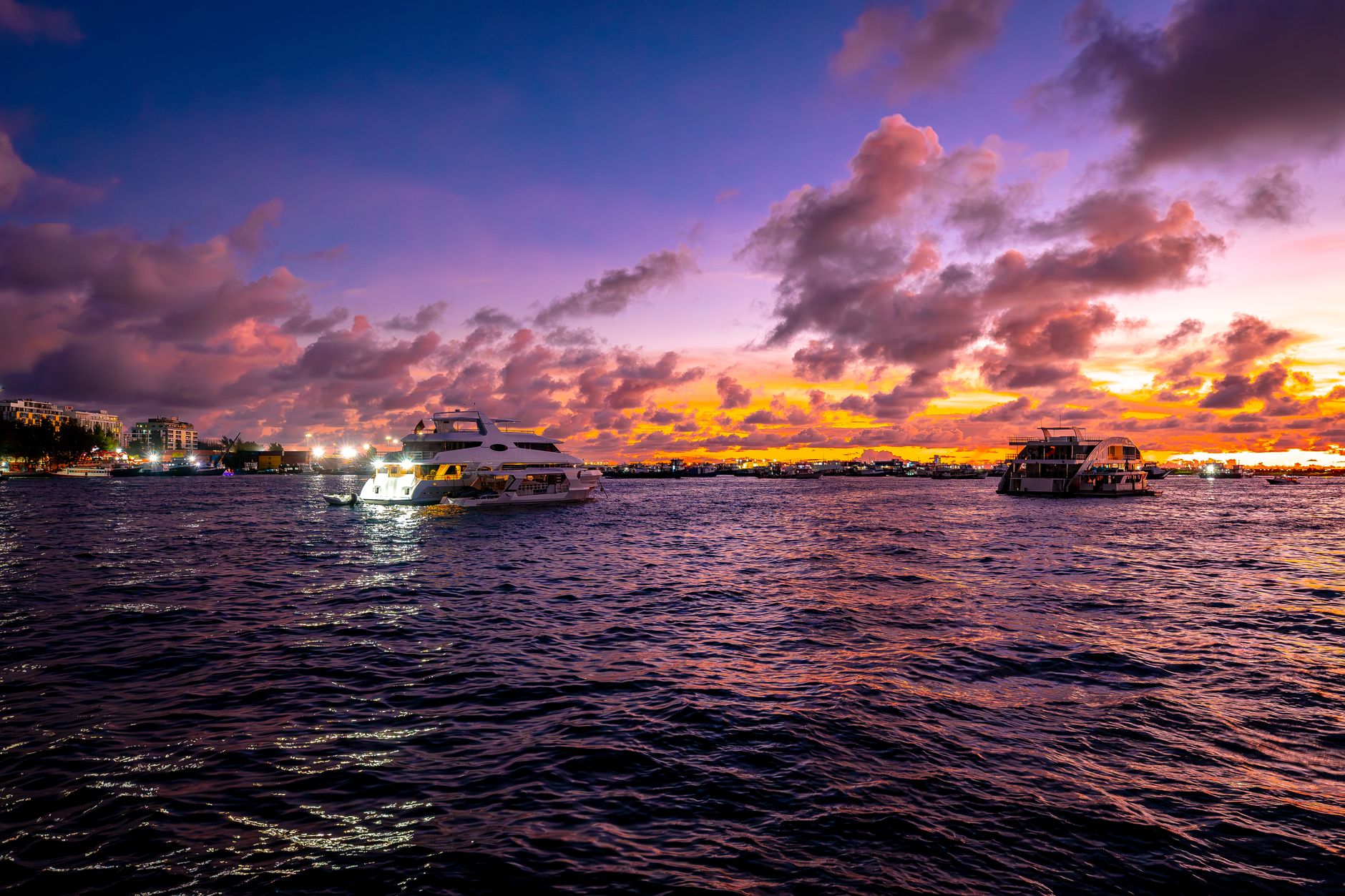
In the Maldives, getting there is part of the trip. Speedboats from Malé, domestic hops to the south, and seaplane descents over atolls turn logistics into one of the country's most memorable rituals.
The same sea that gives you still lagoons also builds serious surf and current-fed dive sites. Thulusdhoo draws surfers in monsoon months, while other atolls reward snorkelers, freedivers, and pelagic-chasing divers.
This is not an empty luxury stage set. The Maldives was Buddhist for centuries before converting to Islam in 1153, and traces of that long history still shadow the coral-stone mosques and old island settlements.
Local food is sharper and more satisfying than most first-time visitors expect. Think mas huni at breakfast, clear garudhiya broth, fried hedhikaa at tea time, and enough lime and chili to keep everything awake.
Malé, Hulhumalé, Maafushi, Ukulhas, Addu City, and Fuvahmulah each show a different country. The smart move is to treat the Maldives as an archipelago of distinct moods, not a single generic beach destination.
12 cities — start with the ones we'd send you to first.
One of the most densely populated capitals on earth, where 200,000 people stack their lives into a coral island barely two kilometres wide, and the fish market at the northern waterfront runs at full volume before sunris
A government-built island rising from reclaimed reef, designed to absorb Malé's overflow — part utopian urban experiment, part early answer to the question of what a Maldivian city looks like when sea-level rise forces t
The southernmost atoll, closer to Sri Lanka than to Malé, where British RAF runways from World War II still cut across the islands and a causeway connects six inhabited islands into a single place with its own dialect an
A single-island atoll — geologically anomalous, with freshwater lakes and soil deep enough to grow fruits the rest of the Maldives has to import, and an outer reef that draws tiger sharks in numbers serious divers track
The island that effectively invented the local-island guesthouse model, sitting 26 kilometres south of Malé and still the benchmark against which every budget traveler measures what non-resort Maldives can and cannot del
A small island in Kaafu Atoll with a Coca-Cola bottling plant, a working boat-building yard, and a right-hand reef break called Cokes that serious surfers schedule entire trips around.
An inhabited island in Alif Alif Atoll that built its reputation on a community-managed reef conservation programme and a house reef so intact that snorkelers find hawksbill turtles within minutes of entering the water.
The domestic hub of Ari Atoll and the closest inhabited island to the whale shark aggregation zone off South Ari — a functional, unglamorous town that serious divers use as a base rather than a backdrop.
The capital of Laamu Atoll, where one of the most significant Buddhist archaeological sites in the Maldives — Isdhoo Lhoamaafaanu — sits largely unvisited, its ancient coral-stone inscriptions older than the country's Is
Malé is where the Maldives drops the fantasy act. Streets are tight, scooters cut through impossible gaps, ferries leave on real schedules, and the country finally looks like a place where people live rather than a brochure set. Hulhumalé broadens the picture with reclaimed land, apartment blocks, and the airport-facing logistics that make the whole archipelago run.
Maafushi is the hinge between budget Maldives and resort Maldives: dive boats at dawn, bikini beaches with rules, cafés pricing in rufiyaa and dollars, and transfer desks that can make or break your day. Thulusdhoo sits in the same broad orbit but with a surf-town edge, less polished than a resort and more interesting for it.
Around Maamigili and Ukulhas, the sea does most of the editing. One island leans into whale-shark trips and dive departures, the other into tidy local-island stays and easy reef access, but both belong to the same marine logic: channels, sandbanks, and boats timing their day to the water rather than the clock.
Eydhafushi and Naifaru sit in the northern half of the country where island life feels less staged and transfers matter more. This is a good region for travelers who care about reef quality, smaller harbors, and the everyday texture of inhabited atolls rather than nightlife or resort theatrics.
Fonadhoo belongs to a stretch of the Maldives that rewards patience. Ferries are thinner, distances feel larger, and the mood shifts away from quick-turn tourism toward islands where fishing, family networks, and prayer times still shape the day more than excursion boards do.
The deep south has its own gravity. Addu City and Hithadhoo feel unusually spread out by Maldivian standards, with roads, neighborhoods, and a history tied to British military presence, while Fuvahmulah stands apart again: one island, one atoll, and dive conditions that pull in serious pelagic hunters rather than casual snorkelers.
From Buddhist islands and trading shells to climate diplomacy on the edge of the Indian Ocean
Archaeology and later tradition point to early settlement by seafaring communities linked to South India and Sri Lanka. The Maldives enters history not as an isolated paradise but as a lived chain of islands on maritime routes.
Buddhism becomes the dominant religious framework of the islands, leaving behind monasteries, mounds and carved remains. For more than a millennium, royal and sacred life would be shaped by this world.
Later royal histories place Koimala at the start of the first recognized dynasty. The tale has the flavor of myth, but its purpose is clear: to give the monarchy a noble founding drama tied to the sea.
The ruler of the Maldives converts to Islam, and the archipelago follows. Tradition gives the central role to Abu al-Barakat Yusuf al-Barbari and the defeat of the spirit Rannamaari in Malé.
The scholar at the heart of the conversion legend becomes one of the most revered names in Maldivian memory. One night of prayer turns into centuries of spiritual authority.
The Moroccan traveler reaches the Maldives and later serves as qadi. His exasperated writing captures a courtly Muslim society that refused to conform to all of his expectations.
A reigning queen holds power in the Maldives during a period of instability and faction. Her rule is a reminder that the archipelago's political history did not always follow the script outsiders assumed.
Portuguese power establishes itself in the capital, beginning a period of resentment and resistance. For the Maldives, this is the sharpest early encounter with direct European control.
After a campaign remembered for night raids and maritime daring, Muhammad Thakurufaanu expels the Portuguese and restores Maldivian rule. The episode becomes one of the country's founding stories of resistance.
Invaders from the Malabar coast seize control for a short but traumatic period. The episode shows how exposed the islands remained to forces arriving by sea even after earlier victories.
The Maldives keeps its sultan but yields control of foreign affairs to Britain. Imperial influence arrives in the careful language of protection rather than annexation.
A written constitution marks a new political vocabulary in Malé. Court ritual still matters, but law, representation and reform now enter the argument in explicit form.
The sultanate is briefly abolished and the First Republic is proclaimed. It does not last, but it proves that the monarchy is no longer untouchable.
Southern atolls centered on what is now Addu City and Hithadhoo break away in a short-lived secessionist experiment. Regional grievance, strategic geography and Cold War conditions all play their part.
The Maldives becomes fully sovereign in international law. Protectorate language ends, even if the political system is still deciding what shape the post-imperial state should take.
A referendum abolishes the monarchy and inaugurates the modern republic. Centuries of sultans give way to a new political order, though not immediately to liberal calm.
Gayoom begins a presidency that will last three decades. Stability, tourism growth and authoritarian control become tightly braided under his rule.
The tsunami floods and damages islands across the country, exposing just how physically vulnerable the Maldives is. The disaster alters infrastructure planning and public consciousness alike.
A new constitution and election bring Mohamed Nasheed to the presidency in the Maldives' first multi-party democratic transfer of power. The country's politics open up, even if turbulence does not disappear.
Nasheed's government stages a cabinet meeting underwater to dramatize the existential threat of sea-level rise. It is theater, certainly, but theater backed by geography and fear.
Land reclamation launches the project that will become Hulhumalé, a planned extension of the capital region. It is urbanism with an undertow of necessity: the country is building space because nature gave it so little.
Buddhist Kingdom and Sea Routes
Koimala survives half as ruler, half as legend: a ship-borne founder whose political usefulness mattered as much as his biography.
A diver rises from a lagoon with a fistful of cowries, each shell no bigger than a thumbnail, each one already halfway to becoming money in Bengal or West Africa. That is where the Maldivian story begins: not with armies, not with marble, but with white shells gathered from shallow water and counted like treasure on the sand.
Ce que l'on ignore souvent, c'est que these islands mattered because they sat in the path of the Indian Ocean trade, between Arabia, India and Sri Lanka. Long before the skyline of Malé became a thicket of concrete and glass, the archipelago was a chain of Buddhist communities linked by monks, sailors and traders, with coral-stone stupas rising where palms now lean over guesthouses.
Archaeology gives us the mood more than the names. Havitta mounds, monastic remains and carved stones suggest a Buddhist kingdom that lasted well over a thousand years, and the chronicles later wrapped that memory in legend, especially around Koimala, the stranger-prince said to have arrived by sea and founded the first royal line.
The most moving detail is also the most material. When later builders raised Islamic monuments, some reused older Buddhist stones in their foundations, so the new faith quite literally stood on the old one. Under the polished story of conversion, the Maldives kept its habit of layering one world over another, and that habit would define everything that followed.
Maldivian cowries once circulated so widely as currency that the islands exported money itself, not merely goods.
Conversion and the Medieval Sultanate
Abu al-Barakat Yusuf al-Barbari, whether Moroccan or Maghrebi in origin, became the man one night of courage turned into a national patriarch.
Picture a dark prayer hall by the sea in Malé, a frightened community outside, and a stranger inside reciting Quranic verses until dawn. According to Maldivian tradition, that was the night the sea spirit Rannamaari was defeated, the monthly sacrifice ended, and the ruler embraced Islam in 1153.
Legend is never innocent. A conversion of this scale also suited the logic of the Indian Ocean, because a Muslim sultan could deal more easily with Arab merchants and enter a wider commercial world with prestige rather than apology. Faith arrived with conviction, yes, but also with ports, contracts and rank.
Then came one of the great gossips of world travel: Ibn Battuta, who landed in the 1340s and promptly tried to reform local manners as chief judge. He was scandalized by Maldivian women, who did not dress according to his liking, and even more scandalized when powerful women ignored him. His pages are delicious because they reveal what irritated him most: the islands were Muslim, but they were not prepared to become his version of Muslim.
This was also an age of queens, court factions and maritime scholarship, all in a kingdom outsiders liked to imagine as remote. Ce que l'on ignore souvent, c'est que the medieval Maldives was not a passive dot on the map but a court society with its own etiquette, its own power struggles and its own sense of rank. What began as a conversion story soon turned into a sultanate with opinions, and foreign visitors discovered that distance does not make a people submissive.
Ibn Battuta left furious that elite Maldivian women would not accept the dress code he tried to impose, and he recorded the defeat with remarkable self-pity.
Resistance, Raids and Ocean Power
Muhammad Thakurufaanu is remembered not as a distant bronze hero but as a commander who won back a kingdom by mastering the geography of fear.
The Portuguese occupation began not with trumpets but with intrusion: foreign power installed in Malé, local rule bent, resentment growing house by house. From 1558, the islands learned a lesson every small state learns sooner or later: paradise has never discouraged empire.
The hero who answered was Muhammad Thakurufaanu al-Auzam, and his story has exactly the texture one hopes for in island history. By tradition he and his companions struck at night from their vessel, moving from island to island, gathering support, killing collaborators and making the occupiers feel that nowhere in the archipelago was truly safe.
In 1573 he retook Malé and entered the national imagination not as an abstract liberator but as a man of nerve, timing and saltwater endurance. One can almost hear the scrape of hull against jetty, the whispers before dawn, the relief of a capital that had discovered the difference between submission and patience.
But the islands did not become serene after that. South Indian raids, palace intrigues and shifting foreign pressure kept the sultanate on alert, and each century reminded the Maldives that the sea brings creditors as easily as merchants. By the time European influence thickened in the nineteenth century, the monarchy had prestige, memory and ceremony, but less room to maneuver than before.
Maldivian memory preserves Thakurufaanu's campaign as a sequence of night attacks launched from a single vessel, a guerrilla war written on water.
Protectorate, Constitutions and the End of the Sultan
Ibrahim Nasir began inside the late sultanate's machinery and ended by supervising the burial of the monarchy itself.
By 1887, sovereignty still had its rituals in Malé, but Britain held the strategic upper hand. The Maldives became a British protectorate, which meant the sultans kept their throne and ceremonies while foreign policy moved under imperial supervision, a familiar arrangement in the age when empire preferred accountants to conquerors.
The twentieth century brought paperwork, constitutions and impatience. A first constitution appeared in 1932, modern education widened expectations, and the old court order began to look less eternal than it pretended. Ce que l'on ignore souvent, c'est que monarchies rarely fall in a single dramatic collapse; they fray, compromise, recover, then fray again.
The most curious episode came in the far south. In 1959, islands around what is now Addu City, including Hithadhoo, joined with nearby atolls in the short-lived United Suvadive Republic, a secessionist challenge born from regional grievance and the distortions of the Cold War, with the British base at Gan in the background like an inconvenient uncle at a family dinner.
Then the curtain finally came down. Independence from Britain arrived in 1965, and three years later the sultanate was abolished in a referendum, making way for the Second Republic in 1968. The palace world did not vanish without leaving perfume in the room, but power had changed costume.
The British military presence in the deep south helped make Gan and Addu feel politically distinct from Malé, which fed the United Suvadive breakaway experiment.
Republic, Strongmen and the Climate Age
Mohamed Nasheed understood before most leaders that the Maldives could turn its own precarity into diplomatic theater without trivializing the danger.
A republic was proclaimed, but republican calm did not follow at once. Ibrahim Nasir pushed modernization and secured full independence, yet he also ruled hard, and when he left for Singapore in 1978 under a cloud of accusation, the country passed into the extraordinarily long era of Maumoon Abdul Gayoom.
Gayoom governed for three decades, surviving coup attempts, shaping institutions and perfecting the small-state habit of balancing control with the image of order. Resorts multiplied, aircraft brought in the world, and the Maldives became rich in postcard fantasies just as ordinary island life remained far more modest in Malé, Maafushi and beyond.
Then nature struck with pitiless clarity. The 2004 Indian Ocean tsunami flooded islands across the country, wrecked infrastructure and reminded everyone that the map itself is fragile here. That fragility later became political language under Mohamed Nasheed, who turned the Maldives into a global symbol of climate vulnerability and staged the famous underwater cabinet meeting to force the world to look.
Today the story stretches in two directions at once. Hulhumalé rises from reclaimed land as an answer to crowding and sea-level anxiety, while old island communities still live by tuna, prayer times and harbor weather. The modern Maldives sells dreamlike stillness to outsiders, but its real drama lies in how a nation barely higher than the tide intends to outlast the century.
Hulhumalé is not simply a suburb but a man-made extension of the national future, built because the capital region had run out of room and time.
Dhivehi does not greet you first by sound but by direction. Thaana runs right to left, like a tide with private intentions, and in Malé the shop signs look as if the island has decided that even writing should move by current rather than by road.
English works perfectly well for hotels, ferries, invoices, and polite transactions. Dhivehi handles the rest: teasing, prayer, impatience, affection, family rank, the small changes of tone that decide whether a sentence lands like silk or like a slap. A country is a table set for strangers; its language decides who may sit and who must wait by the door.
Listen in a harbor in Hithadhoo or on a side street in Hulhumalé at dusk. You will hear greetings soften the air before business begins, and names placed with care, and laughter arrive sideways rather than head-on. The speech has the courtesy of people who live close together and cannot afford verbal vandalism.
Maldivian food is built on a severe quartet: tuna, coconut, starch, chili. Severity, however, can produce tenderness. Mas huni at breakfast tastes of salt, lime, raw onion, and the strange generosity of an island that knows sweetness is not required at eight in the morning.
On inhabited islands, food does not pose for anyone. In Maafushi a pot of garudhiya can appear almost monastic, clear broth and rice and cut lime, until the first spoonful releases the full doctrine of the sea. Rihaakuru goes further. It reduces tuna broth into a dark paste with the moral force of an argument. Spread it on roshi and you understand that concentration is one of the great pleasures.
Then comes hedhikaa, the late-afternoon rite of fried things and black tea, where bajiya, gulha, and bis keemiya vanish from plates faster than dignity permits. Luxury resorts sell silence. Local islands sell appetite. I know which world feels more civilized.
Maldivian politeness is not theatrical. It is spatial. You lower your voice near a mosque, use the right hand to eat or pass an object, and let the other person decide whether a greeting becomes a handshake, a nod, or only words. Civilization often begins with the management of elbows.
Because islands are small, conduct has acoustics. Doors stand close to one another, courtyards breathe into lanes, and everybody knows roughly who returned on which boat. In Malé this creates a compressed urban alertness; in Fonadhoo or Naifaru it becomes a form of social weather. People notice. That is not hostility. That is proximity doing its work.
Visitors from loud countries should treat restraint as intelligence rather than shyness. Covering shoulders and knees on inhabited islands, especially outside beach zones, is not costume compliance but basic literacy. The Maldives may trade in fantasy abroad; at home it still prefers good manners to performance.
Islam in the Maldives does not feel imported. It feels absorbed, salted, made local by centuries of repetition. The call to prayer over a harbor in Addu City or Fuvahmulah has a different authority from the same sound in a continental city: water receives it, walls do not, and the note seems to travel farther because the horizon offers no objection.
The country converted in 1153, and the founding legend still carries the clean architecture of myth: a sea spirit, a learned stranger, a night of Quranic recitation, a ruler convinced by dawn. Legends survive because they explain temperament as much as events. In the Maldives, faith and the sea remain in conversation.
For a traveler, the practical lesson is simple and not negotiable. Friday has weight. Ramadan changes the cadence of public life on inhabited islands. Modesty matters more off the resort stage than many outsiders expect, and that difference between polished seclusion and lived society is one of the first serious facts the country teaches.
Bodu beru means big drum, which is accurate in the same way that calling the monsoon wet is accurate. The name states the object and omits the event. What begins as percussion becomes escalation: beat, answer, faster beat, bodies entering the argument one by one until the circle admits that rhythm has won.
The form arrived centuries ago by sea, with African traces carried along Indian Ocean routes, then settled so completely into Maldivian life that it now sounds native in the deepest sense of the word. On a local island the performance often starts with composure and ends with sweat, grins, and the useful collapse of self-consciousness. Ceremony first. Surrender after.
If you hear bodu beru in Thulusdhoo or Eydhafushi, stand close enough to feel the drum in your ribs. Ears can lie. The sternum is more honest. Music in the Maldives is rarely about private introspection; it is about pulse becoming public property.
Maldivian architecture had to negotiate with scarcity before it could dream of beauty. No mountains, no great forests, no inland quarries: only coral stone, timber brought by trade, lime, lacquer, rope, and human patience. The result is a building tradition of low silhouettes, deep practical intelligence, and moments of startling delicacy.
The old coral stone mosques are the clearest proof. Their carved surfaces look less constructed than grown, as if the reef had accepted a second life as scripture and wall. Scholars have found Buddhist remains beneath some Islamic foundations, which gives the whole landscape a grave, almost intimate continuity: one devotion standing on the shoulders of another.
Modern Maldives often appears in photographs as teak decks and overwater geometry, but that is the export version. Walk the denser streets of Malé or the residential grids of Hulhumalé and you meet another architecture entirely: sea walls, shade, concrete, balconies, laundry, scooters, prayer space, water tanks, survival with a façade. Islands make every building confess its purpose.
Koimala stands at the threshold where memory turns into monarchy. The chronicles present him as a seaborne founder from the Sri Lankan world, which tells you less about his passport than about what Maldivian rulers wanted their origins to look like: noble, chosen, and anchored in the wider Indian Ocean.
His fame rests on a single night in Malé and it was enough to place him in the country's sacred memory. Whether one reads the Rannamaari story as miracle, statecraft or both, he became the outsider who changed the language of legitimacy for the whole archipelago.
He came to the Maldives expecting to teach and left having been taught a few things himself. His irritated account of court life, marriage, dress and female authority gives the islands one of their sharpest medieval portraits, precisely because he could not stop judging what he saw.
Rehendi Khadijah is the sort of ruler who ruins lazy assumptions about Islamic courts and female power. She held the throne more than once in a vicious political climate, which suggests not a ceremonial queen but a woman with allies, enemies and formidable resilience.
National memory keeps him in motion: at sea, at night, landing where he was least expected. His victory over the Portuguese in 1573 is not told as a treaty or a cabinet maneuver but as a campaign of daring that restored Malé to Maldivian hands.
Nasir belongs to that ambiguous category of state-builders who modernize fast and leave argument behind them. He helped end both protectorate status and monarchy, but his departure into exile gave his career the sharp aftertaste that clings to many founders.
For thirty years he was the country's political weather system. Under Gayoom the Maldives expanded its global tourism profile and tightened executive power at home, a combination that made the state look stable until it suddenly looked brittle.
Nasheed gave the Maldives a new kind of visibility. He understood that a low-lying republic could speak to the world not only through beaches and resorts but through moral urgency, and he turned that insight into one of the most memorable climate campaigns of the century.
This is the shortest Maldives trip that still shows you two different countries in one archipelago: the tight urban pulse of Malé, the newer planned edges of Hulhumalé, and the guesthouse-and-boat rhythm of Maafushi. It works if you have one long weekend, want easy logistics from Velana, and would rather spend money on the water than on transfers.
Start in Thulusdhoo for surf culture and quick access from the capital region, then move north into cleaner reef-water territory around Ukulhas and Naifaru. This route trades overwater-villa theatre for guesthouses, marine life, and a better look at how inhabited islands actually function.
The deep south feels less polished and more singular, with longer distances, stronger local identities, and marine encounters that justify the extra flights. Addu City and Hithadhoo give you roads, neighborhoods, and a sense of scale rare in the Maldives, while Fuvahmulah and Fonadhoo pull the trip toward tiger sharks, old island routines, and a far less generic sea.
This is a wide-arc island-hopping trip for travelers who want to understand how different atolls feel rather than settle into one beach. Eydhafushi and Naifaru bring you through the inhabited-island north, Maamigili adds South Ari's dive-and-excursion engine, and the long finish in Fonadhoo gives the journey a quieter southern landing.
Breakfast. Tuna, coconut, onion, chili, lime. Roshi tears, fingers lift, family gathers.
Lunch or dinner. Broth pours over rice, lime squeezes, chili bites. Tables share, silence follows.
Evening hunger. Paste spreads, onions scatter, tea arrives. Cooks, fishermen, guests eat and keep talking.
Late afternoon. Bajiya, gulha, bis keemiya, black tea. Friends visit, plates empty, gossip moves.
Tea hour or celebration table. Squares cut, hands take, crumbs fall. Conversation stays longer than the cake.
Morning ferry, harbor wait, school break. Flatbread folds around tuna and coconut. One hand eats, one hand carries.
Births, feasts, family calls. Rice, coconut, sugar, rose water. Spoons serve, children return for more.




Most travelers from the US, Canada, the UK, the EU, and Australia get a free visa on arrival in the Maldives if they have a passport with machine-readable zone, a return or onward ticket, confirmed accommodation, and enough funds for the stay. You also need to file the IMUGA Traveller Declaration within 96 hours before arrival; it is free, and airlines may ask to see it before boarding.
The local currency is the Maldivian rufiyaa (MVR), but resorts and many dive operators quote rates in US dollars. Carry some rufiyaa for cafés, ferries, and small shops in Malé, Hulhumalé, Maafushi, or Thulusdhoo, and check the bill for 17% TGST, green tax, and a 10% service charge before adding any tip.
Most visitors land at Velana International Airport near Malé, then continue by speedboat, domestic flight, or seaplane. Gan works for the deep south around Addu City and Hithadhoo, while Hanimaadhoo now matters more for the far north, but Velana still handles the bulk of long-haul traffic.
The Maldives has no rail network and almost no reason to rent a car; boats and short flights run the country. Public ferries are the cheap option, speedboats save time on popular routes like Malé to Maafushi, and resorts usually bundle or arrange the expensive part for you: seaplanes and private launches.
Expect heat, humidity, and warm water all year, usually around 25C to 32C. The driest, calmest stretch usually runs from December to April, while mid-May to November brings the southwest monsoon, rougher seas in some atolls, and better odds of lower room rates.
Wi-Fi is standard at resorts and common in guesthouses, though speeds can dip once everyone logs on after dinner. In the Malé area and on bigger local islands, a local SIM or eSIM from Dhiraagu or Ooredoo is the safer bet for ferry updates, transfer messages, and WhatsApp-heavy guesthouse logistics.
For most visitors, the real risks are sun, dehydration, coral cuts, and moving between islands on weather-shaped schedules rather than street crime. On local islands such as Ukulhas or Naifaru, dress more modestly away from designated bikini beaches, keep an eye on currents before swimming, and leave a buffer before international departures in case boats or domestic flights shift.
In the Maldives, the room rate can be the cheap part. Compare the bed price with the speedboat, domestic flight, or seaplane before you book, because a bargain island can turn expensive once you add mandatory transfers.
Cards work well at resorts, but ferries, corner shops, and simple cafés on local islands still run better with cash. Keep a modest stash of MVR for snacks, taxi rides in Malé, and last-minute harbor payments.
The Maldives has no rail system at all, so do not build your schedule with mainland instincts. Think in boats and short flights, then add slack for weather and same-day transfer cutoffs.
If a guesthouse offers to arrange the speedboat, take the offer unless you know the route well. One missed arrival transfer can burn most of a day, especially outside the Malé region.
On inhabited islands, cover shoulders and thighs away from bikini beaches and resort grounds. Near mosques, keep the volume down and avoid blocking paths around prayer times; people will notice, even if nobody says much.
Guesthouses, dive shops, and transfer operators often confirm the details on WhatsApp faster than by email. Get a local data plan at the airport if you are moving beyond one resort and one prebooked transfer.
A quoted nightly rate may still be missing TGST, green tax, and service charge. Check whether breakfast, transfer fees, and airport taxes are included before comparing properties that look similar on the first screen.
Explore Maldives with a personal guide in your pocket
Audio guides for 1,100+ cities across 96 countries. History, stories, and local insight — offline ready.

Usually no pre-arranged visa is needed. Most tourists receive a free visa on arrival if they have a valid passport, a return or onward ticket, confirmed accommodation, enough funds, and a completed IMUGA Traveller Declaration submitted within 96 hours before arrival.
A local-island trip can work from about USD 70 to 130 per person per day, not counting international flights. That usually means guesthouses in places like Maafushi or Thulusdhoo, local food, public ferries where possible, and only a few paid excursions.
Not by default. The country gets expensive when you add private speedboats, seaplanes, meal plans, and resort taxes, but local islands can be surprisingly manageable if you travel slowly and book transfers with care.
Yes, you can island-hop independently between many inhabited islands. The catch is logistics: ferry schedules are limited, speedboats cost more, and some remote combinations work only if you add a domestic flight.
January to March is the safest bet for dry weather and calmer seas, with December and April often still working well. May through October usually brings more rain, more wind, and rougher water in some atolls, though prices can soften.
You still need some cash. Cards are normal at resorts and many hotels, but ferries, cafés, taxis, and small shops in Malé, Hulhumalé, or local islands are easier with rufiyaa.
Malé is worth at least a few hours if you want the Maldives as a country, not just as a lagoon. It is dense, hectic, and very unlike the resort image, which is exactly why it helps the rest of the trip make sense.
Dress modestly on inhabited islands unless you are on a designated bikini beach or inside a resort. Swimwear belongs on the beach, while streets, ferry terminals, and café areas are better handled with shoulders and thighs covered.
They are usually arranged by the resort, not booked like a casual taxi. Seaplanes run in daylight hours, baggage limits matter, and a late international arrival can force you into an airport-area overnight before the onward transfer.
Last reviewed