Tun Razak Exchange Mrt Station
Kuala LumpurMalaysia 3° N · 101° E Updated Apr 2026
KL's largest underground MRT interchange links two lines and walks you straight into a mall built despite RM3 billion in 1MDB misappropriation.
- Time needed
- 10–15 minutes as a transit transfer; 2–3 hours if continuing into The Exchange TRX
- Entry
- Standard Rapid KL MRT fare (token or Touch 'n Go card)
- Access
- Fully accessible — lifts on all levels, continues into The Exchange TRX mall
- Best season
- Year-round (fully underground and air-conditioned)
Somewhere beneath Kuala Lumpur's newest financial district, two metro lines cross at Tun Razak Exchange MRT Station — Malaysia's largest underground interchange and the front door to a neighborhood that nearly didn't exist. The station sits at the heart of the TRX district, a glossy precinct of towers and parkland in Malaysia's capital that had to survive a billion-dollar scandal before a single commuter tapped through its gates. For visitors, it's both a practical transit hub and a strange, compelling piece of the city's recent story.
TRX station works best understood as a threshold. Step off either the Kajang Line or the Putrajaya Line at concourse level, and an air-conditioned underground corridor delivers you straight into The Exchange TRX, the shopping and dining complex that anchors the district. You never need to surface into the heat if you don't want to.
But you should surface. Above ground, TRX City Park spreads across rooftop gardens and water features, and the towers of Malaysia's answer to Canary Wharf rise around you. The station itself — themed "Islamic Corporate" by MRT Corp, which is exactly as interesting and awkward as it sounds — uses geometric motifs drawn from Islamic art to soften what is otherwise a very corporate underground space.
None of this existed before 2012. The speed of transformation is part of the point.
What to see
-
The Stacked-Platform Interchange
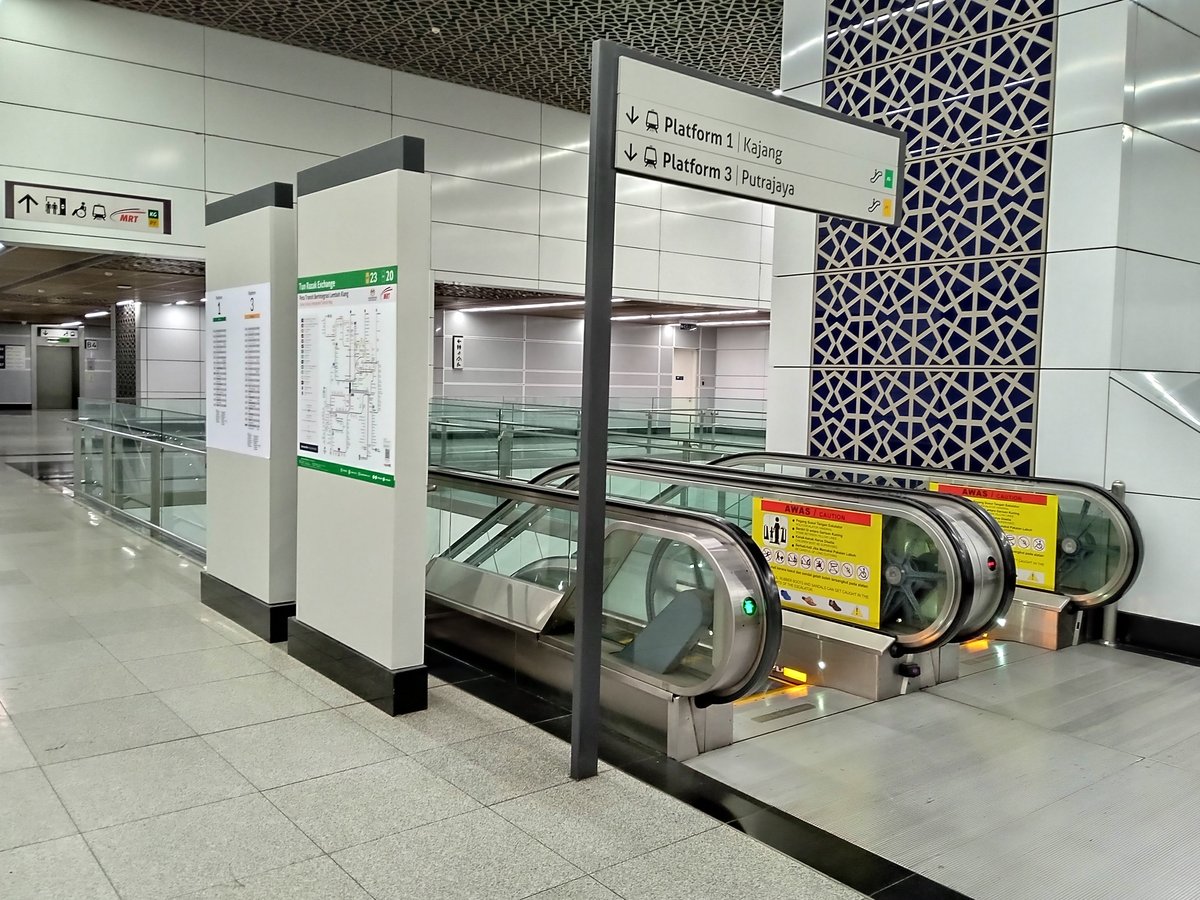
Most interchange stations in Southeast Asia spread their platforms across long horizontal distances, forcing transfers that eat five or ten minutes of walking through corridors longer than a football pitch. TRX stacks its two lines vertically, so switching from the Kajang Line to the Putrajaya Line means riding an escalator rather than trudging a tunnel. Stand at the edge of either platform and look up or down — the engineering required to slot two full-width platforms plus concourse levels beneath an active construction district is quietly impressive. The compressed design makes it one of the more efficient transfers in KL's metro network. -
The Underground Link to The Exchange TRX
At concourse level, a wide pedestrian corridor connects the station directly to The Exchange TRX mall without ever requiring you to step outside. In a city where afternoon temperatures regularly exceed 33°C, this air-conditioned passage matters more than any architectural flourish. The link opened on 29 November 2023 alongside the mall itself, and it functions as a kind of climate-controlled high street — commuters, shoppers, and office workers all funneled through the same corridor. Follow it far enough and you'll surface at TRX City Park, where the contrast between underground fluorescence and equatorial sky hits harder than you'd expect. -
Islamic Geometry in a Corporate Shell
MRT Corp assigns each station a design theme, and TRX drew "Islamic Corporate." In practice, this means geometric patterns adapted from traditional Islamic art — interlocking stars, hexagonal lattices — rendered in the clean materials of a 21st-century transit station. The effect is subtle enough that most commuters walk past without registering it. Look at the column cladding on the platform levels and the tessellated wall panels near the fare gates. These aren't decorative afterthoughts; they're the station's attempt to be something other than a concrete box. Whether they succeed depends on how much you're willing to slow down in a place designed to move you through as fast as possible.
Plan your visit
- Getting There
- The station sits on both the MRT Kajang Line and MRT Putrajaya Line — two of KL's busiest rail corridors. From KL Sentral, take the Kajang Line directly; the ride is about 15 minutes. An underground walkway connects the station concourse straight into The Exchange TRX mall, so you never need to surface into the heat if you'd rather not.
- Opening Hours
- As of 2026, the station opens at 6:00am daily and runs until roughly midnight, matching Rapid KL's standard MRT operating hours. The connected Exchange TRX mall keeps its own retail hours (typically 10am–10pm), so arriving by train before 10am means you'll have the underground link to yourself but the shops won't be open yet.
- Time Needed
- If you're just transferring between the Kajang and Putrajaya lines, allow 5–8 minutes — the stacked-platform design keeps the walk shorter than most KL interchanges. To wander the station's Islamic geometric detailing, the underground mall link, and the TRX City Park above ground, budget 30–45 minutes. Pair it with a half-day at The Exchange TRX if shopping or eating is the real agenda.
- Accessibility
- The station has lifts connecting street level to both platform levels, and barrier-free gates at every entry point — standard for KL's MRT network. The underground link to The Exchange TRX is flat and step-free the entire way, making it one of the more wheelchair-friendly routes into a KL mall. Platform screen doors on both lines eliminate the gap hazard common at older stations.
Photo Gallery


History
From Scandal to Skyline
The TRX district's origin story reads like a political thriller with a transit station as its epilogue. On 30 July 2012, Prime Minister Najib Razak launched the Tun Razak Exchange as Malaysia's planned international financial hub — a bet that Kuala Lumpur could rival Singapore and Hong Kong for global capital. The project drew funding through 1Malaysia Development Berhad, a sovereign wealth fund that would soon become the subject of one of the largest financial frauds ever prosecuted across six countries.
By the time investigators were tracing billions in missing funds, construction was already well underway. The station and the district around it became hostages of a political crisis that had nothing to do with urban planning.
The turning point
Lim Guan Eng and the Decision to Finish What Scandal Started
When Malaysia's new government took power after the 2018 election that unseated Najib Razak, Finance Minister Lim Guan Eng faced a brutal question: what do you do with a half-built financial district funded by dirty money? Abandoning TRX would have left a construction crater in central KL and written off billions in sunk costs. Finishing it meant completing a project forever associated with 1MDB.
Lim chose to build. In June 2018, he confirmed that the government would spend an additional RM2.8 billion to complete TRX, even while acknowledging that more than RM3 billion tied to the project had been misappropriated. The logic was ruthlessly pragmatic — an abandoned hole helps no one.
The station you walk through today is the clean, efficient result of that calculation. It opened on the Kajang Line on 17 July 2017, became a two-line interchange on 16 March 2023, and now handles transfers between the MRT's two busiest corridors. Whatever you think of TRX's origins, the trains run on time.
A Ceremony Underground
The Samsung Interlude
Tips for visitors
Transfer Smart
The Kajang and Putrajaya platforms are stacked rather than spread across a sprawling concourse. Follow signage to the escalators between levels — the whole interchange takes under three minutes if you know which direction you're headed.Skip the Surface
KL's midday humidity is brutal. The underground pedestrian link from the station concourse delivers you into The Exchange TRX in full air-conditioning. No reason to step outside unless you want TRX City Park, which is best after 4pm when the sun drops behind the towers.Eat at The Exchange
The Exchange TRX has a proper food hall with everything from RM12 nasi lemak to high-end Japanese. For something specific, the basement-level food court skews local and affordable — far better value than the upper-floor restaurants facing the park.Read the Walls
MRT Corp gave this station an "Islamic Corporate" design theme, which sounds like a committee named it — but the geometric patterning on the columns and walls is genuinely well-executed. Pause at concourse level where the motifs are densest. Most commuters walk right past them.Combine with KLCC
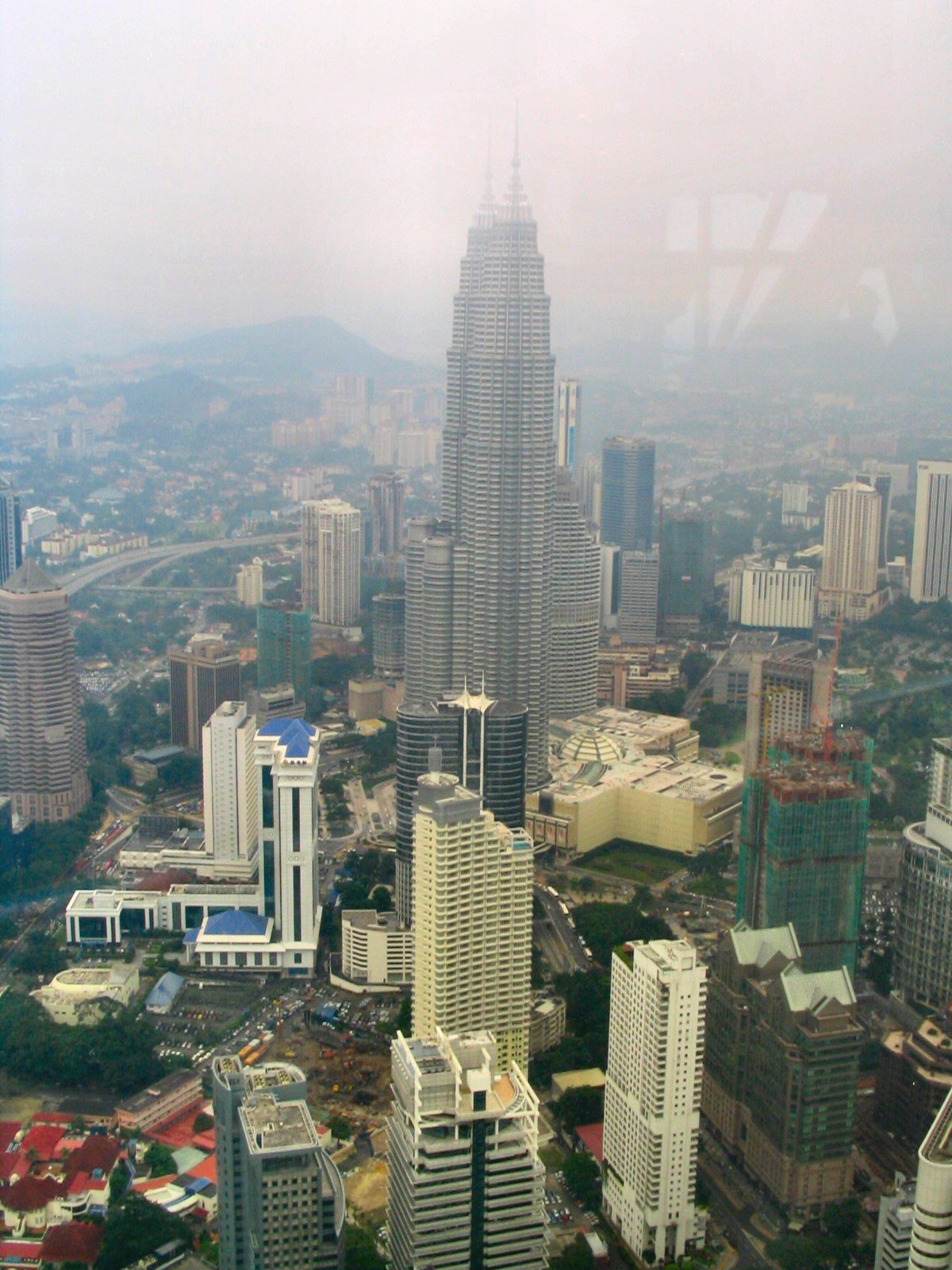
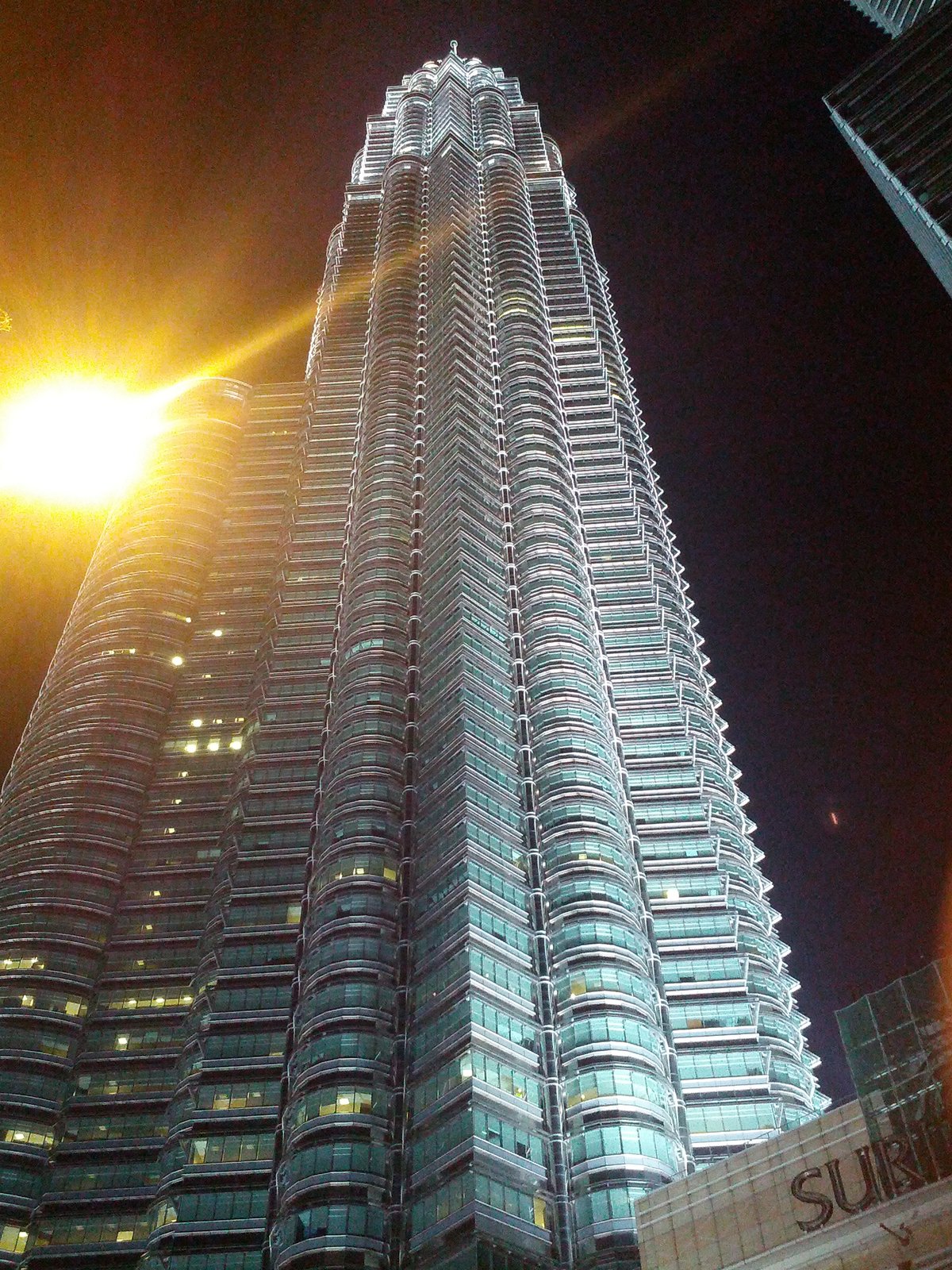
The Petronas Towers at KLCC are just two stops north on the Kajang Line. Do TRX and KLCC in the same half-day — the train takes four minutes, and you avoid the traffic that makes that short distance feel like a cross-city expedition by car.Watch Your Belongings
The station gets crowded during weekday rush hours (7:30–9:30am and 5:30–7:30pm). Keep bags in front of you on the platforms — the usual big-city common sense applies, nothing worse than that.
Frequently asked
Is Tun Razak Exchange MRT station worth visiting?
As a destination, not really — but as a transit hub it's one of the most useful stops in Kuala Lumpur. It's a genuine two-line interchange with a direct underground walk into The Exchange TRX mall, and it carries a footnote most commuter stops don't: the full Kajang Line was ceremonially launched here on 17 July 2017.
How do I get to The Exchange TRX mall from Tun Razak Exchange MRT station?
Walk through the concourse level — the underground pedestrian link into The Exchange TRX is direct, air-conditioned, and takes under two minutes. No street crossing required. When it's 34°C outside, that matters.
What MRT lines stop at Tun Razak Exchange station?
Both the Kajang Line and the Putrajaya Line stop here. The Putrajaya Line connection opened on 16 March 2023, turning this into one of the few true two-line interchange points in KL's MRT network.
What time does Tun Razak Exchange MRT station open?
The station opens at 6:00am daily, following the standard Rapid KL MRT schedule. Last trains typically run past midnight — check the Rapid KL app for exact final departure times on each line.
Why was Tun Razak Exchange MRT station temporarily renamed Samsung Galaxy Station?
Samsung purchased naming rights from 29 February 2024, rebranding it 'TRX Samsung Galaxy Station' for roughly one year. Official MRT pages now list the station under its original name again.
What is the design theme of Tun Razak Exchange MRT station?
MRT Corp describes it as 'Islamic Corporate' — a contemporary business-district station where Islamic geometric motifs appear on columns, walls, and finishes rather than in ornamental decoration. It's also the largest underground station on the Kajang Line.
Is Tun Razak Exchange MRT station wheelchair accessible?
Yes. Lifts connect all platform levels to the concourse and street exits, and the underground link into The Exchange TRX mall continues that accessibility through to the shopping centre.
What is the connection between TRX station and the 1MDB scandal?
The wider Tun Razak Exchange district was launched in 2012 under a government program closely tied to 1MDB, and over RM3 billion linked to the project was later found to have been misappropriated. Malaysia's government after 2018 decided to finish it regardless — walking away from a half-built financial district in central Kuala Lumpur was not a real option.
Sources & attribution 14
- MRT Corp — Tun Razak Exchange Station — Official station page: architectural theme ('Islamic Corporate'), station size, Kajang Line context
- Rapid KL — Tun Razak Exchange Station Info — Station layout, interchange details, underground mall link, operating hours
- The Exchange TRX — Getting Here — Confirmed underground pedestrian connection from MRT concourse to mall
- MRT Corp — Kajang Line Completion Event — Full Kajang Line launched 17 July 2017, ceremony held at TRX station
- The Star — Najib Launches MRT Phase 2 (2017) — News coverage of Kajang Line full opening ceremony at TRX
- MRT Corp — Putrajaya Line Launch — Putrajaya Line Phase 2 opened 16 March 2023, making TRX a two-line interchange
- Bernama — MRT Putrajaya Line Phase 2 — News report confirming Putrajaya Line Phase 2 opening date
- TRX Press Release — Underground Tunnel Opens — The Exchange TRX and TRX City Park opened 29 November 2023
- Lendlease — The Exchange TRX Opens to Public — Developer confirmation of mall opening date and district context
- Samsung Malaysia — Samsung Galaxy MRT Station — Samsung naming rights announcement, effective 29 February 2024
- TRX Official Launch Speech — PM Najib (2012) — TRX district officially launched 30 July 2012
- The Star — Government to Continue with TRX (2018) — Post-election decision to continue TRX despite 1MDB misappropriation findings
- Malay Mail — Putrajaya to Spend RM2.8b to Complete TRX — Finance minister confirmation of continued TRX development cost and rationale
- Wikipedia — Tun Razak Exchange MRT Station — General station history including Pasar Rakyat site background
Built from cited sources · see the method · How we make our guides →
More in Kuala Lumpur.
162 places to discover — a few worth pairing.
Pick up where you left off
Saved and recently read places — kept on this device only.
Photo credits (4)
- Escalators from concourse level to platforms at Tun Razak Exchange MRT station (230319) — *angys* — CC BY-SA 4.0 (https://creativecommons.org/licenses/by-sa/4.0/) — Source: https://commons.wikimedia.org/wiki/File:Escalators_from_concourse_level_to_platforms_at_Tun_Razak_Exchange_MRT_station_(230319).jpg
- Bench at the Tun Razak Exchange MRT station — Fazley01 — CC BY-SA 4.0 (https://creativecommons.org/licenses/by-sa/4.0/) — Source: https://commons.wikimedia.org/wiki/File:Bench_at_the_Tun_Razak_Exchange_MRT_station.jpg
- Elevators at Tun Razak Exchange MRT station — Fazley01 — CC BY-SA 4.0 (https://creativecommons.org/licenses/by-sa/4.0/) — Source: https://commons.wikimedia.org/wiki/File:Elevators_at_Tun_Razak_Exchange_MRT_station.jpg
- Elevators from concourse level to platforms at Tun Razak Exchange MRT station — Fazley01 — CC BY-SA 4.0 (https://creativecommons.org/licenses/by-sa/4.0/) — Source: https://commons.wikimedia.org/wiki/File:Elevators_from_concourse_level_to_platforms_at_Tun_Razak_Exchange_MRT_station.jpg
Photos may have been resized or cropped.