Type 2+ letters to search all countries, cities, and places
/Ctrl KEsc
travel_explore
Type 2+ letters to search all countries, cities, and places
Press Enter to open the top result
Sri Petaling Lrt Station
Kuala Lumpur·Malaysia·3° N · 101° E·Updated Apr 2026
Opened in 1998 as 'Komanwel' for the Commonwealth Games, Sri Petaling LRT Station later gave its name to an entire line. Gateway to Bukit Jalil and KL's south.
5 minutes in transit; 1-2 hours if exploring the surrounding food streets
Entry
Free to enter; distance-based LRT fare applies (typically a few Malaysian ringgit)
Access
Lifts and ramps available; note that platforms have separate ticketing areas requiring re-entry to switch directions
Best season
Year-round — covered station, unaffected by weather
Most transit stations are just places you pass through, but Sri Petaling LRT Station in Kuala Lumpur, Malaysia, carries a story that most of its daily commuters never think about. Opened in 1998 under a different name for a different purpose, it was built so the world could come to KL for the Commonwealth Games — and then the city kept it, renamed it, and let a whole neighborhood grow around it. If you're interested in how a metropolis remakes itself at speed, this unremarkable-looking station on the Sri Petaling Line is a quiet confession of that ambition.
The station sits in KL's southern sprawl, coded SP18 on the network map, flanked by the residential towers and hawker-stall streets of the Sri Petaling suburb. It won't win architecture prizes. Its low-rise platforms are open to the humid air, its white pillars and latticed steel frames belong firmly to the practical vocabulary of late-1990s Malaysian transit design. But the building's plainness is part of the point: this was infrastructure built at national-event velocity, and it has aged into something useful rather than decorative.
For travelers, the station matters as a gateway. The International Medical University campus is nearby. Bukit Jalil National Stadium — the 87,000-seat arena that hosted those 1998 Games — is one stop south. And Sri Petaling's food streets, dense with Chinese-Malaysian coffee shops and mamak restaurants, fan out from the station's exits in every direction.
The station also serves as a practical connection point for anyone heading to or from the southern end of the Sri Petaling Line, which now runs all the way to Putra Heights. It's not the kind of place you'd plan a pilgrimage to. But if you're riding the LRT through KL's less-photographed neighborhoods, it rewards a pause.
Researched by the Audiala editorial team from historical records, architectural archives, and local expertise.
What to see
The Three-Track Platform Layout
Sri Petaling's two side platforms bracket three tracks — an unusual arrangement for the line, inherited from its years as a terminus where trains needed to reverse direction. Stand on either platform and you'll notice the middle track, now less frequently used, sitting like a vestigial organ of the station's former life. The platforms themselves are open-air, with multi-tiered roofs and latticed steel frames that let the equatorial breeze through. On a hot afternoon, the light falls in geometric patterns across the concrete — not beautiful exactly, but specific to this era of Malaysian transit design, when stations were built to breathe rather than to be sealed and air-conditioned. The whole structure is roughly the length of a football pitch, low-slung and practical, with none of the soaring glass volumes you'd find at newer stations like Tun Razak Exchange MRT-Station.
Vista Komanwel and the Commonwealth Games Ghost
Visible from the station platforms, the Vista Komanwel residential towers are the most tangible remnant of the 1998 Commonwealth Games in this immediate area. They housed athletes during those two weeks in September 1998, then were converted into private apartments and condominiums. The towers are unremarkable as architecture — standard late-1990s Malaysian high-rise residential — but their name preserves a piece of history the station itself has discarded. Walking from the station toward the towers takes about ten minutes along Jalan Radin Bagus, past the kind of mixed-use streetscape that defines KL's southern suburbs: hair salons, phone-repair shops, and kopitiam coffee stalls with plastic chairs spilling onto the pavement.
Sri Petaling's Food Streets
The real reason to pause at this station isn't the station itself — it's what surrounds it. Sri Petaling's streets, particularly along Jalan Radin Bagus and Jalan Radin Anum, are packed with hawker stalls and coffee shops that serve KL's southern residential population. This is working-class eating at its best: char kuey teow with wok hei you can smell from half a block away, pan mee noodle soup, and roti canai at mamak restaurants that stay open well past midnight. The density of food options within a five-minute walk of the station is remarkable — easily two dozen spots before you've covered three blocks. None of it is aimed at tourists, which is precisely why it's good.
Plan your visit
Getting There
Sri Petaling is station SP18 on the Sri Petaling Line (LRT). From KL Sentral, take the Ampang/Sri Petaling Line toward Putra Heights — the ride is roughly 25 minutes. If you're connecting from the MRT Putrajaya Line, swap at Tun Razak Exchange MRT-Station to the Ampang Line at Chan Sow Lin, then continue south. By car, the station sits just off Jalan Radin Bagus, about 12 km south of the city centre — a 30-minute drive without traffic, which in Kuala Lumpur is an optimistic assumption.
Opening Hours
As of 2026, the station opens daily at 06:00. Last train toward Putra Heights departs at 24:31; last train toward Sentul Timur at 23:57. The customer-service counter closes at 23:52, but if you're using a Touch 'n Go card or cashless payment, you can still board after that.
Time Needed
This is a transit station, not a destination — you'll spend 5 to 10 minutes passing through. If you're a transport-history enthusiast curious about its 1998 Commonwealth Games origins, budget 15 to 20 minutes to look at the platform layout and the three-track configuration, which hints at its former life as a terminus.
Cost / Tickets
LRT fares are distance-based and typically range from RM1.20 to RM4.40 per trip. A Touch 'n Go card saves you from queuing at ticket machines and gets a small discount. Buy or top up the card at any convenience store or the station counter before 23:52.
Photo Gallery
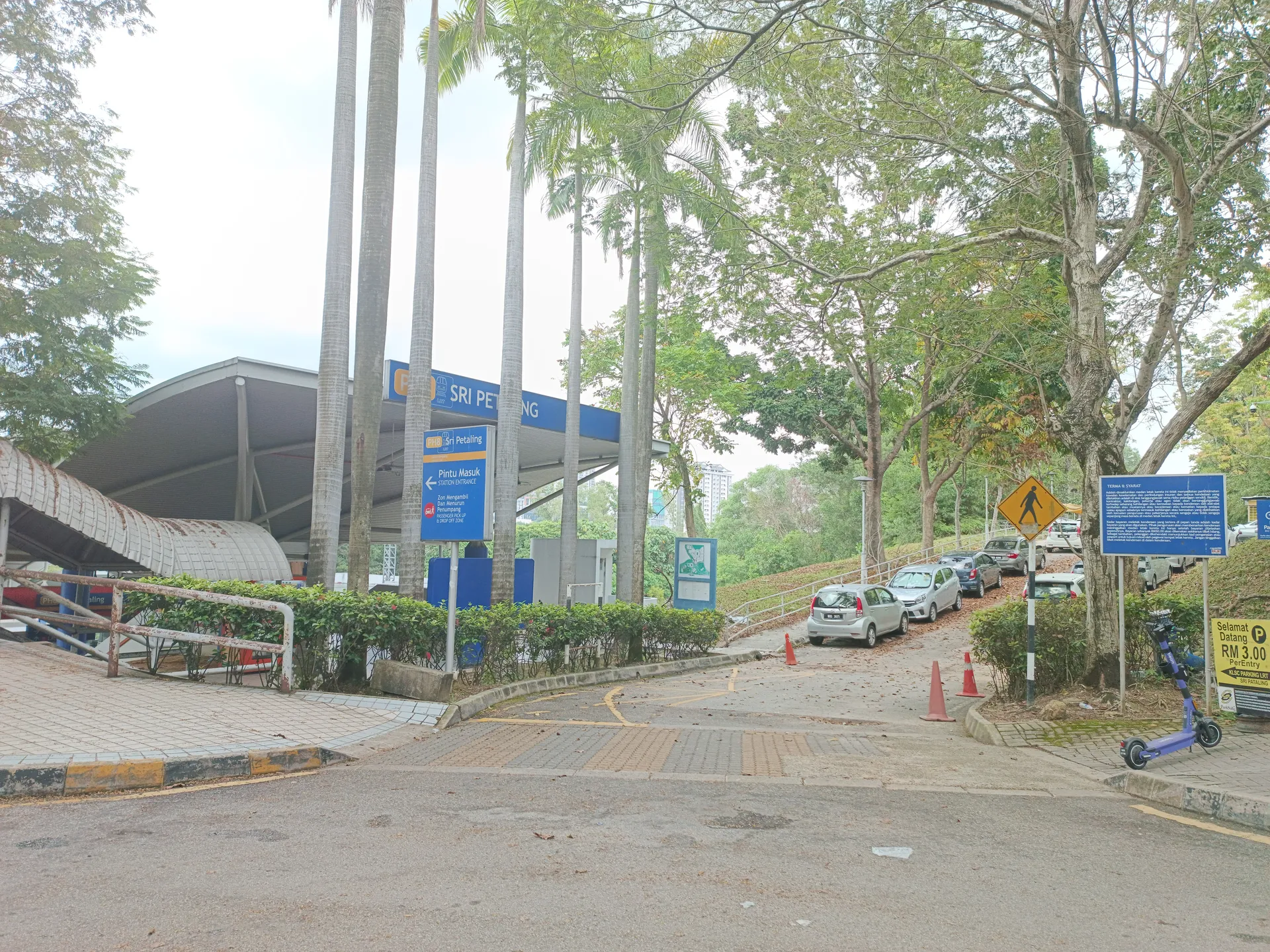
A view inside the Sri Petaling LRT Station in Kuala Lumpur, Malaysia, showing the ticket gates and customer service area. · *angys*A quiet bus stop area located beneath the elevated tracks of the Sri Petaling LRT Station in Kuala Lumpur, Malaysia. · *angys*A detailed view of the RapidKL T582 bus departure schedule posted at the Sri Petaling LRT Station in Kuala Lumpur, Malaysia. · Zh9567A view of the Sri Petaling LRT Station in Kuala Lumpur, Malaysia, showing the transit area with a Grab pickup point, covered walkways, and commuters waiting. · *angys*A quiet night at the Sri Petaling LRT Station in Kuala Lumpur, Malaysia, showcasing the station's modern platform architecture and lighting. · *angys*A view of the modern architectural design and elevated platform structure at the Sri Petaling LRT Station in Kuala Lumpur, Malaysia. · *angys*A quiet, illuminated platform at the Sri Petaling LRT Station in Kuala Lumpur, Malaysia, showcasing a festive digital advertisement. · *angys*
History
A Station Built for the World, Then Handed to the Commuters
Kuala Lumpur's southern edge was mostly rubber estates and kampung houses until the mid-1990s, when Malaysia's then-Prime Minister Mahathir Mohamad decided the country would host the 1998 Commonwealth Games. That decision triggered a wave of construction — stadiums, athlete housing, highways — and with it came a rail line extension that would knit these new venues into the city's transit network.
Sri Petaling LRT Station was part of that wave. It opened on 11 July 1998 as a STAR LRT Phase 2 station, just in time for the Games. But it didn't carry the name Sri Petaling. It was called something else entirely.
The turning point
Komanwel: The Station That Wore a Different Name
When the station opened, it was branded Komanwel — the Malay transliteration of "Commonwealth." The name made sense in July 1998: the athletes' village, now known as Vista Komanwel, rose just nearby, and one stop south sat Sukan Negara station (now Bukit Jalil), serving the main stadium complex. Mahathir's government had staked national prestige on these Games, and the rail infrastructure was meant to prove that KL could operate at a world-class level.
The Games came and went. The athletes left. The village became condominiums. And the station quietly shed its event-specific identity. By 2005, after Prasarana — the government's public transit holding company — took over STAR operations in 2002, the branch was rebranded as the Sri Petaling Line, and the station adopted the name of the suburb it served. A name chosen for a two-week sporting event gave way to one that reflected daily life.
That shift captures something honest about how cities absorb their own grand gestures. The Commonwealth Games infrastructure didn't vanish — it just became ordinary, which is arguably the best thing that can happen to public transit.
Terminus, Then Through-Station
For seventeen years, Sri Petaling was the end of the line. Trains stopped here, reversed, and headed back north toward Sentul Timur. That changed on 31 October 2015, when the first stage of the line's westward extension opened, sending trains onward past Awan Besar and eventually all the way to Putra Heights. Overnight, the station went from being a destination to being a waypoint — a shift that reshaped foot traffic, altered the rhythm of the platforms, and turned what had been a quiet terminus into a busier corridor station.
The Separate-Ticketing Quirk
Unlike most modern metro stations, Sri Petaling uses separate ticketing areas for each platform. Once you've tapped in on one side, you can't cross to the other without exiting and re-entering. The design dates from the station's original role as a terminus, when cross-platform movement was less necessary. It's the kind of small operational detail that catches out first-time visitors — and a physical reminder that this station was designed for a different era of the network.
Tips for visitors
Mind the Platform Split
Sri Petaling has separate ticketing areas for each side platform — once you tap in, you can't cross to the opposite direction without exiting and re-entering. Check your direction before you tap your card.
Sri Petaling Food Streets
Walk south from the station along Jalan Radin Bagus and Jalan Radin Anum to hit one of KL's better-known hawker clusters — budget Chinese-Malaysian fare, from clay pot rice to pan mee, mostly under RM12 a plate. Endah Parade mall, about 5 minutes on foot, has air-conditioned mid-range options if the heat wins.
Late-Night Awareness
The area around the station is well-lit and busy until about 22:00, but thins out after that. If you're catching one of the last trains past midnight, stick to the main road and keep your phone in your pocket rather than waving it around.
Avoid Peak Crush
The station gets packed between 07:30–09:00 and 17:30–19:30 on weekdays, especially toward Sentul Timur. Midday or weekends are far more comfortable — the open-air platform design means you'll feel the breeze instead of being pressed against strangers.
Combine with Bukit Jalil
Bukit Jalil National Stadium is just one stop south. If you're heading to a football match or concert there, Sri Petaling station is often less chaotic than Bukit Jalil station itself on event nights — walk the 1.2 km instead, roughly the length of 12 football pitches.
Where to Eat
local_dining
Don't Leave Without Trying
Nasi Lemak — fragrant coconut rice with sambal, anchovies, peanuts, and eggLaksa — creamy, spicy noodle soup with prawns or chickenSatay — grilled meat skewers with rich peanut sauceNasi Kerabu — blue-tinted Kelantanese rice with fresh herbs and sambalRoti Canai — crispy flatbread served with dhal curryChar Kuey Teow — stir-fried rice noodles with prawns and local flavorsNasi Kukus — steamed fragrant rice, often with spiced accompaniments
Alif Nasi Kukus Berempah
local favorite
Malaysian Traditional€€star5.0(10)
Order: The nasi kukus berempah — fragrant steamed rice infused with spices, served with rich curries and sambal. This is the real deal, the kind of comfort food locals queue for.
Perfect 5-star rating from locals who know their food. This is authentic Malaysian home cooking, not tourist fare—the kind of place where you taste generations of family recipes.
Order: The Taiwan-style fried chicken (炸鸡排) — crispy, juicy, and seasoned with that signature Taiwanese flair. Order it fresh and eat it immediately for maximum crunch.
A standout for quality street food done right. This is where locals grab lunch when they want something craveable and quick, without compromise on flavor.
Order: Their lunch and dinner sets offer solid variety—check what's fresh that day. The cafeteria format means you can mix and match, so grab what catches your eye.
Consistent 4.5-star reviews from a solid base of regulars. This is a neighborhood gathering spot where families and office workers know they'll get reliable, honest food.
Order: Pandan-infused drinks and pastries—pandan leaf is a Malaysian classic, and a cafe named after it knows what it's doing. Try their pandan-flavored beverages and any house-made baked goods.
Early-opening hours (7:00 AM) make it perfect for a pre-work coffee. The pandan theme signals they're serious about local flavors, not just another generic chain.
checkSri Petaling is dominated by shop-lot restaurants along Jalan Radin Bagus—explore the commercial streets, not just the LRT exit.
checkMany restaurants have limited hours; verify opening times on Google Maps before heading out, as hours change seasonally.
checkCash is widely accepted, but increasingly, card and mobile payments are standard in KL.
checkLunch hours (11:30 AM–1:30 PM) are peak times; arrive early or late to avoid crowds.
Food districts:Jalan Radin Bagus area — dense concentration of hawker stalls and shop-lot restaurants, the real heart of Sri Petaling diningBukit Jalil residential zone — quieter, with family-friendly cafes and casual eateries serving the local community
Restaurant data powered by Google
Frequently asked
Is Sri Petaling LRT Station worth visiting?
As a destination in itself, no — but as a transit hub for Bukit Jalil, IMU, and Sri Petaling's food streets, it earns its place on your itinerary. The station carries an overlooked historical footnote: it was built for the 1998 Commonwealth Games and originally named Komanwel, linking athletes staying at the nearby Vista Komanwel towers to the sports complex. That backstory makes a routine train stop feel slightly more interesting than it looks.
How long do you need at Sri Petaling LRT Station?
Five minutes to pass through, longer if you're connecting to the surrounding neighbourhood. The station itself is functional rather than scenic, but Sri Petaling's food streets are within walking distance and reward an hour or two of wandering.
What time does Sri Petaling LRT Station open and close?
The station opens daily at 06:00. Last trains depart at 24:31 toward Putra Heights and 23:57 toward Sentul Timur, though the customer service counter closes at 23:52 — cashless travellers can still board after that.
How much does it cost to use Sri Petaling LRT Station?
There is no entry fee; you pay only the fare for your journey. Rapid KL fares are distance-based and generally low — a ride from Sri Petaling to KL Sentral, for example, costs a few Malaysian ringgit. Cashless payment via the Touch 'n Go card is the fastest option.
Is Sri Petaling LRT Station accessible for wheelchair users?
Rapid KL stations on the Sri Petaling Line are built with accessibility provisions including lifts and ramps. That said, the station has separate ticketing areas for each platform, so plan your direction before tapping in — crossing platforms once inside is not possible without exiting and re-entering.
What is the history of Sri Petaling LRT Station?
The station opened on 11 July 1998 as part of the STAR LRT Phase 2 expansion, originally named Komanwel to mark its role in the 1998 Commonwealth Games. It served as the southern terminus of the line for 17 years — roughly as long as it takes to complete a medical degree — until 31 October 2015, when the westward extension converted it from a dead-end stop into a through-station. The entire Sri Petaling Line takes its name from this station.
What can you do near Sri Petaling LRT Station?
Sri Petaling's hawker streets are the main draw, particularly along Jalan Radin Bagus, where you'll find a dense run of kopitiam and night-market stalls. The Bukit Jalil National Stadium and sports complex are one stop away at Bukit Jalil station, and the International Medical University (IMU) campus is also within the station's catchment area.
Sources & attribution10
Researched and written by the Audiala editorial team from historical records, architectural archives, and local expertise. Last updated April 2026.
Saved and recently read places — kept on this device only.
Photo credits (14)
Sri Petaling LRT Station outview (220713) alt — *angys* — CC BY-SA 4.0 (https://creativecommons.org/licenses/by-sa/4.0/) — Source: https://commons.wikimedia.org/wiki/File:Sri_Petaling_LRT_Station_outview_(220713)_alt.jpg
Sri Petaling LRT Station platform (220713) — *angys* — CC BY-SA 4.0 (https://creativecommons.org/licenses/by-sa/4.0/) — Source: https://commons.wikimedia.org/wiki/File:Sri_Petaling_LRT_Station_platform_(220713).jpg
Sri Petaling LRT Station 2017 3 — *angys* — CC BY-SA 4.0 (https://creativecommons.org/licenses/by-sa/4.0/) — Source: https://commons.wikimedia.org/wiki/File:Sri_Petaling_LRT_Station_2017_3.jpg
Sri Petaling LRT Station concourse (220713) 01 — *angys* — CC BY-SA 4.0 (https://creativecommons.org/licenses/by-sa/4.0/) — Source: https://commons.wikimedia.org/wiki/File:Sri_Petaling_LRT_Station_concourse_(220713)_01.jpg
KL1297 LRT Sri Petaling bus stop (240609) — *angys* — CC BY-SA 4.0 (https://creativecommons.org/licenses/by-sa/4.0/) — Source: https://commons.wikimedia.org/wiki/File:KL1297_LRT_Sri_Petaling_bus_stop_(240609).jpg
Rapid KL bus route T582 timetable at LRT Sri Petaling (20240514 153518) — Zh9567 — CC BY-SA 4.0 (https://creativecommons.org/licenses/by-sa/4.0/) — Source: https://commons.wikimedia.org/wiki/File:Rapid_KL_bus_route_T582_timetable_at_LRT_Sri_Petaling_(20240514_153518).jpg
Sri Petaling LRT Station bus stop (220713) — *angys* — CC BY-SA 4.0 (https://creativecommons.org/licenses/by-sa/4.0/) — Source: https://commons.wikimedia.org/wiki/File:Sri_Petaling_LRT_Station_bus_stop_(220713).jpg
Sri Petaling LRT Station concourse (220713) 03 — *angys* — CC BY-SA 4.0 (https://creativecommons.org/licenses/by-sa/4.0/) — Source: https://commons.wikimedia.org/wiki/File:Sri_Petaling_LRT_Station_concourse_(220713)_03.jpg
Sri Petaling LRT Station 2017 2 — *angys* — CC BY-SA 4.0 (https://creativecommons.org/licenses/by-sa/4.0/) — Source: https://commons.wikimedia.org/wiki/File:Sri_Petaling_LRT_Station_2017_2.jpeg
Sri Petaling LRT Station entrance area (220713) — *angys* — CC BY-SA 4.0 (https://creativecommons.org/licenses/by-sa/4.0/) — Source: https://commons.wikimedia.org/wiki/File:Sri_Petaling_LRT_Station_entrance_area_(220713).jpg
Sri Petaling LRT Station concourse (220713) 02 — *angys* — CC BY-SA 4.0 (https://creativecommons.org/licenses/by-sa/4.0/) — Source: https://commons.wikimedia.org/wiki/File:Sri_Petaling_LRT_Station_concourse_(220713)_02.jpg
Sri Petaling LRT Station outview (220713) — *angys* — CC BY-SA 4.0 (https://creativecommons.org/licenses/by-sa/4.0/) — Source: https://commons.wikimedia.org/wiki/File:Sri_Petaling_LRT_Station_outview_(220713).jpg
Sri Petaling LRT Station concourse (220713) 04 — *angys* — CC BY-SA 4.0 (https://creativecommons.org/licenses/by-sa/4.0/) — Source: https://commons.wikimedia.org/wiki/File:Sri_Petaling_LRT_Station_concourse_(220713)_04.jpg
Sri Petaling LRT Station concourse (220713) 05 — *angys* — CC BY-SA 4.0 (https://creativecommons.org/licenses/by-sa/4.0/) — Source: https://commons.wikimedia.org/wiki/File:Sri_Petaling_LRT_Station_concourse_(220713)_05.jpg
Strictly necessary cookies keep the site working. Analytics (PostHog, Google Analytics) measures how each visitor uses our pages. Marketing loads YouTube videos and walking-route maps without a tap and lets Google Analytics set advertising cookies. We never sell your data. You can change this any time from the footer.
Analytics and marketing cookies are optional and only load if you agree. Details under Customize.
Privacy
Cookie preferences
Pick what you're okay with. You can change this any time from the footer.
Strictly necessary
Always on
Sign-in, language, navigation. Always on.
Product analytics
PostHog (EU) and Google Analytics record which pages you view and how you use them, under a random identifier stored in your browser. Helps us see which pages work and which need fixing. Google's ad personalisation stays off. No selling.
Marketing
Loads YouTube videos and the walking-route maps (OpenFreeMap) without a tap; without it, they load only when you tap them. If analytics is also on, Google Analytics may set advertising cookies. Ad personalisation stays off.