Introduction
Nestled in the heart of Vilnius Old Town, the Church of the Blessed Virgin Mary of Consolation (Lithuanian: Švč. Mergelės Marijos Ramintojos bažnyčia) is a distinguished symbol of Lithuania’s Catholic heritage and a testament to the city’s enduring spiritual and cultural vibrancy. Built by the Augustinian order in the 18th century, this late Baroque church reflects the historic role of Vilnius as a crossroads of religious tradition, resilience, and architectural excellence. Its dedication to the Virgin Mary “of Consolation” encapsulates the profound Marian devotion that has provided solace to generations of Lithuanians, especially during times of adversity (Britannica; True Lithuania).
This guide offers a comprehensive overview of the church’s history, architectural evolution, religious and cultural importance, as well as practical visitor information including hours, accessibility, tours, and travel tips. Whether you are a pilgrim, history buff, or traveler exploring Vilnius’s rich past, the Church of the Blessed Virgin Mary of Consolation is an essential stop.
Foundation and Origins
Established in the mid-18th century by the Augustinians, the church’s foundation is rooted in Vilnius’s growth as a multi-faith, multicultural capital. The church’s Marian dedication reflects Lithuania’s longstanding Catholic tradition, particularly the veneration of Mary as a source of comfort and spiritual refuge during periods of political upheaval and religious oppression (Britannica).
Architectural Evolution
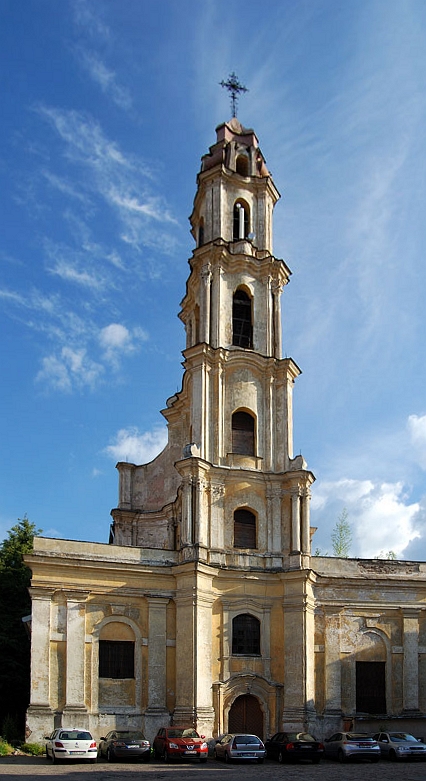
The church is a remarkable example of Vilnian Baroque architecture, characterized by its unique single-towered façade—the only one of its kind in Vilnius. The exterior’s pale stucco and the prominent dome and lantern atop the tower create a striking silhouette visible throughout the Old Town (Acta Academiae Artium Vilnensis). Inside, the single-nave layout, side chapels, and vaulted ceilings once featured ornate Baroque décor. While much was lost during the Soviet era, ongoing restoration has revealed original painted motifs and gilded details, highlighting the church’s former grandeur.
A two-storey Augustinian monastery adjoins the church, adding context to the monastic life that flourished here. Archaeological excavations have unearthed earlier structures, including remnants from a wooden Orthodox church and a winter sacristy, deepening our understanding of the site’s layered history (Lituanistika).
Soviet Era and Restoration
During Soviet rule, the church suffered neglect and repurposing, reflecting a broader suppression of religious life. For decades, it was managed by the Ministry of Education rather than a religious order, resulting in severe deterioration. Since Lithuania’s independence, stewardship has passed to the Ministry of the Interior, and a collaborative restoration effort—driven by clergy, volunteers, and state support—has revived the building as a center of worship and community life (Council of Europe).
Religious and Cultural Importance
The church remains a vital Marian shrine, hosting feasts, processions, and daily worship that celebrate the Virgin Mary’s role as intercessor and comforter (Catholicism Website). Its liturgical calendar features events such as the Nativity of Mary (September 8), Immaculate Conception (December 8), and the Assumption (August 15). Artistic elements—statues, paintings, and stained glass—underscore the church’s role as both a sanctuary and a beacon of hope.
Beyond religion, the church serves as a cultural hub, hosting concerts, exhibitions, and educational programs that foster dialogue and unity among Vilnius’s diverse communities. This multifunctional approach exemplifies the broader post-Soviet revival of sacred spaces as centers of cultural renewal (Council of Europe).
Practical Visitor Information
Visiting Hours
- General Hours: Daily, 9:00 AM–6:00 PM
- Note: Hours may vary on religious holidays and during special events. Check the church’s official channels before planning your visit.
Admission & Tickets
- Entrance: Free
- Donations: Welcome to support ongoing restoration
Guided Tours
- Availability: Guided tours are available by reservation and provide in-depth insights into the church’s history, architecture, and religious significance.
- Booking: Contact the church directly or arrange through Vilnius tourism offices.
Accessibility
- Main Entrance: Wheelchair accessible
- Interior: Most public areas are accessible, though some sections may remain challenging due to historic features and ongoing restoration.
Photography
- Permitted: Yes, generally allowed (no flash during services)
Nearby Attractions
Located in Vilnius’s UNESCO-listed Old Town, the church is within walking distance of:
- Vilnius Town Hall: A neoclassical landmark and cultural venue
- Lithuanian Art Museum: Featuring national and European collections
- Gates of Dawn: Home to the revered icon of the Virgin Mary
- Orthodox Church of St. Nicholas: Known for its unique architecture
- Užupis and Paupys: Artistic neighborhoods with galleries and cafes
Archaeological Insights
Recent archaeological digs have brought to light 18th-century foundations, a lost winter sacristy, and artefacts spanning several centuries. These discoveries reveal the site’s rich, multi-layered history and underscore Vilnius’s long-standing religious diversity (Lituanistika).
Liturgical Life and Community
The church’s vibrant liturgical calendar and Marian devotions foster a strong sense of community. Special Masses, processions, and the recitation of the Rosary and Angelus are central to its religious life. The church also plays host to cultural events, art exhibitions, and musical performances, strengthening its role as a space for both worship and cultural engagement.
Restoration and Future Prospects
Significant progress has been made in preserving and revitalizing the church, with ongoing restoration focused on expanding worship spaces and restoring original art and architecture. Plans include expanding educational and social programs, ensuring the church remains a vibrant community center (Council of Europe).
Travel Tips
- Dress Code: Modest attire recommended
- Transport: Easily accessible by foot, public transit, or taxi within Vilnius Old Town
- Amenities: Cafés, restaurants, and restrooms are nearby
- Best Time to Visit: Early mornings or weekdays for a quieter experience; sunrise and sunset for photography
Frequently Asked Questions (FAQ)
Q: What are the visiting hours?
A: Daily from 9:00 AM to 6:00 PM, subject to change during holidays.
Q: Is there an entrance fee?
A: No, entry is free; donations are appreciated.
Q: Are guided tours available?
A: Yes, by reservation or through local tourism offices.
Q: Is the church wheelchair accessible?
A: The main entrance is accessible; some interior areas may be less so.
Q: Can I attend religious services?
A: Yes, visitors are welcome at Masses and Marian celebrations.
Visual Highlights
- Exterior: “Baroque façade of the Church of the Blessed Virgin Mary of Consolation in Vilnius”
- Interior: “Interior Baroque decorations inside the Church of the Blessed Virgin Mary of Consolation”
- Archaeology: “Archaeological excavation site near the Church of the Blessed Virgin Mary of Consolation”
Plan Your Visit
The Church of the Blessed Virgin Mary of Consolation offers an immersive experience of Vilnius’s spiritual and architectural heritage. Attend a service, join a guided tour, or explore nearby historical sites to enrich your understanding of Lithuania’s rich cultural tapestry. Stay connected and informed on restoration progress, special events, and visiting details through the Audiala app and the church’s official channels.
Listen to the full story in the app
Your Personal Curator, in Your Pocket.
Audio guides for 1,100+ cities across 96 countries. History, stories, and local insight — offline ready.
Audiala App
Available on iOS & Android
Join 50k+ Curators
Sources
- verified
- verified
- verified
- verified
- verified
- verified
- verified
Last reviewed: