
Ninth Fort
KaunasLithuania 54° N · 23° E Updated Aug 2026
In 1943, 64 Jewish prisoners escaped a Nazi corpse-burning unit beneath Kaunas's Ninth Fort; its tunnels and memorial now hold a profound, lasting silence.
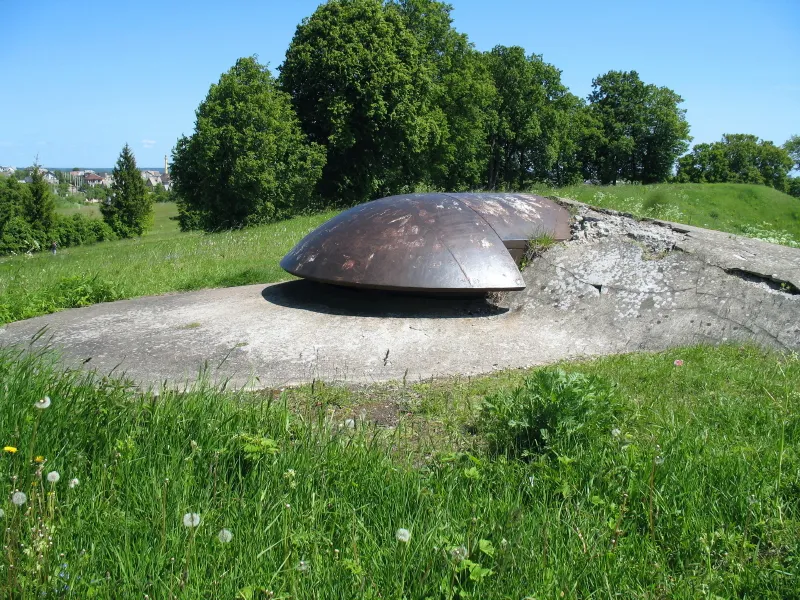 Photo: Creative at lt.wikipedia · CC BY-SA 3.0
- Time needed
- 2-3 hours
How can the Ninth Fort in Kaunas, Lithuania, be a fortress that museum records say never fired a defensive shot, yet draw you here to confront the evidence of war, occupation, murder, resistance, and memory? Today, Žemaičių plentas brings you to low concrete casemates, damp underground corridors, a museum of photographs and testimony, and a 32-metre memorial rising like a ten-storey shard above the former execution grounds.
Inside, the light turns grey and footsteps lose their confidence against the concrete. Look closely at the plaster: names, dates, and French words cut into the walls survive as messages from people who had only hours left to speak.
Records show that Russian military engineers and construction workers raised this reinforced-concrete fort between 1902–03 and 1913–14. The garrison abandoned it during the German assault of August 1915 without firing a defensive shot; Lithuania then converted it into a hard-labour prison in 1924, while the Soviet NKVD and Nazi authorities gave the same rooms darker purposes.
The Ninth Fort functions now as a museum, memorial, and place of active remembrance. Jewish mourners recite Kaddish, visitors leave stones rather than flowers, and ceremonies remember both the Nazi murder of Jews and the Soviet deportations that passed through the fort; the silence here has a civic job.
What to see
-
The 32-metre Monument to the Victims of Fascism
The first surprise at Ninth Fort is its scale: a 32-metre concrete memorial rises from the execution grounds like three enormous shards of earth, taller than a ten-storey building and angled toward the Baltic sky. Sculptor Alfonsas Vincentas Ambraziūnas and architects Gediminas Baravykas and Vytautas Vielius shaped it between 1976 and 1984, leaving rough timber-grain impressions in the concrete; run your eyes along the grooves and the monument begins to feel less like poured cement than charred wood petrified in place. From the lowest path, its hard shadow falls across the grass and burial ditches, changing the fort from a military relic into a place where absence has a physical outline. -
The Fort, Cells, and Underground Galleries
Beneath the grassy ramparts, the 1902–1914 fortress turns inward: red-brick barrel vaults, narrow gun embrasures, iron doors, and corridors where footsteps return as a low, damp echo. Military engineers directed the construction while teams of laborers shaped the brick and early reinforced concrete, building walls thick enough to make an artillery shell seem almost impolite; in summer, the tunnels can feel 15–20°C colder than the open grounds. Look closely in Cell No. 1, where prisoners scratched names, dates, and the French words “Nous sommes neuf cents Français...” into the plaster—small marks that keep individual lives audible after the fort’s later history as an NKVD prison and Nazi execution site. -
A Quiet Circuit from Casemates to the Memorial Field
Allow at least two hours for a slow circuit: begin in the museum pavilion, descend through the casemates, then follow the grassy moat between the brick counterscarp and earthen rampart before crossing the execution field to the monument. Along the route, find the preserved steel escape door whose cut edges recall the 64 prisoners who broke out on December 25, 1943, after the Sonderkommando 1005 laborers spent weeks sawing through it with smuggled tools. Keep voices low outdoors; wind moves through the grass, while the concrete mass catches the last light and leaves you understanding that Ninth Fort is both a building and a record of what people did to one another inside it.
Plan your visit
- Getting There
- From Kaunas Old Town, drive 8–10 km northwest via the Western Bypass and A1/E67, following brown IX fortas signs; the trip usually takes 10–15 minutes, with free parking at Žemaičių pl. 73. Bus 57 runs directly to the Kauno IX forto muziejus stop; buses 23 and 35 reach 9-ojo forto muziejus on Vandžiogalos g., followed by a 10–15-minute walk via Šeduvos g. and the pedestrian underpass beneath the A1. Walking from central Kaunas takes roughly 2–2.5 hours each way over 8–10 km.
- Opening Hours
- As of 2026, the museum opens Tuesday–Friday 09:00–17:00 and Saturday–Sunday 10:00–18:00 from April 1 to September 30; from October 1 to March 31 it opens Tuesday–Sunday 09:00–17:00. Mondays are closed, last admission comes 30 minutes before closing, and the outdoor memorial grounds remain open and free 24/7. The museum closes on January 1, April 5–6, May 1, May 3, June 7, June 24, July 6, August 15, and staff-development days February 25, May 27, August 26, and December 16; holiday eves end one hour early.
- Time Needed
- Allow 45–60 minutes for the 32-metre monument, execution field, memorial grounds, and exterior ramparts—the monument rises almost as high as a 10-storey building. A self-guided museum visit takes 2–2.5 hours, while a full visit with the 70–90-minute underground tour and careful reading of the occupation and Holocaust exhibitions needs 3–4 hours.
- Accessibility
- The modern exhibition building has entrance ramps and an elevator, making the core permanent displays accessible to wheelchair users. Historic cells, underground galleries, poternes, and ramparts contain steep steps, narrow passages, uneven thresholds, low light, and cold concrete; these sections are not wheelchair accessible. Outdoor paths are paved or hard-packed gravel but include gentle slopes and grassy or sandy stretches.
- Cost & Tickets
- As of 2026, admission costs €8 for adults, €4 for pupils, full-time students with ID, and pensioners, or €8 for one adult plus €2 per child with the family ticket; the outdoor monument and grounds are free. The last Sunday of each month offers free museum admission for individual visitors, with tickets collected at the desk and no advance booking, though English guided tours are suspended that day. The weekend English tour begins at 12:00, lasts about 70 minutes, and costs €11 for adults or €6 at the discount rate, including admission.
Photo Gallery


History
The Fortress That Changed Its Witnesses, Not Its Silence
Continuity at the Ninth Fort feels uncomfortable. The documented sequence shows a single enclosure repeatedly used to confine people, process them through state power, and preserve the evidence afterward, even as imperial Russia, independent Lithuania, the Soviet Union, and Nazi Germany changed the flags above it.
Museum records date the fort's construction to 1902–03, when Russian military engineers and construction workers poured reinforced concrete into the Linkuva heights. Since Lithuania established the museum in 1958–59, the site has kept another function alive: asking visitors to stand where official power once tried to erase human beings.
The turning point
The Prisoners Who Broke the Fort's Final Script
At first glance, Christmas 1943 offers the fort's bleakest certainty: SS guards force 64 prisoners in Sonderkommando 1005 to exhume and burn bodies, and the SS expects every witness to disappear when the work ends. But a detail breaks the surface story. Yad Vashem testimony records that Aleksandr “Alex” Faitelson, a young Jewish prisoner and former ghetto underground fighter, helps plan an escape because he knows the guards will kill him once the corpse-burning work finishes; survival and the chance to testify stand at stake for him personally.
The turning point comes on the night of 25 December. According to survivor testimony, Faitelson, locksmith Pinia Krakinowski, and their companions use a hidden hacksaw and oil to cut iron locking pins, crawl through a roughly 70-metre underground gallery, cross the snow-covered moat, and cover the barbed wire with blankets. Records report that all 64 prisoners escape, scattering into the countryside before the guards understand what happened.
That revelation changes the way you read the fort. The concrete no longer looks like an all-powerful machine; its drainage tunnels become the route of a collective act of calculation and courage, while the scratched names in the casemates carry the same refusal to vanish. At the Ninth Fort, resistance does not erase horror, but it prevents the perpetrators from owning the final sentence.
What Changed
Confirmed records place construction in 1902–03 and completion in 1913–14; during the German assault in August 1915, General Vladimir Grigoriev abandoned the Russian garrison and the fort fired no defensive shot. In 1924, the Republic of Lithuania converted the site into a hard-labour prison, and after 15 June 1940 the Soviet NKVD used it for interrogation and transit toward deportation. After June 1941, Nazi forces and local collaborators turned the fort into an execution site, shooting thousands of Lithuanian and deported European Jews; museum estimates place the total killed here above 30,000. Lithuania opened museum exhibitions in 1959 and dedicated the 32-metre memorial by Alfonsas Vincentas Ambraziūnas, Gediminas Baravykas, and Vytautas Vielius in 1984.
What Endured
The fort keeps its power to make absence physical. Records of annual commemorations show Jewish communities, descendants, diplomats, and local residents gathering for Kaddish, El Malei Rachamim, candlelight vigils, and readings of names, especially around 29 October and Yom HaShoah. Visitors still place small stones beside memorials, while the casemates preserve the marks of people who wrote their identities into plaster. The ritual has changed with each generation, but the demand remains the same: stand here, look carefully, and refuse a convenient version of the past.
Tips for visitors
Keep Memorial Silence
Treat the fort and execution grounds as a cemetery and crime scene: keep voices low and avoid staged, playful, or slogan-heavy clothing. Museum rules prohibit alcohol, picnics, pets, monument climbing, fireworks, confetti, and swimming or fishing in the moat and fire reservoir.Photograph Carefully
Personal, non-commercial photography is allowed without flash or tripods, but wedding, fashion, automotive, and other staged shoots require permission; commercial filming needs written authorization. Unauthorized drones should stay away from the monument, burial fields, crowds, and protected grounds.Use The Underpass
If buses 23 or 35 leave you at 9-ojo forto muziejus, follow Šeduvos g. to the pedestrian tunnel under the A1. Never cross the multi-lane highway, and take extra care on icy steps and paths during winter.Eat In Šilainiai
The fort has no full-service café, so buy a quick drink at Šilas near the Vandžiogalos g. stop or walk about 380 metres to budget-to-mid-range Piatto Pizza & Grill. For Lithuanian dishes such as cepelinai, try Bernelių Užeiga at Baltų pr. 81; Talutti Bakes ’n’ Shakes in Šilainiai is the more casual budget-to-mid-range option.Choose Morning Light
Visit in the morning if you want the best photographs: the 32-metre concrete memorial faces east, while its carved faces fall into hard shadow after midday. The hill is exposed to Baltic wind, rain, and snow, while underground rooms sit around 10–12°C even in summer, so bring a windproof outer layer.Pack Light And Warm
Bring a jacket and shoes with reliable grip for damp tunnels, uneven thresholds, and steps. Small backpacks are accepted, but leave bulky suitcases at lockers in Kaunas railway or bus station because the bunker corridors are too narrow for rolling luggage.Use Free Sunday
The last Sunday of every month removes the museum admission fee for individual visitors, while the outdoor memorial is always free. Claim the ticket at the on-site desk, but choose another day if an English guided tour matters to you.Pair Memory Sites
Follow the Ninth Fort with Sugihara House in central Kaunas: the two sites place rescue, occupation, and mass murder in the same city’s historical frame. The contrast between the fort’s cold concrete and Sugihara’s intimate rooms changes how the city’s wartime story reads.
Watch & Explore Ninth Fort.

Frequently asked
Is Ninth Fort worth visiting?
Yes—Ninth Fort is worth visiting if you want a serious, layered account of Kaunas rather than a quick fortress photo stop. The 1903–1914 reinforced-concrete fort became a prison, a Nazi execution site, and a museum, while Alfonsas Vincentas Ambraziūnas’s 32-metre memorial rises above the execution grounds like a concrete shard. Allow time for the museum and the outdoor memorial field; the place changes meaning as you move from cold cells into the open wind.
How long do you need at Ninth Fort?
Allow 2–3 hours for the museum, fort rooms, inscriptions, memorial grounds, and monument. An exterior visit takes about 45–60 minutes, while a guided underground visit can extend the stop to 3–4 hours because the tunnels, poternes, and defensive galleries require a guide. Bring a layer: the underground rooms remain cold and humid even in summer.
How do I get to Ninth Fort from Kaunas?
Take bus 57 from central Kaunas to the stop named Kauno IX forto muziejus, which serves the museum grounds directly. Buses 23 and 35 stop at 9-ojo forto muziejus on Vandžiogalos Street; from there, follow the pedestrian route and use the underpass beneath the A1 rather than crossing the highway. A Bolt or taxi usually takes 10–15 minutes, and free parking sits outside the museum.
What is the best time to visit Ninth Fort?
Visit in the morning, especially if you want the best light on the east-facing 32-metre memorial before its carved forms fall into heavier shadow. May through September makes the exposed memorial grounds easier to walk, while autumn mist and winter snow give the site a stark stillness; the interior remains cold in every season. The museum closes on Mondays, with longer hours from April 1 to September 30.
Can you visit Ninth Fort for free?
Yes—the outdoor memorial grounds and park are free year-round, while museum admission costs €8 for adults and €4 for pupils, full-time students, and pensioners. Individual visitors also receive free museum admission on the last Sunday of each month, but tickets must be collected at the on-site desk and English guided tours do not run on those Sundays. Underground galleries remain guide-only.
What should I not miss at Ninth Fort?
Don’t miss the 32-metre memorial, the museum’s prison cells, the scratched prisoner inscriptions, and a guided walk through the underground galleries. Look for the French words “Nous sommes neuf cents Français...” and ask the guide about the steel escape door used by 64 Sonderkommando 1005 prisoners on December 25, 1943. The contrast between the damp brick corridors and the raw, wood-marked concrete monument carries the site’s history more powerfully than any single display.
Sources & attribution 57
- Kauno IX forto muziejus — History — Official chronology of the fort’s construction, prison history, Soviet use, Nazi occupation, museum foundation, and memorial context.
- Live the World — The Tragic History of the Ninth Fort — Supplementary history of Kaunas Fortress and the Ninth Fort’s construction.
- Wikipedia — Ninth Fort — Overview of the fort’s history, architecture, wartime use, museum, and memorial.
- Kaunas 2022 — Ninth Fort Memorial — Architectural history of the 1984 memorial, its designers, materials, symbolism, and museum pavilion.
- United States Holocaust Memorial Museum Collections — Ninth Fort — Collection material on the Ninth Fort, Jewish deportees, prisoner inscriptions, and the Holocaust at the site.
- United States Holocaust Memorial Museum — Massacre in Fort IX — Timeline account of the October 1941 massacre of Jews from the Kovno Ghetto.
- Yad Vashem — Evidence on Burning Bodies in the Ninth Fort in Kovno — Evidence concerning Sonderaktion 1005, the corpse-burning unit, and the December 1943 escape.
- Wikidata — Ninth Fort — Structured reference identifying the Ninth Fort and its location.
- Wikipedia — Kaunas Fortress — Background on the wider Russian Imperial Kaunas Fortress system.
- ResearchGate — Heritage of Tsarist Russia’s Military Forts — Research reference used for the dating and heritage context of Russian Imperial fortifications.
- Hi-Story Lessons — Educational Materials on Kaunas — Educational material on Kaunas Fortress, its construction, and wartime history.
- Wikipedia — Siege of Kaunas — Reference for the 1915 German assault and Russian abandonment of Kaunas Fortress.
- Researching Internal Displacement — Mass Deportations of Lithuanians — Context on Soviet deportations and the movement of Lithuanian political prisoners.
- United States Holocaust Memorial Museum Collections — Fort IX — Collection material on executions, deportations from Western Europe, and Sonderkommando 1005.
- Wikipedia — Kaunas Massacre of October 29, 1941 — Background on the Great Action and the October 1941 massacre.
- VilNews — Ninth Fort History — Supplementary account of the fort’s wartime and postwar uses.
- Lithuanian Jewish Community — Anniversary of Escape from Ninth Fort — Information on the 1943 escape and its commemoration.
- Wikipedia — Ninth Fort Memorial — Reference for the 1984 memorial, its designers, dimensions, and later history.
- Center for Jewish Art — Ninth Fort Memorial — Art-historical documentation of the Ninth Fort memorial.
- Compasses & Quests — Ninth Fort of Kaunas — Practical visitor information on transport, free outdoor access, visit duration, and tours.
- Kauno IX forto muziejus — Working Hours — Official opening hours, seasonal schedules, last admission, and closures.
- Kauno IX forto muziejus — Prices — Official admission prices and concession information.
- Tripadvisor — Ninth Fort Museum Entrance Ticket — Visitor information referenced for outdoor access and ticket details.
- Kauno IX forto muziejus — Official Home — Official visitor updates, free Sundays, public tours, and museum announcements.
- Kauno IX forto muziejus — News — Official updates on exhibitions, access, and museum programming.
- Kauno IX forto muziejus — Guided Tours — Official information on guided tours, underground access, prices, group limits, and booking.
- Rome2Rio — Kaunas to Ninth Fort — Transport-planning reference for routes and approximate travel distance.
- Debbie Ding Blog — Kaunas Ninth Fort Museum — Visitor account and public transport information, including bus 23.
- Stops.lt — Kaunas Public Transport — Live timetable and route reference for Kaunas buses.
- Kauno IX forto muziejus — How to Arrive — Official directions by public transport and car, pedestrian underpass details, and parking information.
- Tripadvisor — Kauno IX forto muziejus Reviews — Visitor reports on access, visit duration, terrain, facilities, and conditions inside the fort.
- Wheelchair Traveling — Lithuania Wheelchair Travel Tips — Accessibility information for the museum building, outdoor paths, and historic fort structures.
- Dark-Tourism — Ninth Fort — Visitor guidance on the memorial, suggested visit length, photography light, and historical setting.
- Trip.com — Kaunas Ninth Fort Museum — Visitor reference for approximate visit duration and nearby food options.
- Kauno IX forto muziejus — Memories Alive for 80 Years — Official account of the 1943 escape and the preserved escape route.
- Scan Magazine — Memory Etched in Concrete — Feature on the museum, memorial architecture, and its role in public memory.
- Tripadvisor UK — Lithuania Attractions — Visitor reference for audio-guide and attraction information.
- The Daily Packers — Things to Do in Kaunas — Practical visitor reference for the outdoor memorial grounds.
- Kauno IX forto muziejus — Visiting Rules — Official rules covering conduct, photography, dress, drones, and memorial-ground etiquette.
- Biveros Bulletin — Šilainiai, Kaunas — Neighborhood context on Šilainiai, nearby landmarks, and the surrounding residential district.
- March of the Living — National Memorial Day — Information on September 23 commemorations and the Ninth Fort’s memorial ceremonies.
- United States Holocaust Memorial Museum — Days of Remembrance Calendar — Reference for International Holocaust Remembrance Day and remembrance dates.
- Travel with Hello — Lithuanian Cultural Guide — Cultural guidance on Lithuanian customs, dress, etiquette, and food.
- UAV Coach — Drone Laws in Lithuania — General reference on Lithuanian drone restrictions.
- Tripadvisor FAQ — Ninth Fort Museum Facilities — Visitor reference confirming the lack of a full-service cafe inside the museum.
- International Holocaust Remembrance Alliance — Holocaust Sites and Societies of Silence — Context on Holocaust-site interpretation, memory politics, and suppressed Jewish-specific narratives.
- Sharon Memorial Park — The Mourner’s Kaddish — Reference for the Jewish mourning prayer Kaddish.
- Reform Judaism — Prayers for Yom HaShoah — Reference for Yom HaShoah prayers, songs, and remembrance practices.
- Kaunas 2022 — Current Issues — Information on contemporary cultural programming connected with the Ninth Fort.
- Claims Conference — Abraham Malnik Testimony — Survivor testimony concerning the burning of bodies and local memories of the Ninth Fort.
- Kauno IX forto muziejus — Workshop at the Museum — Information on Holocaust education workshops and research activity at the museum.
- Yahad–In Unum — Holocaust Education in Spanish — Reference for international Holocaust education work connected with the research context.
- Yahad–In Unum — Field Seminars — Reference for academic field seminars and educational activity.
- ResearchGate — Holocaust Narratives in Soviet Lithuania — Research on Soviet-era Holocaust narratives and the Ninth Fort Museum’s changing interpretation.
- University of Cambridge — Holocaust Sites — Academic reference on Holocaust sites, interpretation, and memory debates.
- European Network Remembrance and Solidarity — Kaunas Massacre Commemoration — Reference for commemoration of the October 1941 massacre.
- UNESCO — Holocaust Remembrance — Reference for International Holocaust Remembrance Day and global remembrance.
Built from cited sources · see the method · How we make our guides →
More in Kaunas.
1 places to discover — a few worth pairing.

Pick up where you left off
Saved and recently read places — kept on this device only.
Photo credits (10)
- Kaunas Fortress.Ninth Fort 3 — Creative at lt.wikipedia — CC BY-SA 3.0 (https://creativecommons.org/licenses/by-sa/3.0/) — Source: https://commons.wikimedia.org/wiki/File:Kaunas_Fortress.Ninth_Fort_3.jpg
- Battle-Scarred Wall and Drainage Ditch - Ninth Fort - Nazi Genocide Site - Kaunas - Lithuania (27919769655) (2) — Adam Jones from Kelowna, BC, Canada — CC BY-SA 2.0 (https://creativecommons.org/licenses/by-sa/2.0/) — Source: https://commons.wikimedia.org/wiki/File:Battle-Scarred_Wall_and_Drainage_Ditch_-_Ninth_Fort_-_Nazi_Genocide_Site_-_Kaunas_-_Lithuania_(27919769655)_(2).jpg
- Battle-Scarred Wall - Ninth Fort - Nazi Genocide Site - Kaunas - Lithuania - 02 (27818267472) (2) — Adam Jones from Kelowna, BC, Canada — CC BY-SA 2.0 (https://creativecommons.org/licenses/by-sa/2.0/) — Source: https://commons.wikimedia.org/wiki/File:Battle-Scarred_Wall_-_Ninth_Fort_-_Nazi_Genocide_Site_-_Kaunas_-_Lithuania_-_02_(27818267472)_(2).jpg
- Battle-Scarred Wall - Ninth Fort - Nazi Genocide Site - Kaunas - Lithuania - 01 (27641267740) (2) — Adam Jones from Kelowna, BC, Canada — CC BY-SA 2.0 (https://creativecommons.org/licenses/by-sa/2.0/) — Source: https://commons.wikimedia.org/wiki/File:Battle-Scarred_Wall_-_Ninth_Fort_-_Nazi_Genocide_Site_-_Kaunas_-_Lithuania_-_01_(27641267740)_(2).jpg
- Courtyard of Ninth Fort - Nazi Genocide Site - Kaunas - Lithuania (27818243792) (2) — Adam Jones from Kelowna, BC, Canada — CC BY-SA 2.0 (https://creativecommons.org/licenses/by-sa/2.0/) — Source: https://commons.wikimedia.org/wiki/File:Courtyard_of_Ninth_Fort_-_Nazi_Genocide_Site_-_Kaunas_-_Lithuania_(27818243792)_(2).jpg
- Centrinė Kauno IX forto poterna — autorius Sergej Orlov — CC BY-SA 3.0 (https://creativecommons.org/licenses/by-sa/3.0/) — Source: https://commons.wikimedia.org/wiki/File:Centrinė_Kauno_IX_forto_poterna.jpg
- Deerskin Boots Made by Lithuanian Deportee to Soviet Russia - Memorial Museum Adjacent to Ninth Fort - Nazi Genocide Site - Kaunas - Lithuania (27641261440) (2) — Adam Jones from Kelowna, BC, Canada — CC BY-SA 2.0 (https://creativecommons.org/licenses/by-sa/2.0/) — Source: https://commons.wikimedia.org/wiki/File:Deerskin_Boots_Made_by_Lithuanian_Deportee_to_Soviet_Russia_-_Memorial_Museum_Adjacent_to_Ninth_Fort_-_Nazi_Genocide_Site_-_Kaunas_-_Lithuania_(27641261440)_(2).jpg
- Detail of 'Burning of the Corpses at the Ninth Fort' - 1943 Drawing by Slave Laborer Anatoli Garnik-Gran - Ninth Fort - Kaunas - Lithuania (27306683133) (2) — Adam Jones from Kelowna, BC, Canada — CC BY-SA 2.0 (https://creativecommons.org/licenses/by-sa/2.0/) — Source: https://commons.wikimedia.org/wiki/File:Detail_of_'Burning_of_the_Corpses_at_the_Ninth_Fort'_-_1943_Drawing_by_Slave_Laborer_Anatoli_Garnik-Gran_-_Ninth_Fort_-_Kaunas_-_Lithuania_(27306683133)_(2).jpg
- Detail of Battle-Scarred Wall - Ninth Fort - Nazi Genocide Site - Kaunas - Lithuania (27307658034) (2) — Adam Jones from Kelowna, BC, Canada — CC BY-SA 2.0 (https://creativecommons.org/licenses/by-sa/2.0/) — Source: https://commons.wikimedia.org/wiki/File:Detail_of_Battle-Scarred_Wall_-_Ninth_Fort_-_Nazi_Genocide_Site_-_Kaunas_-_Lithuania_(27307658034)_(2).jpg
- Detail of Plaque by Killing Field - Ninth Fort - Nazi Genocide Site - Kaunas - Lithuania (27307634154) (2) — Adam Jones from Kelowna, BC, Canada — CC BY-SA 2.0 (https://creativecommons.org/licenses/by-sa/2.0/) — Source: https://commons.wikimedia.org/wiki/File:Detail_of_Plaque_by_Killing_Field_-_Ninth_Fort_-_Nazi_Genocide_Site_-_Kaunas_-_Lithuania_(27307634154)_(2).jpg
Photos may have been resized or cropped.