Introduction
Libya travel guide starts with a surprise: some of the Mediterranean's greatest ruins stand here almost alone, from Tripoli to Leptis Magna.
Libya rewards the traveler who cares more about substance than convenience. Along the coast, Tripoli still carries Ottoman lanes, Italian facades, and the salt edge of the Mediterranean, while Leptis Magna rises from the shore with forums, baths, and an arch built for Septimius Severus, Rome's African emperor. East of there, Sabratha keeps its three-story Roman theatre facing the sea, and Cyrene sits high in the Jebel Akhdar with Greek temples, a vast necropolis, and the memory of silphium, the extinct plant that made the city rich. Few countries hold Phoenician, Greek, Roman, Amazigh, and Saharan worlds in such close quarters.
Then the landscape changes completely. Ghadamès, in the far west, was built to outwit desert heat, with mud-brick houses, covered passages, and rooftop routes that once divided social life by shade, season, and custom. Farther south, Ubari opens into dune seas and salt lakes, while Murzuq and Sebha mark the threshold of the Fezzan, where caravan history matters more than postcard scenery. In the Nafusa Mountains, Nalut and Zintan hold stone granaries, escarpment views, and living Amazigh identity that never quite blended into a single national story. Libya feels assembled from strong regions, not polished into one easy narrative.
That said, any honest Libya travel guide has to start with reality: this is not a standard leisure destination right now. Entry rules are restrictive, visas depend on prior approval and local sponsorship, and transport plans can change fast. For travelers who do reach it, the draw is rare and specific: Roman cities without crowds, desert settlements shaped by engineering rather than fantasy, and a history that still feels raw in Benghazi, Derna, and the coast between them. You come for depth, not ease.
A History Told Through Its Eras
When Libya Was Green, and the Desert Kept the Memory
Green Sahara and the Desert Kingdoms, c. 10000 BCE-700 CE
A painted rock face in the Tadrart Acacus changes everything. You expect camels and emptiness; instead you find swimmers, cattle, giraffes, and hunters moving across stone that now stands above dust. Before Libya became a country of long horizons and hard light, this was grassland with lakes, and the people who lived here left a record more intimate than any monument: not victory inscriptions, but daily life.
Ce que l'on ignore souvent, c'est que the first great Libyan drama was climate. Between roughly 10000 and 5000 BCE, the Sahara was wet enough to support herding and settlement; then the rains withdrew, slowly at first, then decisively, and whole ways of life had to move or vanish. That retreat northward and southward shaped everything that came later, from oasis culture to the coastal cities that would one day trade with Greeks, Romans, and Arabs.
In the Fezzan, around Murzuq and farther west toward the old caravan corridors, the Garamantes performed one of antiquity's quiet miracles. They dug foggara tunnels for kilometers under the ground, chasing fossil water through darkness so their fields could survive on the surface. Imagine it: men working below the desert, blind to the sun, so that wheat and dates might appear where no river flowed.
And then the trick failed. Water tables sank, trade routes shifted, Rome weakened, and the kingdom that had made the Sahara obey began to thin out into memory. But the pattern was set for all Libya after it: survival here would always belong to those who understood that water, not empire, writes the first law.
The Garamantian rulers remain half in shadow, but their engineers were the true sovereigns of the Fezzan, governing the land by mastering water no one could see.
Archaeologists estimate the Garamantian underground irrigation system ran for thousands of kilometers, a hidden empire of tunnels beneath the sand.
Cyrene, the Spring, and the Plant That Made an Empire Rich
Greek Cyrenaica, 631-96 BCE
A spring rises from the rock at Cyrene, and with it a city. Greek settlers from Thera arrived in 631 BCE after drought and oracles had pushed them across the sea, but colonies are never founded by prophecy alone; they are founded by water, grain, and nerve. On the high ground above the coast, with air cooler than the plains below, Cyrene became one of the Greek world's most refined outposts, more intellectual than martial, though no less ambitious for that.
Its great secret was silphium. This plant, which grew only in the Cyrenaican zone, financed the city with astonishing speed: seasoning, medicine, perfume, and, so ancient writers whispered with raised eyebrows, a form of contraception. Ce que l'on ignore souvent, c'est que a Libyan plant may lie behind one of the most persistent symbols in the Western imagination, because some scholars suspect the heart shape descends from the form of the silphium seed.
Cyrene also gave the world Eratosthenes, born here around 276 BCE, a librarian's mind with a geometer's audacity. Using shadows in Syene and Alexandria, he calculated the circumference of the Earth with astonishing accuracy. One sees the marble columns today and thinks of temples; one should also think of a man with numbers in his head, proving the planet larger and more orderly than anyone had reason to assume.
But wealth can destroy what it loves. Silphium was harvested too eagerly, traded too widely, praised too extravagantly, and then it was gone. The last specimen, the story goes, was sent to Nero as a curiosity, as if an emperor might preserve by admiration what commerce had already finished. That disappearance is a warning, and it leads directly to the next age: when Rome looked at Libya, it did not see mystery. It saw value.
Eratosthenes, the son of Cyrene, measured the Earth with shadows and patience, which is a far more elegant form of conquest than most empires ever managed.
Julius Caesar reportedly seized 1,500 pounds of silphium from the state treasury, treating an extinct Libyan plant as if it were silver.
Leptis Magna and the African Emperor Who Adorned His Birthplace
Roman Africa, 96 BCE-643 CE
Stand beneath the arch at Leptis Magna and you feel the vanity of a dynasty made stone. Reliefs crowd the surfaces, imperial faces still trying to look serene, while the Mediterranean light exposes every ambition. This was already an important city before Rome, Phoenician in origin and prosperous in trade, but under Septimius Severus it became something more intimate and more revealing: a hometown elevated to imperial theatre.
Severus was born here in 145 CE, an African from a family of Punic and Roman standing, and he never forgot the slight of being thought provincial by the Roman elite. Once emperor, he poured wealth into Leptis Magna with almost filial intensity: forum, basilica, harbor works, ceremonial architecture, the full language of Roman magnificence translated into local pride. Ce que l'on ignore souvent, c'est que empire can be personal, even touchingly so; this was not only policy, but a son dressing his native city for history.
The family tableau, alas, was already cracking. Julia Domna, his Syrian wife, was brilliant, politically agile, and more formidable than many men who outranked her on paper; their sons Caracalla and Geta were being presented as the future of Rome even while hatred grew between them. In 211, after Severus died in York, that hatred ended in murder, Geta killed on Caracalla's orders, with ancient sources placing the horror in his mother's presence or near enough to stain her forever.
This coast held more than Leptis Magna. Sabratha flourished west of Tripoli with its theatre facing the sea, while Cyrene remained one of the eastern jewels of the province. Yet Roman Libya was never simply Roman; Punic speech, Berber roots, Greek habits, and African trade all persisted beneath the marble skin. Then the imperial frame weakened, and from the east came a new faith, a new language of power, and a new argument about who belonged to the land.
Septimius Severus ruled Rome, but his most revealing gesture was provincial and almost tender: he spent like an emperor to make Leptis Magna look eternal.
Ancient writers mocked Severus for his accent in Latin, a sharp reminder that the emperor of Rome could still be treated as an outsider in polite society.
Kahina's Defiance, the Saints of the Interior, and the Pirate City of Tripoli
Arab Conquest, Berber Resistance, and Ottoman Tripoli, 643-1835
The conquest of Libya did not unfold as a clean procession of armies and banners. It came in waves after 643, through Barqa and westward, across ground where loyalties were local, faiths were mixed, and tribal politics mattered as much as doctrine. The story is often told as inevitability. It was nothing of the sort.
One woman broke that illusion. Al-Kahina, very likely Dihya, led Berber resistance in the late seventh century with enough force to halt Umayyad advance for years, and her legend still carries the electricity of refusal. Was she Jewish, Christian, or attached to older Berber beliefs? Sources disagree. That uncertainty makes her more interesting, not less, because she stands for a world not yet pressed into one official identity.
By the medieval centuries, Libya had become a zone of routes and devotions as much as states. Caravans threaded the Fezzan; oasis towns such as Ghadamès learned the art of shade, storage, and diplomacy; and saintly lineages carried moral authority across regions where central power was often thin. Ce que l'on ignore souvent, c'est que the desert city was not an accident of mud brick but a masterpiece of social architecture, with covered lanes below and women's movement across the rooftops above.
Then came Ottoman Tripoli and, with it, the age of corsairs. From 1551 onward, Tripoli became a port where diplomacy, captivity, ransom, and opportunism formed an economy of their own. European sailors feared it, local rulers profited from it, and the Mediterranean learned again an old lesson: a city at the edge of empire can become richest when it is only partly obedient. That ambiguous prosperity opened the door to dynasts, foreign pressure, and finally the Karamanli household, which made Tripoli both grander and more dangerous.
Al-Kahina survives in memory because she was not merely defeated; she was first feared, which is always a better measure of a ruler's force.
Medieval descriptions of Ghadamès note the city's vertical separation of life, with shaded lanes below and roof terraces above forming a second circulation system largely used by women.
From Pirate Regency to Oil State, with a Crown, a Coup, and a Revolution
Karamanlis, Colony, Kingdom, and the Hard Modern State, 1711-2026
A household coup in Tripoli began this chapter. In 1711 Ahmed Karamanli seized power and turned Ottoman Tripolitania into a family dominion that was nominally loyal to Istanbul and practically its own affair. The court glittered when money flowed, decayed when succession disputes sharpened, and treated diplomacy as something between theatre and extortion. The Americans discovered as much during the Barbary Wars, when Tripoli entered the young republic's imagination not as romance, but as a problem with cannons.
Italian conquest in 1911 brought a colder modernity. What followed was not just annexation but settler colonialism, concentration camps, deportations, and a war against resistance in Cyrenaica that left deep scars. Omar Mukhtar, a Qur'anic teacher turned guerrilla leader, became the face of that resistance; photographed in chains before his hanging in 1931, he entered history with the grave dignity of a man who had already outlived his captors in memory.
After the Second World War came an improbable monarchy. In 1951, King Idris I presided over Libya's independence, and for a brief moment the country seemed to have found a conservative balance between regional loyalties, Senussi prestige, and the promise of statehood. Then oil transformed the arithmetic. Revenue arrived, expectations rose, and a military coup by Muammar Gaddafi in 1969 replaced the crown with a republic that soon hardened into one of the strangest political systems of the twentieth century, full of slogans, surveillance, vanity projects, and sudden violence.
The revolution of 2011 shattered that edifice but did not settle the inheritance. Benghazi became one of the uprising's decisive stages; Tripoli changed hands; Derna, Sebha, Nalut, Zintan, and the desert south each carried their own burdens of war, local power, and unfinished reckoning. Ce que l'on ignore souvent, c'est que Libya today is not the ruin of one regime alone, but the afterlife of many unfinished states layered on top of one another. And that is where the historical bridge leads: from royal lineage to military rule, from central command to fragmentation, with the people still paying the bill.
Omar Mukhtar was already in his seventies when the Italians hanged him, which lends his resistance an added gravity: he fought not for glory, but because surrender had become impossible.
When Gaddafi seized power in 1969, he was only twenty-seven years old, younger than many ministers who would spend decades trying to guess his moods.
The Cultural Soul
A Gate Opens With the Second Greeting
Libyan Arabic does not fling the door open at the first knock. It listens. A greeting here is not a password but a small ceremony, and anyone who rushes through it sounds like a person eating soup with a fork. You begin with peace, continue with health, then family, then the road, then the weather, which in Libya is not small talk but meteorology with consequences.
The language itself keeps old fingerprints. Italian left edible fossils in the vocabulary of streets and workshops, so colonial history survives in the mouth as pasta names, pavement words, metal gates. In the Nafusa Mountains, around Nalut and Zintan, Amazigh speech still changes the air; in the south, toward Ghadamès and Ubari, Tuareg tongues carry the desert in them, spare and exact. A country reveals itself by what it refuses to flatten.
Then there are the words that pretend to be simple. Baraka means blessing, yes, but also the good force a room can hold after tea has been poured properly and nobody has raised their voice. Allah ghaleb is resignation with posture. Inshallah can be hope, delay, tact, mercy, or a refusal too civilized to wound. One phrase, five destinies. Arabic excels at this kind of courtesy.
The Courtesy of Taking Time
Libyan politeness is generous and slightly severe. It offers you tea, asks after your mother, your health, your road, and expects you to understand that speed is not efficiency but rudeness in a cheaper coat. A fast transaction leaves the soul unpaid.
The right hand matters. So does the pause before sitting, the care with which one receives a small glass, the refusal to lunge toward the best piece of meat as if appetite were a moral argument. In a hawsh, that inward courtyard around which domestic life arranges its shade and privacy, manners are architecture in motion. People do not merely occupy space. They dignify it.
This is why Libya can feel more formal than a visitor expects and warmer than one deserves. Hospitality is not loud. It is precise. Someone notices that your glass is empty before you do; someone else adds bread without announcing the kindness. The gesture says: we have seen your need and chosen not to embarrass you with it. That is elegance.
When Belief Lowers Its Voice
Religion in Libya rarely needs to perform for strangers. It lives in the timing of the day, in the phrases that gather around meals and departures, in the discipline of modesty, in the quiet certainty that blessing can settle on a house the way evening settles on stone. One hears God invoked with the regularity of breathing. That is not spectacle. That is weather.
Most Libyans are Sunni Muslims, often within Maliki practice, yet the map of faith has finer lines than a census admits. Cyrenaica carries the long afterimage of the Senussi order; the Nafusa Mountains and Zuwara keep Ibadi traditions with a reserved strength that suits mountain country. The difference matters. Piety is not one posture repeated across a nation. It changes its gait.
And formal religion does not exile older intuitions. The evil eye still stings in conversation. Jinn remain available as explanation, warning, or joke with a serious center. Baraka may cling to a saint's memory, a grandmother's hand, a meal prepared without meanness. Modernity has many ambitions. It has not managed to evict metaphysics from daily life.
Houses Built Like Secrets
Libyan architecture understands a fact that many modern cities have forgotten: the outside is not the whole story. In the old quarters of Tripoli and Ghadamès, walls can look almost withholding from the street, plain surfaces guarding a private intelligence of courtyards, stairways, shade, and air. A house does not expose itself. It unfolds.
The hawsh is the key. Around that central court, life arranges its rooms, its privacy, its gossip, its laundry, its children, its winter sun. This is architecture as social grammar. In Ghadamès, the old covered lanes keep ground level cool while the rooftops form another city above, one historically used by women moving between houses under light instead of scrutiny. Separate circulation systems inside one settlement: urban planning with a veil and a wink.
Then Libya performs one of its grander jokes. A country of desert and inward houses also holds the extrovert stone theatre of Sabratha, the imperial muscle of Leptis Magna, the Greek severity of Cyrene. Rome and Greece built for display; the oasis built for survival. Both remain. Few places teach the difference between public glory and private intelligence so cleanly.
The Hand Learns Before the Tongue
Libyan food does not begin with menu language. It begins with the platter. A central bowl arrives, bread appears, hands position themselves, and grammar becomes edible. You tear, dip, drag, scoop, wait, offer. The meal teaches you that appetite is social before it is personal.
Bazin makes this lesson impossible to miss. Barley dough is beaten into a dense mound, cratered, then flooded with tomato sauce, lamb, potatoes, and hard-boiled eggs. You pull from the edge with the right hand and draw it inward through the stew. The motion is half eating, half calligraphy. Mbakbaka takes pasta, that Italian inheritance, and subjects it to Libyan law by cooking it directly in spiced broth until spoon and bread become equally necessary. History softens quickly in tomato.
The coast answers with fish and rice rich from stock, coriander, garlic, lemon. The south offers dates, tea, preserved patience. Ramadan sharpens the sequence: date, soup, prayer, sweets, more tea, the slow generosity of late conversation. A country is a table set for strangers, but Libya adds a correction. First, it teaches the stranger how to sit.
What the Desert Refused to Forget
Libya's oldest art predates the Libya we name now. In the Tadrart Acacus, rock paintings and engravings record cattle, swimmers, giraffes, hunters, chariots: evidence of a Sahara that was once grassland, lake country, a place where hippos made sense. The desert did not erase that world. It lacquered it into memory.
That is what makes the images so unsettling. They are not decorative remains but proof that climate can rewrite civilization with a ruthlessness no empire can match. You stand before a painted bovine in stone country and understand that the impossible once grazed here. Art, at its best, humiliates your sense of permanence.
Libya keeps making art out of survival. Berber weaving in the Jebel Nafusa, Tuareg silver and leatherwork in the Saharan south, carved wood, ceramics, domestic ornament in old houses: none of this behaves like museum work first. It belongs to use, dowry, ritual, prestige, inheritance. Beauty here often begins as something practical and only later consents to be admired. That may be the most civilized order of events.
What Makes Libya Unmissable
Roman Cities by Sea
Leptis Magna and Sabratha are not minor ruins with good marketing. They are major Roman cities on the Mediterranean, still legible in stone, and often remembered precisely because they are so empty.
Greek Cyrene
Cyrene gives Libya a different antiquity entirely: Apollo's sanctuary, the Temple of Zeus, and a hillside necropolis tied to one of the richest Greek colonies in North Africa. The setting in the greener northeast changes the mood as much as the history.
Saharan Oasis Architecture
Ghadamès shows how a city can be built around heat, privacy, and survival instead of spectacle. Covered lanes, thick earthen walls, and rooftop circulation turn climate control into urban design.
Fezzan Dunes and Lakes
Ubari, Murzuq, and the wider Fezzan offer the Sahara in its severe form: sand seas, salt lakes, long distances, and caravan routes that once stitched Libya to the Sahel. This is desert geography, not desert fantasy.
Layered Coastal History
Tripoli and Benghazi make the country's mixed inheritance visible in the street. Ottoman forts, Italian planning, Arab daily life, and the aftershocks of modern conflict sit side by side without pretending to agree.
Rock Art Deep Time
In the Tadrart Acacus, prehistoric art records cattle, swimmers, and savannah animals from a Sahara that no longer exists. Few places show climate change and human adaptation with this much force.
Cities
Cities in Libya
Benghazi
"Cyrenaica's capital and Libya's second city, a port with a complicated modern history and a corniche that locals still walk at dusk as if the city is quietly insisting on normality."
Tripoli
"A waterfront capital where Ottoman clock towers, Italian colonial arcades, and the chaotic energy of the Medina's souk all press against each other within a few hundred metres."
Leptis Magna
"Rome's most complete African city stands largely unexcavated and unguarded on the coast east of Tripoli — a triumphal arch, a circus, a harbour, all in Libyan limestone, with almost no other visitors."
Cyrene
"A Greek colony founded in 631 BCE on a green escarpment above the sea, where the Temple of Zeus is larger than the Parthenon and the necropolis stretches for kilometres along the ridge road."
Sabratha
"A three-storey Roman theatre whose stage wall still carries carved panels, positioned close enough to the Mediterranean that the sea fills the silence between acts."
Ghadamès
"A pre-Saharan oasis town where the old city's streets are entirely roofed in mud-brick and the women's quarter runs across the rooftops, a parallel city above the men's world below."
Murzuq
"The administrative centre of Fezzan sits at the edge of the Idhan Murzuq, one of Africa's great sand seas, and has served as a Saharan crossroads for caravan trade since the medieval period."
Ubari
"The gateway to the Mandara Lakes — hypersaline pools of turquoise water cupped between dunes in the Sahara, fed by fossil water and fringed with dead palms."
Nalut
"A Berber ksar perched on the Nafusa escarpment, where a fortified multi-storey ghorfas granary has stored grain and olive oil since the twelfth century, the rooms still smelling faintly of what they once held."
Zintan
"A mountain town in the Nafusa highlands that sits at the intersection of Amazigh identity and recent Libyan history, with a landscape of limestone terraces and olive groves that feels nothing like the coast two hours awa"
Derna
"A small, steep city wedged between a wadi and the sea in the Green Mountain region, historically one of the most literate and literary towns in Libya, with a turbulent twentieth-century story to match."
Sebha
"The capital of Fezzan is a desert crossroads city where Trans-Saharan trade routes converge, the air carries fine Saharan dust even on clear days, and the surrounding erg begins almost at the edge of town."
Regions
Tripoli
Tripolitanian Coast
Western Libya's coast is where Ottoman courtyards, Italian facades, fishing ports, and Roman ruins sit in the same frame without pretending to agree. Tripoli gives you the country's political pulse and its best urban base, while Sabratha and Leptis Magna deliver the antique grandeur that usually comes with crowds elsewhere and silence here.
Benghazi
Cyrenaica and the Green Mountain
The east feels more spacious, more wind-cut, and more entangled with Greek memory than western Libya. Benghazi is the working city, Cyrene is the intellectual shock, and Derna marks the point where mountain, wadi, and coast meet in a landscape that looks almost improbable after hours of desert road.
Nalut
Jebel Nafusa
The escarpment west of Tripoli holds stone villages, Amazigh identity, and some of the country's most striking examples of architecture built for defense and storage rather than display. Nalut is the cleanest entry point, while Zintan adds altitude and a different social texture from the coast below.
Sebha
Fezzan Desert Belt
Fezzan is not one thing. Sebha is the logistical hub, Ubari opens into dunes and salt lakes, and Murzuq pushes you deeper into the old caravan world where distance still rules the schedule more than the clock does.
Ghadamès
Pre-Saharan Oases
Ghadamès deserves its own region because the old town works by a logic you can feel under your feet: covered lanes below, rooftop circulation above, thick walls holding the heat outside as long as they can. It is less a single monument than a whole urban argument about how to live in a furnace without surrendering elegance.
Suggested Itineraries
3 days
3 Days: Roman Shore from Tripoli
This is the shortest route that still shows why Libya matters to anyone with a weakness for stone, empire, and sea light. Base yourself in Tripoli, then work the western and eastern coastal ruins in sensible order: Sabratha first, Leptis Magna second, with enough slack for permits, road checks, and the fact that travel days here rarely behave like brochure math.
Best for: archaeology-focused travelers with tight schedules
7 days
7 Days: Greek East and the Jebel Akhdar Edge
Eastern Libya feels different from the west: greener, more Hellenic in memory, and quieter in mood. Start in Benghazi, move on to Cyrene for the great Greek site, then continue to Derna for a coastal finish shaped by the Green Mountain and the Mediterranean rather than the desert.
Best for: history travelers who want Greek and early Islamic layers
10 days
10 Days: Nafusa Escarpment to the Old Oasis City
This western inland route trades harbors for cliff towns, Amazigh heritage, and roads that lift out of the coastal plain into harder country. Zintan and Nalut make sense together, then Ghadamès gives you the architectural payoff: a pre-Saharan town built for shade, privacy, and survival long before air-conditioning tried to solve the same problem badly.
Best for: travelers interested in mountain towns, vernacular architecture, and Amazigh culture
14 days
14 Days: Fezzan Dunes, Oases, and Desert Distance
Southern Libya is the route for people who do not confuse emptiness with absence. Fly or drive into Sebha, head west into the dune country around Ubari, then continue toward Murzuq, where the Sahara stops being scenery and starts setting the terms of the day.
Best for: experienced desert travelers working with a serious local operator
Notable Figures
Eratosthenes
c. 276-194 BCE · Mathematician and geographerCyrene gave the ancient world one of its great measuring minds. Eratosthenes calculated the Earth's circumference with shadows, distances, and nerve, which is a splendid advertisement for a city often remembered only for temples and columns.
Septimius Severus
145-211 · Roman emperorHe rose from Leptis Magna to the imperial throne and never quite stopped answering Rome's snobbery. The monuments he funded in his birthplace feel almost personal, as if an emperor were still trying to impress the schoolmates who once smirked at his accent.
Julia Domna
c. 160-217 · Roman empress and political patronShe was the Syrian wife of an African emperor and one of the sharpest political minds in Rome. At Leptis Magna her image appears in the dynastic stonework, but the real story is her stamina: philosopher's hostess, imperial strategist, and mother trapped between two murderous sons.
Al-Kahina (Dihya)
d. c. 702 · Berber resistance leaderArab chroniclers remembered her because they had to. She stopped an advancing conquest, ruled by force of personality and alliance, and still refuses easy classification, which is often the mark of a figure larger than the labels later centuries try to pin on her.
Ahmed Karamanli
d. 1745 · Founder of the Karamanli dynastyIn 1711 he turned Tripoli from an Ottoman province into a family enterprise with corsairs, court ritual, and a careful measure of plausible deniability toward Istanbul. His achievement was not stability, exactly, but survival dressed as sovereignty.
Omar Mukhtar
1858-1931 · Anti-colonial resistance leaderA village teacher became the moral center of Libyan resistance to Italian rule. His execution was meant to end a rebellion; instead it gave Libya one of its clearest national martyrs, stern, elderly, and impossible to patronize.
King Idris I
1889-1983 · First king of independent LibyaIdris looked more like a cautious elder than a founder of states, which was part of his peculiar strength. He tried to balance Tripolitania, Cyrenaica, and Fezzan under a crown rooted in Senussi prestige, then watched oil wealth make that balance harder to hold.
Muammar Gaddafi
1942-2011 · Military ruler and political ideologueHe replaced a monarchy with a republic and then replaced the republic with his own vocabulary. For decades Libya lived inside his improvisations: revolutionary committees, green books, security fear, and sudden turns from grand theory to private vengeance.
Huda Ben Amer
born 1955 · Political enforcer under GaddafiHer notoriety came from one grotesque image of regime zeal: she was accused of helping pull the rope during a public hanging in Benghazi. Libya's history is not made only by kings and generals; sometimes it is also shaped by the terrifying ambition of those who serve them too eagerly.
Photo Gallery
Explore Libya in Pictures
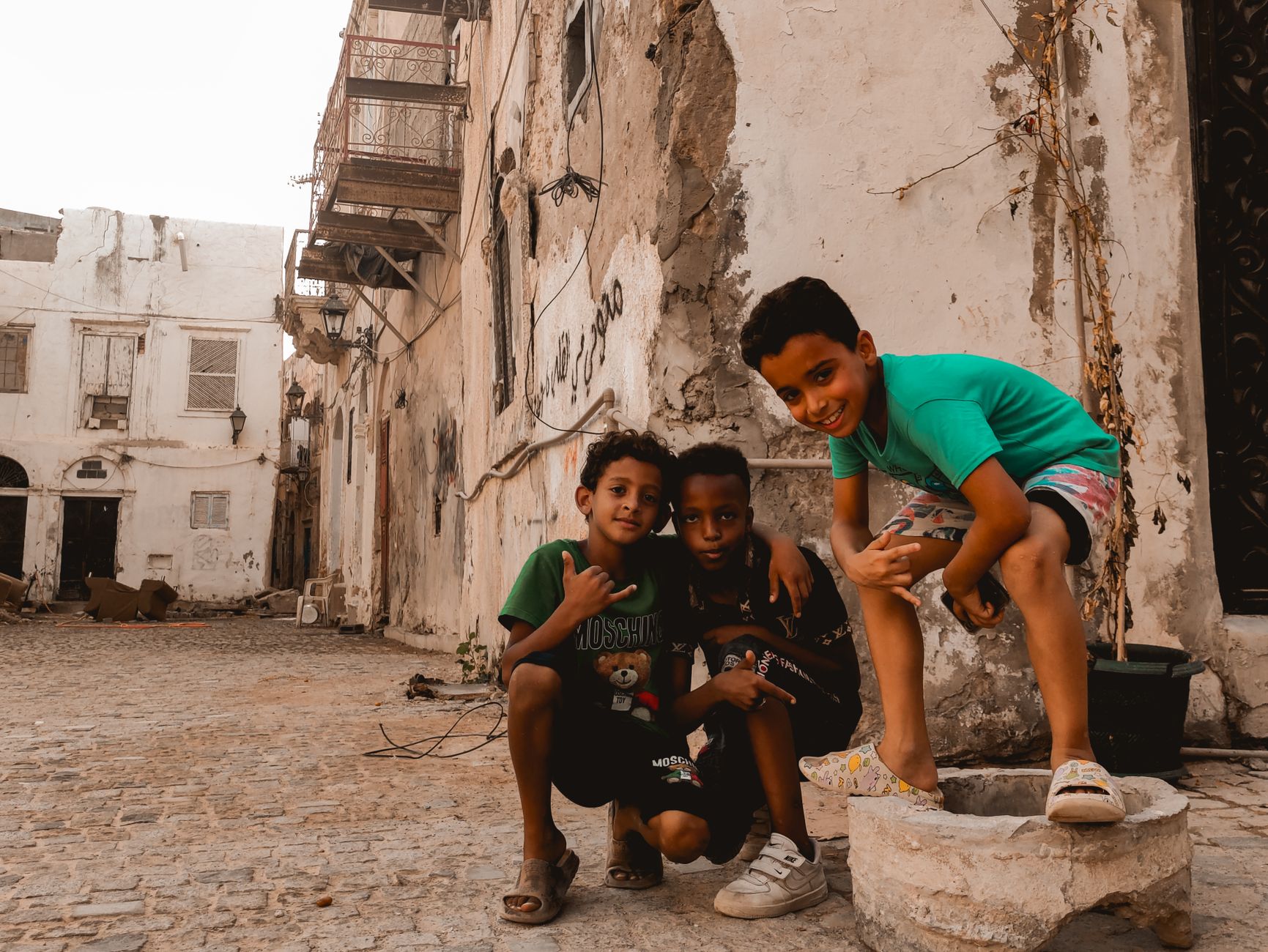
Three children enjoying a playful moment in the historic streets of Tripoli, Libya.
Photo by Mohammed Alashibi on Pexels · Pexels License
Charming harbor with boats and a city skyline backdrop, perfect for travel and urban themes.
Photo by Diego F. Parra on Pexels · Pexels License
Stylish sneakers in various colors hanging with laces on a vivid orange backdrop. Ideal for fashion themes.
Photo by Mohaned tamzini on Pexels · Pexels License
Peaceful urban marina with boats moored against city skyline backdrop.
Photo by Diego F. Parra on Pexels · Pexels License
Practical Information
Visa
Assume you need a visa in advance, plus a Libyan sponsor or operator who can confirm your entry arrangements in writing. Rules vary by embassy and even by port of entry, so check the exact process with the Libyan mission handling your passport before you book anything non-refundable.
Currency
Libya uses the Libyan dinar (LYD), and cash runs the trip. Foreign bank cards often fail at ATMs, hotels, and banks, so carry enough declared cash, change money only through approved channels, and treat card acceptance as the exception.
Getting There
Most arrivals use Tripoli Mitiga for the west, Benghazi Benina for the east, or Misrata if your route and security planning point that way. Flights from Tunis, Istanbul, Cairo, Amman, Dubai, Malta, and Rome are the practical links; land borders can close with little warning.
Getting Around
Libya has no working passenger rail network, so every trip moves by road or domestic flight. For anything beyond a short urban hop in Tripoli or Benghazi, plan on a driver, fixer, or tour operator; self-drive sounds romantic until you meet checkpoints, paperwork, and fuel logistics.
Climate
The coast works best from October to April, when Tripoli and Benghazi are warm rather than punishing. Desert routes around Sebha, Ubari, and Murzuq are most manageable from November to February, because summer in Fezzan can push past 45C and turn small mistakes into medical problems.
Connectivity
Mobile coverage is decent in the main coastal cities and much thinner once you leave them. Buy a local SIM if your sponsor can help, download offline maps before leaving Tripoli or Benghazi, and do not assume your hotel Wi-Fi will handle calls, uploads, or payment apps.
Safety
This is not a standard leisure destination right now. Foreign ministries still warn against most travel, and security conditions, flight schedules, and local authority rules can shift quickly, so any trip needs current advice, local contacts, and a plan that accepts last-minute changes.
Taste the Country
restaurantBazin
Right hand tears. Sauce drags inward. Family gathers around one mound, one bowl, one silence between remarks.
restaurantMbakbaka
Spoon lifts pasta and broth. Bread follows the red film. Night meal, friends, long talk.
restaurantShorba libiya
Dates open the fast. Soup follows, hot and slow. Ramadan table, close kin, television murmurs.
restaurantCouscous bil-bosla
Platter lands in the center. Lamb, chickpeas, onion, sauce. Fridays, guests, second helpings.
restaurantOsban
Knife slices stuffed intestine. Couscous waits nearby. Feast day, wedding, Eid, appetite.
restaurantTea with foam
Glass receives dark tea in rounds. Foam crowns the surface. Visit stretches, gossip moves, time loosens.
restaurantRuz hoot bil kusbur
Fish arrives with rice from head stock. Lemon, cumin, coriander do the work. Coast meal, lunch, shared platter.
Tips for Visitors
Carry Cash
Bring enough cash for the full trip plus delay money. Cards can fail even in better hotels, and the problem is not inconvenience so much as having no backup when plans slip.
Forget Trains
Libya has no practical passenger rail network. Build every route around flights, road transfers, and the simple fact that a 200-kilometer stretch can take longer than the map suggests.
Book for Reliability
Choose hotels for security, generator backup, and location rather than romance. A plain business hotel in Tripoli or Benghazi can save hours of friction that a prettier address cannot.
Use a Local Fixer
For ruins, desert routes, or intercity travel, a local operator is not a luxury add-on. They handle permits, checkpoints, changing road conditions, and the kind of phone calls visitors cannot improvise.
Read the Table
In local settings, greet properly, accept tea if offered, and watch how people eat before you reach in. Shared platters are common, the right hand matters, and haste reads badly.
Go Offline Early
Download maps, hotel details, passport copies, and contact numbers before leaving the main cities. Signal drops fast once you move into the desert or mountain roads, and hotel Wi-Fi may not rescue you.
Travel by Season
October to April works for Tripoli, Benghazi, Sabratha, and Leptis Magna. November to February is the safer window for Sebha, Ubari, and Murzuq, when the desert is still harsh but no longer openly hostile.
Explore Libya with a personal guide in your pocket
Your Personal Curator, in Your Pocket.
Audio guides for 1,100+ cities across 96 countries. History, stories, and local insight — offline ready.
Audiala App
Available on iOS & Android
Join 50k+ Curators
Frequently Asked
Is Libya safe for tourists in 2026? add
Not in the usual sense. Most foreign governments still warn against most travel to Libya, so this is a specialist trip that needs current security advice, trusted local contacts, and a willingness to cancel or reroute at short notice.
Do I need a visa to visit Libya? add
Probably yes, and you should assume it must be arranged before arrival. Tourist access is inconsistent, embassy rules vary, and the safest approach is to rely on written confirmation from both your Libyan sponsor and the embassy processing your passport.
Can you visit Leptis Magna from Tripoli? add
Yes, Leptis Magna is the most realistic major archaeological day trip from Tripoli. The site lies east of the capital on the coastal road, but you should still go with a driver or operator because road conditions, checkpoints, and access arrangements can change.
What is the best time of year to visit Libya? add
October to April is best for the coast, including Tripoli, Sabratha, Benghazi, and Leptis Magna. November to February is better for desert routes around Sebha, Ubari, and Murzuq, when daytime temperatures are manageable and nights turn cold rather than brutal.
Can I use credit cards in Libya? add
Do not count on it. Libya is still overwhelmingly cash-based for visitors, and foreign cards often fail at ATMs, hotels, and banks, so you need declared cash in reserve from the start.
Is Libya worth visiting for Roman ruins? add
Yes, if you can manage the access and the risk. Leptis Magna and Sabratha are among the most impressive Roman sites in the Mediterranean, and Cyrene adds a Greek city of real scale rather than a token stop.
Can women travel in Libya? add
Yes, but conservative dress and local context matter. Women travelers usually do best with prearranged transport, a reliable local contact, and clothing that covers shoulders, arms, and legs, especially outside major hotels or formal business settings.
Is there public transport or trains in Libya? add
Trains are not a practical option because there is no working passenger rail network. Shared taxis, minibuses, and domestic flights exist, but visitors usually rely on private drivers because schedules and operating conditions are too fluid for tight planning.
How many days do you need for Libya? add
Three days can cover Tripoli with Sabratha or Leptis Magna, but a more realistic first trip is seven to ten days. That gives you time for delays, permits, and at least one region beyond the capital, whether that means Cyrene in the east or Ghadamès in the west.
Sources
- verified UK Foreign, Commonwealth & Development Office: Libya travel advice — Current official safety warnings, entry requirements, money advice, and transport risks.
- verified U.S. Department of State: Libya Travel Advisory — U.S. government guidance on security conditions, entry rules, and travel disruption.
- verified UNESCO World Heritage Centre: Libya — Official record for Libya's World Heritage sites, including Leptis Magna, Sabratha, Cyrene, and Ghadamès.
- verified Embassy of Libya in Ottawa: Consular Services — Example of current visa categories, application requirements, and published fee structure.
- verified Libya Airports and scheduled airline listings — Useful for checking current nonstop routes into Tripoli, Benghazi, and Misrata before booking.
Last reviewed: