
Art Nouveau Capital
One in three downtown buildings is Art Nouveau—800 in total. Alberta iela feels like an open-air gallery designed by Mikhail Eisenstein between 1901 and 1908, all sculptural masks and vertical steel ribs.
The scent of birch smoke drifts across a city where medieval gables shoulder up to facades exploding with terracotta dragons and stone peacocks. Riga, Latvia, keeps its wildest architecture in plain sight—800 Art Nouveau buildings, the world’s heaviest hitters—yet first-time visitors still arrive expecting a quiet Hanseatic backwater.
Researched from Wikidata, Wikipedia & official sources · fact-checked · How we make our guides →
RThe scent of birch smoke drifts across a city where medieval gables shoulder up to facades exploding with terracotta dragons and stone peacocks. Riga, Latvia, keeps its wildest architecture in plain sight—800 Art Nouveau buildings, the world’s heaviest hitters—yet first-time visitors still arrive expecting a quiet Hanseatic backwater.
Between the granite banks of the Daugava and the low Baltic sky, the capital compresses eight centuries into a walkable grid. Cobblestones echo beneath the 1211 cathedral’s 124-meter spire while, three streets away, a Soviet-era market hall sells smoked lampreys beside third-wave espresso stalls. Locals call the contrast normāli—normal—because continuity here is stitched from interruption.
The city rewards detours: duck through the Swedish Gate (1698) and emerge into courtyards where laundry snaps between 15th-century beams; cross the river to Āgenskalns for rye bread still warm from wood-fired ovens. Stay after dark when amber beers appear in Art-Nouveau basements and choral harmonies leak from 19th-century opera walls. Riga doesn’t shout; it murmurs, then sticks in your head like a folk song you can’t translate.
What makes this place worth slowing down for.
One in three downtown buildings is Art Nouveau—800 in total. Alberta iela feels like an open-air gallery designed by Mikhail Eisenstein between 1901 and 1908, all sculptural masks and vertical steel ribs.
Vecrīga’s cobbles cover three urban layers: the 13th-century Hanseatic core, 19th-century boulevard ring, and former suburbs. The 1211 cathedral’s organ once held the world-record pipe count.
Ķemeri National Park is 30 minutes by train. A 1.2 km timber boardwalk floats above a 5,000-year-old peat bog that clicks and sighs as you walk—no guardrails, just sky and sphagnum.
Locals still mark birthdays with a pirts ritual: oak-leaf whisks, herb steam, cold plunge. Authentic sessions run in Čiekurkalns wooden houses; expect to be lightly thrashed, then handed beer.
Where to wander, by quarter — each with its own rhythm.
Inside the 14th-century walls, lantern-lit alleys deliver guildhalls, the House of the Black Heads’ reconstructed façade, and basement bars pouring kvass from wooden taps. The area pulses with tourists by day but belongs to night owls once the cruise coaches roll out.
North of the canal, Alberta and Elizabetes ielas erupt with Eisenstein’s 1901–1908 fever dreams—anthropomorphic cornices, screaming masks, gilt peacocks. Ground floors host specialty coffee bars, vintage Baltic fashion ateliers, and yoga classes inside the Latvian National Museum of Art’s marble vestibule.
Five Zeppelin hangars built in 1928 shelter Europe’s largest market complex. Each hall has a specialty: fish, meat, dairy, produce, and groceries. Arrive hungry for gray-pea stew, smoked sprats, and seasonal cloudberries sold by babushkas who still count change in pre-euro lats.
Across the Daugava, wood-heated saunas perfume the air around the 1898 red-brick market. Inside, craft brewers pour hemp porter while upstairs pop-up kitchens plate modern takes on Latvian pig-snout terrine. Quiet ponds and 1920s wooden villas make it the city’s slow living quarter.
Once a vodka-soaked shortcut, Miera has become Riga’s caffeine spine—roasteries, natural-wine bars, and a 24-hour bookshop that smells of cardamom and printer’s ink. Street art covers crumbling facades; follow the murals to find basement jazz clubs and bakeries that run out of rye before noon.
A Baltic trading post that became Europe's Art Nouveau capital
Albert von Buxhoeveden lands on the Daugava with 23 crusader ships and builds a fortress that will become the Baltic's most important port. He chooses the site strategically - 15 km from the sea where the river bends, perfect for controlling trade routes to Byzantium. Within months, German merchants follow, establishing the grid of streets that still anchors Vecrīga.
Bishop Albert lays the foundation stone for what will become the Baltic's largest church. Built in soft red brick with rounded Romanesque arches, it dominates the skyline for centuries. The cathedral's pipe organ, installed in 1884, will briefly hold the title of world's largest - 6,768 pipes that shake the nave when Bach is played.
The city's merchants gain entry to Europe's most powerful trade alliance. Overnight, Riga becomes the link between Russian furs and Flemish cloth. Warehouse receipts replace barter. The Black Heads - unmarried foreign merchants - establish their guild hall where they'll store amber, wax and the occasional secret treaty.
Young foreign merchants raise their headquarters on the main square, its stepped gables reaching toward heaven. Inside, they host wild banquets where beer flows in silver tankards and merchants negotiate deals in five languages. The original 14th-century cellar survives WWII bombing - you can still see the hand-chisel marks on the stone.
Luther's ideas sweep through the city like wildfire. Priests abandon their posts. Churches strip their altars. The Livonian Order, once all-powerful, watches helplessly as their authority crumbles. Within a decade, Riga's churches echo with sermons in Latvian instead of Latin.
Gustavus Adolphus's troops breach the walls after a brief siege. The city's German merchants adapt quickly - Swedish rule means stability and expanded trade rights. Riga becomes Sweden's largest provincial city, its spires visible for miles across the flat Livonian plain.
In a merchant house near the Powder Tower, the future Nobel laureate takes his first breath. The Baltic German boy will grow up watching ships unload chemicals on the Daugava docks, sparking a fascination that leads him to found physical chemistry. He'll coin the term 'catalysis' and win the 1909 Nobel Prize.
The city council orders the fortress walls demolished. For seven centuries they'd protected Riga; now they're choking growth. Where ramparts once stood, broad boulevards appear, lined with lime trees and neoclassical mansions. The demolition takes three years and costs more than building the walls originally did.
Ten thousand singers gather in Riga for the first national song festival. In a park near the canal, choirs perform traditional Latvian songs banned during serfdom. The festival becomes sacred tradition - every five years, Riga fills with singers wearing traditional costumes, their voices echoing off the cathedral walls.
The future film revolutionary enters the world in a Riga apartment overlooking Alberta Street. As a boy, he'll wander past the Art Nouveau facades his father designed, absorbing the visual drama that shapes his cinematic montage theory. His 1925 film 'Battleship Potemkin' will change cinema forever.
Mikhail Eisenstein unleashes his architectural fever dream on Alberta Street. Dragons curl around windows. Sphinxes guard doorways. Faces peer from facades, some serene, some screaming. In seven years, Riga gains the world's highest concentration of Art Nouveau buildings - 300 in the city center alone.
In the Latvian National Theatre, the lights dim and history turns. The National Council proclaims Latvia's independence as cannon fire echoes from the civil war. Outside, citizens gather despite the cold, hearing their national anthem performed for the first time in their own capital. Riga becomes a capital city overnight.
German bombs crash through the cathedral's roof. The tower, rebuilt six times since lightning first struck in 1666, becomes a flaming torch visible across the city. Firefighters watch helplessly as centuries of history turn to ash. The church's famous spire collapses at 3:47 AM, its bells falling silent mid-peal.
Morning frost still clings to the pines when the killing begins. 25,000 Jews from the Riga ghetto march to the forest. By nightfall, mass graves hold entire communities. The pine trees absorb the sound of gunfire. Today, the forest remains eerily quiet - locals say the trees remember.
In Vērmanes Garden, thousands gather to sing banned Latvian songs. No slogans, no banners - just voices raised in harmony. The KGB watches from unmarked cars but doesn't intervene. It's the start of the Baltic Singing Revolution that will end Soviet rule without a single shot fired in Riga.
The Supreme Council votes 111-13 to restore Latvia's independence. Outside, crowds surge toward the Freedom Monument, laying flowers at Milda's feet. The Soviet flag comes down from the parliament building. For the first time since 1940, Riga's lights burn for a free Latvia.
After six centuries of conquest, fire, and reconstruction, the United Nations recognizes what locals always knew - Riga's old town is irreplaceable. The UNESCO designation protects 438 hectares of medieval streets, Hanseatic warehouses, and Art Nouveau masterpieces. Property values jump overnight. Tourists start arriving with guidebooks instead of tank divisions.
At midnight, fireworks explode over the Daugava as Latvia becomes the EU's 25th member. In the old town, Estonians and Lithuanians join Latvians celebrating together - the Baltic Three reunited in Europe. The border guards who once checked papers now wave EU flags.
The people who shaped the city — and were shaped by it.
He gave Riga its most flamboyant skin: screaming faces, lions, and naked maidens pressed into plaster. Walk Alberta iela at dawn and you can almost hear him arguing with city clerks about budget overruns.
The montage genius spent his first years watching trams rattle past his father's architectural fantasies. Return today and the same Art Nouveau facades frame his earliest memories of movement and light.
He fled creditors via a smuggler's skiff across the Daugava, an escape that later coloured The Flying Dutchman. The riverside promenade still smells of tar when the wind shifts east.
Where locals actually book dinner — not the tourist menus.
Small things that change how the city treats you.
Take Bus 22 from the airport to the center for €1.50 instead of a €20 taxi. The stop is directly outside arrivals and gets you downtown in 30 minutes.
Alberta iela has the densest cluster of Eisenstein's flamboyant facades. Go at 9 am when the low sun turns the plaster sculptures gold and the crowds haven't arrived.
Bypass Old Town tourist menus. Walk 10 minutes to Āgenskalns Market for grey peas with bacon and craft beer at half the price.
Push the unmarked wooden doors off Jauniela Street. They open into hushed 17th-century courtyards where laundry flaps and time stops.
May and September give you 16°C days, golden evening light on the cathedral spires, and hotel prices 30% below July.
Take the 40-minute train to Ķemeri National Park. The boardwalk floats over blood-red peat bogs and feels like walking on another planet.
The city, as it actually looks.

The iconic Railway Bridge in Riga, Latvia, glows against the night sky, casting vibrant reflections across the Daugava River.
Claudia Schmalz on Pexels

The historic House of the Blackheads stands as a stunning example of ornate Dutch Renaissance architecture in the heart of Riga, Latvia.
Efrem Efre on Pexels

The historic skyline of Riga, Latvia, showcases a blend of medieval church spires and the modern TV tower overlooking the Daugava riverfront.
Joerg Hartmann on Pexels

A stunning panoramic view of Riga, Latvia, showcasing the historic architecture of the Old Town against the backdrop of the Daugava River.
Efrem Efre on Pexels

The historic Railway Bridge spans the Daugava River in Riga, Latvia, with its steel arches beautifully reflected in the partially frozen water.
Efrem Efre on Pexels

A stunning elevated view of Riga, Latvia, showcasing the contrast between the historic Riga Cathedral and the iconic Vanšu Bridge spanning the frozen Daugava River.
Efrem Efre on Pexels

The iconic Vanšu Bridge and modern Z-Towers are beautifully reflected in the calm waters of the Daugava River during a golden sunset in Riga, Latvia.
Mihail Emelyanov on Pexels
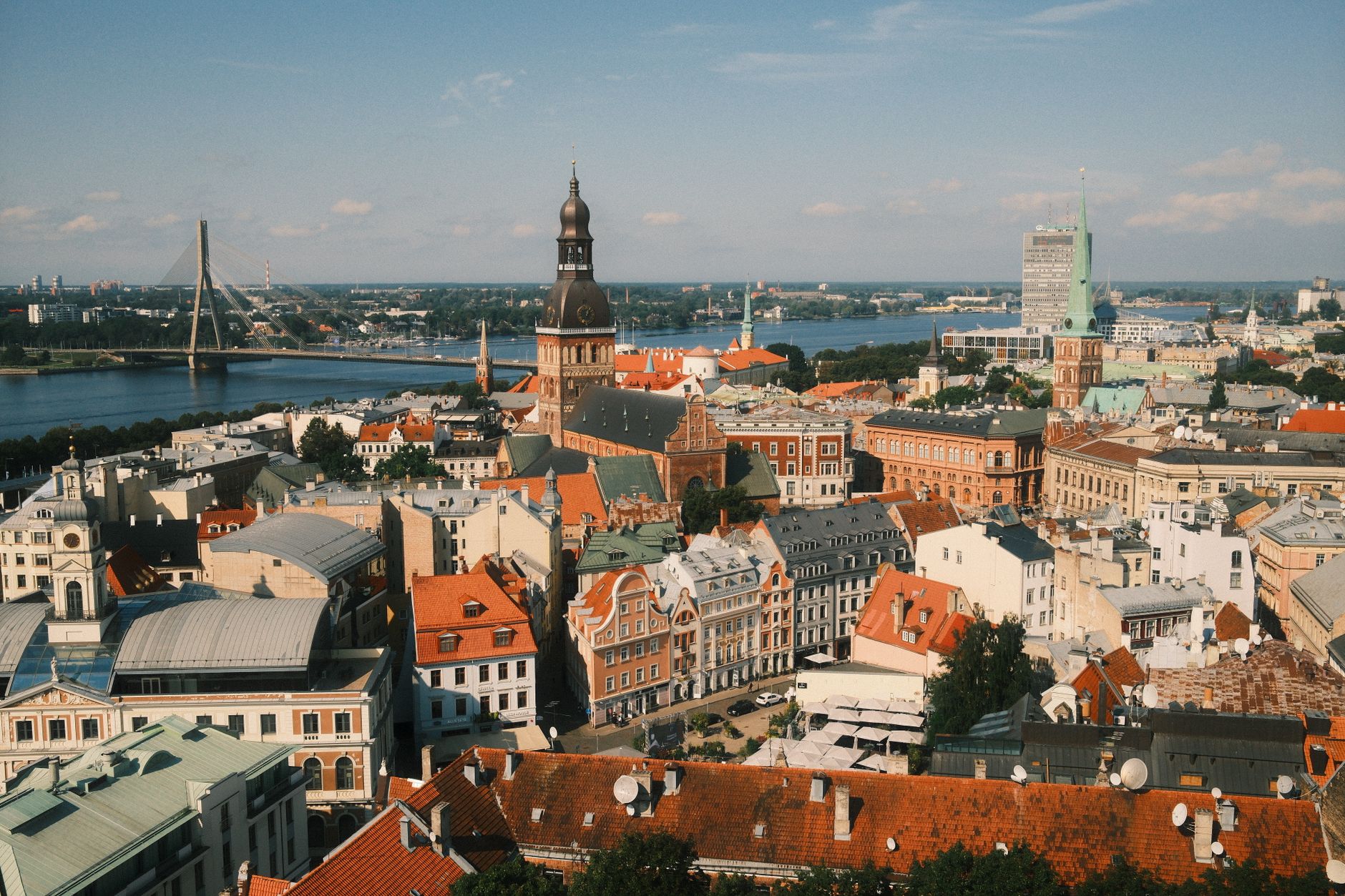
A stunning elevated view of Riga's historic Old Town, featuring the iconic cathedral spire and the scenic Daugava River under bright daylight.
Boris K. on Pexels

A stunning black and white aerial perspective of Riga, Latvia, highlighting the city's historic Old Town architecture and the prominent Riga Cathedral.
Efrem Efre on Pexels
Yes. Riga has the world's largest collection of Art Nouveau architecture, a UNESCO-listed medieval core, and a living sauna culture you can experience in under 72 hours. It's cheaper than Stockholm and less crowded than Prague.
Two days covers the Old Town and Art Nouveau district; add a third for the Central Market, a pirts ritual, and a bog walk in Ķemeri. Stay four if you want day-trips to Jūrmala beach or Rundāle Palace.
Generally yes, but stick to main streets after midnight. Avoid Prāgas iela and the area east of the train station nicknamed 'Little Moscow' where poorly lit blocks and rowdy bars attract pickpockets.
Cards work everywhere, even for €1 tram tickets. Carry a few €5 notes for market stalls and tip jars—taxi drivers appreciate cash but Bolt accepts card too.
Bus 22 costs €1.50 if you buy the 90-minute ticket at the red machine in P1 car park before boarding. Ride takes 30 minutes and drops you beside the Central Market.
Late May and early September give you 16–20°C, long daylight, and lower hotel prices. July is warmest but cruise-ship crowds spike pickpocket numbers around the Town Hall Square.
Yes—Riga's tap water comes from deep artesian wells and is safe, tasteless, and free. Bring a bottle and refill at public fountains in Bastejkalna Park instead of buying plastic.
Ready to book?
Riga International Airport (RIX). Bus 22 reaches Central Railway Station (Centrālā stacija) in 30 min, €1.50. No metro; no suburban rail to airport. Via Baltica (A1/E67) highway from Tallinn, A7/E22 from Vilnius.
No subway. 6 tram, 18 trolley, 51 bus routes run 05:30–23:30. 90-minute ticket €1.50; 24 h pass €5; 3-day €8; 5-day €10. Bolt scooters vanish in winter. Riga Pass (€25) bundles 70 museum & tour discounts.
Winter -5–0 °C, snow lingers. Spring 5–15 °C, May is golden. Summer 18–24 °C, 17 h daylight, peak crowds July. Autumn 10–15 °C, fewer tourists. Rain evenly spread; September edges June for comfortable light.
Violent crime low; watch pickpockets in Old Town and Central Market June–August. Avoid Maskavas Forštate (“Little Moscow”) after dark; poorly lit, higher petty theft. Emergency dial 112.
Latvian is official; Russian widely understood, English spoken by under-40s in service jobs. Euro (€) since 2014. Cards accepted everywhere; tipping 5–10 % optional, never demanded.
0 places, one continuous walking route. Free with your first city.