Introduction
This Latvia travel guide starts with a surprise: one of Europe’s flattest countries can feel startlingly dramatic, from Riga’s spires to Cape Kolka’s colliding seas.
Latvia works best when you stop expecting spectacle on Mediterranean terms. The pull here is sharper than that: Art Nouveau staircases in Riga, pine-framed beaches in Jūrmala, and castle ruins above the Gauja valley near Sigulda and Turaida. The distances are kind to travelers. In a single week, you can move from a UNESCO-listed old town to a bog boardwalk, then finish the day with smoked fish, dark rye bread, and a glass of Riga Black Balsam that tastes half pharmacy, half folklore.
History sits close to the surface here, and it rarely behaves like museum wallpaper. Cēsis still carries the weight of Livonian power struggles; Kuldīga feels unusually intact, with timber houses and Venta Rapid stretching wider than many rivers look elsewhere; Daugavpils brings a different Latvia into view, more eastern, more layered, less polished for outsiders. Then the country turns quiet again: forest, marsh, river, long evening light. That rhythm is the point. Latvia gives you cities with backbone, then hands you enough silence to hear what they mean.
Food and culture land with the same plainspoken force. You taste the country in grey peas with bacon, cold beet soup with hot potatoes, caraway-studded Jāņu cheese, and heavy slices of rupjmaize that make most supermarket bread seem unserious. You hear it in the dainas, those compact folk songs that can hold work, grief, flirtation, and cosmology in four lines. Head west to Liepāja for wind and sea, north toward Valmiera for Gauja country, or out to Kolka where the Gulf of Riga meets the Baltic. Latvia does not perform for you. It reveals itself in specifics.
A History Told Through Its Eras
Amber, Hill-Forts, and the Sword at the Daugava
Amber Coast and Crusader Conquest, c. 3000 BCE-1290
A bead of amber in the palm tells you how old Latvia's story is. Long before a bishop laid out the streets of Riga, Baltic traders were carrying this fossil resin south toward the Roman world, while Livs, Curonians, Semigallians and Latgalians held the coast, the river mouths and the forest clearings behind them.
Their power was not marble but earth. Across the country rose hill-forts, those pilskalni of packed soil and timber, where a chief could watch the tree line and where a community fled when raiders came in from the sea. Excavations at places linked to Tervete have turned up charred beams, blades and horse bones. The chronicles were late. The ground was not.
Then came Bishop Albert. In 1201 he founded Riga at the mouth of the Daugava, and one feels at once that this was no pious improvisation: it was a military port, a counting house and a statement of power. Ce que l'on ignore souvent, c'est que Albert's great talent was administrative rather than heroic. He recruited crusaders with indulgences, built alliances in parchment as much as in blood, and set in motion the Livonian Brothers of the Sword.
Resistance did not vanish politely into a footnote. The Semigallian leader Nameisis fought the crusading orders for years, using the forests and marshes against armored cavalry, and after defeat his people are recorded as burning their own strongholds rather than surrendering them intact. By 1290 the old Baltic order had been broken, but the wound remained. Out of that wound came medieval Livonia, with Riga at its center.
Nameisis survives in Latvian memory not because he won, but because he refused to let defeat look obedient.
Roman writers prized Baltic amber so highly that Nero is said to have used it lavishly for arena decoration; the resin from this cold coast was already a luxury at the center of empire.
Riga Rich, Castles Burned, and the Baltic Never Quiet
Livonia, Merchants, and Rival Crowns, 1290-1721
In the fourteenth century the soundscape changed. Where hill-forts had stood, one heard warehouse doors, church bells and the creak of cranes on the river in Riga, now a Hanseatic city where wax, furs, timber and grain changed hands under Gothic gables. The Brotherhood of the Black Heads, those unmarried foreign merchants with a taste for ceremony, turned trade into theater on Town Hall Square.
But wealth did not bring peace. The castles at Cesis, Sigulda and Turaida guarded a land forever pulled between bishops, military orders, Polish-Lithuanian power and Sweden's northern ambition. One ruler replaced another, confessions shifted, charters were rewritten, and ordinary Latvians remained mostly peasants under Baltic German elites who owned the land and often the law as well.
The Reformation arrived, and with it a new politics of language and authority. Lutheranism spread through Riga and beyond, and the printed word began to matter in a different way. Ce que l'on ignore souvent, c'est que this was one of the turning points that later made a Latvian literary culture possible: once religion demanded texts, language could no longer stay only oral.
Then came the Polish-Swedish wars, Russian pressure, siege after siege. In 1621 the Swedish king Gustavus Adolphus took Riga, and for a time the city became Sweden's largest possession after Stockholm. Yet even that northern grandeur was provisional. The Great Northern War shattered it, and in 1710 plague and Russian arms carried Riga into the empire of the tsars.
Gustavus Adolphus appears in Latvian history less as a distant monarch than as the king who made Riga a Swedish imperial prize.
When Riga belonged to Sweden, it was actually the largest city in the Swedish realm after Stockholm, a fact that still surprises visitors who picture Sweden's empire as a purely Scandinavian affair.
Under the Tsars, a Nation Learns Its Own Name
Russian Empire and National Awakening, 1721-1918
The eighteenth century opened with exhaustion. After plague and war, Riga entered the Russian Empire in 1710 and was formally ceded in 1721, yet the old Baltic German nobility kept much of its local power. One can picture the arrangement very clearly: a tsar in Saint Petersburg, German landlords in manor houses, Latvian peasants in the fields, and the Daugava carrying commerce past them all.
The human cost was immense. Serfdom in Latvian lands lasted into the early nineteenth century, and emancipation did not instantly produce freedom so much as paperwork, debt and a longer horizon. But cities grew. Riga industrialized, railways spread, and the countryside began sending sons and daughters into a modern world of factories, newspapers and politics.
This is where the miracle begins. Young Latvians started collecting songs, studying their language and insisting that peasant speech was not a rustic inconvenience but the skeleton of a nation. Krišjānis Valdemārs urged Latvians toward the sea and toward education; Krišjānis Barons gathered the dainas, those compressed folk songs in which a whole cosmology fits into four lines. Ce que l'on ignore souvent, c'est que Barons worked with slips of paper and boxes, like a patient archivist of the national soul.
By 1905 the pressure burst. Revolution swept across the Russian Empire, manor houses burned in the Latvian countryside, and repression followed with executions and exile. Then came the First World War, the Latvian Riflemen, collapsing empires and a chance that had seemed impossible for centuries. On 18 November 1918, in Riga, the republic was proclaimed.
Krišjānis Barons did not command armies, yet by collecting more than 200,000 folk-song texts he gave Latvia something armies cannot produce: continuity.
Barons' famous 'cabinet of songs' was not a metaphor but an actual piece of furniture, a custom-built archive where the nation was filed line by line.
A Flag Raised, Torn Down, and Raised Again
Republic, Occupations, and the Singing Revolution, 1918-1991
The first Latvian republic began in uncertainty, not triumph. Independence declared in Riga in November 1918 had to be defended in war against Bolshevik forces and other armies still moving through the ruins of empire, and only in 1920 did peace feel remotely solid. Yet the interwar years gave Latvia ministries, schools, passports, a diplomatic voice and the difficult pleasure of governing itself.
Then democracy narrowed. In 1934 Kārlis Ulmanis carried out a coup and established authoritarian rule, paternal, disciplined and intensely national in style. He liked to present himself as the farmer-statesman, close to the soil and above party squabbles. History is less indulgent: stability came at the price of parliament and opposition.
The catastrophe arrived in secret clauses. The Molotov-Ribbentrop Pact of 1939 assigned Latvia to the Soviet sphere, Soviet occupation followed in 1940, Nazi Germany invaded in 1941, and the Red Army returned in 1944. Few European countries were crushed so thoroughly between two murderous regimes. Jews from Riga and elsewhere were shot in forests such as Rumbula, deportations tore families from farms and apartments, and after the war Soviet rule remade the country through censorship, collectivization and demographic change.
Yet memory kept working underground. Songs, language, private grief, forbidden flags hidden in drawers: these became a form of resistance. In the late 1980s Latvians joined Estonians and Lithuanians in the Singing Revolution, and on 23 August 1989 around two million people formed the Baltic Way across three countries. The chain ended in restored independence in 1991. After silence, voices.
Kārlis Ulmanis remains unsettling because he is remembered both as a founder and as the man who shut the doors of parliamentary life.
During the Baltic Way, people joined hands across roughly 600 kilometers from Tallinn to Riga to Vilnius, turning a political demand into a human line visible from the sky.
From Barricades to Europe, Without Forgetting the Cost
Restored Independence and European Latvia, 1991-present
The winter of 1991 in Riga was not grand in a theatrical sense. It was bonfires, concrete blocks, buses pulled into defensive positions and people standing in the cold to protect institutions they had only just recovered. The Barricades were improvised, civic and stubborn. That is often how freedom looks when it is real.
What followed was not easy romance but repair. Latvia rebuilt state institutions, privatized, argued over citizenship and memory, and worked to leave the Soviet system not just politically but mentally. In 2004 it joined both NATO and the European Union, anchoring itself westward with a determination that makes sense only if one remembers the twentieth century in full.
The country also reclaimed its cities in layers. Riga restored its Art Nouveau facades and its old mercantile confidence; Kuldiga, with its low timber-and-brick fabric, preserved a scale of urban life that much of Europe paved over; the castles and landscapes around Cesis, Sigulda and Turaida re-entered public imagination as places of inheritance rather than propaganda. Ce que l'on ignore souvent, c'est que heritage in Latvia is never only aesthetic. It is an argument about survival.
Today Latvia is digital, European and still marked by the fault lines of language, memory and geography. Russia's war against Ukraine has only sharpened that awareness. The modern state is not a neat happy ending. It is the latest chapter in a country that learned, repeatedly, how fragile sovereignty can be.
Vaira Vīķe-Freiberga, who returned from exile to become president, embodied the strange Latvian twentieth century in one life: loss, return, and intellectual steel.
The 1991 barricades in Riga were defended not by a professional army alone but by ordinary civilians, who brought tractors, timber, tea and sleeplessness to the center of politics.
The Cultural Soul
A Language That Refuses Padding
Latvian does not waste syllables on social upholstery. You hear it first in Riga, at a bakery counter or on tram line 11 toward Jūrmala: Labdien, lūdzu, paldies. Three words, perfectly sufficient, each one placed like cutlery on a white cloth.
The grammar has an old aristocracy to it. Diminutives soften a sentence without making it foolish, and the line between Jūs and tu is guarded with more care than many countries reserve for state borders. Use Jūs too long and you are correct. Use tu too early and you have entered the room wearing somebody else's coat.
Then come the dainas, those four-line folk songs that look tiny on the page and turn immense in the mouth. A people that can fit courtship, barley, the moon, grief, and a rake into four lines has understood something brutal about beauty: brevity increases pressure.
Rye, Smoke, Cream, Repeat
Latvia tastes of weather made edible. Rye bread, smoked fish, grey peas, kefīrs, dill, caraway, mushrooms, pork fat, birch sap in spring: the menu reads like a farm inventory compiled by a poet with cold hands.
In Riga Central Market, under those former Zeppelin hangars, the logic becomes physical. Fish glisten in rows. Dark loaves sit with the gravity of legal documents. Smoked sprats smell like a sentence the Baltic Sea has been composing for centuries, and somebody, mercifully, has interrupted it with butter.
The national genius lies in contrast. Aukstā zupa arrives pink and cold, with hot potatoes on the side; sklandrausis gives you sweet carrot over potato over rye and dares you to object; Rīgas Melnais balzāms tastes medicinal, monastic, and faintly punitive, which is one reason people remain loyal to it. A country is a table set for strangers, but Latvia checks first whether the strangers know how to sit down.
When the Choir Becomes Weather
Latvia sings on a scale that makes the individual seem like an administrative detail. The Song and Dance Festival, held every five years, gathers tens of thousands of performers; what matters is not the spectacle alone but the sensation that the human voice has been promoted to climate.
This is not decorative folklore. During occupation, songs carried memory when institutions could not. A choir can look harmless to power. Then it opens its mouth.
You feel the afterimage of that tradition in quieter places too. In Cēsis, in Sigulda, in parish halls and school auditoriums, children still learn music as if it were table manners. They are right. Song in Latvia is not an accessory to identity. It is one of the machines that keeps identity alive.
The Courtesy of Restraint
Latvian politeness does not grin at you from across the room. It stands up when you enter, makes space, speaks at a reasonable volume, and waits to see whether you deserve warmth. This is a much higher form of respect than forced cheerfulness.
Silence is allowed here. More than allowed. In a cafe in Riga or on a platform before the train to Valmiera, nobody treats a pause as a medical emergency. People speak when they have something to say, and the result is oddly luxurious.
The ritual is simple. Greet first. Keep your voice down. Do not perform intimacy. If a Latvian begins formal and then turns suddenly generous, you will understand that a small gate has opened. These gates are not automatic. That is why they matter.
Wood, Brick, and the Cult of Survival
Latvia builds as if history were expected to return with an axe. Wooden houses in Kuldīga lean into the street with a patience that feels almost moral; Riga answers with Gothic spires, Hanseatic facades, and then that delirious Art Nouveau quarter where stone women, masks, eagles, and botanical nightmares climb the walls as if masonry had started dreaming.
The trick is to notice that grandeur is only half the story. Go to Turaida or Cēsis and you meet the medieval appetite for defense: thick walls, steep positions, masonry that distrusts the future. Go to Jūrmala and the mood changes entirely: carved wooden villas, pale light, the seaside teaching timber to behave like lace.
Latvian architecture has a habit of keeping receipts. Crusaders, merchants, imperial administrators, Soviet planners, post-1991 restorers: each left a layer, and none had the decency to match the others. Good. A city should show its quarrels. Riga does.
Forest as Method
Latvia's unwritten philosophy begins in the forest, where half the country seems to have gone to think. The lesson is not romance. Forest here is work, shelter, fuel, mushrooms, berries, resin, silence, and the pleasing reminder that humans are temporary managers of damp soil.
You see the idea in pirts culture, where steam, birch whisks, heat, cold water, and endurance produce something far older than wellness. The body is not pampered. It is corrected. One emerges pink, humbled, and much less persuaded of one's own importance.
This may explain a national talent for surviving history without narrating it too loudly. Latvia has known occupation, deportation, censorship, and recovery, yet much of its wisdom still arrives sideways, through ritual, food, song, and seasonal habits rather than public declarations. In Daugavpils or Rēzekne, as in Riga, one keeps hearing the same proposition in different forms: endure first, explain later.
What Makes Latvia Unmissable
Riga and Beyond
Start in Riga for church spires, market halls, and one of Europe’s richest Art Nouveau districts, then use the capital as a springboard to Jūrmala, Sigulda, and Cēsis.
Castles and Strongholds
Latvia’s medieval story is written in stone and ruin, from Turaida’s red-brick towers to Cēsis Castle and the old urban fabric of Kuldīga.
Forest, Bogs, Coast
Half the country is forest, and the variety surprises people: Gauja sandstone cliffs, Kemeri boardwalks, and the raw meeting of waters at Kolka.
Rye, Smoke, Caraway
Latvian food is built from climate and habit: dark rye bread, smoked fish, grey peas with bacon, hemp spread, beet soup, and the bitter punch of Riga Black Balsam.
Song as Memory
Few countries carry folk culture this lightly and this deeply. Dainas, midsummer rituals, and mass choral traditions still shape how Latvia sounds and sees itself.
Easy Baltic Add-On
Latvia fits neatly into a Baltic trip, but it also rewards slower travel. A week gives you time for Riga, the Gauja valley, the western coast, and one smaller city that most visitors skip.
Cities
Cities in Latvia
Riga
"Half a million people, the densest concentration of Art Nouveau architecture on earth, and a medieval skyline that Bishop Albert of Riga would still recognize from the Daugava."
Jūrmala
"Twenty-five kilometres of white-sand Baltic beach backed by tsarist-era wooden villas where Soviet composers once summered, all reachable from Riga in 30 minutes by commuter train."
Sigulda
"Sandstone cliffs, a 13th-century crusader castle ruin, and a bobsled track that locals actually use — this is the Gauja River valley at its most theatrical."
Cēsis
"The best-preserved medieval town in Latvia, where the Livonian Order's castle still stands roofless and roofless by design — visitors are handed lanterns to explore its dark interior."
Liepāja
"Latvia's third city is a port with a Soviet-era military fortress on an island, a reputation for breeding rock musicians, and a beach wide enough to get genuinely lost on."
Daugavpils
"Latvia's second city sits in Latgale near the Belarusian and Lithuanian borders, and its 19th-century fortress is the birthplace of Mark Rothko — a fact the town has only recently decided to celebrate loudly."
Kuldīga
"A Baroque brick waterfall — the widest in Europe at 249 metres — runs through the centre of a town so intact that the EU used it as a case study in small-city heritage preservation."
Valmiera
"The gateway to the northern Gauja valley doubles as a university town with a craft-beer culture that punches well above its 25,000-person weight."
Ventspils
"A free port that spent its post-Soviet oil-transit windfall on public art, a children's open-air ethnographic museum, and a beach ranked among the cleanest on the Baltic."
Rēzekne
"The self-styled 'Heart of Latgale' carries a distinct Catholic and Old Believer Russian cultural layer that makes it feel like a different country from Riga, 240 kilometres to the west."
Turaida
"A reconstructed red-brick medieval castle on a forested bluff above the Gauja, paired with an open-air museum and the grave of the 'Rose of Turaida' — a 17th-century legend that Latvians treat as history."
Kolka
"At the tip of the Courland Peninsula, where the Gulf of Riga collides with the open Baltic in visible standing waves, there is almost nothing here except wind, pines, and the knowledge that the Couronians once launched p"
Regions
Riga
Riga and the Gulf
Riga is where most trips begin, and for good reason: medieval lanes, market halls in old Zeppelin hangars, and one of Europe's richest Art Nouveau districts all fit inside a city that still feels manageable on foot. Jūrmala, 25 kilometers west, changes the mood completely with wooden villas, resin in the air and a beach long enough to make the skyline feel irrelevant.
Sigulda
Vidzeme and the Gauja Valley
This is castle country, but the real draw is the way sandstone cliffs, forested slopes and river bends keep interrupting the history lesson. Sigulda, Turaida, Cēsis and Valmiera belong on the same mental map: a compact northern arc where trains work, hiking is easy, and medieval Latvia stops being an abstraction.
Liepāja
Kurzeme Coast
Kurzeme has more salt in it. Liepāja mixes military scars, music history and one of the best urban beaches in the country; Kuldīga slows the tempo with timber houses and the broad Venta Rapid; Ventspils and Kolka pull you farther into dunes, fishing villages and weather that changes by the hour.
Daugavpils
Latgale
Eastern Latvia carries a different accent, a different religious map and a stronger memory of empires pressing in from every side. Daugavpils is the anchor, with its vast fortress and Mark Rothko Art Centre, while Rēzekne opens the road into lake country, pilgrimage sites and a region where Latvian identity never looks quite singular.
Valmiera
Northern Latvia
Northern Latvia is less theatrical than the castle belt farther south, which is part of its appeal. Valmiera gives you a lived-in regional city rather than a stage set, and the wider area rewards travelers who like breweries, river walks, manor fragments and the feeling of being somewhere locals actually use year-round.
Suggested Itineraries
3 days
3 Days: Riga and the Baltic Beach
This is the cleanest first trip if you want architecture, markets and sea air without spending your holiday in transit. Base yourself in Riga, then take the short hop to Jūrmala for pine forest, broad sand and a look at how Latvia does resort nostalgia without Mediterranean noise.
Best for: first-timers, long weekends, architecture lovers
7 days
7 Days: Gauja Valley Castles and North Vidzeme
This route trades city breaks for river valleys, castle ruins and the slow drama of northeastern Latvia. Start in Sigulda and Turaida for the classic Gauja landmarks, then continue to Cēsis and Valmiera, where medieval bones and modern small-city life sit close together.
Best for: hikers, castle fans, travelers without a car for every day
10 days
10 Days: Kurzeme Coast and Western Latvia
Western Latvia works best as a loop of sea wind, old brick, fishing harbors and one of the country's strangest small towns. Liepāja gives you military history and a beach with attitude, Kuldīga adds brick bridges and the Venta Rapid, and Ventspils plus Kolka take you into the quieter Baltic edge where the Gulf of Riga meets open sea.
Best for: road-trippers, coastal travelers, repeat visitors
14 days
14 Days: Latgale and the Eastern Borderlands
Latgale feels different from the rest of Latvia: more lakes, more Catholic churches, more Slavic influence, and a stronger sense that borders have shaped daily life for centuries. Daugavpils gives you the big fortress and Rothko center, while Rēzekne slows the pace and opens the door to eastern Latvia's lake country and layered identity.
Best for: history travelers, second-time visitors, slow overland trips
Notable Figures
Albert of Riga
c. 1165-1229 · Bishop and founder of RigaAlbert did not found Riga as a pious abstraction. He placed it with a strategist's eye on the Daugava trade route, then built a crusading machine around it. Latvia still lives with the consequences of that decision: a capital born at once as port, fortress and colonial project.
Nameisis
fl. 1270s-1290 · Semigallian ruler and resistance leaderNameisis belongs to the heroic gallery of defeated men who become larger after loss. Chroniclers describe him fighting the crusading orders for years, and Latvian memory kept him alive because he chose ruin over submission. His ring later became a national symbol, which is what happens when history hardens into emblem.
Krišjānis Valdemārs
1825-1891 · National awakening thinkerValdemārs told Latvians to think bigger than the manor and the parish. He urged education, seafaring and self-respect, and in doing so helped shift Latvian identity from peasant condition to national ambition. His importance lies not in one monument but in a change of posture.
Krišjānis Barons
1835-1923 · Collector of folk songsBarons preserved the country's memory in small paper slips and immense patience. By collecting and organizing folk songs, he proved that Latvian culture did not need permission from an empire to be profound. Few men have done more with cabinets and handwriting.
Rainis
1865-1929 · Poet, playwright, political thinkerRainis gave Latvia a language grand enough for tragedy and modern enough for revolution. Exiled, watched, celebrated, he turned literature into a political instrument without killing its music. In Latvia he is not merely read; he is consulted.
Aspazija
1865-1943 · Poet, playwright, feminist voiceAspazija was never just Rainis's companion, though history often tries that trick on gifted women. She wrote with fire about freedom, desire and women's place in society, and she did so in a culture still deciding who was allowed to speak in a full voice. Latvia remembers her because she refused to be decorative.
Kārlis Ulmanis
1877-1942 · Statesman and authoritarian rulerUlmanis helped build the Latvian state, then suspended its democracy in the name of order. He cultivated the image of the sober national father, close to farmers and above ideological noise, but the silence he imposed was political, not pastoral. His fall into Soviet custody gave his story a grim final act.
Mikhail Tal
1936-1992 · World chess championTal brought to Riga a kind of genius that looked like mischief. His chess was sacrificial, daring, almost theatrical, the work of a man who preferred danger to correctness. Latvia claims him proudly because brilliance of that sort gives a city swagger.
Vaira Vīķe-Freiberga
1937- · President and public intellectualA child of wartime displacement who built a life abroad, she came back to lead the restored state with uncommon seriousness. Vīķe-Freiberga helped place Latvia firmly in Euro-Atlantic institutions while speaking about memory with the authority of someone who had lived exile rather than merely commemorated it.
Photo Gallery
Explore Latvia in Pictures

Peaceful wooden path winding through a lush forest at sunset near a tranquil coastline.
Photo by Anastasiya Badun on Pexels · Pexels License

Tranquil view of the Baltic Sea shoreline with lush forests and rocky beaches in Limbaži, Latvia.
Photo by Efrem Efre on Pexels · Pexels License
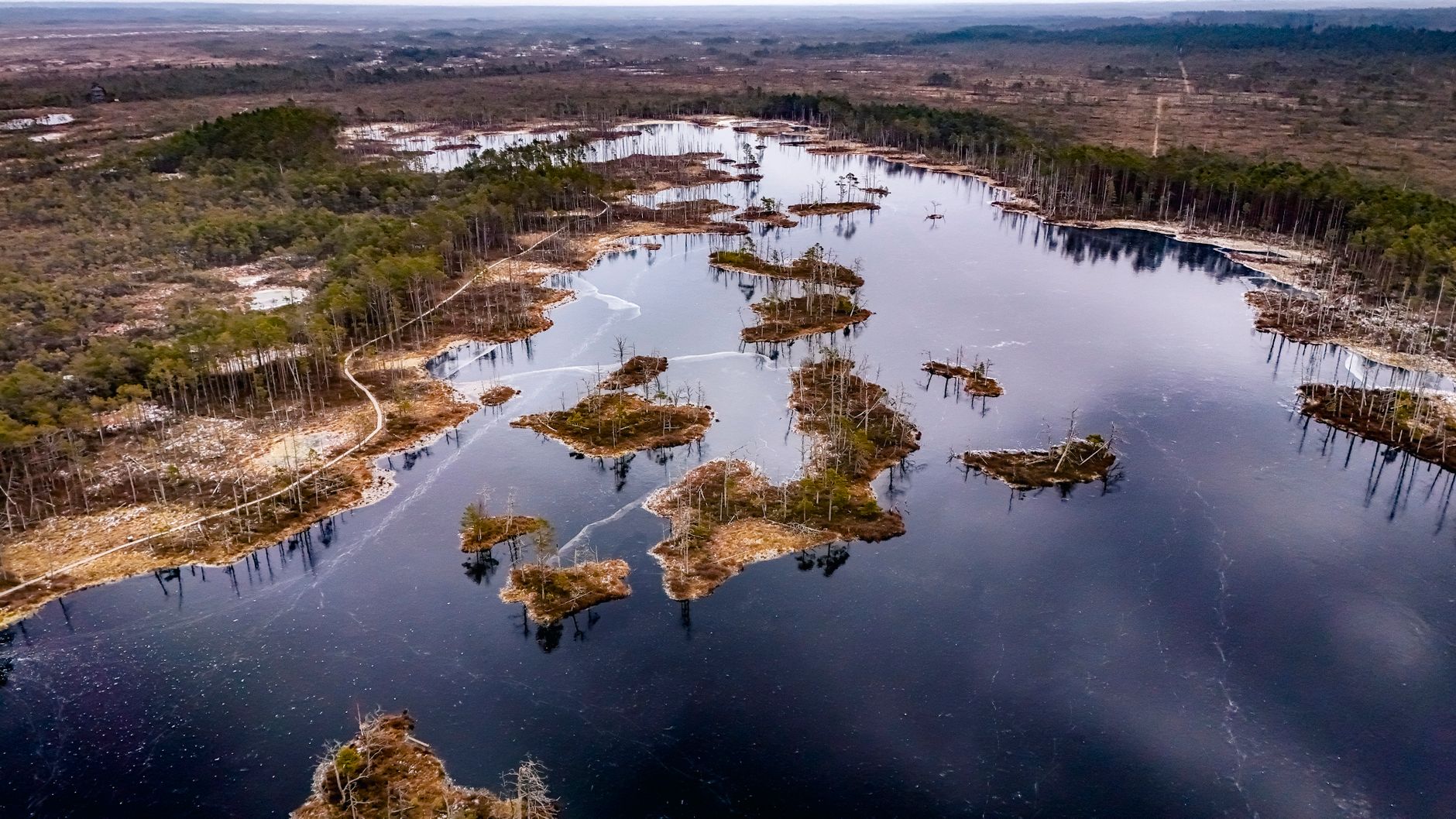
Captured in Latvia, a stunning aerial view of frozen marshland displaying a serene winter landscape.
Photo by vilnis Izotovs on Pexels · Pexels License
Practical Information
Visa
Latvia is in the Schengen Area, so EU travelers enter under normal EU rules and many non-EU visitors can stay up to 90 days in any 180-day period without a visa. Since 1 September 2025, some third-country nationals must file an electronic pre-entry declaration at eta.gov.lv at least 48 hours before arrival, though travelers from the US, UK, Canada and Australia are listed as exempt.
Currency
Latvia uses the euro. A canteen lunch often lands around €7-10, a three-course restaurant meal around €30-50, and a standard city public-transport ticket around €1.50, so daily costs stay lower than in Scandinavia if you keep hotels and long transfers in check.
Getting There
Most international arrivals come through Riga International Airport, the Baltics' main air hub. Overland, buses still make the easiest links from Lithuania and Estonia, while the Vilnius-Riga-Tallinn rail corridor and the Tallinn-Tartu-Riga train have made cross-Baltic rail trips far less awkward than they used to be.
Getting Around
Use Vivi for domestic trains and Mobilly for a mix of rail, bus, Riga transit and parking payments. Trains work well for day trips from Riga to Jūrmala, Sigulda and Cēsis, but a rental car saves serious time once you head for Kuldīga, Kolka, Ventspils or the smaller corners of Latgale.
Climate
Expect four distinct seasons. June to August brings the easiest weather and the longest daylight, May and September usually give the best balance of prices and comfort, while January to March can mean cold wind, early darkness and thinner tourist services outside Riga.
Connectivity
Mobile coverage is strong in cities and on main rail corridors, and most travelers can get by with an eSIM or local SIM rather than roaming at home-country rates. Cafes, hotels and transport hubs in Riga, Jūrmala and other larger towns usually offer dependable Wi-Fi, but the signal can thin out on the Livonian Coast and in bog or forest areas.
Safety
Latvia is generally a low-drama destination for independent travel, with the usual urban pickpocket risk in busy transport areas and nightlife districts. Winter ice, dark rural roads and cold-water Baltic beaches cause more practical trouble than crime, so pack for weather first and keep an eye on train or bus times if you are traveling outside the main cities.
Taste the Country
restaurantRupjmaize
Breakfast, supper, train snack. Butter, smoked fish, cheese, hemp spread. Hands tear, mouths chew, tables quiet.
restaurantPelēkie zirņi ar speķi
Christmas table. Grey peas, bacon, onion, sour cream, rye bread. Families eat, refill, argue, sing.
restaurantJāņu siers and beer
Jāņi night. Caraway cheese, beer, bonfire, smoke, grass, dawn. Friends slice, toast, wait for sunrise.
restaurantSklandrausis
Kurzeme ritual. Rye crust, potato, carrot, caraway. Tea or milk, small bites, puzzled faces, then surrender.
restaurantAukstā zupa with hot potatoes
Summer lunch. Kefīrs, beetroot, cucumber, dill, egg, hot potatoes. Spoon, bite, contrast, relief.
restaurantRīgas Melnais balzāms
Late evening in Riga. Small glass, blackcurrant, ice or none. Sip, wince, continue.
restaurantSmoked fish on the coast
Jūrmala, Liepāja, Kolka. Bread, butter, eel or sprats, onion. Fingers smell of sea and smoke.
Tips for Visitors
Budget by season
May and September usually buy you the best trade-off between weather and price. June to August is easier for beaches and long daylight, but Jūrmala rooms and central Riga hotels climb fast around weekends and Jāņi.
Use trains smartly
Vivi trains are ideal for Riga, Jūrmala, Sigulda and Cēsis, where road traffic adds nothing to the experience. Once your route includes Kuldīga, Kolka or smaller stretches of Latgale, the timetable starts dictating the day unless you rent a car.
Book Jāņi early
If you plan to be in Latvia around 23-24 June, reserve beds and intercity transport well ahead. Midsummer is not a niche folk event; it is the national holiday that rearranges travel demand across the country.
Cards work almost everywhere
In Riga and other larger towns, cards are routine for transport, cafes and museum tickets. Keep some cash for rural guesthouses, market stalls and the occasional place where the terminal works only when it feels philosophical.
Respect winter surfaces
Old Town cobbles, station steps and coastal boardwalks get slippery fast in winter. Good boots matter more than an extra sweater, especially if you are taking early trains or walking between bus stations and hotels in the dark.
Tip lightly
Round up in taxis and cafes, and leave 5-10% in restaurants if service was good. North American tipping habits are unnecessary here and can make normal prices look misleadingly cheap when you budget.
Start formal
Use a polite hello such as "Labdien" and default to a respectful tone with strangers. Latvia is not a place where instant first-name warmth always reads as friendly; a little formality lands better.
Explore Latvia with a personal guide in your pocket
Your Personal Curator, in Your Pocket.
Audio guides for 1,100+ cities across 96 countries. History, stories, and local insight — offline ready.
Audiala App
Available on iOS & Android
Join 50k+ Curators
Frequently Asked
Do I need a visa for Latvia if I have a US passport? add
Usually no for a short tourist trip. US passport holders can visit Latvia visa-free for up to 90 days in any 180-day period under Schengen rules, and Latvia's pre-entry declaration system currently lists US travelers among the exempt nationalities.
Is Latvia expensive for tourists? add
No, not by northern European standards. A budget traveler can often manage on about €45-70 a day, while mid-range trips with private rooms, restaurant dinners and intercity transport usually land around €90-150 a day.
What is the best time to visit Latvia? add
May, June and September are the sweet spot for most travelers. You get long daylight or decent shoulder-season weather, lower pressure on hotels than high summer, and better odds of moving around without winter ice or January gloom getting in the way.
How many days do you need in Latvia? add
Three days is enough for Riga and Jūrmala, but a week starts to make sense if you want castles or coast. Ten to fourteen days lets you split the country properly between Vidzeme, Kurzeme and Latgale instead of turning Latvia into a single-base city break.
Can you travel around Latvia by train? add
Yes, but only on the main corridors. Trains are excellent for Riga, Jūrmala, Sigulda, Cēsis and some eastern routes, while western coastal places such as Kuldīga and Kolka are much easier by bus or car.
Is Riga enough for a Latvia trip? add
Riga is enough for a strong long weekend, but not enough to explain the country. Add Jūrmala for the coast or Sigulda and Cēsis for the Gauja valley, and Latvia starts to feel larger, stranger and more varied than the capital alone suggests.
Is Latvia safe for solo travelers? add
Yes, generally it is. The main risks are ordinary city theft, alcohol-heavy nightlife areas and winter conditions on streets and rural roads rather than the kind of security problems that dominate trip planning in some destinations.
Do people speak English in Latvia? add
Yes in most tourism-facing situations, especially in Riga and larger towns. Younger people and hospitality staff usually manage English well, while Russian is also widely spoken, but a basic "Labdien" and "Paldies" still improves the tone of an interaction.
Is Jūrmala worth visiting from Riga? add
Yes, especially if you want a low-effort escape from the city. The train is short, the beach is broad, and the wooden-villa atmosphere feels different enough from Riga to justify the half-day or full-day detour.
Sources
- verified Latvia Travel — Official tourism portal used for cost benchmarks, transport basics and seasonal planning.
- verified Ministry of Foreign Affairs of the Republic of Latvia — Official entry rules, consular advice and the 2025 electronic pre-entry declaration framework.
- verified Vivi — Latvia's passenger rail operator for domestic routes and current international rail connections.
- verified Riga International Airport — Primary source for Latvia's main air gateway and passenger traffic context.
- verified UNESCO World Heritage Centre — Authoritative reference for the Historic Centre of Riga, Old Town of Kuldīga and Latvia's UNESCO listings.
Last reviewed: