
Independence in Public View
Pristina wears its recent history in plain sight. The NEWBORN monument, unveiled on 17 February 2008, turns a political date into street-level design, and the whole center still feels charged by that moment.
Fresh coffee, diesel, and the metallic glint of the National Library hit you before any old-world romance does. Pristina, Kosovo, feels young in the bones: a capital where the NEWBORN monument still speaks in the present tense, and where a pedestrian boulevard can carry a cathedral, a socialist-era relic, and a bar packed past midnight within a few blocks. The surprise is how compact it all is.
Researched from Wikidata, Wikipedia & official sources · fact-checked · How we make our guides →
PFresh coffee, diesel, and the metallic glint of the National Library hit you before any old-world romance does. Pristina, Kosovo, feels young in the bones: a capital where the NEWBORN monument still speaks in the present tense, and where a pedestrian boulevard can carry a cathedral, a socialist-era relic, and a bar packed past midnight within a few blocks. The surprise is how compact it all is.
Pristina works by contrast. Ottoman traces survive in the old core, then the street opens onto late-Yugoslav concrete, domes wrapped in steel mesh, and independence-era symbols that refuse to sit quietly in the background.
Cafes are the city's true public rooms. By late afternoon, Mother Teresa Boulevard fills with slow-moving conversations, cigarette smoke, and the clink of tiny coffee cups, while students drift between the university quarter and the bars around Rexhep Luci Street as if the whole center were one extended living room.
What makes this place worth slowing down for.
Pristina wears its recent history in plain sight. The NEWBORN monument, unveiled on 17 February 2008, turns a political date into street-level design, and the whole center still feels charged by that moment.
Few capitals stack their eras this tightly. The National Library of Kosovo wraps domes in a metal lattice that looks half fortress, half sci-fi prop, while the Emin Gjiku complex preserves the timber-and-stone calm of Ottoman Pristina.
Coffee here is not a pit stop; it is the city’s operating system. Mother Teresa Boulevard and the streets around it fill from morning espresso through late rakia, with students, journalists, and night owls all working the same small radius.
A short ride from the center, Germia Park changes the mood completely. Pine air replaces traffic fumes, and Pristina starts to make sense as a capital built beside hills rather than on a postcard square.
Where to wander, by quarter — each with its own rhythm.
The center is where Pristina explains itself fastest. Mother Teresa Boulevard, the NEWBORN monument, the National Theatre, and a thick concentration of cafes and bars sit within an easy walk, so you can move from state symbolism to espresso to nightlife in under ten minutes.
Around the Çarshia Mosque and the Emin Gjiku Ethnological Museum, the city briefly drops its modern guard. Courtyards, low Ottoman-era houses, and the smell of grilled meat from nearby eateries give this part of Pristina a quieter grain, even if traffic is never far away.
Ulpiana shows Pristina at its most lived-in rather than staged. Apartment blocks from the socialist period, neighborhood bakeries, and a steady cafe rhythm make it a good place to see how residents actually use the city once the monument photos are done.
Dardania sits just southwest of the core and feels practical, dense, and local. Visitors come for a more everyday Pristina: residential towers, small shops, and the kind of casual bars where nobody is performing for tourists because almost none are there.
Arbëria climbs above the center, and the change in elevation matters. Streets here feel broader, newer, and more diplomatic, with embassies, apartment developments, and views back toward the city's uneven roofline and the cathedral tower.
Around the University of Pristina, the National Library, and Mother Teresa Cathedral, the city turns argumentative in the best way. Students, protest memory, bold architecture, and cheap coffee keep this district intellectually restless, even when the concrete looks half-asleep in the afternoon sun.
The people who shaped the city — and were shaped by it.
Rugova turned Pristina into the stage for a stubborn, almost literary form of resistance, pressing for Kosovo's independence with scarves, books, and a refusal to sound like a warlord. He'd recognize the capital's appetite for argument today, though the giant flags and louder traffic might test his patience.
Demaçi spent 28 years in Yugoslav prisons, then returned to Pristina not softened but sharpened, becoming the city's moral irritant when power grew too comfortable. He would probably approve that Pristina still talks politics over coffee as if the table itself were a debating chamber.
Rita Ora was born in Pristina just before her family left for London, which gives the city one of those biography lines that sounds almost too neat for pop history. If she walked the center now, she'd find a capital far more self-assured than the one her parents had to leave.
Dua Lipa's bond with Pristina isn't a birth certificate story but a return story: she lived here as a teenager after independence, when the city was teaching itself how to sound new. That makes sense of Sunny Hill and her repeated homecomings; Pristina isn't just family background for her, it's part of the rhythm.
Bogdani arrived in Pristina in the middle of war and plague, carrying the force of one of the earliest major works written in Albanian and the burden of an anti-Ottoman uprising. The city's national library now bears his name, which feels right: in Pristina, books and politics have rarely lived far apart.
Where locals actually book dinner — not the tourist menus.
This is the dish locals mention with a little pride because it takes time and patience. Layer after layer of batter is baked and brushed with cream until the whole thing turns smoky, rich, and slightly crisp at the edges; order it where it is made to order, not as an afterthought.
Pristina does grilled meat extremely well, and qebapa are the fast, satisfying proof. Expect short minced-meat sausages, warm flatbread, chopped onions, and the smell of charcoal hanging in the air before the plate even lands.
Lamb baked with yogurt and eggs sounds gentler than it tastes. The top bronzes, the sauce turns tangy and savory, and the whole dish feels built for a city that likes long lunches more than flashy plating.
A good burek in Pristina is breakfast, hangover cure, and commuter food all at once. Go early for the flaky version with meat, cheese, or spinach, when the pastry is still hot enough to steam in the paper.
Sweet peppers stuffed with fresh curd cheese bring a welcome coolness to a table full of grilled meat and bread. The contrast is the point: soft roasted pepper, salty dairy, and just enough char.
Ordering coffee here means joining the local rhythm, not grabbing caffeine and leaving. A Pristina macchiato often comes with a slow seat, a cigarette haze on nearby tables, and the sense that half the city’s conversations are being negotiated over tiny cups.
Small things that change how the city treats you.
Pristina's city buses are cheap enough to change your plans: a one-way ticket costs €0.50 and a day ticket costs €0.80 on Trafiku Urban. Pay the conductor in cash and use the day pass if you're linking the bus station, library, cathedral, and center in one day.
Taxis are usually safe and inexpensive in Pristina, but stick to established companies and make sure the meter is on. Typical central rides run about €3 to €5, so treat any much higher quote as a cue to wave down the next car.
From Adem Jashari Airport, bus line 1A is the budget move into town. It stops in the center and costs far less than a taxi, which matters if you land in daylight and aren't carrying half your wardrobe.
Most visitors find Pristina safe, with petty theft the main everyday risk, but demonstrations are different and worth avoiding. If a square starts filling with flags, speeches, or police vans, change streets early rather than standing around for context.
Late spring and early autumn suit Pristina better than deep winter or high summer. You get café weather, easier walking, and softer light on the National Library's metal skin instead of January fog or August heat.
Do the Ethnological Museum and the National Library on the same day. The jump from 18th-century wooden rooms to 1982 concrete-and-dome ambition explains Pristina faster than any lecture.
The city, as it actually looks.
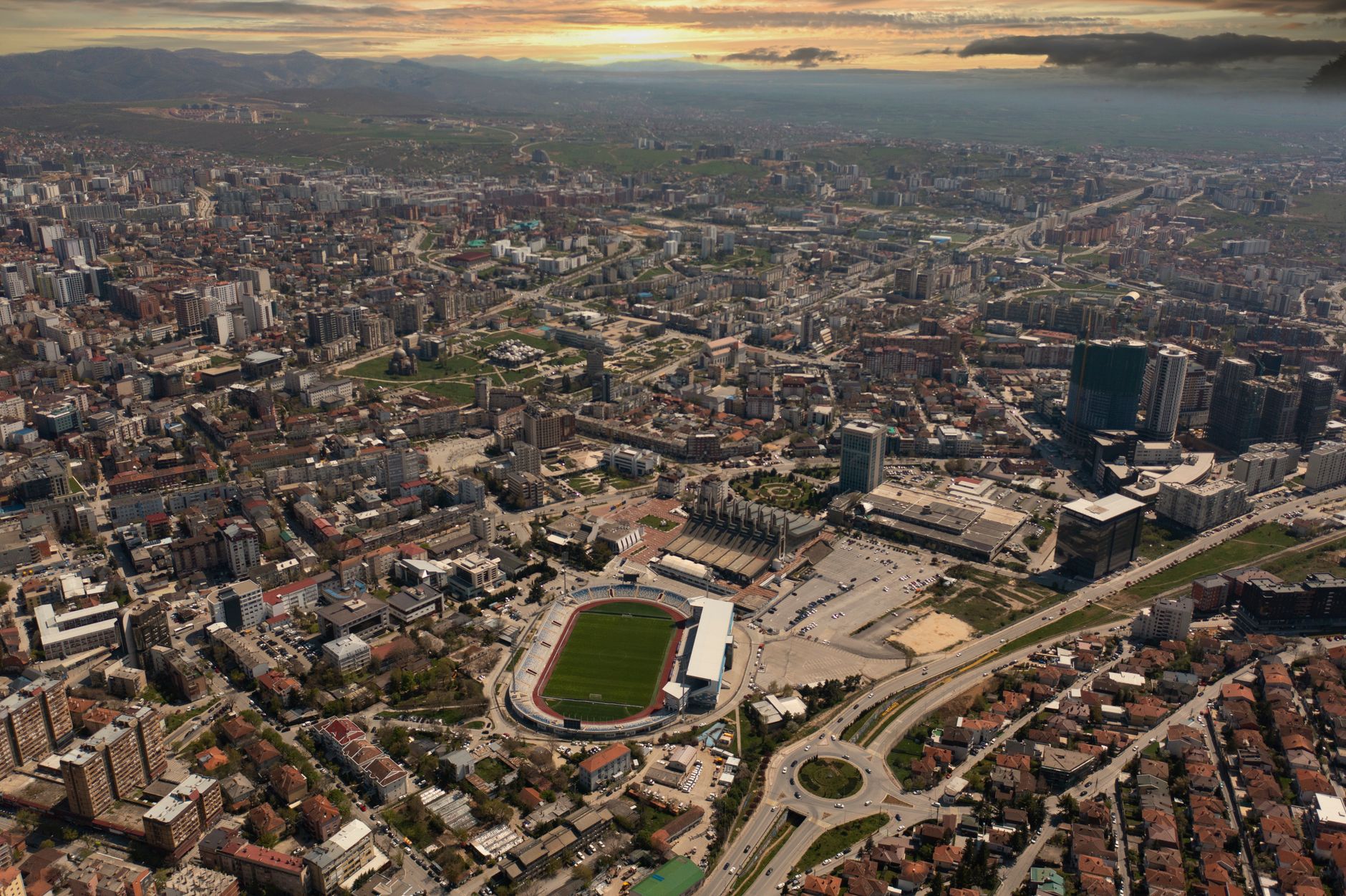
Pristina spreads across the valley below, with apartment blocks, stadiums, roads, and distant mountains under warm evening light.
Denis Sllovinja on Pexels

Pristina’s urban grid spreads around red-roofed buildings, mosque domes, traffic, and open public squares. The low sun casts long shadows across the Kosovo capital.
Ferdi Noberda on Pexels

Pristina spreads across the valley in warm evening light, with mosque minarets rising above red roofs and modern towers. The hills beyond the city soften into the sunset haze.
Ferdi Noberda on Pexels
Yes, especially if you like cities with tension in the walls rather than postcard prettiness. Pristina folds Ottoman traces, Yugoslav modernism, independence symbolism, and serious café culture into a compact center you can read on foot. Come for a day and you'll catch the monuments; stay longer and the city's mood starts to make sense.
Two to three days is the right amount for most travelers. One day covers NEWBORN, the National Library, Mother Teresa Cathedral, and the old core, but a second day gives you room for the Ethnological Museum, long coffee stops, and the slower political texture that makes the city interesting.
Generally yes. U.S. travel guidance says Kosovo is mostly safe for visitors, with petty street crime the most common issue, but it advises extra caution around demonstrations and large political gatherings. In practical terms, use normal city awareness, keep your phone close at night, and don't drift into protests out of curiosity.
The cheapest option is bus line 1A from the airport into central Pristina. If you want speed or arrive late, take a licensed taxi; official rides cost much more than the bus but are still reasonable by European capital standards. The bus makes more sense in daylight, the taxi makes more sense after a delayed flight.
No, by European capital standards Pristina is relatively affordable. City buses cost €0.50 for one ride and €0.80 for a day ticket, while common taxi rides in the center are often around €3 to €5. The city gets pricier only when you pay for convenience without checking the easy local option first.
Yes, the center is compact and walking is the best way to feel the city shift from boulevard to backstreet. You'll still want buses or taxis for longer hops, and U.S. travel advice warns that drivers do not always yield to pedestrians even at crossings. Cross with intent, not optimism.
Ready to book?
Pristina’s main gateway is Prishtina International Airport Adem Jashari (PRN), about 15 km southwest of the center; it is Kosovo’s only international airport. By rail, the city uses Prishtine Railway Station and the larger junction at Fushë Kosovë/Kosovo Polje, with Trainkos services on the Pejë and Hani i Elezit corridors in 2026. By road, the key approaches are the R7 motorway toward Prizren and Albania, and the R6 toward Ferizaj and the North Macedonia route to Skopje.
Pristina has no metro or tram in 2026, so daily movement depends on buses, taxis, and your own feet. Trafiku Urban and private operators run more than a dozen bus lines across the city, including the airport-linked 1A line; single rides are typically around €0.50, and the compact center around Mother Teresa Boulevard is easy to cross on foot. Cycling exists, but it is still a secondary option rather than an Amsterdam-style system, so buses and short taxi hops remain the practical choice.
Spring usually sits around 10-20 C, summer around 27-32 C by day, autumn around 10-22 C, and winter often drops to -2 to 7 C with frost and occasional snow. Rain is more common from late autumn through spring, with May among the wetter months, while July and August are warmer and drier. Peak visitor months are July and August; for easier walks and lighter crowds, late May to June and September work best.
Albanian is the main language you will hear first, with Serbian also official and English widely used by younger people, hotel staff, and cafe workers. Kosovo uses the euro, which keeps things simple for most visitors in 2026, though cash still helps in bakeries, market stalls, and older neighborhood restaurants.
0 places, one continuous walking route. Free with your first city.