hiking
Mountains Near Almaty
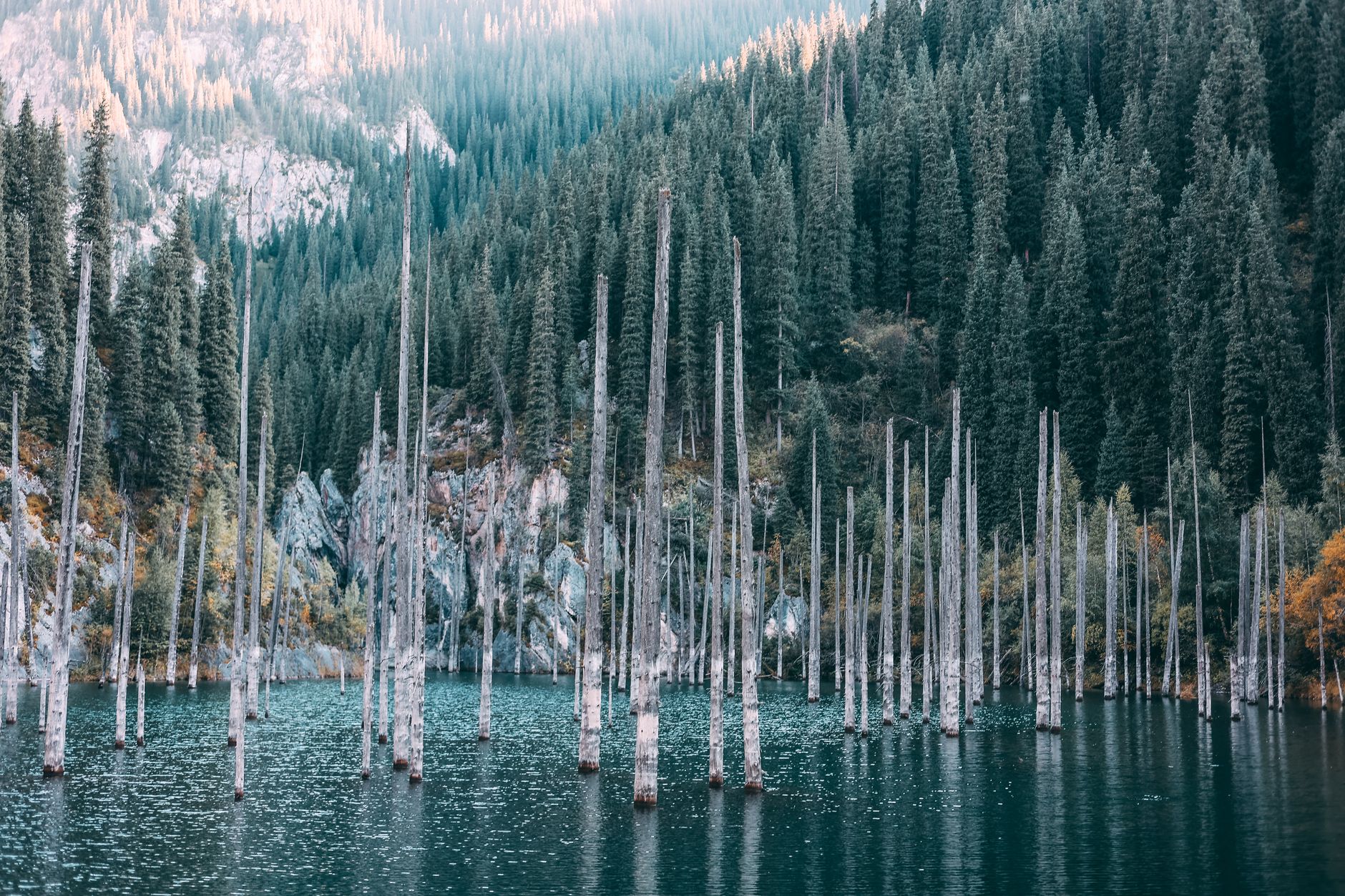
Almaty gives you the rare city break with altitude. Snow peaks, Medeu, Shymbulak, Charyn Canyon, and the road toward Kolsai all sit close enough to turn a coffee stop into a mountain day.
Kazakhstan is not one trip but a whole geography of trips: Silk Road shrines, alpine trails, oil-port coastlines, and a steppe so large it changes how you read distance.
 Kazakhstan
EntryVisa-free up to 30 days for many passports
KA Kazakhstan travel guide starts with a scale shock: this is the ninth-largest country on Earth, yet some of its best days unfold between one canyon, one tea bowl, and one long train ride.
Kazakhstan rewards travelers who like geography with teeth. You can wake in Almaty under the snow line of the Ile-Alatau, drive east to Charyn Canyon where the rock drops 300 meters, then fly west to Aktau and stand on the Caspian shore in a country with no ocean at all. The distances are real, and so is the payoff. This is where apple forests gave the world its domestic ancestor, where steppe horizons reset your sense of proportion, and where a map stops being abstract and starts bossing around your itinerary.
History here does not sit politely in museums. It rides in on horseback from Botai, where some of the earliest evidence for horse domestication was found, glints in the Golden Man discovered near Issyk, and gathers under the unfinished Timurid vaults of Turkestan. In Astana, that same country speaks in glass, steel, and winter light, while Taraz and Shymkent keep the older Silk Road pulse closer to the surface. Kazakhstan feels layered rather than packaged. Empires crossed it, saints were buried in it, and modern cities still argue with the steppe around them.
The Steppe Before Thrones, c. 3500 BCE-500 BCE
A corral on the Botai plain, north of present-day Petropavlovsk, may be where human beings first turned the horse from prey into companion. Archaeologists found mare's milk residue in pottery, bit-worn teeth on horse skulls, and the remains of entire settlements built around animals that would soon change warfare, trade, distance, everything. The steppe made its first political invention here long before it made a state.
Then came the burial mounds. In the frozen kurgans of the Altai and the rich graves of the Saka world, the dead were sent off with felt, weapons, ornaments, and horses arranged as carefully as courtiers in an antechamber. Ce que l'on ignore souvent, c'est que these tombs are not mute heaps of earth but stage sets for power: leather shoes on sacrificed horses, pigments still clinging to saddles, gold sewn onto garments that rotted away and left the metal hovering in the exact outline of vanished bodies.
The great emblem of this age emerged near Issyk, not far from Almaty, in 1969. Soviet archaeologist Kemal Akishev opened a mound and found the so-called Golden Man, a young Saka elite figure dressed in around four thousand gold elements, with snow leopards, winged horses, and a pointed headdress so theatrical one almost expects a trumpet flourish. Beside the body lay a silver cup scratched with signs no one has fully deciphered. A kingdom speaks. We still do not know its alphabet.
That is how Kazakhstan enters history: not as a margin, but as a workshop of movement, ceremony, and animal power. The horse, the grave mound, the glittering warrior near Almaty, the eastern-facing dead in the Altai near Oskemen: all of them prepared the political grammar of the steppe. Soon, rulers with names preserved by Greek and Persian authors would stride onto that stage.
The Golden Man is less a single hero than a reminder that steppe nobility dressed for eternity with the same care later courts gave to coronations.
The Issyk inscription on the silver cup remains undeciphered, which means one of Kazakhstan's earliest written voices is still speaking just beyond our hearing.
Queens, Saints, and the Silk Road, c. 500 BCE-1220 CE
A queen stands at the edge of empire and refuses a marriage proposal she knows is a military trick. Herodotus gives her the name Tomyris, ruler of the Massagetae, and the scene has never lost its force: Cyrus the Great advances, her son is captured, the war turns savage, and if the ancient account is to be believed, the victorious queen has the Persian conqueror's head plunged into a skin filled with blood. Perhaps legend enlarged the gesture. The point remains. On these plains, imperial arrogance could meet a woman with a better army.
Centuries later, the traffic changed shape. Caravans crossed southern Kazakhstan through towns such as Taraz, Shymkent, and the older settlements around Sayram, carrying silk, slaves, metalwork, and religion with equal seriousness. The Silk Road was never just camel bells and romance. It was taxation, protection money, diplomacy, and the long patience of merchants who knew that one closed gate could ruin a year.
The most intimate revolution of this era happened not in a palace but in language. Khoja Ahmed Yasawi, born in Sayram and buried in Turkestan, chose to write mystical teaching in Turkic rather than keeping it safely in the learned prestige of Persian. That decision matters enormously. It let Islam travel the steppe in a voice people could feel in the mouth, not merely admire from a distance.
Then comes the scene Stephane Bern would never skip: at sixty-three, the age at which the Prophet Muhammad died, Yasawi judged himself unworthy to remain above ground and withdrew into an underground cell. Timur later ordered a colossal mausoleum over his memory in Turkestan, with turquoise tiles, monumental vaults, and an ambition large enough to flatter both God and the ruler who sponsored it. The building was never completed. One can still read the interruption in the masonry itself, as though history had stepped out for a moment and forgotten to come back.
Tomyris survives because she is more than a patriotic symbol: she is the rare ancient sovereign remembered not for marriage but for refusing one.
Yasawi's mausoleum in Turkestan remains visibly unfinished because Timur died before the work was completed, leaving the great portal as a magnificent interruption.
The Jochid Shadow and the Birth of the Kazakh Khanate, 1220-1731
The Mongol invasion arrived like an administrative storm with cavalry attached. Otrar and other Silk Road cities were broken with such force that some never recovered their old standing, and the steppe was folded into the empire of Genghis Khan through terror, tribute, and family politics. Family politics matter here. They always do.
The most haunting figure is Jochi, eldest son of Genghis Khan and ruler of the western ulus that would shape much of what became Kazakhstan. His birth carried a whisper from the start because his mother Borte had been held captive before he was born, and that whisper never quite left the tent. Ce que l'on ignore souvent, c'est que entire dynasties can rest on a private doubt. Jochi died in 1227 before his father, officially of illness, unofficially under a cloud so thick that later chronicles practically invite suspicion.
From the Jochid inheritance came the Golden Horde, and from its fragmentation came new political forms on the steppe. In the fifteenth century, Janibek and Kerei broke away and founded what became the Kazakh Khanate, a polity less neat on a map than in schoolbooks, but real enough in allegiance, diplomacy, and war. Over time, its people were grouped into the three zhuz, or hordes: Senior, Middle, and Junior. This was not a decorative ethnographic detail. It was the architecture of loyalty.
The khanate's authority rose and frayed in constant negotiation with Dzungar pressure, rival sultans, and the harsh arithmetic of pasture and survival. Yet this is the age in which a distinctly Kazakh political identity hardens into view, stretching from the routes near Turkestan and Taraz to the northern grasslands and the eastern approaches beyond Semey. The next chapter follows almost inevitably: when internal division meets a northern empire with clerks, forts, and patience, the balance shifts.
Jochi is the dynastic ghost of Kazakhstan: acknowledged, disputed, indispensable.
Kazakh legend says Jochi died during a hunt when a wild kulan broke his spine, a version so vivid that it survived alongside the darker suspicion of murder.
Empire, Famine, and the Long Road to Independence, 1731-2022
It begins with petitions and protection, the most dangerous pair of words in steppe politics. In 1731, Abu'l Khayr Khan of the Junior zhuz accepted Russian suzerainty, hoping for support against rivals and external enemies. One imagines the paperwork in Saint Petersburg, so tidy, so calm. Out on the grasslands, it opened the door to forts, settlers, boundary lines, and the slow conversion of alliance into rule.
The nineteenth century tightened the imperial grip. Cossack lines, administrative reform, and a new world of governors and surveys pressed into older rhythms of migration and clan authority. Yet Kazakhstan also produced modern voices from within that pressure. Abai Kunanbayuly, writing near Semey, turned moral reflection and poetry into a new intellectual language for the steppe, while the city now called Almaty grew from the Russian fort of Verny into an urban hinge between empire and mountain frontier.
Then came the catastrophe. Soviet power brought literacy campaigns, industrial projects, and a ruthless assault on nomadic life. Forced collectivization in 1931-1933 caused a famine so severe that well over a million people died and many more fled across borders; entire herding worlds were shattered. Ce que l'on ignore souvent, c'est que modern Kazakhstan was not only built in factories and ministries but also in grief, in emptied auls, in the silence left by livestock gone and family lines broken.
The late Soviet decades added another layer: Karaganda and the gulag archipelago, Semey and its nuclear test site, the Virgin Lands campaign across the north, and the December 1986 protests in Almaty when young Kazakhs challenged Moscow's contempt. Independence came in 1991, not with a clean slate but with Soviet concrete, ecological scars, and immense ambition. The capital moved from Almaty to Astana in 1997, was renamed Nur-Sultan in 2019, then returned to Astana in 2022, a sequence almost novelistic in its eagerness to stage power through architecture and naming. Kazakhstan today still lives inside that tension: nomadic memory, imperial inheritance, Soviet trauma, post-Soviet reinvention.
Abai turned the moral restlessness of the steppe into literature, which is another way of founding a country.
Astana has had three official names in living memory: Akmola, Astana, Nur-Sultan, then Astana again, proving that capitals can be as politically theatrical as any court.
Kazakhstan speaks in stereo. In Almaty, you hear Russian in the elevator, Kazakh at the family table, then both in the same taxi ride as if the driver were changing horses mid-gallop. It is not confusion. It is precision.
Kazakh has round vowels, room in the mouth, a courtesy that seems to arrive before the meaning does. Russian can sound brisker, more urban, more Soviet in its bones. Put them together and you get the country’s audible truth: empire and steppe, apartment block and ancestor, bureaucracy and blessing sharing the same afternoon.
A traveler notices this fastest in forms of address. The respectful distance matters. Elders are greeted with care, not because people are acting out folklore, but because age still carries rank in the social grammar. A country is a table set for strangers, yes, but somebody still decides who sits where.
In Astana, the bilingual signs look official. In kitchens, the code-switching becomes tender. One language for paperwork, one for memory, and both for jokes. That is civilization.
Kazakh food was built by people who understood winter. Meat had to nourish, dough had to travel, milk had to survive transformation, and tea had to make a house out of wind. You taste this at once in beshbarmak: boiled horse meat or lamb over broad noodles, broth on the side, the whole thing less like a recipe than a social contract.
Then comes the shock Western diners rarely expect. Horse is not a stunt here. Kazy, the dense sausage of rib meat and fat, arrives sliced in thick coins with perfect seriousness, and seriousness is exactly right. You do not nibble at it. You accept it as you would accept an introduction to the eldest person in the room.
Tea governs the ceremony. Not vodka. Black tea in a piala, often half-filled on purpose, because the host is telling you without words that your cup deserves attention and your presence deserves repetition. A full bowl can mean the opposite. Hospitality has its own punctuation.
In Shymkent, laghman and samsa announce the south with Uyghur and Uzbek confidence. In Turkestan, the dastarkhan still feels ceremonial, almost juridical: bread, meat, sweets, fruit, tea, blessing. Abundance is not decoration. It is ethics with steam rising from it.
Kazakhstan trusts poets more than many countries trust ministers. This is sensible. A steppe the size of an argument with history requires compression, music, memory, and a little moral weather. Abai Kunanbayuly understood that in the nineteenth century when he gave Kazakh thought a written modern form without draining it of its oral blood.
Abai is quoted the way other nations quote scripture or law. Not always solemnly. Sometimes a line appears in conversation like a knife placed quietly on the table: elegant, useful, impossible to ignore. He wrote about conscience, vanity, learning, idleness, the disciplines of being human. He still sounds inconvenient. That is a compliment.
Then you meet Mukagali Makatayev, Olzhas Suleimenov, the long shadow of Soviet literature, the fracture between village memory and city ambition, and you see that Kazakh writing often carries two landscapes at once. One is geographical. The other is historical, and far colder.
Semey changes the reading. So does Almaty. The first carries the wound of the nuclear polygon nearby and the aura of Abai’s region; the second, with its cafes and bookshops and apple-laden mythology, makes literature feel almost flirtatious. Almost. Kazakhstan does not flirt for long. It prefers revelation.
The dombyra has only two strings. This is a rebuke to excess. With those two strings, Kazakh musicians can summon hoofbeats, grief, satire, weather, and the kind of pride that travels better than passports. The instrument looks modest. Its effect is not.
Traditional kuy pieces are not background music. They are narrative without permission from words. One composition may describe a galloping horse, another a widow’s sorrow, another a political sneer so well coded that melody does the smuggling. The hand flickers. The room understands.
Then the city enters. In Almaty and Astana, you can hear Q-pop, Soviet afterlives, conservatory polish, wedding singers with impossible lungs, and a dombyra line threaded through electronics as if ancestry had learned to use a mixing desk. Purists will complain. Nations that stay alive always disappoint purists.
Listen during Nauryz if you can, or at a family gathering where the performance is half art, half duty. Music in Kazakhstan still remembers what oral cultures know: the song is not separate from the people present when it happens.
Kazakh etiquette looks gentle until you realize how exact it is. Who greets first, who speaks first, who is served first, who receives the sheep’s head, who offers the bata before departure: none of this is random, and none of it is quaint. Order is how warmth avoids chaos.
Age carries weight. Guests carry consequence. Bread should not be treated carelessly. Feet do not belong on thresholds. A younger person who barrels through conversation with Western confidence may think they are being relaxed; the room may hear only amateurism. Civilization often survives in details small enough to embarrass the careless.
At the table, the host keeps watch with almost liturgical attention. Your tea is replenished before absence appears. Baursak multiplies. Plates refill. Refusal once may be politeness. Refusal twice may be believed. Refusal three times becomes a declaration of character, and not the flattering kind.
This is why a meal in Kazakhstan can feel oddly moving. The kindness is real, but it has architecture. In Astana, the form may wear a sharper suit. In villages outside Taraz or near Turkestan, it may arrive in a more traditional key. The principle does not change: respect is not sentiment. It is technique.
Religion in Kazakhstan rarely shouts. It settles. Sunni Islam shapes the moral atmosphere, the calendar, the gestures around food, mourning, blessing, and family duty, yet it often shares space with older steppe instincts that never asked permission to disappear. Ancestors remain present. Sky, luck, and spoken blessing still carry force.
This produces a faith that can feel less doctrinal than atmospheric, especially to a visitor arriving with crude expectations about what Muslim life should look like. You may hear Quranic recitation, then see someone tie a wish cloth, invoke an elder’s blessing, or speak of kut as if fortune had weather. Perhaps it does.
Turkestan gives this its grand architectural form in the Mausoleum of Khoja Ahmed Yasawi, Timur’s unfinished gesture of devotion and power, all turquoise ambition and interrupted grandeur. The building is imperial. The feeling is intimate. Pilgrims come not for abstraction but for nearness.
In daily life, the religious register is often one of tact rather than display. Modesty, remembrance, hospitality, burial customs, Friday rhythms, Ramadan meals, the spoken bata before a journey. Faith here often enters by the side door. It leaves its shoes neatly aligned.
Almaty gives you the rare city break with altitude. Snow peaks, Medeu, Shymbulak, Charyn Canyon, and the road toward Kolsai all sit close enough to turn a coffee stop into a mountain day.
Turkestan anchors one of Central Asia's great pilgrimage landscapes. The Mausoleum of Khoja Ahmed Yasawi is grand, unfinished, and politically charged in the best way: faith, empire, and architecture all visible at once.
Kazakhstan makes sense from a train window. Sleeper routes between cities like Astana, Karaganda, and Almaty turn raw distance into part of the experience rather than dead time between stops.
Kazakh cuisine still carries the instincts of pastoral life: preserved dairy, ceremonial meat, dough that travels, tea that keeps a conversation going. Come hungry for beshbarmak, kazy, manty, laghman, and the tart snap of kumys.
Few countries shift scenery this hard. Southeast Kazakhstan gives you alpine valleys and canyon walls; the west around Aktau opens onto chalk deserts, salt flats, and the inland immensity of the Caspian Sea.
Astana has the kind of skyline that looks slightly improbable even in person. Monumental government avenues, futuristic landmarks, and brutal winter light make it one of Central Asia's strongest photography cities.
12 cities — start with the ones we'd send you to first.
In Almaty the mountains arrive before you do—snow ridges flash between Soviet tower blocks like a promise the city hasn’t quite decided to keep.
A capital city conjured from frozen steppe in under three decades, where Norman Foster's glass tent and a pyramid of peace sit two kilometers apart on a boulevard built for a country still deciding what it looks like.
The 14th-century turquoise dome of Khoja Ahmed Yasawi's mausoleum — commissioned by Timur himself and never quite finished — still dominates a city that was Central Asia's second Mecca for six hundred years.
Kazakhstan's third city runs hotter and louder than the north, a southern border town where Uzbek plov competes with Kazakh kuyrdak and the bazaar operates on its own timezone.
A Soviet-planned port city on a Caspian bluff with no river and no natural spring, where streets are numbered rather than named and the sea is technically the world's largest lake.
One of the oldest continuously inhabited cities in Kazakhstan, sitting on a Silk Road node that was already ancient when the Karakhanids built their mausoleums here in the 11th century.
Dostoevsky was exiled here, Abai Qunanbaiuly grew up in its steppe hinterland, and for four decades the Soviet Union detonated nuclear devices close enough that the city still carries the weight of that history in its mu
The gateway to the Kazakh Altai sits where the Irtysh and Ulba rivers meet, a working industrial city that serious hikers pass through on the way to Katon-Karagai's untouched valleys and the Berel kurgan site.
Built on coal and Gulag labor in the 1930s, Karaganda wears its Soviet bones honestly — the memorial at Dolinka, 45 kilometers out, is one of the most sobering sites in the former USSR.
Almaty is Kazakhstan at its most immediately legible: leafy avenues, Soviet facades, coffee shops full of young professionals, and the Ili Alatau rising so close they seem to lean over the city. Push east and the tone changes fast, from canyon country to frontier towns like Zharkent, where the border with China feels less like a line than a long historical pressure.
Southern Kazakhstan carries the oldest urban memory in the country, and Turkestan is the clearest expression of it. Around Turkestan, Shymkent, and Taraz, the landscape reads in mausoleums, caravan routes, tandyr ovens, and shrine culture rather than in mountain sports or imperial boulevards.
Astana stands in a landscape that makes most European countries look miniature, and its architecture answers that scale with glass, symbolism, and a taste for spectacle. South and north of the capital, Karaganda and Petropavlovsk offer a sterner, more workmanlike Kazakhstan shaped by railways, Soviet industry, and the weather's absolute lack of sentiment.
Eastern Kazakhstan feels less traveled and more inward-looking, with Oskemen as the practical base for rivers, mountain routes, and access toward the Altai. Semey adds another register entirely: Abai, Dostoevsky, the shadow of the nuclear test zone, and a cultural seriousness that sits under the city's quiet surface.
Aktau is Kazakhstan turned toward the Caspian, all sea wind, oil money, and chalk desert beyond the city limits. West Kazakhstan works best for travelers who do not need constant monuments; the draw is Mangystau's geological drama, long road journeys, and the abrupt contrast between Aktau's shoreline and Aktobe's inland steppe mood.
From Botai horse corrals to the renamed skyline of Astana
On the plains near present-day Petropavlovsk, the Botai culture leaves evidence of horse domestication, including corrals, mare's milk residues, and bit wear on teeth. The steppe begins to change human distance forever.
A Saka elite burial near present-day Almaty is created with thousands of gold ornaments and a mysterious inscribed silver cup. When excavated in the twentieth century, it becomes one of Kazakhstan's strongest national symbols.
According to Herodotus, Queen Tomyris of the Massagetae destroys the Persian army and kills Cyrus. History and legend clasp hands here, but the political message is clear: the steppe could humble empire.
The Turkic Khaganate emerges and folds much of the steppe into a new imperial framework. Turkic political and linguistic influence deepens across the lands of modern Kazakhstan.
Arab and allied forces defeat the Tang near the Talas River corridor. Chinese influence recedes in the region, while Islamic and Turkic currents gain strength over time.
Born in Sayram and later based in Turkestan, Yasawi develops a spiritual vocabulary that brings Sufi Islam into Turkic speech. His influence will outlast dynasties.
The assault on Otrar opens the Mongol conquest of the region with exemplary brutality. Southern cities are shattered, and the political map of the steppe is remade under Chinggisid rule.
Jochi, eldest son of Genghis Khan and ruler of the western ulus, dies in disputed circumstances. His descendants will shape the Golden Horde and the dynastic world from which Kazakhstan later emerges.
In Turkestan, Timur commissions the vast mausoleum of Khoja Ahmed Yasawi as an act of piety and legitimacy. The monument remains unfinished, which only sharpens its grandeur.
Kerei and Janibek lead a breakaway polity that becomes known as the Kazakh Khanate. A distinct Kazakh political identity begins to consolidate across the steppe.
Under Qasym Khan, the Kazakh Khanate reaches a stronger and more coherent form, with wider diplomatic recognition and legal memory attached to his name. Steppe authority acquires sharper edges.
The khan of the Junior zhuz seeks Russian backing against rivals and enemies, opening the door to deeper imperial control. A request for protection becomes the beginning of subordination.
Abai is born in the Semey region and will become Kazakhstan's defining poet-thinker. Through verse and prose, he gives the steppe a language of self-criticism and moral ambition.
The empire reorganizes the steppe through new governorates, legal structures, and settlement policies. Old khanate authority gives way to a bureaucratic order of maps, forts, and files.
Kazakh intellectuals led by Alikhan Bokeikhan attempt to build a modern autonomous government in the chaos of revolution. The experiment is brief, serious, and later crushed by Soviet power.
Forced collectivization destroys nomadic herding life and triggers one of the great disasters in Kazakh history. More than a million die, and many others flee across borders in desperation.
The Semipalatinsk test site begins decades of nuclear detonations that poison land and bodies across eastern Kazakhstan. Modernity arrives here with radiation and official secrecy.
Moscow launches a giant agricultural drive across northern Kazakhstan, plowing the steppe in the name of grain production. The campaign reshapes demography, ecology, and Soviet urban growth.
Students and young protesters in Almaty challenge Moscow after the Kremlin replaces the local party leader with an outsider. The demonstrations are suppressed, but they become a moral prelude to independence.
As the Soviet Union collapses, Kazakhstan emerges as a sovereign state under Nursultan Nazarbayev. Independence comes with immense opportunity and the heavy inheritance of Soviet industry, ecology, and centralized power.
The government shifts the capital from Almaty to Akmola, soon renamed Astana, in a decision that is strategic, symbolic, and highly theatrical. A new state begins building its self-image in glass, steel, and winter light.
The capital is renamed in honor of the departing first president, turning urban toponymy into an act of political devotion. Even by post-Soviet standards, it is a remarkably courtly gesture.
After unrest and political realignment, the city sheds the name Nur-Sultan and becomes Astana again. Few countries have written their recent power struggles so visibly onto the map.
The Steppe Before Thrones
The Golden Man is less a single hero than a reminder that steppe nobility dressed for eternity with the same care later courts gave to coronations.
A corral on the Botai plain, north of present-day Petropavlovsk, may be where human beings first turned the horse from prey into companion. Archaeologists found mare's milk residue in pottery, bit-worn teeth on horse skulls, and the remains of entire settlements built around animals that would soon change warfare, trade, distance, everything. The steppe made its first political invention here long before it made a state.
Then came the burial mounds. In the frozen kurgans of the Altai and the rich graves of the Saka world, the dead were sent off with felt, weapons, ornaments, and horses arranged as carefully as courtiers in an antechamber. Ce que l'on ignore souvent, c'est que these tombs are not mute heaps of earth but stage sets for power: leather shoes on sacrificed horses, pigments still clinging to saddles, gold sewn onto garments that rotted away and left the metal hovering in the exact outline of vanished bodies.
The great emblem of this age emerged near Issyk, not far from Almaty, in 1969. Soviet archaeologist Kemal Akishev opened a mound and found the so-called Golden Man, a young Saka elite figure dressed in around four thousand gold elements, with snow leopards, winged horses, and a pointed headdress so theatrical one almost expects a trumpet flourish. Beside the body lay a silver cup scratched with signs no one has fully deciphered. A kingdom speaks. We still do not know its alphabet.
That is how Kazakhstan enters history: not as a margin, but as a workshop of movement, ceremony, and animal power. The horse, the grave mound, the glittering warrior near Almaty, the eastern-facing dead in the Altai near Oskemen: all of them prepared the political grammar of the steppe. Soon, rulers with names preserved by Greek and Persian authors would stride onto that stage.
The Issyk inscription on the silver cup remains undeciphered, which means one of Kazakhstan's earliest written voices is still speaking just beyond our hearing.
Queens, Saints, and the Silk Road
Tomyris survives because she is more than a patriotic symbol: she is the rare ancient sovereign remembered not for marriage but for refusing one.
A queen stands at the edge of empire and refuses a marriage proposal she knows is a military trick. Herodotus gives her the name Tomyris, ruler of the Massagetae, and the scene has never lost its force: Cyrus the Great advances, her son is captured, the war turns savage, and if the ancient account is to be believed, the victorious queen has the Persian conqueror's head plunged into a skin filled with blood. Perhaps legend enlarged the gesture. The point remains. On these plains, imperial arrogance could meet a woman with a better army.
Centuries later, the traffic changed shape. Caravans crossed southern Kazakhstan through towns such as Taraz, Shymkent, and the older settlements around Sayram, carrying silk, slaves, metalwork, and religion with equal seriousness. The Silk Road was never just camel bells and romance. It was taxation, protection money, diplomacy, and the long patience of merchants who knew that one closed gate could ruin a year.
The most intimate revolution of this era happened not in a palace but in language. Khoja Ahmed Yasawi, born in Sayram and buried in Turkestan, chose to write mystical teaching in Turkic rather than keeping it safely in the learned prestige of Persian. That decision matters enormously. It let Islam travel the steppe in a voice people could feel in the mouth, not merely admire from a distance.
Then comes the scene Stephane Bern would never skip: at sixty-three, the age at which the Prophet Muhammad died, Yasawi judged himself unworthy to remain above ground and withdrew into an underground cell. Timur later ordered a colossal mausoleum over his memory in Turkestan, with turquoise tiles, monumental vaults, and an ambition large enough to flatter both God and the ruler who sponsored it. The building was never completed. One can still read the interruption in the masonry itself, as though history had stepped out for a moment and forgotten to come back.
Yasawi's mausoleum in Turkestan remains visibly unfinished because Timur died before the work was completed, leaving the great portal as a magnificent interruption.
The Jochid Shadow and the Birth of the Kazakh Khanate
Jochi is the dynastic ghost of Kazakhstan: acknowledged, disputed, indispensable.
The Mongol invasion arrived like an administrative storm with cavalry attached. Otrar and other Silk Road cities were broken with such force that some never recovered their old standing, and the steppe was folded into the empire of Genghis Khan through terror, tribute, and family politics. Family politics matter here. They always do.
The most haunting figure is Jochi, eldest son of Genghis Khan and ruler of the western ulus that would shape much of what became Kazakhstan. His birth carried a whisper from the start because his mother Borte had been held captive before he was born, and that whisper never quite left the tent. Ce que l'on ignore souvent, c'est que entire dynasties can rest on a private doubt. Jochi died in 1227 before his father, officially of illness, unofficially under a cloud so thick that later chronicles practically invite suspicion.
From the Jochid inheritance came the Golden Horde, and from its fragmentation came new political forms on the steppe. In the fifteenth century, Janibek and Kerei broke away and founded what became the Kazakh Khanate, a polity less neat on a map than in schoolbooks, but real enough in allegiance, diplomacy, and war. Over time, its people were grouped into the three zhuz, or hordes: Senior, Middle, and Junior. This was not a decorative ethnographic detail. It was the architecture of loyalty.
The khanate's authority rose and frayed in constant negotiation with Dzungar pressure, rival sultans, and the harsh arithmetic of pasture and survival. Yet this is the age in which a distinctly Kazakh political identity hardens into view, stretching from the routes near Turkestan and Taraz to the northern grasslands and the eastern approaches beyond Semey. The next chapter follows almost inevitably: when internal division meets a northern empire with clerks, forts, and patience, the balance shifts.
Kazakh legend says Jochi died during a hunt when a wild kulan broke his spine, a version so vivid that it survived alongside the darker suspicion of murder.
Empire, Famine, and the Long Road to Independence
Abai turned the moral restlessness of the steppe into literature, which is another way of founding a country.
It begins with petitions and protection, the most dangerous pair of words in steppe politics. In 1731, Abu'l Khayr Khan of the Junior zhuz accepted Russian suzerainty, hoping for support against rivals and external enemies. One imagines the paperwork in Saint Petersburg, so tidy, so calm. Out on the grasslands, it opened the door to forts, settlers, boundary lines, and the slow conversion of alliance into rule.
The nineteenth century tightened the imperial grip. Cossack lines, administrative reform, and a new world of governors and surveys pressed into older rhythms of migration and clan authority. Yet Kazakhstan also produced modern voices from within that pressure. Abai Kunanbayuly, writing near Semey, turned moral reflection and poetry into a new intellectual language for the steppe, while the city now called Almaty grew from the Russian fort of Verny into an urban hinge between empire and mountain frontier.
Then came the catastrophe. Soviet power brought literacy campaigns, industrial projects, and a ruthless assault on nomadic life. Forced collectivization in 1931-1933 caused a famine so severe that well over a million people died and many more fled across borders; entire herding worlds were shattered. Ce que l'on ignore souvent, c'est que modern Kazakhstan was not only built in factories and ministries but also in grief, in emptied auls, in the silence left by livestock gone and family lines broken.
The late Soviet decades added another layer: Karaganda and the gulag archipelago, Semey and its nuclear test site, the Virgin Lands campaign across the north, and the December 1986 protests in Almaty when young Kazakhs challenged Moscow's contempt. Independence came in 1991, not with a clean slate but with Soviet concrete, ecological scars, and immense ambition. The capital moved from Almaty to Astana in 1997, was renamed Nur-Sultan in 2019, then returned to Astana in 2022, a sequence almost novelistic in its eagerness to stage power through architecture and naming. Kazakhstan today still lives inside that tension: nomadic memory, imperial inheritance, Soviet trauma, post-Soviet reinvention.
Astana has had three official names in living memory: Akmola, Astana, Nur-Sultan, then Astana again, proving that capitals can be as politically theatrical as any court.
Kazakhstan speaks in stereo. In Almaty, you hear Russian in the elevator, Kazakh at the family table, then both in the same taxi ride as if the driver were changing horses mid-gallop. It is not confusion. It is precision.
Kazakh has round vowels, room in the mouth, a courtesy that seems to arrive before the meaning does. Russian can sound brisker, more urban, more Soviet in its bones. Put them together and you get the country’s audible truth: empire and steppe, apartment block and ancestor, bureaucracy and blessing sharing the same afternoon.
A traveler notices this fastest in forms of address. The respectful distance matters. Elders are greeted with care, not because people are acting out folklore, but because age still carries rank in the social grammar. A country is a table set for strangers, yes, but somebody still decides who sits where.
In Astana, the bilingual signs look official. In kitchens, the code-switching becomes tender. One language for paperwork, one for memory, and both for jokes. That is civilization.
Kazakh food was built by people who understood winter. Meat had to nourish, dough had to travel, milk had to survive transformation, and tea had to make a house out of wind. You taste this at once in beshbarmak: boiled horse meat or lamb over broad noodles, broth on the side, the whole thing less like a recipe than a social contract.
Then comes the shock Western diners rarely expect. Horse is not a stunt here. Kazy, the dense sausage of rib meat and fat, arrives sliced in thick coins with perfect seriousness, and seriousness is exactly right. You do not nibble at it. You accept it as you would accept an introduction to the eldest person in the room.
Tea governs the ceremony. Not vodka. Black tea in a piala, often half-filled on purpose, because the host is telling you without words that your cup deserves attention and your presence deserves repetition. A full bowl can mean the opposite. Hospitality has its own punctuation.
In Shymkent, laghman and samsa announce the south with Uyghur and Uzbek confidence. In Turkestan, the dastarkhan still feels ceremonial, almost juridical: bread, meat, sweets, fruit, tea, blessing. Abundance is not decoration. It is ethics with steam rising from it.
Kazakhstan trusts poets more than many countries trust ministers. This is sensible. A steppe the size of an argument with history requires compression, music, memory, and a little moral weather. Abai Kunanbayuly understood that in the nineteenth century when he gave Kazakh thought a written modern form without draining it of its oral blood.
Abai is quoted the way other nations quote scripture or law. Not always solemnly. Sometimes a line appears in conversation like a knife placed quietly on the table: elegant, useful, impossible to ignore. He wrote about conscience, vanity, learning, idleness, the disciplines of being human. He still sounds inconvenient. That is a compliment.
Then you meet Mukagali Makatayev, Olzhas Suleimenov, the long shadow of Soviet literature, the fracture between village memory and city ambition, and you see that Kazakh writing often carries two landscapes at once. One is geographical. The other is historical, and far colder.
Semey changes the reading. So does Almaty. The first carries the wound of the nuclear polygon nearby and the aura of Abai’s region; the second, with its cafes and bookshops and apple-laden mythology, makes literature feel almost flirtatious. Almost. Kazakhstan does not flirt for long. It prefers revelation.
The dombyra has only two strings. This is a rebuke to excess. With those two strings, Kazakh musicians can summon hoofbeats, grief, satire, weather, and the kind of pride that travels better than passports. The instrument looks modest. Its effect is not.
Traditional kuy pieces are not background music. They are narrative without permission from words. One composition may describe a galloping horse, another a widow’s sorrow, another a political sneer so well coded that melody does the smuggling. The hand flickers. The room understands.
Then the city enters. In Almaty and Astana, you can hear Q-pop, Soviet afterlives, conservatory polish, wedding singers with impossible lungs, and a dombyra line threaded through electronics as if ancestry had learned to use a mixing desk. Purists will complain. Nations that stay alive always disappoint purists.
Listen during Nauryz if you can, or at a family gathering where the performance is half art, half duty. Music in Kazakhstan still remembers what oral cultures know: the song is not separate from the people present when it happens.
Kazakh etiquette looks gentle until you realize how exact it is. Who greets first, who speaks first, who is served first, who receives the sheep’s head, who offers the bata before departure: none of this is random, and none of it is quaint. Order is how warmth avoids chaos.
Age carries weight. Guests carry consequence. Bread should not be treated carelessly. Feet do not belong on thresholds. A younger person who barrels through conversation with Western confidence may think they are being relaxed; the room may hear only amateurism. Civilization often survives in details small enough to embarrass the careless.
At the table, the host keeps watch with almost liturgical attention. Your tea is replenished before absence appears. Baursak multiplies. Plates refill. Refusal once may be politeness. Refusal twice may be believed. Refusal three times becomes a declaration of character, and not the flattering kind.
This is why a meal in Kazakhstan can feel oddly moving. The kindness is real, but it has architecture. In Astana, the form may wear a sharper suit. In villages outside Taraz or near Turkestan, it may arrive in a more traditional key. The principle does not change: respect is not sentiment. It is technique.
Religion in Kazakhstan rarely shouts. It settles. Sunni Islam shapes the moral atmosphere, the calendar, the gestures around food, mourning, blessing, and family duty, yet it often shares space with older steppe instincts that never asked permission to disappear. Ancestors remain present. Sky, luck, and spoken blessing still carry force.
This produces a faith that can feel less doctrinal than atmospheric, especially to a visitor arriving with crude expectations about what Muslim life should look like. You may hear Quranic recitation, then see someone tie a wish cloth, invoke an elder’s blessing, or speak of kut as if fortune had weather. Perhaps it does.
Turkestan gives this its grand architectural form in the Mausoleum of Khoja Ahmed Yasawi, Timur’s unfinished gesture of devotion and power, all turquoise ambition and interrupted grandeur. The building is imperial. The feeling is intimate. Pilgrims come not for abstraction but for nearness.
In daily life, the religious register is often one of tact rather than display. Modesty, remembrance, hospitality, burial customs, Friday rhythms, Ramadan meals, the spoken bata before a journey. Faith here often enters by the side door. It leaves its shoes neatly aligned.
Tomyris enters Kazakhstan's story with a refusal: Cyrus the Great offered marriage, she read conquest, and she answered with war. Her legend endures because she is not remembered as someone's widow or daughter but as the ruler who made an empire bleed.
Yasawi gave Islam on the steppe a human voice by writing in Turkic, not just in the learned languages of the court. In Turkestan, his memory still fills a mausoleum ordered by Timur, but the more startling image is simpler: the old mystic choosing to spend his final years in an underground cell.
Jochi matters because Kazakhstan inherited not only territory from the Mongol world but also a dynastic argument. Eldest son of Genghis Khan, yet shadowed by doubts over his birth, he stands at the hinge where family suspicion turns into state formation.
Kerei is one of those founders whose importance is larger than his portrait. When he and Janibek broke from the Uzbek Khanate, they were not inventing a nation in the modern sense, but they were creating the political frame in which a Kazakh identity could gather force.
Ablai ruled in the age when every decision was a wager between stronger neighbors. Kazakh memory admires him for exactly that reason: he was not free, but he was nimble, and on the steppe nimbleness can be a form of sovereignty.
Abai did for Kazakh letters what a great court reformer does for a language: he made it capable of new seriousness without draining it of music. Around Semey, he observed vanity, laziness, ambition, and spiritual hunger with a sharpness that still feels uncomfortably modern.
Bokeikhan belongs to that noble and tragic gallery of men who tried to outthink empire before empire crushed them. He wanted a modern, educated, self-governing Kazakhstan; Stalin gave him arrest, execution, and decades of official silence.
Kunaev presided over a Kazakhstan of mines, apartments, patronage, and carefully managed advancement, especially visible in Almaty when it was the Soviet republican capital. He is remembered with mixed feelings: stability and prestige for some, stagnation and compromise for others, which is usually how long power is remembered.
Aliya Moldagulova died at nineteen on the Eastern Front, which is young enough to make every medal look indecently heavy. Kazakhstan remembers her not because war needs heroines, but because her story gives a face to the scale of sacrifice that otherwise dissolves into numbers.
This is the sharp, short southeast route: urban Kazakhstan first, then the old border town of Zharkent. You get Soviet geometry, mountain air, apple-country food, and one of the strangest wooden mosques in Central Asia without pretending three days can explain the whole country.
Start in Shymkent, move through Turkestan, and finish in Taraz for the strongest historical corridor in the south. This route works if you care more about mausoleums, bazaars, and layered Islamic history than alpine scenery.
Begin in Astana, cut through Karaganda, then head east to Semey and Oskemen for a route that shows how Kazakhstan changes from planned capital to mining belt to literary and mountain-facing east. It is less polished than the Almaty circuit and more revealing for that reason.
Base the trip on Aktau and Aktobe for a west Kazakhstan journey built around empty distance, oil-boom cities, and the strange beauty of the Caspian edge. It is the least obvious route here, which is exactly why it lingers; bring patience, prebook key transport, and treat long transfers as part of the landscape.
A wide platter. Boiled horse meat or lamb, flat noodles, onion, broth. Family table, feast day, elder at the center, hands and hierarchy doing their quiet work.
Horse sausage in thick warm slices or cool coins. Wedding table, holiday meal, honored guest, serious appetite. No irony survives first bite.
Fried dough, black tea, jam, talk. Morning visit, condolence visit, afternoon visit, any visit. The half-filled bowl means the host intends to keep you.
Liver, heart, kidney, onion, fat, pan heat. Slaughter day food, immediate food, practical food. Best with relatives and no squeamish guests.
Seven ingredients in one bowl. Spring festival, New Year table, neighbors coming and going, ritual more important than elegance. Renewal tastes savory.
Hand-pulled noodles, meat, pepper, vegetables, broth or thick sauce. Urban lunch in Shymkent or Almaty, shared with friends, eaten fast while still dangerous.
Fermented mare's milk, fermented camel's milk, tartness, animal depth. Summer visit, roadside stop, market table, older men discussing weather and horses.


US, Canadian, UK, Australian, and EU passport holders can enter Kazakhstan visa-free for up to 30 days per visit. The wider limit is 90 days in any 180-day period, and your hotel or host is expected to register your arrival within 3 working days.
Kazakhstan uses the Kazakhstani tenge, written KZT or ₸. Cards work well in Almaty, Astana, and other big cities, but cash still matters for bazaars, marshrutkas, village shops, and smaller guesthouses; tipping is modest, usually a round-up or 5 to 10% if service was good.
Most international visitors arrive through Almaty or Astana, with useful secondary gateways in Shymkent and Aktau. Flying is usually the cleanest way in, whether you connect through Istanbul, Dubai, Frankfurt, or another Gulf or European hub.
Kazakhstan is enormous, so choose transport by distance rather than principle: trains for overnight trunk routes, flights for anything that would otherwise swallow two days, taxis and shared cars for shorter hops. Official rail tickets are sold on bilet.railways.kz, while Yandex Go and inDrive are the apps most travelers end up using on the ground.
Spring and autumn are the sweet spots: April to May for wildflowers and lighter prices, September to October for dry weather and easier city walking. Winter in Astana can drop below -30°C, while summer in the south and west can push past 35°C, so season matters more here than in smaller countries.
4G coverage is solid in cities and on major corridors, and most hotels, cafes, and apartments offer workable Wi-Fi. Download offline maps before heading into Mangystau, the Altai side near Oskemen, or long steppe stretches where signal can fade without warning.
Kazakhstan is generally manageable for independent travelers, with the usual big-country caution around winter weather, long road distances, and late-night drinking districts. Border rules and some overland crossings can change quickly, so check live conditions before committing to a land route.
Bring notes for markets, station snacks, village shops, and shared taxis even if you mostly pay by card in Almaty or Astana. ATMs are easy to find in cities, much less so once you get into smaller towns or remote western routes.
Rail tickets usually open about 45 days before departure, and good sleeper berths on popular routes do sell out. For overnight journeys, a lower berth is worth paying for if you want quieter sleep and easier luggage access.
Do not romanticize distance here. Almaty to Aktau or Almaty to Astana is often better by plane unless the train itself is part of the trip.
A service charge is sometimes already included in restaurants, especially in bigger cities. If it is not, a modest 5 to 10% tip is polite but not compulsory.
Hospitality in Kazakhstan is not casual theater; if someone keeps refilling your tea, they are extending the visit, not hovering. At family meals or more traditional settings, let older guests lead the rhythm and watch how dishes are shared before reaching in.
2GIS is especially useful in cities, and offline maps matter once you leave the main urban corridors. Signal can disappear quickly on desert roads, in mountain valleys, and on long rail stretches.
In Almaty and Astana you can improvise; in Aktau day-trip country, around Turkestan in busy periods, or on smaller eastern routes, that approach gets expensive fast. Lock in accommodation before arrival if the town is serving as your transport hub.
Explore Kazakhstan with a personal guide in your pocket
Audio guides for 1,100+ cities across 96 countries. History, stories, and local insight — offline ready.

Usually no, for stays up to 30 days per visit. The common visa-free ceiling is 90 days within a 180-day period, and longer stays or work-related travel require the right visa or permit.
No, not by European or North American standards. A budget traveler can get by on roughly $25 to $45 a day, while a comfortable mid-range trip usually lands around $65 to $120 a day depending on flights and hotel standards.
Fly if time matters, take the train if you want the experience and a lower bill. The country is simply too large to treat long overland moves as minor transfers.
You can use cards in major cities, malls, chain cafes, and many hotels, but you should still carry cash. Smaller restaurants, bazaars, marshrutkas, and rural shops may not take foreign cards reliably.
Generally yes, especially in the main cities and standard tourist circuits. The bigger risks are practical rather than dramatic: winter cold, long road distances, tired driving, and poor planning in remote areas.
April to May and September to October are usually the best months for most travelers. Summer is good for mountain routes, but the south and west can be punishingly hot, while winter in Astana and the steppe is severe.
Seven to ten days is enough for one region plus one major city pairing, not for the whole country. Kazakhstan rewards narrower plans because crossing it properly takes time and usually at least one domestic flight.
Start with Yandex Go, 2GIS, and the official Kazakhstan rail site or app. Add Air Astana or FlyArystan if you are flying domestically, and keep Google Maps or Yandex Maps downloaded for backup.
Last reviewed