An introduction.
Researched by the Audiala editorial team from historical records, architectural archives, and local expertise.
SSaint Ignatius of Loyola never set foot in Japan — he died in Rome in 1556, seven years after dispatching Francis Xavier to evangelize on his behalf. Yet Saint Ignatius Church in Tokyo's Chiyoda-ku exists because that mission was violently suppressed for 230 years, restarted, bombed flat, and rebuilt twice. The building you enter today seats 1,100 beneath a concrete shell that carries a four-generation architectural lineage from Le Corbusier's Paris atelier to a Kojimachi side street.
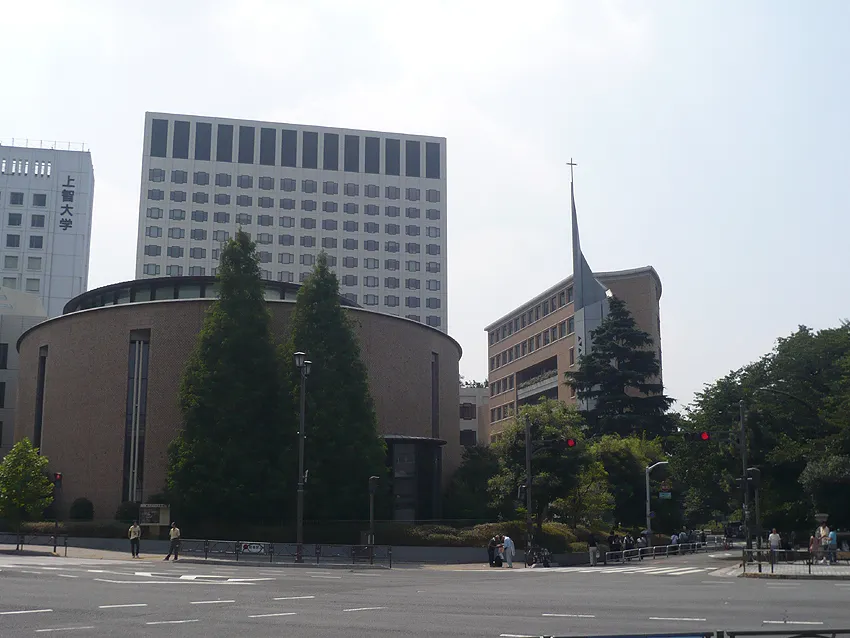
You'll find it at 6-5-1 Kojimachi, a few minutes' walk from Yotsuya Station on the Marunouchi and Namboku lines. The neighborhood is quiet government-district Tokyo — embassies, office blocks, the Imperial Palace moat a short walk south. Nothing about the surrounding streets prepares you for what the Jesuits built here: a reinforced-concrete sanctuary where natural light enters from unexpected angles and the acoustics carry a whispered prayer.
Three buildings have stood on this ground since 1936 — American firebombing destroyed the first, the congregation outgrew the second. The third, designed by Makoto Endo of Sakakura Associates and completed in May 1999, more than doubles the capacity of its predecessor.
What draws visitors beyond the architecture is the weight of compressed history: a German priest who took Japanese citizenship, a Belgian stained-glass window shipped to a bombed-out capital, a religious order expelled under penalty of death that returned 230 years later. All three threads converge on a single city block at the gates of Sophia University.
Tokyo: 5 Best Places To Visit In The City #travelguide2023 #japantravelguide #traveldaiaries
Seatbelt Check01 What to see.
The Oval Sanctuary and Twelve Apostle Columns
Most churches hide their theology in paintings and altarpieces. Saint Ignatius built its theology into the load-bearing structure. Twelve concrete columns ring the oval nave, each one representing an apostle — and each one holding up the roof. Remove one, and the building fails. The symbolism is not decorative; it is structural, which makes it harder to ignore.
The oval footprint itself is unusual for a Catholic church. Completed in 1999 by Shimizu Corporation to a design by Makoto Endo of Sakakura Associates, the sanctuary seats roughly 700 people arranged radially around a central altar — not facing it from one direction like a theater audience, but surrounding it like guests at a table. This is post-Vatican II liturgical architecture taken seriously: the congregation doesn't watch the Mass, it participates. The acoustics reward this arrangement. Spoken words from the altar reach every seat with startling clarity, wrapping around the oval rather than bouncing off flat walls. Sit at different distances and the sound character shifts — under the organ loft, the bass becomes physical; mid-nave, the priest's voice arrives as if amplified, though it isn't.
The Twelve Stained Glass Windows
European stained glass tells stories — saints and martyrs frozen in colored light. The twelve windows at Saint Ignatius do something different. Each one depicts nature as God's creation: plants, elemental forms, patterns of growth and light. No biblical narratives, no human figures. The effect is closer to looking through a kaleidoscope pressed against a forest than reading scripture on a wall.
No two windows share a color composition or pattern, and because they run vertically along the oval's perimeter, the interior changes character every hour. Morning Mass at 9:00am catches eastern light through certain panels, throwing pale color across the latticed concrete walls. By noon — when the English-language Mass draws its international congregation — the light has shifted to something more diffuse and even. Late afternoon turns the western windows incandescent. The concrete walls were deliberately textured with a lattice pattern that catches and scatters this light, giving warmth to a material most people associate with parking garages. Bring a camera, but come twice: the church you see at 10:00am is not the church you see at 4:00pm.
The Chapels and the Grave Most Visitors Walk Past
The main sanctuary gets the attention, but two smaller chapels hide deeper histories. The Chapel of St. Francis Xavier honors the Jesuit missionary who landed at Kagoshima in 1549 — the first Christian in Japan. The Tokugawa shogunate eventually crushed his mission with systematic persecution. That a Tokyo Jesuit church still maintains Xavier's chapel four centuries later is not nostalgia; it is an act of institutional memory with teeth.
The Chapel of Mary offers something simpler: silence. Smaller, more intimate, open during church hours for anyone who wants to sit without an agenda. And somewhere in this complex — not prominently signposted — lies the grave of Heinrich Dumoulin, the German Jesuit theologian who spent decades at neighboring Sophia University writing what remain the definitive Western studies of Zen Buddhism. Dumoulin died in 1995, just as construction on the current building began. He built intellectual bridges between Catholic and Buddhist thought that most interfaith conferences still haven't caught up to. His body rests here, steps from the university where he worked, in a church most visitors experience without knowing he's beneath their feet. Ask at the information center — they can point you to the spot.
02 In pictures.


Watch & Explore Saint Ignatius Church.
Plan and listen to Saint Ignatius Church with Audiala.
Audio guide in your pocket, itinerary in your browser. Built for the way you actually visit.
03 Visitor logistics.
The practical scaffolding for a good visit — kept short.
Getting There
Yotsuya Station sits roughly 60 seconds on foot from the church entrance — one of the shortest station-to-destination walks in Tokyo. Four lines converge here: JR Chuo, JR Sobu, Tokyo Metro Marunouchi, and Tokyo Metro Namboku. No parking on site, so don't even think about driving.
Opening Hours
As of 2026, the reception is open daily from 9:00 AM to 7:00 PM, with no seasonal closures. Access to the sanctuary may be restricted during Mass times — Sunday mornings are busiest, with services in up to seven languages running back to back. Holy Week (early April) brings a modified schedule; check stignatius.jp for exact dates.
Time Needed
A focused architectural visit takes 20–30 minutes: enough to absorb the lotus-petal ceiling, examine the 12 stained glass windows individually, and find the small Japanese-style chapel most visitors miss. Attending an English Sunday Mass adds about an hour. The information center near the entrance sells Bibles, rosaries, and CDs — budget an extra 15 minutes if you browse.
Cost
Entry is free, always. No tickets, no audio guides, no suggested donations at the door. Christmas Eve Midnight Mass is the one exception to the walk-in policy — free capacity-controlled stubs are distributed from 7:15 PM at Kibe Hall Gate on a first-come basis, with 900 spots in the main church and 200 in Our Lady's Chapel.
04 Tips for visitors.
Small things that change the day.
Silence Is Expected
This is a working parish, not a museum. Keep conversation to a whisper inside the main chapel, and avoid entering mid-service unless you intend to stay for the full Mass. Non-Catholics are welcome to attend as observers but should not receive communion.
Photography Timing
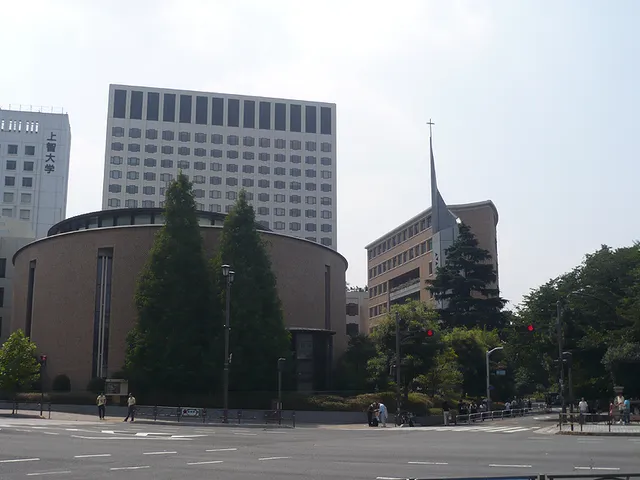
Discreet architectural shots are tolerated between services, but photography during Mass is off-limits. No flash near the altar, and leave the tripod at your hotel. The exterior from the Yotsuya station crossing makes the best photograph anyway.
Find the Hidden Chapel
A small Japanese-style chapel tucked inside the complex draws on tatami-influenced aesthetics — contemplative, minimal, and rarely mentioned in English guides. Ask at reception if you can't find it. Fragments of the original 1949 Belgian stained glass survive in one of the smaller chapels too.
Visit at Midday
The lotus-petal glass ceiling floods the sanctuary with diffused natural light that shifts with the seasons. The effect is most striking between 11:00 AM and 1:00 PM. Late March through early April adds a bonus — the cherry trees along the outer moat turn the walk from Yotsuya Station into something worth arriving early for.
Eat Near Yotsuya
Izakaya Sanzoku, a few minutes' walk away, rates 4.8 on TripAdvisor with 186 reviews — solid mid-range Japanese pub food. For a quick pastry and coffee, Paul at Atre Yotsuya is budget-friendly and reliable. Splurge option: Kobe Beef Yakiniku Halal Wagyu Nikubei does exactly what the name promises.
No Lockers On Site
The church has no luggage storage or coin lockers. Yotsuya Station, barely a minute away, has JR coin lockers — stash your bags there before visiting. Inside the church, benches have bag hooks built into the carpentry, a thoughtful detail you'll appreciate.
Where to Eat
Don't Leave Without Trying
Yakitori Miyagawa Yotsuya
local favoriteOrder: The yakitori skewers—especially the thigh (momo) and skin (kawa)—grilled over charcoal with a perfect char and brushed with their signature tare sauce. Pair with cold beer or sake.
This is where locals actually eat. Yakitori Miyagawa is a Tokyo institution with serious technique: every skewer is grilled to order over binchotan charcoal, not a chain operation. The 376 reviews speak to consistent quality and an unpretentious vibe.
Kouji Machi Cafe
cafeOrder: Their seasonal coffee blend and house-made pastries. Come for breakfast or afternoon tea—the dual service (morning 8:30 AM–4:00 PM, evening 5:00–11:00 PM) makes it perfect for any time.
A genuine neighborhood cafe in Kojimachi, steps from the church, with a 4.5 rating and a real local following. It's the kind of place where regulars know the staff and the coffee is treated seriously.
Tigrato
local favoriteOrder: Craft cocktails and small plates—think yakitori-style bites, edamame, and seasonal snacks paired with well-executed spirits. The bar staff knows what they're doing.
A solid neighborhood bar with serious cocktail credentials (4.5 stars, 165 reviews). It's the kind of place where you can grab a drink after work or on a quiet evening without tourist crowds.
Krispy Kreme Doughnuts Yotsuya
quick biteOrder: Their classic glazed doughnuts and seasonal limited editions. Grab a box for a quick breakfast or afternoon treat before exploring the neighborhood.
Not a local secret, but convenient and reliable. Located in Atre Yotsuya shopping complex, it's a solid quick-bite option if you want something sweet and familiar without overthinking it.
Dining Tips
- check Yakitori spots like Miyagawa are best visited after 5 PM when the charcoal is hot and the vibe is lively.
- check Kojimachi and Yotsuya have strong izakaya and yakitori cultures—this is where salarymen eat after work, so expect a casual, no-frills atmosphere.
- check The area around Saint Ignatius Church (Kojimachi) is quieter and more residential than tourist zones, so restaurants tend to serve locals rather than visitors.
Restaurant data powered by Google
05 The 364-Year Promise
When Ignatius of Loyola sent Francis Xavier east in 1549, Xavier landed at Kagoshima and immediately wrote home calling Japan 'the best nation yet discovered.' His ambition was a university in Kyoto, modeled on the University of Paris where Ignatius had studied. Xavier never reached the city — he died on a wind-scoured island off the Chinese coast in 1552, age 46, the university unbuilt.
Toyotomi Hideyoshi ordered twenty-six Christians crucified in Nagasaki in 1597, but the faith kept spreading — by 1600, Japan had roughly 300,000 Catholics, a higher proportion of the population than today. The Tokugawa shogunate ended that. After the Shimabara Rebellion of 1637–1638, the government banned Christianity outright, and for 230 years the faith survived underground, carried by the kakure kirishitan — hidden Christians who practiced without priests, churches, or protection.
The Jesuits who built Saint Ignatius Church are not the heirs of Xavier's original mission. They belong to the second wave, arriving after Japan reopened to the West in 1853 and founding Sophia University next door in 1913 — 364 years after Xavier first dreamed of a Jesuit school in Japan.
The German Priest Who Became Japanese
Hermann Heuvers arrived in Japan in 1923, a young German Jesuit with a gift for classical Japanese. Over two decades he became one of the country's most unlikely cultural figures — a Catholic priest writing plays staged on national platforms, mastering a literary register most native speakers never attempt. Then the war came.
As a German in an Axis-allied country, Heuvers held an impossible position: nominally protected by his passport, politically suspect for his loyalty to Rome. On the night of May 25, 1945, American B-29s dropped incendiary clusters over Kojimachi. The Church of St. Thérèse where Heuvers served — nine years old — burned to nothing.
Records show the Archdiocese of Tokyo handed the ruined parish to the Jesuits on August 26, 1947, naming Heuvers first chaplain. He oversaw the December 2 groundbreaking; the new church, designed by Jesuit architect Fr. Ignaz Gropper, was dedicated on April 17, 1949. But Heuvers's deeper mark on Japan is literary — his 1962 essay collection Jikan yo Tomare, Utsukushikare ('Time, Stand Still, You Are Beautiful,' echoing Goethe's Faust) sold over 1.5 million copies.
Heuvers took Japanese citizenship before dying in Tokyo in 1977, age 86. A priest from Westphalia who arrived to teach, he became one of Japan's most-read writers on the subject of death — and chose to be buried in the country he had made his own.
The Night Kojimachi Burned
From Le Corbusier's Studio to Kojimachi
Listen to the full story in the app
The whole Saint Ignatius Church,
told well.
Audio guides for 1,100+ cities across 96 countries. History, stories, and local insight — offline ready.
06 Frequently asked.
The questions travellers send us most about Saint Ignatius Church.
Is Saint Ignatius Church in Tokyo worth visiting?
Yes — even if you're not Catholic, the 1999 building is one of Tokyo's most striking modern sacred spaces. Twelve stained-glass windows flood an oval concrete sanctuary with shifting colored light, and the acoustics (engineered by the University of Tokyo's Tachibana Lab) make spoken words arrive with startling clarity from any seat. The Zen Buddhist scholar Heinrich Dumoulin is buried here, and a small Japanese-style chapel blends Catholic worship with Japanese aesthetic sensibility in a way you won't find elsewhere in the city.
How do I get to Saint Ignatius Church from central Tokyo?
Take the Tokyo Metro Marunouchi Line or JR Chuo Line to Yotsuya Station — the church is a one-minute walk from the exit. Four rail lines serve Yotsuya (JR Chuo, JR Sobu, Marunouchi, and Namboku), so you can reach it from almost anywhere in central Tokyo in under 20 minutes. No parking is available on-site, so public transit is the only practical option.
Can you visit Saint Ignatius Church Tokyo for free?
Yes, entry is completely free every day from 9:00 AM to 7:00 PM. The only exception is Christmas Eve Mass, which requires a free capacity-control ticket stub distributed on a first-come basis from 7:15 PM at the Kibe Hall Gate. Regular visits, including attending Sunday Mass in English at noon, cost nothing.
How long do you need at Saint Ignatius Church Tokyo?
A focused architectural visit takes 20 to 30 minutes. That's enough time to take in the main oval sanctuary, the Chapel of Mary, and the Chapel of St. Francis Xavier. If you attend the English Sunday Mass at noon, add an hour. The information center sells religious books and rosaries and is worth a quick browse — budget 15 minutes for that.
What is the best time to visit Saint Ignatius Church Tokyo?
Mid-morning on a weekday, between 10:00 and 11:00 AM, gives you the quietest interior and the best natural light through the eastern stained-glass panels. Late March through early April adds cherry blossoms along the outer moat approach from Yotsuya Station — the pale pink against the church's concrete exterior is worth timing for. Avoid arriving during Mass times unless you intend to attend.
What should I not miss at Saint Ignatius Church Tokyo?
Don't leave without seeing the Chapel of St. Francis Xavier, which most visitors skip entirely — it connects to the 1549 Jesuit mission that started Japanese Christianity. Look up at the lotus-petal glass ceiling, which diffuses natural light in a way that changes by the hour. Run your hand under the pew backs to find bag hooks built into the carpentry — a small, distinctly Japanese detail of functional craft that guidebooks never mention.
Does Saint Ignatius Church Tokyo have Mass in English?
Yes, English Mass runs every Sunday around noon — one of few regular English-language Catholic services in Tokyo. The church also holds Masses in Spanish, Vietnamese, Portuguese, Indonesian, and Polish, making it one of the most multilingual parishes in Japan. Check the official site at stignatius.jp for the current schedule, as times occasionally shift for liturgical seasons.
What is the history of Saint Ignatius Church in Tokyo?
The parish began in 1936 as the Church of St. Thérèse, a small diocesan church with no Jesuit connection. American B-29s burned it to ash on May 25, 1945, during the firebombing of Tokyo. The Jesuits took over the ruined parish in August 1947 and renamed it for their founder, Ignatius of Loyola — completing a symbolic circle that stretches back to 1549, when Ignatius sent Francis Xavier as the first Christian missionary to Japan. The current building, designed by Sakakura Associates and completed in 1999, replaced a beloved 1949 postwar church that had outgrown its 500-seat capacity.
Verified, and shown.
Researched and written by the Audiala editorial team from historical records, architectural archives, and local expertise.
Official parish site with current Mass schedule, 2026 Holy Week schedule, bulletins, and historical background including founding dates and wartime destruction
Church-verified listing with opening hours (9:00–7:00), FAQ confirming no parking, no coin lockers, multilingual Mass availability, and facility details
Construction details for the 1995–1999 rebuild, confirming Shimizu Corporation as contractor and completion dates
Architectural firm's project page confirming design credit to Sakakura Associates, team details, and neighborhood context
Chiyoda ward cultural property listing with local names, volunteer tour information, and civic heritage designation details
Confirmed 12 columns symbolizing Twelve Apostles, 12 stained-glass windows with nature themes, Heinrich Dumoulin burial, and construction timeline
Multiple visitor reviews confirming English Sunday Mass times, acoustic quality, pipe organ visibility, bag hooks in pews, and proximity to Yotsuya Station
January 9, 1998 article confirming first phase (main chapel) unveiling of the current building
Architectural competition history, inculturation debate context, and design philosophy for the 1999 rebuild
Architectural analysis confirming lotus-petal glass ceiling design, stained-glass artist Ueno Yasurō, and octagonal structural form
Neighborhood context including safety, local character, and nearby dining options around Yotsuya/Kojimachi area
Confirmed December 2, 1947 groundbreaking date, Fr. Ignaz Gropper as 1949 building architect, and parish history timeline
Researched from Wikidata, Wikipedia & official sources · fact-checked · How we make our guides →