
Yayoi Kusama Museum
ShinjukuJapan 35° N · 139° E Updated Aug 2026
This five-floor Kusama museum in a quiet Shinjuku backstreet has no ticket window—visitors book a month ahead for timed 90-minute slots and strict photo rules.
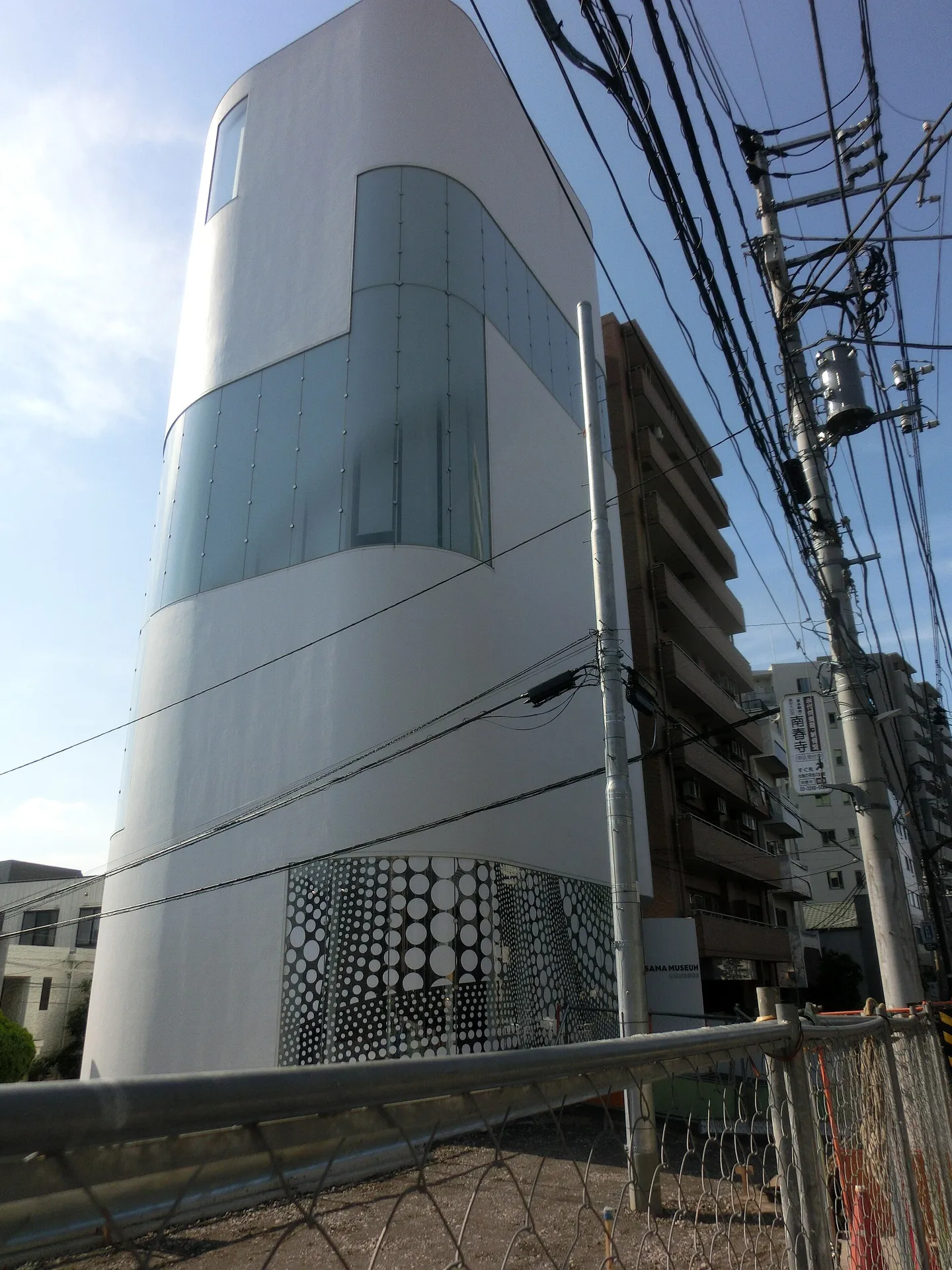 Photo: Bject · CC BY-SA 4.0
- Time needed
- 90 minutes (timed entry)
- Entry
- ¥1,100 (online only)
Why would an artist who has spent four decades living voluntarily in a psychiatric hospital build a five-story monument to herself across the street from her studio? The Yayoi Kusama Museum in Shinjuku, Tokyo, Japan, doesn't answer that question so much as dissolve it — into polka dots, into mirrors, into the quiet residential backstreets of Bentenchō where the world's most expensive living female artist chose to plant her legacy. You come here not to see a retrospective, but to step inside a mind that has been painting itself out of oblivion since 1929.
The building announces itself as a white curved monolith with no corners, punctuated by oversized circular windows — an architectural polka dot dropped into a grid of low-rise houses and printing shops. Kume Sekkei, the firm behind it, finished construction in 2014. Then the building sat silent for three years. No signage. No explanation. Just a windowless white slab that locals walked past daily, wondering.
Inside, the scale shifts entirely. Only 50 visitors enter per 90-minute slot, four times a day, Thursday through Sunday. The galleries climb floor by floor: early monochrome drawings on the second, the sprawling My Eternal Soul acrylic series on the third, immersive installations on the fourth. A rooftop terrace holds Starry Pumpkin, a mosaic-covered sculpture that glints under real Tokyo weather — rain, sun, cloud shadow.
The neighborhood matters. Bentenchō sits on the old Yamanote plateau, once home to samurai estates and later to writers like Natsume Sōseki. The name itself derives from Benzaiten, the goddess of arts and eloquence. Kusama has worked in a studio here since the 1970s, walking daily from Seiwa Hospital in nearby Kawadachō, where she has lived by choice since 1977.
What to see
-
4F: The Infinity Mirror Room
You'll smell the darkness before your eyes adjust—a dry, still black that erases the white stairwell you left seconds ago. The 4th-floor installation, often a version of 2017's Pumpkins Screaming About Love Beyond Infinity, fills the chamber with glowing amber gourds that repeat into impossible depth. Wait for the lights to shift; your own silhouette disappears into the mirror fields, and the 90-minute entry slot suddenly feels both too long and completely untrustworthy. This is one of only two photography zones in the museum, so if you want a memento, make it here. -
5F: The Rooftop Starry Pumpkin
Climb until the stairwell's polished concrete gives way to open sky. On the 5th-floor terrace, Starry Pumpkin (2015) squats like a hallucinated seed pod, every mosaic tile catching the high Tokyo sun or the blue dusk of a winter visit. The surrounding walls have cut-out apertures that frame the power lines and rooftop tanks of Bentenchō, a reminder that Kusama built this white fortress in her own working neighborhood. The reading alcove just inside holds rare international catalogues and children's books; sit for a few minutes and let the city hum do the talking. -
Floors 2 & 3: The Monochrome-to-Color Spiral
Skip the elevator on the way up. Floors 2 and 3 form a two-part argument between Kusama's monochrome discipline and her later color explosion. On 2F, Love Forever (2004–2007) covers the paper with obsessive ink lines, eyes, and faces; on 3F, the My Eternal Soul canvases swing hard into reds, cobalts, and cells that feel like listening to a migraine in widescreen. No wall labels interrupt the white fields, so grab the bilingual paper guide and play detective—look for Kusama's hand-drawn signatures and dates along the canvas edges. When you leave, take the polka-dot elevator down to the ground floor restroom, where vinyl dots on the mirrors erase you into the museum's final artwork.
Plan your visit
- Getting There
- Take the Toei Oedo Line to Ushigome-Yanagicho (East Exit) and walk 6 minutes, or the Tokyo Metro Tozai Line to Waseda (Exit 1, 7 minutes) or Kagurazaka (Exit 2, 9–10 minutes). Toei bus Haku 61 from Shinjuku West Exit stops at Ushigome-Hoken Center, a 2-minute walk away. The museum has no on-site parking.
- Opening Hours
- Open Thursday–Sunday and national holidays, 11:00–17:30, with six 90-minute timed entry slots. Closed Monday–Wednesday, over New Year, and August 31–October 7, 2026 for the exhibition changeover. As of 2026, admission is by advance reservation only.
- Time Needed
- The full five floors take 45–60 minutes at a steady walk, but give yourself 75–90 minutes to linger in the mirror room, browse the 5th-floor reading room, and visit the shop. Your slot hard-stops at 90 minutes, and the Infinity Mirror Room typically allows 1–2 minutes per person inside.
- Accessibility
- Fully wheelchair-accessible with a polka-dot elevator connecting all five floors and smooth thresholds throughout the galleries. A barrier-free toilet with diaper-changing facilities sits on the mezzanine basement level. The 5th-floor rooftop may close in heavy rain or high winds.
- Cost & Tickets
- As of 2026, adults pay ¥1,100, children 6–18 pay ¥600, and under-6s enter free. Tickets are online only via e-tix and go on sale the 1st of each month at 10:00 JST for the month after next; no door sales. You can buy up to 6 per transaction and cancel free up to 48 hours before your slot.
Photo Gallery


History
The Fortress of Self-Obliteration
Yayoi Kusama was born on March 22, 1929, in Matsumoto, Nagano Prefecture, into a family that ran a seed nursery. The pumpkins she saw as a child became talismans — humble, resilient, generous. By 1957 she had talked her way to Seattle, then New York, carrying a suitcase of drawings and a conviction that the art world would eventually catch up to her.
It didn't. Not fairly, anyway. In the 1960s she staged exhibitions of soft sculptures, repetitive silkscreens, and mirror rooms — ideas that peers like Claes Oldenburg, Andy Warhol, and Lucas Samaras adopted and rode to stardom while Kusama faced poverty, racism, sexism, and severe mental crises. She attempted suicide, returned to Tokyo in 1973, and was largely written off by the Japanese art establishment as a sensationalist.
The turning point
The Museum as Vindication
On the surface, the Yayoi Kusama Museum looks like the natural endpoint of a late-career triumph. Records show Kusama is now among the highest-selling living artists in the world, her Infinity Mirror Rooms drawing queues that stretch around city blocks. A private museum in Tokyo seems inevitable, even overdue.
But look closer at the dates. The building was completed in 2014. It stood anonymous for nearly three years — no signage, no announcement, just a silent white monolith in a residential alley. According to local reports, neighbors speculated about what it could be. Art insiders whispered. Kusama said nothing.
The revelation is in the funding. This museum was not built by the Tokyo Metropolitan Government or Shinjuku Ward. It was conceived, financed, and established by Kusama herself through the private Yayoi Kusama Memorial Art Foundation, founded in January 2017. Akira Tatehata, the founding director and former president of Tama Art University, helped shape the curatorial vision — but the money and the control belong to the artist. After decades of watching others profit from her ideas, Kusama built a fortress where her work could never be co-opted, diluted, or removed from her reach.
Stand in the ground-floor gallery now and you'll see it differently. The curved white walls aren't just architecture — they're a boundary. Every polka dot on every canvas is a small act of self-assertion. The museum isn't a monument to fame. It's a declaration of ownership over a life's work that was nearly stolen.
Early Life & Vision
Kusama began experiencing hallucinations as a child — fields of dots, nets, and flowers that seemed to speak to her. She started painting to survive them, a practice she later called self-obliteration (jiko shōmetsu). The repetitive polka dots represent the dissolution of the ego into the cosmos, echoing Buddhist concepts of impermanence and emptiness. Her first New York solo show came in 1959 at Brata Gallery, but recognition arrived decades later, after she had already returned to Japan and checked herself into Seiwa Hospital.
Legacy & Influence
Kusama's influence now spans fashion collaborations, public sculptures, and blockbuster exhibitions worldwide. But the museum in Bentenchō remains her most personal statement. At the September 2017 press preview, the 88-year-old artist, seated in a wheelchair in a red wig and spotted dress, declared the museum the 'greatest thrill of my lifetime.' She told the hushed room: 'With even greater awe toward the people I love and all who wish for world peace, I will continue to fight until the final day of my life.'
Tips for visitors
Know Where to Shoot
Photography is banned on the 2nd and 3rd floor galleries, but allowed in the lobby, elevator, mirror-room area, and 5th-floor rooftop. Leave the flash, tripod, and selfie stick at your hotel; staff enforce this without much patience.Skip the Scalpers
Resellers list ¥1,100 tickets for $40–80 and names may be checked at the door. Buy only through the official e-tix portal on the 1st of the month at 10:00 JST.Don't Arrive Early
The museum has no lobby or waiting area, and staff actively prevent lines forming on the residential street. Arrive at your slot's start time, not before; Bentenchō neighbors negotiated this rule and they notice.Book the 11:00 Slot
The first timed entry has the fewest people in the mirror room and leaves your afternoon free for Kagurazaka or Waseda. Check the forecast before booking because the rooftop sculpture terrace closes in heavy rain and high winds.Pair With Sōseki's House
The Sōseki Sanbō Memorial Museum is a 5-minute walk and offers a quiet counterpoint to Kusama's polka-dot universe. Walk east afterward into Kagurazaka's cobbled alleys to see the old geisha district before it darkens.
Watch & Explore Yayoi Kusama Museum.

Frequently asked
Is Yayoi Kusama Museum worth visiting?
Yes, if you want to see Kusama's late-career masterpieces in a space she built herself. The museum is small but intense—five floors of polka dots, mirror rooms, and a rooftop pumpkin that changes with the weather. You'll need to book weeks ahead, but the 90-minute timed entry keeps crowds low and the experience contemplative.
How long do you need at Yayoi Kusama Museum?
Plan for 60 to 90 minutes. The museum caps visits at 90 minutes per timed slot, and most people see everything in about an hour. That includes the mirror room, the rooftop sculpture, and a browse through the reading nook.
How do I get to Yayoi Kusama Museum from Shinjuku?
Take the Toei Oedo Line to Ushigome-Yanagicho Station, then walk 6 minutes. Or take the Tokyo Metro Tozai Line to Waseda Station and walk 7 minutes. Don't try to walk from JR Shinjuku Station—it's 3 km east in a quiet residential area.
What is the best time to visit Yayoi Kusama Museum?
Book the first slot at 11:00 AM on a weekday (Thursday or Friday) for the quietest experience. The museum is closed Monday through Wednesday, and weekends fill up fast. Late afternoon slots in winter give you twilight on the rooftop pumpkin.
Can you visit Yayoi Kusama Museum for free?
No, tickets cost ¥1,100 for adults and ¥600 for children aged 6–18. Children under 6 enter free. There are no free admission days or discounts, and you must buy tickets online in advance—no door sales.
What should I not miss at Yayoi Kusama Museum?
The 4th-floor Infinity Mirror Room is the main event—you get 1–2 minutes inside, so use them well. Also don't skip the polka-dot elevator and the rooftop Starry Pumpkin, which looks different in rain, sun, or dusk. The 5th-floor reading room has rare catalogues you won't find elsewhere.
Do I need to book tickets in advance for Yayoi Kusama Museum?
Yes, absolutely. Tickets go on sale on the 1st of each month at 10:00 AM JST for the following month, and they sell out within hours. There's no ticket window at the museum, and staff will turn you away if you show up without a reservation.
Sources & attribution 44
- Yayoi Kusama Museum Official Website — Primary source for museum overview, founding, and general information.
- Tabitohon Travel Guide — Confirmed Kusama's birth date and move to the US.
- GLTJP Directory — Provided birth date and nearby dining recommendations.
- Japanese Wikipedia: Yayoi Kusama Museum — Confirmed building completion in 2014 and opening date.
- Hills Life: Yayoi Kusama Museum Opening — Detailed opening ceremony, Kusama's dedication speech, and rooftop sculpture.
- Architect Magazine: Yayoi Kusama's Museum in Tokyo — Confirmed opening date and building completion year.
- The Guardian: Yayoi Kusama Museum Tokyo — Provided Kusama's return to Japan and voluntary hospital residence.
- T Japan: Yayoi Kusama Museum — Described museum as a pilgrimage sanctuary and location choice.
- Wallpaper*: Yayoi Kusama Museum Tokyo — Architectural design details by Kume Sekkei and building silhouette.
- Time Out Tokyo: Floor-by-Floor Guide — Floor layout, photography rules, and hidden details like the polka-dot elevator.
- Savvy Tokyo: Yayoi Kusama Museum — Kusama's daily commute from hospital to studio and museum capacity.
- Yayoi Kusama Museum: About — Foundation establishment and museum mission.
- Bijutsu Techo: Museum Opening News — Opening announcement, director Akira Tatehata, and exhibition details.
- Victoria Miro: Yayoi Kusama Museum News — International press announcement of museum opening.
- Yayoi Kusama Museum English Site — English version of official site with visitor information.
- e-tix Ticketing Portal — Online ticket sales, release schedule, and cancellation policy.
- Yayoi Kusama Museum: Visit Information — Opening days, hours, timed entry slots, and seasonal closures.
- Yayoi Kusama Museum: Tickets — Admission prices and booking rules.
- Yayoi Kusama Museum: Access — Directions from nearby subway stations.
- Trip.com: Yayoi Kusama Museum Moments — Visitor reviews, photography rules, and neighborhood tips.
- Co-Trip Japan: Yayoi Kusama Museum — Access details and nearby dining suggestions.
- Note.com: Walking Log — Walking route description and building exterior.
- Champ Magazine: Yayoi Kusama Museum — Architectural layout and visitor experience.
- Yayoi Kusama Museum: Facilities — Accessibility details and barrier-free restroom location.
- Ikiru-Chikara Barrier-Free Guide — Wheelchair access confirmation.
- Yayoi Kusama Museum: Visitor Policies — Photography restrictions and luggage rules.
- Bijutsu Techo: Floor Guide — Detailed floor-by-floor exhibition descriptions and sensory details.
- Time Out Tokyo (Japanese): Floor Guide — Japanese version of floor guide with hidden gems.
- World-Architects: News — Architectural firm confirmation.
- Lemon8: Yayoi Kusama Museum Review — Visitor photos and polka-dot elevator experience.
- Elle Decor Japan: Yayoi Kusama Spots — Museum shop items and restroom design.
- Hobonichi Culture: Exhibition Report — Rooftop sculpture and seasonal lighting observations.
- Indochina Travel: Japan Museums — Neighborhood reception and strict visitor management.
- Lemon8: Soseki Review — Nearby Soseki Memorial Museum and literary heritage.
- Tripadvisor: Nearby Attractions — Neighborhood vibe and safety.
- Lemon8: Participatory Installation — Obliteration Room and sticker projects.
- Tunagate: Art Circles — Private curatorial talks and academic seminars.
- Yahoo Japan Local Reviews — Insider tip about restroom and elevator micro-installations.
- Rakuski Blog: Exhibition Review — Photography rules for personal use.
- Jalan: Local Gourmet — Budget dining options near Waseda.
- ART iT: Kusama Interview — Kusama's daily painting ritual, groundbreaking ceremony, and philosophy.
- Shinjuku Convention & Visitors Bureau — Exhibition cycles and civic recognition.
- Shinjuku City Cultural Tourism — Museum as official cultural landmark.
- Shinjuku Field Museum — Inclusion in Shinjuku Field Museum registry.
Built from cited sources · see the method · How we make our guides →
Pick up where you left off
Saved and recently read places — kept on this device only.
Photo credits (4)
- Pawel Nolbert — Unsplash License (https://unsplash.com/license) — Source: https://images.unsplash.com/photo-1503899036084-c55cdd92da26
- Birmingham Museums Trust — Unsplash License (https://unsplash.com/license) — Source: https://images.unsplash.com/photo-1579783902614-a3fb3927b675
- YAYOI KUSAMA MUSEUM 草間彌生美術館2018sideCIMG3596 — Bject — CC BY-SA 4.0 (https://creativecommons.org/licenses/by-sa/4.0/) — Source: https://commons.wikimedia.org/wiki/File:YAYOI_KUSAMA_MUSEUM_草間彌生美術館2018sideCIMG3596.jpg
- YAYOI KUSAMA MUSEUM 草間彌生美術館2018frontCIMG3591 — Bject — CC BY-SA 4.0 (https://creativecommons.org/licenses/by-sa/4.0/) — Source: https://commons.wikimedia.org/wiki/File:YAYOI_KUSAMA_MUSEUM_草間彌生美術館2018frontCIMG3591.jpg
Photos may have been resized or cropped.