Mount Fuji.

Fujiyoshida Japan 35° N · 138° E

Japan's highest peak is also a pilgrimage mountain: Fujisan rises 3,776 meters above Fujiyoshida, where shrine trails still frame the climb as ritual.

Listen to the guide View map
Verified July 2026
Mount Fuji
Mount Fuji · Fujiyoshida
Best season
Summer (July-early September) for climbing

An introduction.

Researched by the Audiala editorial team from historical records, architectural archives, and local expertise.

WWhy does Mount Fuji, the most familiar silhouette in Japan, make more sense as a shrine than as a mountain? From Fujiyoshida, Japan, that answer is all around you: cedar-dark approaches, stone lanterns, the sharp line of the cone rising 3,776 meters above town, and pilgrims mixing with hikers under the great torii of the old north route. Visit because Fuji is not just a view. It is one of the rare places where geology, worship, and national imagination still share the same slope.

Most first-time visitors arrive expecting pure nature. The surprise is that UNESCO did not inscribe Fuji on 22 June 2013 as a natural wonder but as a cultural one, tied to shrines, trails, Oshi pilgrim lodgings, and centuries of ritual use.

The physical experience keeps correcting the postcard. Morning light turns the upper scoria a rusty brown rather than snow-globe white, wind carries the resin smell of old cedars near Kitaguchi Hongu Fuji Sengen Jinja, and the mountain feels less isolated than staged, as if the whole town had been built to face it. In a sense, it was.

Fujiyoshida is the right place to understand that. Records show the Yoshida route became the great northern gateway for Edo-period pilgrims, and the town still keeps that posture: a threshold first, a settlement second.

01 What to see.

01

Kitaguchi Hongu Fuji Sengen-jinja

Mount Fuji does not begin on the summit; it begins here, under cedar trunks so tall they make the stone lanterns look like chess pieces left in the forest. The gravel approach crunches underfoot, incense hangs in the damp air, and the richly carved worship hall shows what Edo-period pilgrims paid for with real devotion and real money, because this was the formal threshold before the Yoshida Trail carried them uphill toward 3,776 meters of rock and weather. Pause at the purification pavilion and listen. The water, the trees, the hush between footsteps make Fuji feel less like a photo and more like a deity with strict standards.
02

Former Oshi Togawa Residence

The secret of Fujiyoshida sits in a wooden house from 1768, where climbing Fuji once meant sleeping on tatami, washing in a narrow stream, and letting priests decide whether your body and mind were fit for the mountain. Floorboards creak, cedar darkened by centuries catches the light, and the right-hand threshold is worn smooth by generations of barefoot pilgrims, while the family entrance beside it stayed flatter, a small piece of architecture that still records who belonged where. Look for the tiny nail covers stamped with pilgrimage marks. Most people miss them, which is a pity, because they turn this house from period set into living evidence.
03

Kanadorii to Arakurayama: the approach that explains Fuji

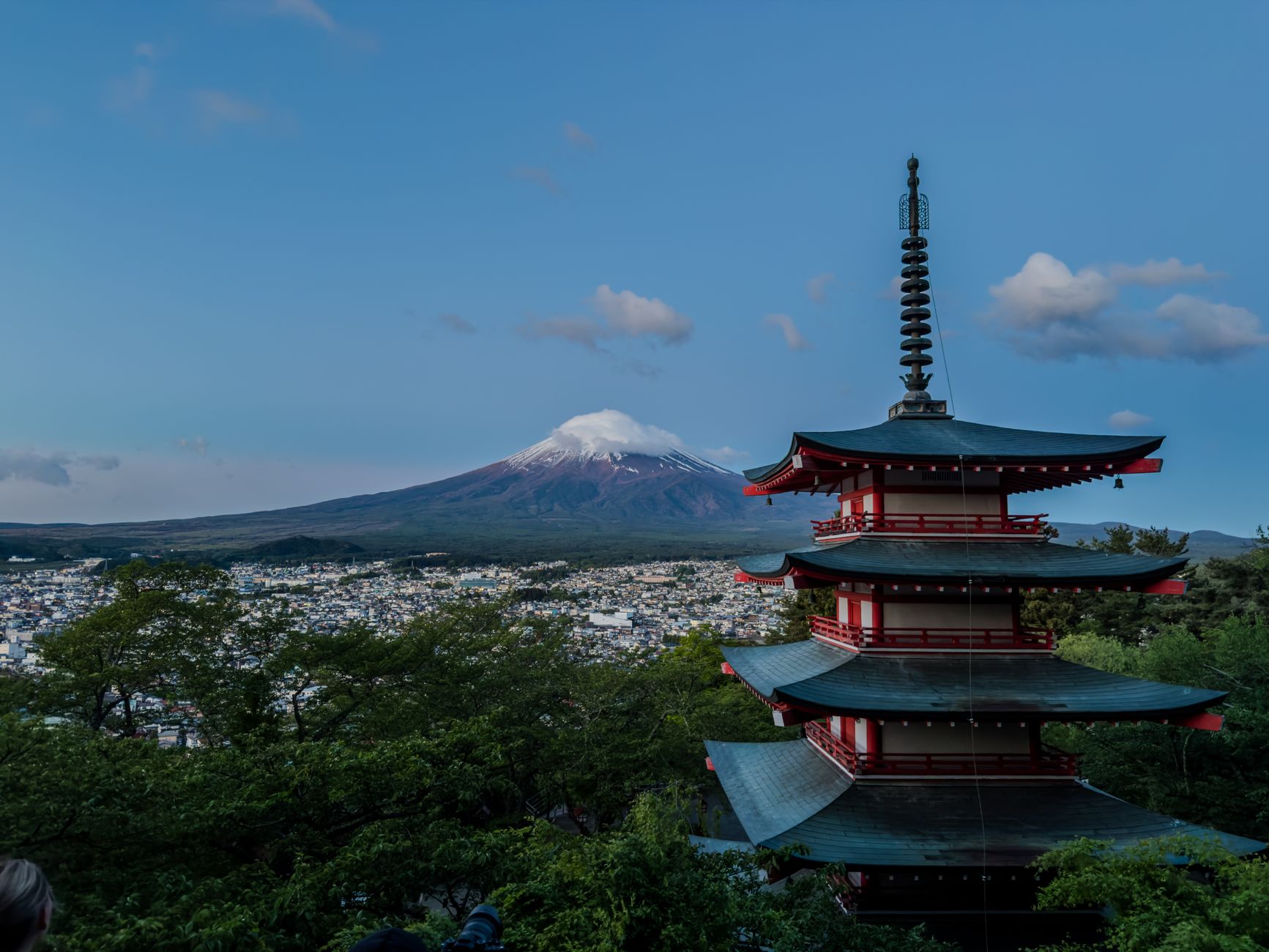
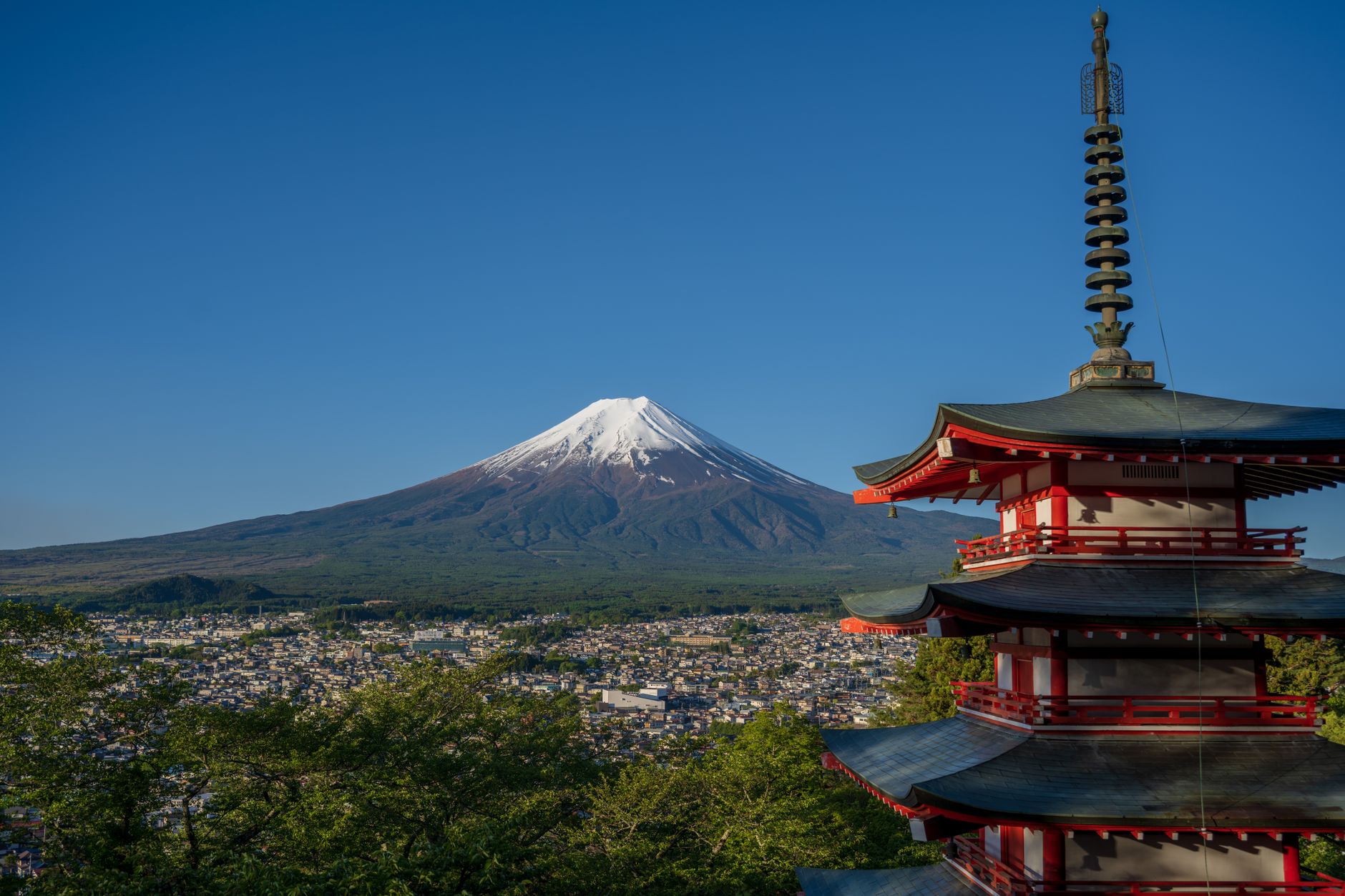
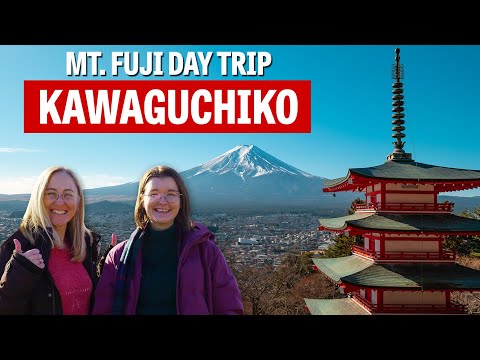
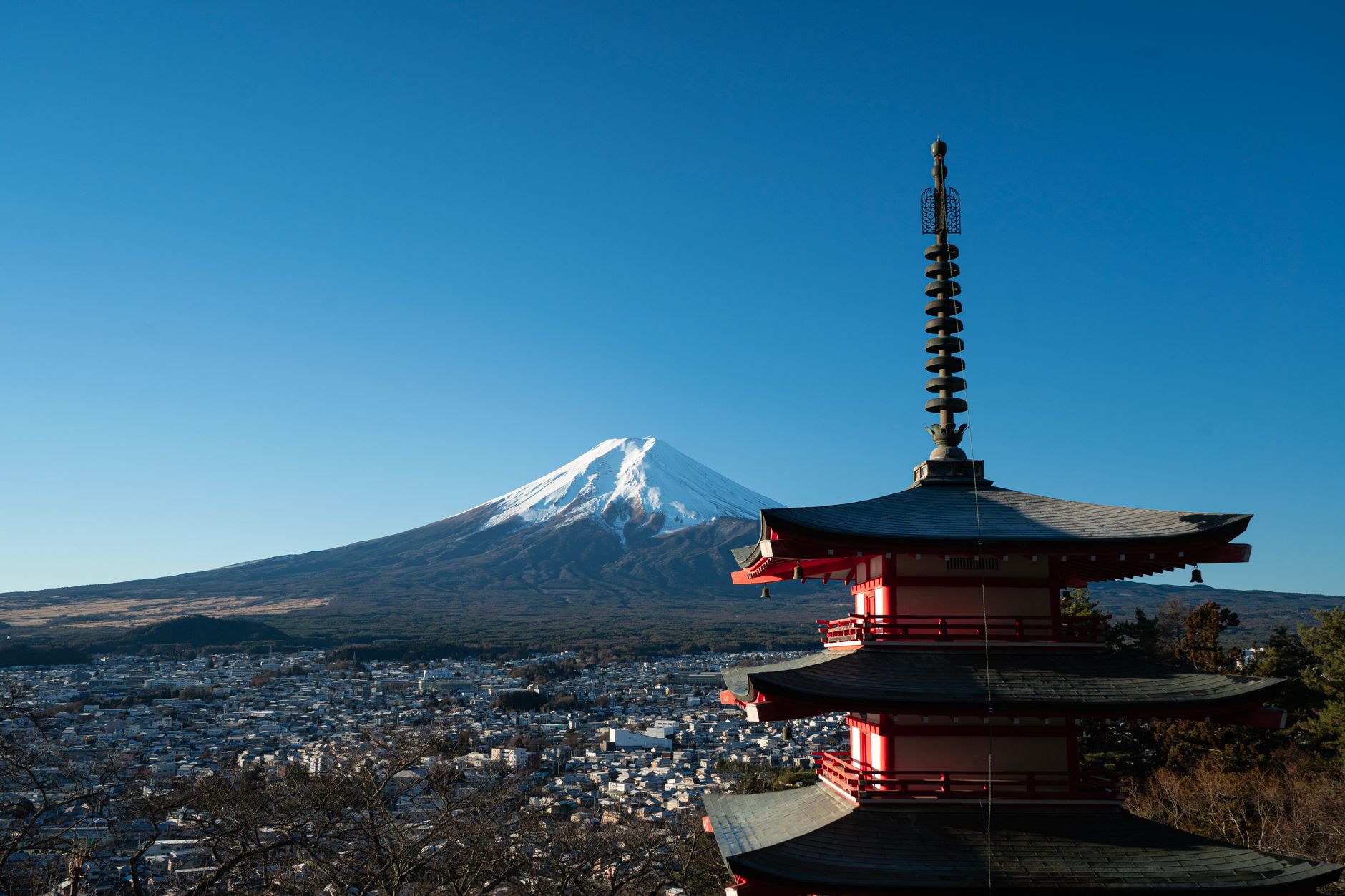
Start at the Kanadorii, the 9.88-meter gate that marks the old line between ordinary town and sacred mountain, then walk through Shimoyoshida where Fuji keeps appearing above shop roofs like a stage backdrop that forgot to stay in the background. Finish with the 398 steps to Chureito Pagoda in Arakurayama Sengen Park; your legs will complain, the wind will sharpen, and then the whole composition snaps into place, pagoda, town grid, and the cone of Fuji rising beyond it with the clean authority of a brushstroke. Go early, before 6:30 a.m. if you can. The crowds arrive later, but dawn still gives you the mountain the way pilgrims once met it: in silence, with a little effort, and no room for irony.
Make the visit yours

Plan and listen to Mount Fuji with Audiala.

Audio guide in your pocket, itinerary in your browser. Built for the way you actually visit.

03 Visitor logistics.

The practical scaffolding for a good visit — kept short.

Getting There

Mount Fuji from Fujiyoshida really means choosing your entry point. From Tokyo, the fastest easy run is the highway bus from Busta Shinjuku to Kawaguchiko in about 1 hour 45 minutes for ¥2,200 one way, or the Fuji Excursion train to Shimoyoshida or Kawaguchiko in about 1 hour 58 minutes for ¥4,200; from Kawaguchiko Station, buses to the Fuji Subaru Line 5th Station take about 50 minutes and cost ¥2,000 one way or ¥3,400 round trip. For town-level Fuji views, ride the Fujikyu Line to Shimoyoshida for Chureito Pagoda, or take a 15-minute bus from Kawaguchiko Station to Kitaguchi Hongu Fuji Sengen Shrine; during the 2026 private-car ban from July 3 at 18:00 to September 10 at 18:00, private cars must park at Fujisan Parking near Fujiyoshida IC and continue by shuttle.

Opening Hours

As of 2026, the Yoshida Trail climbing season runs from July 1 to September 10, with the 5th-station gate closed from 14:00 to 03:00 the next day and a daily cap of 4,000 climbers; mountain-hut guests are exempt from that cut-off, but still pay the climbing fee. The Fuji Subaru Line 5th Station sightseeing area is open almost year-round when snow allows, while Arakurayama Sengen Park and Chureito Pagoda are open 24 hours year-round, and Kitaguchi Hongu Fuji Sengen Shrine generally keeps 06:00-17:00 hours with slight seasonal variation. Winter can shut or limit the Subaru Line road, especially from December through March.

Time Needed

A quick look from the 5th Station needs 3 to 4 hours round trip from Kawaguchiko, enough time for the wind, the sulfur edge in the air, and a slow walk around the plaza at 2,300 meters, roughly as high as eight Eiffel Towers stacked end to end. Chureito Pagoda usually takes 1.5 to 2 hours from Shimoyoshida Station, while a Fujiyoshida half-day with Kitaguchi Hongu Sengen Shrine, Honcho Street, and a bowl of Yoshida udon takes 3 to 4 hours. A real summit climb on the Yoshida Trail is best done over 2 days: 5 to 7 hours up to a hut, then 3 to 5 hours down after sunrise.

Accessibility

The 5th Station is the practical Fuji experience for visitors with limited mobility: paved areas, viewing decks, and accessible vehicles can reach the plaza, and taxis, hire cars, plus EVs and FCVs remain exempt from the summer car ban. Chureito Pagoda is the opposite story, with 398 steps and no lift, and anything above the 5th Station turns into loose volcanic gravel on slopes that steepen toward nearly 40 degrees near the summit, sharp enough to feel like walking up a roof made of ash.

Cost & Tickets

As of 2026, climbing Mount Fuji costs ¥4,000 per person on all four official trails, paid online or at the 5th Station; sightseeing at the 5th Station plaza, Chureito Pagoda, Honcho Street, and Kitaguchi Hongu Sengen Shrine is free. The useful saving is transport, not admission: Kawaguchiko-5th Station bus tickets are ¥2,000 one way or ¥3,400 round trip, and mobile bus tickets can cut queue time. If you drive outside the regulation period, the Subaru Line toll is ¥2,800; during the ban, Fujisan Parking costs ¥1,000 per vehicle and the shuttle to the 5th Station is ¥2,000 one way or ¥3,400 round trip.

05 Tips for visitors.

Small things that change the day.

Gate Cutoff

The 14:00 Yoshida Trail gate closure is the rule that catches people out. Arrive at the 5th Station early, because even prepaid reservations are refused after 14:00 unless you have a mountain-hut booking, and the daily 4,000-person cap can also shut the gate.

Shrine Manners

Kitaguchi Hongu Fuji Sengen Shrine still feels like a threshold, not a backdrop. Remove hats, keep voices down, and if you approach the main hall, follow the local pattern: rinse at the temizuya, bow, offer your coin, then step away without turning the place into a photo set.

Street Photos

Honcho Street gives you the famous straight-on Fuji shot, but cars use it all day and locals are tired of people drifting into the road. Stay on the sidewalk, keep tripods off narrow walkways in busy hours, and assume shrine interiors are no-photo unless a sign says otherwise.

Eat Before Three

Fujiyoshida's best food trap is timing, not price. Yoshida udon shops often close around 14:00, so aim for an early lunch at Miura Udon in Shimoyoshida for a budget bowl around ¥500, Kitchen Kurau for a longer lunch-or-dinner window, or Harvest Terrace for mid-range plates and Fujiyama Beer at roughly ¥1,500 to ¥3,500.

Best Light

Clear Fuji is a weather event here, not a promise, and morning usually gives you the cleanest mountain before cloud wraps the summit like a pulled blanket. For Chureito, arrive near sunrise if you want quieter paths and slanting light on the pagoda; for climbing season, late July through early September tends to offer the most reliable conditions.

Save Smart

Skip expensive viewpoint cafes and spend your budget on the part that matters: a mountain hut if you're climbing, or a round-trip 5th Station bus ticket if you're not. Chureito, Honcho Street, the Sengen Shrine, and the 5th Station plaza all cost nothing, which means Fujiyoshida can be a strong Fuji day without paying a yen in entry fees.

Leave Luggage

Kawaguchiko Station is the safest place to offload bags before heading uphill. Staffed storage runs ¥500 for bags under 60 cm and ¥800 for larger ones from 09:00 to 17:30, and the station area also has large lockers; the 5th Station has lockers too, which is a better place for spare town clothes than your back.

Pair It Properly

Most visitors treat Fujiyoshida as a quick photo stop, which misses the point. Pair the 5th Station or Chureito with Kitaguchi Hongu Fuji Sengen Shrine, because that shrine marks the old pilgrim start and changes the mountain from a pretty cone into a place people once approached with fear, ritual, and very sore legs.

04 A history of reinvention.

The Mountain People Still Ask Permission To Climb

Mount Fuji changes shape in the historical record as a volcano, a deity, a training ground, a national emblem, and now a managed World Heritage site. One function has held. People still approach it as a place that demands ritual, whether that means shrine prayers, cold-water purification, sunrise worship, or the simple act of passing through a gate before the ascent.

That continuity matters more than the summit buildings, many of which changed or vanished. The old pattern remains visible from Fujiyoshida: shrine at the threshold, lodging in the approach town, trail rising through forest, then the crater circuit at the top where pilgrims still walk the bowl called ohachimeguri.

The turning point

The Mountain Was Never Just a Hike

At first glance, Fuji looks like a mountain that became sacred because it is beautiful. That is the easy story: a perfect cone, admired by artists, then opened to modern climbers who come for the sunrise and the bragging rights.

But the dates resist that version. Records show Miyako no Yoshika, a Heian court scholar who died in 879, described Fuji in the 870s as a place of smoke, summit danger, and extraordinary power, long before tourism existed. And when the Meiji state ordered the separation of Shinto and Buddhism after 1868, Buddhist structures on the summit were dismantled or converted, which means the "ancient" sacred scenery many visitors imagine is partly a modern reconstruction of an older, messier faith.

The turning point was personal as well as political. For Yoshika, writing Fujisan-ki meant translating a feared local peak into language the imperial court could absorb; his stake was cultural authority, and he gave Fuji one of its first enduring national descriptions. Then came the Meiji rupture, when what generations of ascetics had climbed for was stripped away by policy. The surface story survives because the mountain kept its ritual frame even after the institutions on top changed.

Once you know that, the view from Fujiyoshida shifts. The torii, the old Oshi houses, the summer opening rites, even the hush before dawn on the Yoshida trail stop looking decorative. They are the surviving machinery of a sacred route that never really closed.

What Changed

Documented eruptions repeatedly remade the mountain's setting: the Enryaku eruption of 800-802 and the Jogan eruption of 864-866 spread ash and lava across the region, while the Hoei eruption from 16 December 1707 to 24 February 1708 threw tephra toward Edo and buried fields. Roads changed the approach too. The Fuji Subaru Line opened in 1964, the Fuji Skyline in 1970, and access rules tightened again on 1 July 2024 after overcrowding on the Yoshida Trail turned sunrise climbing into a safety problem.

What Endured

The ritual sequence has proved harder to erase than any building. Verified sources describe pre-ascent purification, organized Fuji-ko pilgrimages, sunrise worship called goraiko, and the summit crater circuit known as ohachimeguri continuing into the present. Even now, climbers pass from town to shrine to trail in almost the same order Edo pilgrims did, with Fujiyoshida still acting as the north gate where worldly routine gives way to mountain time.

Listen to the full story in the app

Your personal curator

The whole Mount Fuji,
told well.

Audio guides for 1,100+ cities across 96 countries. History, stories, and local insight — offline ready.

The Audiala app

06 Frequently asked.

The questions travellers send us most about Mount Fuji.

Is Mount Fuji worth visiting?

Yes, even if you never touch the summit. Mount Fuji works on two levels: the 3,776-meter cone itself, which rises higher than 100 stacked double-decker buses, and the old pilgrimage world in Fujiyoshida, where cedar shade, shrine gravel, and the first torii still make the mountain feel like a deity rather than a postcard.

How long do you need at Mount Fuji?

You need anything from half a day to two days, depending on which Mount Fuji you mean. A 5th Station sightseeing trip from Kawaguchiko usually takes 3 to 4 hours, while the Yoshida Trail climb is best done over 2 days so you can sleep in a hut instead of pushing through the night on loose volcanic scree and thin, metallic-cold air.

How do I get to Mount Fuji from Tokyo?

The easiest route from Tokyo is a direct highway bus from Busta Shinjuku to Kawaguchiko, then a local bus up to Fuji Subaru Line 5th Station if you want mountain access. The bus takes about 1 hour 45 minutes to Kawaguchiko, the train takes about 1 hour 58 minutes on the Fuji Excursion, and the last leg to the 5th Station adds about 50 minutes by bus.

What is the best time to visit Mount Fuji?

Late July to early September is best for climbing, while October and November are better for clear views and quieter shrine visits. July 1 to September 10, 2026 is the official Yoshida Trail season, but autumn often gives you the sharper light: dry air, hard-edged views, and fewer people panting past you on the path.

Can you visit Mount Fuji for free?

Yes, if you visit the free parts, but climbing the mountain itself is not free. Chureito Pagoda, Kitaguchi Hongu Fuji Sengen Shrine, Honcho Street viewpoints, and the 5th Station plaza cost nothing, while the 2026 climbing fee is ¥4,000 per person on the Yoshida Trail and the other main routes.

What should I not miss at Mount Fuji?

Don’t miss the old threshold before the mountain: Kitaguchi Hongu Fuji Sengen Shrine, the Kanadorii gate, and the sense that Fujiyoshida was built to send people uphill. If you climb, skip the reckless overnight dash and plan for the crater rim or sunrise from high on the mountain; if you stay below, catch the cedar-dark shrine approach at dawn, when footsteps on gravel sound louder than traffic and Fuji feels close enough to rule the town.

Sources & attribution

Verified, and shown.

Researched and written by the Audiala editorial team from historical records, architectural archives, and local expertise.

Last reviewed July 2026

Confirmed the 2013 World Heritage inscription and the fact that Mount Fuji is recognized as a cultural site tied to faith and artistic inspiration, not just as a mountain.

Provided the 2026 Yoshida Trail season dates, 14:00 to 03:00 gate closure, 4,000-climber cap, and the ¥4,000 climbing fee.

Confirmed official 2026 climbing regulations, equipment checks, and trail management rules on the Yamanashi side.

Supplied practical transport context from Tokyo to Kawaguchiko and clarified the difference between town access and actual mountain access.

Provided bus travel times and fares between Kawaguchiko and the Fuji Subaru Line 5th Station.

Used for 5th Station context, seasonality, sightseeing logistics, and the distinction between climbing access and casual visits.

Provided details on the Kanadorii gate, key viewpoints, and the cultural corridor linking Fujiyoshida to Mount Fuji.

Used for the shrine’s role as the traditional starting point of the Yoshida pilgrimage route and as part of Mount Fuji’s sacred setting.

Last reviewed

Researched from Wikidata, Wikipedia & official sources · fact-checked · How we make our guides →

Explore the Area
See Mount Fuji on the map and discover what's nearby.
View map

Images: Stjepko Krehula (wikimedia, cc by 4.0) | Dang Son (wikimedia, cc0) | DimiTalen (wikimedia, cc0) | DimiTalen (wikimedia, cc0) | 江戸村のとくぞう (wikimedia, cc by-sa 4.0) | 江戸村のとくぞう (wikimedia, cc by-sa 4.0) | Suicasmo (wikimedia, cc by-sa 4.0) | 名古屋太郎, (edited by Hannes_24) (wikimedia, cc by-sa 3.0)