


Place
Japan Updated Jul 2026
A vermilion pagoda, a curtain of power lines, the smell of soy broth from an udon shop, and then Mount Fuji filling the end of the street like a stage set gone slightly mad: Fujiyoshida, Japan, does contrast better than almost anywhere. This is not the polished Fuji of souvenir tins. It is a working city where pilgrimage gates, textile warehouses, thrill rides, and neighborhood bars all live under the same volcanic shadow.
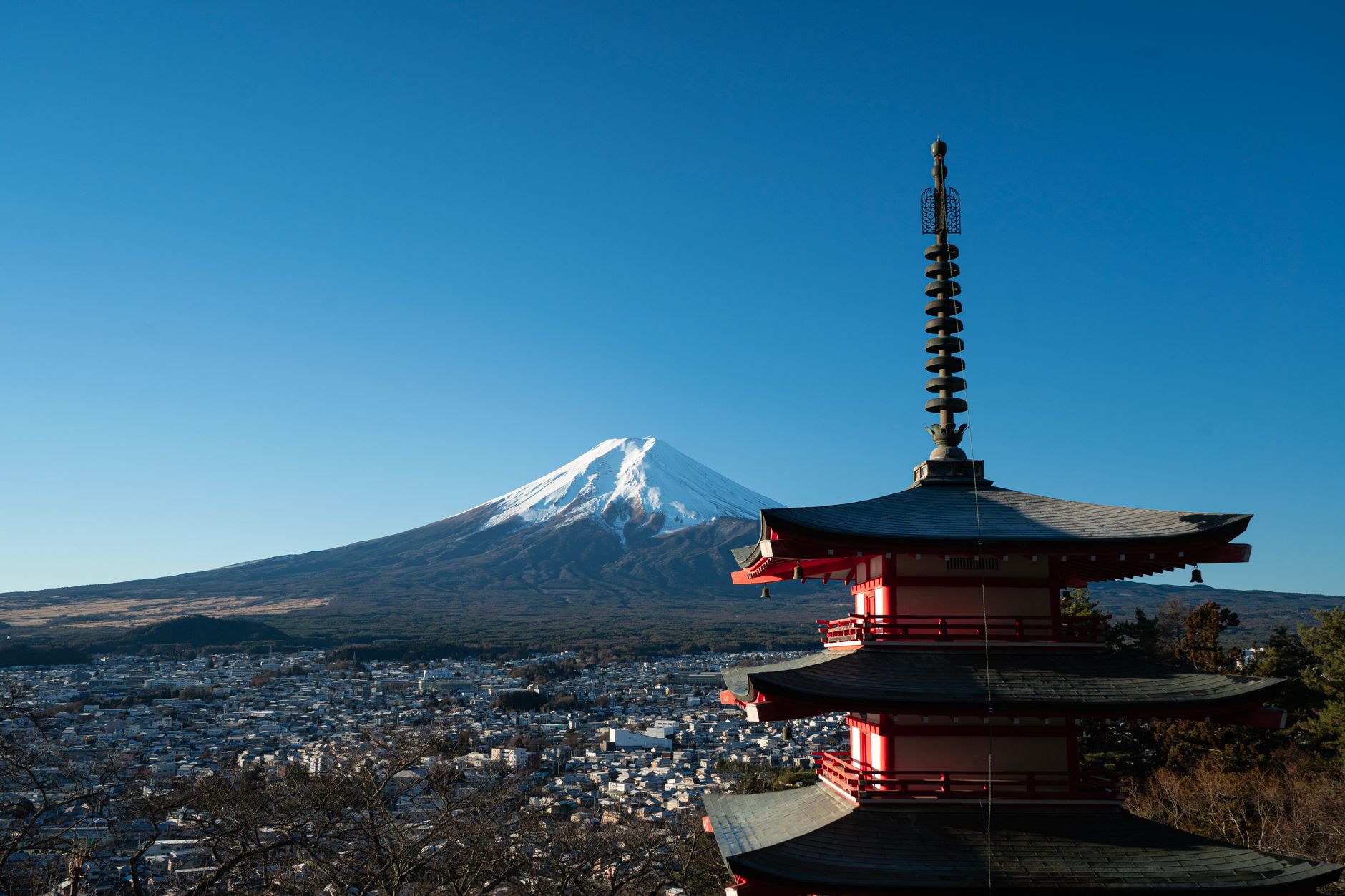 Photo: Minh Vũ / Pexels
Built from cited sources · see the method · How we make our guides →
Fujiyoshida grew rich on two obsessions: climbing the mountain and weaving cloth beneath it. Edo-period pilgrims once lodged with oshi guides before setting out through Kitaguchi Hongu Fuji Sengen Shrine, and the old route still gives the city its spine. You feel that inheritance in cedar-dark shrine precincts, in the old Kyu Togawa-ke residence, and in the way locals still treat Fuji less as scenery than as a presence with moods.
One street captures the place perfectly. Honcho looks like a retro shopping arcade with lanterns, bakeries, and low shopfronts until you glance up and realize the road seems to run straight into the mountain; the famous photograph is real, but the better reason to come is the life around it, from matcha soft serve to wagashi that sell out by early afternoon.
And Fujiyoshida has more edge than first-time visitors expect. Fuji-Q Highland sends screams across the air, Nishiura keeps its Showa drinking alleys alive after dark, and bowls of Yoshida udon arrive with noodles so firm they feel almost argumentative. That tension is the city's secret: reverence and everyday grit, side by side, with Fuji watching both.
Not every monument, just the ones we'd walk you past ourselves.

Where to wander, by quarter — each with its own rhythm.
Before you go
From shrine legends and ashfall to textile mills, pagodas, and UNESCO fame
Archaeological evidence places human communities in the Fuji Five Lakes basin by late prehistory, living with cold water, dense forest, and a mountain that never let anyone forget it was there. Fujiyoshida's story begins less as urban history than as a long act of attention to Fuji's slopes, weather, and moods.
According to shrine tradition, Prince Yamato Takeru passed through the area and inspired an early sacred marker here. Legend, not document. But the story matters because Fujiyoshida still explains itself through that meeting of road, warrior, and mountain.
A permanent sanctuary was established at what became Kitaguchi Hongu Fuji Sengen Shrine, dedicated to Konohanasakuya-hime and meant to pacify Fuji's eruptions. You can still feel the logic of the place: cedar shade, cold air, and the sense that prayer here was never decorative.
By the early Heian period, mountain ascetics were using the northern approaches to Fuji, and the path through what became Kamiyoshida gained ritual weight. This was no scenic stroll. Pilgrimage here meant purification, danger, and the thin line between devotion and exposure.
During the medieval period, the oshi system took shape in Kamiyoshida: hereditary guides who offered lodging, ritual instruction, and access to the mountain. They were innkeepers, brokers, and spiritual managers at once. Fujiyoshida grew because pilgrims needed all three.
As the Takeda clan tightened control over Kai Province, Fujiyoshida sat inside a harsher political world of mobilization and territorial pressure. The city never became a battlefield spectacle. Its value lay in routes, manpower, and the strategic edge of being the gateway to Fuji's north side.
Tokugawa rule brought the kind of order that turns difficult devotion into mass movement. Roads became safer, confraternities grew, and Fujiyoshida turned into the great staging ground for the Yoshida trail. Religion needed logistics. The town supplied them.
The Hoei eruption of Mount Fuji sent ash across the region and darkened fields around Fujiyoshida, wrecking crops and interrupting pilgrimage. Imagine the sound first, then the grit underfoot, then the silence after. The disaster deepened the town's religious identity because eruption here was never abstract geology.
Katsushika Hokusai was born in Edo in 1760, but his later images of Mount Fuji helped fix the mountain's northern approaches in Japan's visual imagination. Fujiyoshida benefited from that cultural aftershock. A pilgrimage town became, in part, an image people already knew before they arrived.
The main structure of the Togawa family oshi house was completed in 1768, giving physical form to the town's pilgrimage economy. Its rooms were built for bodies in transit: tired climbers, ritual objects, damp clothing, shared meals, and talk before dawn departures.
Renewed volcanic activity in the Tenmei era brought more ash damage and more strain to households that depended on fields and pilgrims alike. Fujiyoshida did what mountain towns often do. It absorbed the blow, reorganized, and kept receiving people headed uphill.
The Meiji Restoration and the policy of separating Shinto and Buddhism reordered religious life across Japan, including Fuji worship at Kamiyoshida. Old mixtures were pulled apart by law. Fujiyoshida kept its sacred function, but the administrative grammar changed underneath it.
In the late nineteenth century, mechanized textile production expanded in the area and gave Fujiyoshida a second identity beyond pilgrimage. The soundscape changed with it: shrine precincts and climbing chants on one side, factory rhythm and spinning machinery on the other. Modern Fujiyoshida was born in that overlap.
Itchiku Kubota was born in 1917 and later became the artist most closely tied to the wider Fuji region's textile imagination. His work revived tsujigahana dyeing with obsessive patience and color that seems lit from inside. In Fujiyoshida, textile skill was never just industrial output; Kubota proved it could still become art.
Kamiyoshida's formal incorporation gave local administration a modern legal frame at a moment when pilgrimage, industry, and transport were all changing fast. Paperwork matters. This was one step in turning a sacred gateway into a municipality that could plan, tax, and build.
The Great Kanto Earthquake sent tremors through the region and damaged local wooden structures. Fear travels through timber. The shock encouraged more attention to fire-resistant building and more modern urban planning in a town that knew too well how fragile wood, cloth, and ash could be together.
During the war, textile mills had been drawn into uniform production and strained by shortages; Japan's defeat forced another reset. Fujiyoshida emerged without the direct bombing that erased other cities, but the local economy still had to reinvent itself from the spool up.
On March 20, 1951, the modern city of Fujiyoshida was officially established through municipal merger. Administrative maps caught up with lived reality. A pilgrimage hub, factory town, and mountain-facing settlement now had one civic name.
Actor Shun Suda was born in Fujiyoshida in 1955, carrying the city's name into Japanese film and television rather than shrine records or factory ledgers. His career belongs to modern popular culture, which matters because Fujiyoshida is not frozen in heritage amber no matter how often photographs treat it that way.
Fuji-Q Highland opened in 1961 and pushed the local economy toward leisure on a large scale. This was a sharp turn and a very Japanese one: sacred mountain in the background, roller coaster steel in the foreground. Fujiyoshida learned to host pilgrims and screamers at the same time.
Chureito Pagoda was completed in 1963 as a peace memorial, later becoming one of Japan's most reproduced views. The image looks serene. The backstory is postwar grief, municipal ambition, and a hillside engineered into an icon.
Karia Nomoto was born in Fujiyoshida in 1986, another reminder that the city produces contemporary cultural figures as well as shrine myths and tourist photographs. Her presence in the timeline is useful precisely because it interrupts the tendency to leave smaller Japanese cities in the past tense.
The Itchiku Kubota Art Museum opened in 1990, giving the Fuji region one of its strangest and most absorbing artistic spaces. Cloth, lacquered wood, filtered light, mountain weather outside. Fujiyoshida's textile past suddenly had a museum-scale poetic answer.
Mount Fuji was inscribed as a UNESCO World Cultural Heritage site in 2013, and Fujiyoshida's shrine, trail, and oshi heritage moved into a global frame. The designation recognized belief and artistic influence more than raw scenery. That distinction suits the city perfectly.
During the 2020s, Honcho Street and the Chureito view became global social-media images, drawing visitors who arrived already chasing a frame. Fujiyoshida now lives with a strange modern problem: when a city's most famous sight is a photograph, how do you protect the streets behind it? That question may shape its next century more than any pagoda postcard.
In 2022, 4,039 Fuji worship artifacts connected to the Yoshida trail were designated Important Tangible Folk Cultural Properties. Numbers can feel dry until you picture the objects themselves: staffs, garments, ritual tools, traces of thousands of hands. The city preserved not just buildings, but the equipment of belief.
Actor · born 1955
Born here
Shun Suda was born in Fujiyoshida before becoming one of Japan's great hard-faced character actors, the kind of presence who can make a scene tense by walking into it. A town that lives in Mt. Fuji's shadow probably taught him something about scale; he would still recognize the old streets, though now half the world comes to photograph them.
Actress and model · born 1986
Born here
Karia Nomoto was born in Fujiyoshida, a place better known for shrines and summit views than for producing screen personalities. Her connection adds a modern footnote to a city usually framed through pilgrimage and folklore, and she would find that the retro streets of Honcho now play to cameras almost as confidently as any film set.
Where locals actually book dinner — not the tourist menus.
This is the dish to start with: brutally firm hand-kneaded noodles in a soy-miso broth, usually topped with cabbage and often horse meat. Try it because the texture is the point, a kind of edible stubbornness that locals wear with pride.
Miura Udon is one of the city's benchmark bowls, the place many locals and repeat visitors name first. Go hungry, expect bounce and chew, and don't mistake the simplicity for lack of character.
Yamanashi's other comfort classic is hoto, wide flat noodles simmered in a thick miso broth with pumpkin and vegetables. On a cold Fujiyoshida evening, it tastes like somebody turned a farmhouse hearth into soup.
Horse meat appears in traditional Yoshida udon as a savory, slightly sweet accent rather than a stunt ingredient. If you are curious but cautious, this city is a good place to try it because it arrives in a familiar bowl, softened by broth and cabbage.
Harukiya in Shimoyoshida is worth your sugar break for high-grade matcha soft serve and proper tea, not the powdered green afterthought some places sell. The bitterness lands first, then the milk and sweetness round it out.
At Michi no Eki Fujiyoshida, the food scene shifts from shrine-town tradition to regional grazing: local vegetables, seasonal snacks, and Fuji-Q Beer poured with the mountain somewhere in your peripheral vision. It is less polished than a city tasting menu and more useful for understanding what people here actually eat and drink.
Small things that change how the city treats you.
Yes, especially if you want Mount Fuji with a sense of ritual rather than just a postcard view. Fujiyoshida gives you Chureito Pagoda, shrine approaches lined with old cedars, retro shopping streets, and the old pilgrimage route in one compact city.
Two days works well for most travelers. That gives you time for the main viewpoints, a shrine visit, Yoshida udon, and either Fuji-Q Highland or a museum day, with room for weather shifts around Mt. Fuji.
The easiest routes are the Fujikyu Railway via Otsuki or a direct highway bus from Shinjuku. Trains give you more flexibility, while buses can be simpler if you are heading straight for Mt. Fuji Station or Fuji-Q Highland.
Yes, Fujiyoshida is generally very safe. The real risks are practical ones: steep steps at Chureito, sudden weather changes around Mt. Fuji, and winter ice on early-morning paths.
Winter often gives the sharpest mountain views and the cleanest light. Late March to early April brings cherry blossoms at Arakurayama Sengen Park, while November adds red maple leaves and golden fields around the quieter viewpoints.
Yes, if you stay near Shimoyoshida, Mt. Fuji Station, or Fuji-Q Highland. Many key sights are reachable by train, local bus, or on foot, though a car helps if you want rural viewpoints such as Noson Koen Park.
No, it can be fairly moderate by Japanese resort-area standards if you focus on shrines, street walks, and local noodle shops. Costs rise fast if you add Fuji-Q Highland, taxis, or peak-season hotels with direct Fuji views.
Yoshida udon is the dish to come for: thick, chewy noodles in a soy-miso broth, usually with cabbage, horse meat, and a side of spicy suridane. Hoto, the Yamanashi pumpkin-miso noodle stew, shows up more often in colder weather.
Saved and recently read places — kept on this device only.
Photos may have been resized or cropped.
