Introduction
A Jamaica travel guide should start here: this island moves from pirate ruins and mountain mist to jerk smoke and bass-heavy streets in a single day.
Jamaica rewards travelers who want more than a beach chair. Start in Kingston, where the island's cultural nerve center runs on studio history, sharp conversation, and food that tastes like nowhere else in the Caribbean. A short ride away, Port Royal sits at the edge of Kingston Harbour with one of the region's strangest stories: a 17th-century pirate city partly swallowed by the sea after the earthquake of June 7, 1692. Then the road opens north and west. Ocho Rios gives you waterfalls and river gorges, Montego Bay delivers the classic north-coast mix of old plantation wealth and resort ease, and Negril stretches time out along Seven Mile Beach until sunset turns the whole coast copper.
The island's scale is part of its appeal. In a week, you can drink Blue Mountain coffee in the cool heights above Kingston, raft a river near Port Antonio, eat peppery jerk beside the road outside Boston Bay, and finish with fried fish on the south coast near Treasure Beach. Geography keeps changing the mood: the Blue Mountains rise to 2,256 meters, Cockpit Country folds into steep limestone hollows, and the dry south coast feels almost like a different country. That variety explains why Jamaica works for first-time visitors and repeat ones. You can build a trip around music, food, history, hiking, or pure sea time, and the island still has room to surprise you.
History here is never sealed behind glass. Spanish Town carries the memory of colonial administration, Falmouth still shows off one of the Caribbean's best Georgian street grids, and Accompong keeps Maroon history rooted in a living community rather than a museum label. Jamaica's real trick is that the famous things are only half the story. Yes, you'll find reefs, rum, and reggae. But you'll also find mountain roads wrapped in mist, Sunday plates of curry goat and rice and peas, and a social code where a proper greeting matters as much as the right address. That is usually when the island clicks.
A History Told Through Its Eras
Xaymaca Before the Cannons
The TaÃno World, c. 650-1494
Dawn breaks over a batey court cut into the earth, and the first sound is not a church bell but the slap of bare feet on packed ground. Long before Kingston, Montego Bay, or Port Royal had names on European maps, the TaÃno called this island Xaymaca, the land of wood and water. They came in waves from the Orinoco world, bringing cassava, canoes hollowed from giant trunks, and a political order built around caciques, ceremony, and trade across the Caribbean.
Ce que l'on ignore souvent, c'est que Jamaica was never an empty Eden waiting to be "discovered." Villages stood in careful relation to rivers, fishing grounds, and sacred objects called zemis, carved spirits that linked the living to ancestors and to weather, harvest, and war. The island already belonged to a network: canoes moved between Jamaica, Cuba, Hispaniola, and Puerto Rico with goods, stories, and marriage ties.
Spanish chroniclers preserved only fragments, but even fragments can sting. They tell us of Huareo, the cacique who met Columbus in 1494, paddling out in state with feathers and attendants, prepared to defend his shore. Then the record goes thin, which is often what conquest does first: it reduces a life to a footnote, then erases the footnote.
And yet the TaÃno did leave the world something intimate. Hammocks, cassava bread, barbecue technique, place names, ways of sleeping, planting, and moving through heat. The island's first great inheritance was not a fort or a crown. It was a manner of living with wood, water, and sea, an inheritance the conquerors would exploit, rename, and never fully replace.
Huareo appears for a moment at the edge of the written record, a ruler facing strange sails, then disappears into the silence conquest so often imposes.
The word "hammock" comes into European languages from the TaÃno hamaca, one of Jamaica's earliest exports to the wider world.
Columbus Stranded, the Island Renamed
Spanish Jamaica, 1494-1655
On 5 May 1494, Christopher Columbus landed at what is now St. Ann's Bay near Ocho Rios and claimed the island for Spain with the breezy confidence of men who mistake arrival for ownership. He called it Santiago. Ten years later, his relationship with Jamaica would look rather less glorious: worm-eaten ships, hungry crewmen, and a long, humiliating dependence on the very people he had meant to dominate.
The scene belongs in theatre. In 1503, during his fourth voyage, Columbus ran aground on the north coast and remained stranded for more than a year. When the TaÃno, understandably tired of feeding his party, began to withhold provisions, he reached for astronomy as if it were sorcery. On 29 February 1504, knowing a lunar eclipse was coming, he warned local leaders that his God would darken the moon in anger. The sky obeyed, the moon went red, and food returned.
Spain's century on Jamaica never had the splendour of Mexico or Peru. Sevilla la Nueva rose in 1509 near today's St. Ann's Bay, then faltered; by 1534 the capital had shifted inland to Villa de la Vega, the place later known as Spanish Town. Cattle, hides, small settlements, churchyards, and administration replaced dreams of gold. Meanwhile the TaÃno population collapsed under disease, forced labour, and hunger with terrifying speed.
Another Jamaica was born in that violence. Enslaved Africans were imported as the old population was destroyed, and by the time English forces appeared in 1655, the island already carried the social fault lines that would define its next three centuries. The Spanish lost Jamaica almost casually. The consequences were anything but casual.
Christopher Columbus, so often shown as master of the ocean, spent one of his most theatrical years in Jamaica as a castaway bargaining for cassava and mercy.
Columbus survived his Jamaican ordeal by predicting the lunar eclipse of 29 February 1504 from an almanac and presenting it as divine punishment.
Port Royal, Nanny's Mountains, and the Price of Sugar
Pirates, Planters and Maroons, 1655-1838
A tavern table shakes, silver spills, and outside the harbour at Port Royal is packed with ships flying legal flags and criminal intentions. After the English seized Jamaica in 1655, they turned weakness into policy: if they could not yet build a rich colony, they would license men brutal enough to wreck Spain's empire. Port Royal became the great indecent marvel of the English Caribbean, half fortress, half gambling hall, full of merchants, sailors, privateers, enslaved labour, and fortunes that vanished as fast as they were made.
Henry Morgan was its grand performer. He raided Portobelo and Panama with a mixture of daring, discipline, and appetite that London found useful right up to the point it became embarrassing. Ce que l'on ignore souvent, c'est that Morgan's story ends not with a rope but with a title: he was knighted and returned to Jamaica as lieutenant-governor, asked to suppress the same buccaneering world that had made his name.
Then came the island's most famous convulsion. On 7 June 1692, an earthquake shattered Port Royal in minutes and much of the town slid into Kingston Harbour. Witnesses wrote of church towers collapsing, streets liquefying, and people swallowed where they stood. The wickedest city in the Caribbean did not vanish completely, but its aura did, and the mainland settlement that would become Kingston began to rise from the catastrophe.
Away from the harbour, another Jamaica fought a far harder war. In the mountains, communities of formerly enslaved people and their descendants, the Maroons, built armed settlements that the British could not easily crush. Nanny of the Maroons became the era's unforgettable presence: strategist, spiritual leader, and defender of Windward Maroon freedom. The treaties of 1739 and 1740 were not acts of British generosity. They were admissions that the empire had met an enemy it could not subdue at a price it liked.
But sugar kept the machine turning. Plantations spread, fortunes accumulated in Great Houses, and human beings were bought, worked, punished, and sold with bureaucratic calm. By the time emancipation arrived in 1834, followed by full freedom in 1838, Jamaica had been shaped by two opposed sovereignties: the planter's ledger and the rebel's mountain path. The next century would ask which one truly owned the future.
Nanny of the Maroons stands at the centre of Jamaican memory because she represents military genius, spiritual authority, and refusal in a world built on coercion.
Large sections of old Port Royal still lie underwater, preserving streets and buildings from the 1692 earthquake like a drowned time capsule at the edge of Kingston Harbour.
After Freedom, the Long Argument Over Who Counts
Rebellion, Crown Rule and Political Awakening, 1838-1962
A market square in Morant Bay, 11 October 1865: rain in the dust, angry voices, militia rifles, a courthouse that has become a stage for empire's fear. Emancipation had ended slavery, but it had not produced land, wages, justice, or dignity in equal measure. Apprenticeship gave way to freedom, yet plantation power lingered in law, debt, and the daily humiliations of colonial rule.
Before Morant Bay came another tremor. In 1831, Sam Sharpe, a Baptist deacon from Montego Bay, helped organize the Christmas Rebellion, a mass strike that became a full uprising when repression answered petition. Sharpe was hanged in 1832, and his body was left as warning. The warning travelled in two directions: to the enslaved, yes, but also to Britain, where the scale of Jamaican resistance helped push slavery toward abolition.
Three decades later, Paul Bogle marched from Stony Gut to Morant Bay with grievances so concrete they still read like a charge sheet against the colonial state: no fair access to land, crushing poverty, courts tilted toward the powerful. Governor Edward Eyre answered protest with executions, floggings, and a repression so severe it scandalized Britain itself. Bogle was hanged. George William Gordon, who had not even been at Morant Bay, was tried under martial law and killed as well.
And yet repression never quite restores the old order. Jamaica became a Crown Colony in 1866, tighter under imperial control, but the island's political imagination kept widening. Marcus Garvey, born in St. Ann's Bay in 1887, would later speak to Black people across oceans with a grandeur the empire could neither absorb nor silence. By the 1930s, labour unrest, trade union organizing, and charismatic leaders such as Alexander Bustamante and Norman Manley had made one fact impossible to ignore: Jamaica could no longer be governed as a useful possession pretending to be a society.
The bridge to independence was built from strikes, newspapers, street meetings, and the stubborn claim that ordinary Jamaicans were the nation. When the Union Jack came down in 1962, it did not close the argument. It simply moved the argument into Jamaican hands.
Paul Bogle was no marble abstraction but a Baptist deacon who turned grievance into action and paid for it with his life under colonial law.
The outcry in Britain after Governor Eyre's crackdown on Morant Bay was so fierce that public figures, including John Stuart Mill and Charles Dickens on opposite sides, argued over Jamaica in one of the Victorian era's bitterest imperial debates.
Flag Raised, Bassline Heard Around the World
Independent Jamaica, 1962-present
Midnight, 6 August 1962: uniforms, floodlights, a new flag rising as the old one descends. Independence arrived with ceremony, but Jamaica's modern identity was shaped just as much in yards, studios, churches, campuses, and crowded streets as in parliament. The island inherited colonial inequalities, external dependence, and political rivalry. It also inherited a furious cultural intelligence.
Kingston became the great engine room. Sound systems dragged amplifiers into the night and turned competition into art; ska gave way to rocksteady, then reggae, then dancehall. Bob Marley carried Jamaican music into the global bloodstream, but he was never a solitary miracle. He emerged from a city of selectors, producers, singers, Rastafari thinkers, and neighbourhood feuds where politics, poverty, faith, and rhythm met at punishing volume.
Ce que l'on ignore souvent, c'est that Jamaica's post-independence story is not just one of exportable cool. The 1970s brought ideological struggle between Michael Manley and Edward Seaga, deep social violence, and neighbourhoods in Kingston where party allegiance could shape survival itself. Tourism flourished in Montego Bay, Negril, and Ocho Rios; financial and political power remained concentrated; migration linked the island ever more tightly to London, Toronto, New York, and Miami.
Yet the nation kept enlarging its own archive. Louise Bennett-Coverley made Jamaican patois impossible to dismiss as broken English. Athletes turned school fields into national theatres. Maroon history, Rastafari thought, and the memory of Port Royal, now recognized by UNESCO in 2025, all re-entered public life with new authority. Jamaica today is not a postcard of beaches but a country that learned, repeatedly, how to turn pressure into style, dissent into language, and survival into influence.
Bob Marley matters because he made Jamaica audible to the planet while remaining inseparable from Kingston's political, spiritual, and social tensions.
Port Royal, long treated as a pirate legend and archaeological curiosity at the mouth of Kingston Harbour, entered the UNESCO World Heritage List on 12 July 2025.
The Cultural Soul
A Greeting Before the World Begins
In Jamaica, speech begins with ritual. You do not walk up to a fruit stall in Kingston or ask for directions in Montego Bay as if language were a vending machine. You say good morning first. You place the greeting on the table like a clean plate. Only then may business begin.
This is not decorative politeness. It is social architecture. Jamaican English handles the official day; Patois carries heat, irony, rank, tenderness, mischief, and the exact shade of disbelief a sentence requires. People move between them with the speed of a swallow turning in air, and the change itself means something. A school office, a route taxi, a dance, a church yard after service: each has its register, its pressure, its little throne of words.
Outsiders usually misunderstand "soon come" first. They hear a timetable. Jamaica means a philosophy with a grin. "Irie" suffers the same fate. Tourists flatten it into cheerfulness, when the word has weather inside it: calm after disorder, alignment after friction, the body and the hour agreeing for once.
Listen hard enough and the island reveals its moral code through address. "Miss" may outlast your acquaintance with a woman. "Boss" can sound respectful, teasing, affectionate, or all three at once. A country is a table set for strangers; Jamaica begins by teaching you how to speak before you reach for the food.
Respect Wears Ironed Clothes
Jamaica has a reputation for ease that misleads the lazy observer. The island is warm, yes, but warmth is not vagueness. Respect here is precise. It lives in greetings, in how you address elders, in whether you enter a shop as though human beings were already inside it.
The code announces itself in small acts. Men at a barbershop in Spanish Town will pause for a proper morning salutation before any argument about cricket or politics. In Port Antonio, a child who passes an older neighbor without greeting may be corrected on the spot, and rightly so. Manners are not garnish. They are proof that you were raised among people.
Dress matters more than visitors expect. Church clothes on Sunday still possess theatrical authority: white gloves, pressed shirts, hats with ambition. Even outside church, sloppiness can read as a moral failure rather than a casual choice. Jamaica understands appearance as a language, and the sentence should not arrive rumpled.
This exactness produces a strange elegance. You feel it when someone calls you "my dear" without sentimentality, or "general" with a face so serious that the joke acquires dignity. Affection here can be stern. That is why it lasts.
Pepper, Smoke, and the Grammar of Hunger
Jamaican food tastes like history refusing to behave. The island took TaÃno cassava, African yam and callaloo, British salt cod, Indian curry, Chinese shopkeeping, Spanish escovitch, and turned the whole inheritance over a flame until each ingredient confessed its new allegiance. Purity never stood a chance.
Ackee and saltfish is the perfect national dish because it should not work and does. The ackee, buttery and delicate, came from West Africa. The cod arrived salted through empire's brutal circuits. On the plate, with boiled green banana, roast breadfruit, or fried dumpling, they become a breakfast of such composure that one wonders why diplomacy is left to politicians.
Then comes jerk, which tourists often mistake for a sauce rather than a method and a memory. Proper jerk means pimento wood, smoke, patience, a blade chopping meat into impatient little shards, grease on your fingers, Scotch bonnet rising through your sinuses like a revelation. In Boston Bay near Port Antonio, or at roadside pans outside Ocho Rios, you eat standing up because the body understands truth better on its feet.
The side dishes do not behave like sides. Festival brings sweet fried dough to the fish, because Jamaica distrusts a plate without contrast. Bammy absorbs gravy with the calm of old wisdom. Rice and peas anchors the meal like bass under melody. Even a patty from a paper bag in Kingston can feel ceremonial if the crust flakes onto your shirt at exactly the right moment.
Bass That Rearranges the Ribs
Jamaica does not treat music as background. Music here is weather, argument, scripture, seduction, neighborhood boundary, and public memory with a drum machine. A passing car in Kingston can deliver bass so dense it seems to move your organs a few centimeters to the left. This is not aggression. This is acoustics with ambition.
Reggae gave the world one of its great moral sounds: patient, grave, spacious, prophetic. Then dancehall arrived and narrowed the beam, sharpened the wit, raised the temperature, and taught rhythm to travel in harder shoes. Between the two lies half a century of the island thinking aloud through speakers. Bob Marley is the obvious monument, but Jamaica's genius never sat still long enough to become marble.
Sound system culture explains more about the island than many history books. Giant speaker stacks, selectors, dub plates, crews, rivalries, street corners turned into temporary kingdoms: the setup is mechanical, the result nearly metaphysical. A song does not merely play. It claims territory. It tests allegiance. It dares your body to deny what the drum already knows.
Even silence behaves differently after this. In Negril after a night session, or in a lane off Half Way Tree when the last speaker cuts, the air feels used, as if music had kneaded it. Jamaica makes one suspect that hearing is the most physical of the senses.
Where Scripture Walks with Duppies
Jamaica is officially Christian enough to fill Sunday morning with hats, hymnals, and sermons that can shake the rafters. Yet the island's spiritual life has never been content with a single register. Revivalism, Pocomania, Kumina, Rastafari, and the older fear of duppies live close to one another, sometimes in argument, sometimes in secret collaboration. A people can pray in one language and fear the night in another.
Church remains a social spine. In Mandeville or Falmouth, Sunday still changes the choreography of the street: pressed linen, patent shoes, children polished to an improbable shine. The service is not only doctrinal. It is vocal performance, communal discipline, and an occasion to be seen behaving as though grace had excellent tailoring.
Rastafari altered the island's moral imagination in a different key. It gave Jamaica a theology of dignity, Africa, ital food, herb, scripture reread against empire, and the serious art of reasoning, that long communal talk in which politics, prophecy, memory, and laughter sit at the same table. Few places have exported a spiritual vocabulary so widely and been so badly paraphrased by outsiders.
And then the duppy returns. Not as Gothic decoration. As presence. Stories of spirits circulate through family memory, roadside caution, and late-night talk with unnerving calm. Jamaica does not force a choice between the visible and the invisible. It lets both attend the gathering.
Stone, Veranda, and the Art of Surviving Heat
Jamaican architecture begins with climate and then admits history through the side door. Verandas, jalousie windows, deep eaves, thick walls, courtyards: these are not ornaments but negotiations with glare, rain, salt, and the tyranny of afternoon heat. A house that cannot breathe has already failed.
Then history crowds in with its own materials. Georgian order arrived with empire and found itself altered by light. In Falmouth, the old street grid and merchant houses still carry the geometry of Atlantic trade, beautiful in the way ledgers can be beautiful when someone has carved them into brick. In Spanish Town, the colonial square retains its administrative stiffness, though the island around it long ago chose livelier rhythms.
Port Royal offers the most savage lesson. A pirate city, a port of appetite, then the 1692 earthquake sent much of it under water in minutes. Architecture here is not only what stands. It is also what sank, what tilted, what survived in fragments and stubborn walls. Ruin is part of the style.
The great exception rises in the mountains. Coffee country in the Blue Mountains prefers mist, timber, corrugated roofs, and a discretion bordering on theology. Jamaica's buildings know that the sun is magnificent and merciless. They answer with shade.
What Makes Jamaica Unmissable
Reggae's home ground
Jamaica changed global music from a relatively small island. In Kingston especially, reggae and dancehall are not background culture; they are part of the country's political language, fashion, slang, and daily rhythm.
Pirates and Maroons
Few Caribbean islands hold history this dramatic. Port Royal's sunken pirate city, Spanish Town's colonial legacy, and Accompong's Maroon story give Jamaica a past that still feels alive rather than staged.
Mountains to rainforest
The landscape shifts fast for an island this size. You get Blue Mountain trails, wet forest in the east, limestone sinkholes in Cockpit Country, and rivers that cut through the north coast toward the sea.
Food with backbone
Jamaican cooking is precise, smoky, hot, and deeply regional. Come for jerk, patties, curry goat, and escovitch fish, then notice how breadfruit, bammy, callaloo, and Scotch bonnet shape nearly every table.
More than beach resorts
Yes, Jamaica has classic coastlines, from Negril to Montego Bay. It also gives you rafting near Port Antonio, waterfall climbs near Ocho Rios, quiet coves on the south coast, and harbors loaded with history.
Blue Mountain coffee
Jamaica's most famous export grows high in the cool southeast between roughly 900 and 1,500 meters. Visiting the Blue Mountains lets you trade resort heat for mist, long views, and one of the world's most tightly controlled coffee regions.
Cities
Cities in Jamaica
Kingston
"The capital runs on contradiction — Bob Marley's childhood zinc-fence yard sits minutes from the National Gallery's TaÃno zemis and a downtown waterfront where fishermen still haul pots beside the largest natural harbour"
Montego Bay
"Strip away the all-inclusives and you find the Hip Strip's jerk smoke, the Georgian colonnades of Sam Sharpe Square, and a bay named, with colonial bluntness, for the lard once shipped from it."
Negril
"Seven miles of unbroken sand running west until the island simply ends, where cliff-top bars at Rick's Café mark sunset with a diver's silhouette against a sky that turns the colour of overripe mango."
Ocho Rios
"The tiered limestone cascades of Dunn's River Falls pour directly into the Caribbean here, and the town's market stalls sell the same Scotch bonnets and pimento that fuelled the plantation economy three centuries before "
Port Antonio
"Errol Flynn moored his yacht here in 1946 and never quite left — the deep twin harbours, the Blue Lagoon's spring-fed turquoise water, and the Rio Grande rafting runs that he personally invented as a sport still carry hi"
Spanish Town
"Jamaica's former capital holds the finest Georgian square in the Caribbean — a crumbling ensemble of 18th-century courthouse, Rodney Memorial, and King's House ruins that the tourist buses skip entirely on their way to t"
Falmouth
"A Georgian port town so intact that HBO used its streets for period filming, where the water square, the Barrett House, and the Tharp House survive as unsentimental evidence of the sugar wealth that built and then abando"
Treasure Beach
"Six fishing communities stitched along a dry south-coast bay where the sand runs dark brown from volcanic sediment, pelicans outnumber tourists, and the community-run Jake's hotel has been hosting artists and writers sin"
Port Royal
"The 1692 earthquake dropped two-thirds of this pirate entrepôt into Kingston Harbour, and the submerged streets — newly inscribed as a UNESCO World Heritage Site in July 2025 — make it the most archaeologically significa"
Mandeville
"Sitting at 620 metres in the island's cool central plateau, this former British hill station has a village green, a Georgian courthouse, and a temperature that drops enough at night to require a blanket — a fact that sti"
Accompong
"The only Maroon town in Jamaica still governed under the 1739 peace treaty signed with the British Crown, where the annual January 6th festival marks the day Colonel Cudjoe secured the freedom that the rest of the island"
Bath
"A forgotten spa town in the eastern parish of St. Thomas where a Maroon discovered hot mineral springs in 1699, and the Botanical Garden — Jamaica's oldest, founded 1779 — still grows breadfruit trees descended from the "
Regions
Kingston
Kingston and the Harbour
Kingston moves fast. Music, politics, street food and sharp social codes all live close together here, and Port Royal at the edge of the harbour adds the pirate-era aftershock that still shapes how the city sees itself. This is the Jamaica of galleries, dancehall, government offices and serious breakfasts, not a place to reduce to beach clichés.
Montego Bay
North Coast Gateways
The north coast is built for arrivals, but not every stop feels the same. Montego Bay handles the airport churn, Falmouth carries one of the best Georgian street plans in the Caribbean, and Ocho Rios turns rivers and falls into a full industry. Distances look short on the map; traffic can stretch them.
Negril
West End and Cliffs
Negril is the part of Jamaica that takes sunset seriously, then undercuts the romance with a bar stool, a Red Stripe and a very direct opinion about where you should eat. Seven Mile Beach draws the package crowd, but the cliffs on the West End are where the town gets its edge.
Port Antonio
Portland and the Eastern Coast
Portland is greener, wetter and less interested in hurry. Port Antonio still feels shaped by bananas, boats and old money, while Bath points to a much older spa culture that never quite turned into polished luxury. Come here for rivers, coves and roads that bend more than they should.
Treasure Beach
South Coast and Maroon Country
The south coast runs drier and quieter than the north, and that changes the mood at once. Treasure Beach keeps things low-rise and local, Mandeville sits higher and cooler in the interior, and Accompong carries one of the island's most important Maroon histories. This region rewards travelers who can live without all-inclusive choreography.
Suggested Itineraries
3 days
3 Days: Kingston, Port Royal and Spanish Town
This is the tight, urban Jamaica that many beach-only trips miss. Base yourself in Kingston, then follow the island's political and maritime story through Port Royal and Spanish Town, where old capitals, fort walls and government squares sit a short drive apart.
Best for: first-timers who want history, music and city life
7 days
7 Days: Montego Bay to Negril via Falmouth
Start with easy arrivals in Montego Bay, then move east to Georgian Falmouth before finishing on Negril's long beach and cliff edge. The route keeps transfers simple and front-loads comfort, so it works well for a first Jamaica trip that wants sea time without staying in one resort zone.
Best for: beach travelers and short holiday planners
10 days
10 Days: Ocho Rios to Port Antonio and Bath
This eastern run trades big-resort rhythm for rivers, mountain roads and a greener coast. Begin in Ocho Rios, continue to Port Antonio for Portland's slower pace, then end at Bath, where the old spa tradition still gives the southeast a slightly faded, stubborn charm.
Best for: return visitors, drivers and travelers who prefer scenery over nightlife
14 days
14 Days: Kingston to Treasure Beach via Mandeville and Accompong
This inland-and-south-coast route shows how different Jamaica feels once you leave the airport corridor. Start in Kingston, climb to Mandeville's cooler hills, continue to Maroon country in Accompong, then slow down in Treasure Beach where fishing boats, guesthouses and long empty stretches of coast replace resort timing.
Best for: slow travelers, culture-focused visitors and second trips
Notable Figures
Huareo
fl. 1494 · TaÃno caciqueHuareo is the first named Jamaican in European writing, which says more about the archive than about his importance. He appears at the moment of contact, receiving Columbus near St. Ann's Bay by Ocho Rios, then slips from the record as conquest closes over the island.
Christopher Columbus
1451-1506 · NavigatorJamaica caught Columbus at both his grandest and his most reduced. He claimed the island for Spain with ceremonial ease, then later sat marooned on its coast, using a lunar eclipse to frighten hungry hosts into feeding him.
Nanny of the Maroons
c. 1686-c. 1755 · Maroon leaderNanny belongs to the Blue Mountains as much as to the page. Jamaican memory keeps her alive not as a symbol of vague resistance but as a tactician, healer, and leader who helped force the British into treaties they had not wanted to sign.
Sir Henry Morgan
c. 1635-1688 · Privateer and colonial officialMorgan made Port Royal rich, notorious, and briefly indispensable to English strategy. His greatest trick was not the sack of Panama but the transformation from raider to knighted establishment man, a pirate welcomed back as governor's right hand.
Sam Sharpe
1801-1832 · Baptist deacon and anti-slavery rebelSharpe began with the language of wages and rights, then watched protest become insurrection once the colonial system answered with force. He died on the gallows, but the rebellion tied his name forever to slavery's collapse in the British Caribbean.
Paul Bogle
1822-1865 · Baptist deacon and rebel leaderBogle walked from Stony Gut to Morant Bay with followers and a list of grievances that still read with brutal clarity. The colonial state hanged him for rebellion; Jamaica later made him a National Hero for insisting that freedom without justice was a fraud.
Marcus Garvey
1887-1940 · Political thinker and Black nationalistGarvey left Jamaica, but Jamaica never left Garvey. From a printer's apprentice in St. Ann's Bay he became one of the 20th century's most influential Black political voices, proving that a small island could generate ideas too large for empire to contain.
Louise Bennett-Coverley
1919-2006 · Poet and performerMiss Lou did something subtler than writing verse: she changed what counted as worthy speech. By putting patois on stage, on radio, and in print, she forced Jamaica to hear its own voice as art rather than embarrassment.
Bob Marley
1945-1981 · Singer and songwriterMarley is often flattened into a saintly poster image, which misses the harder truth. He came out of Kingston's recording yards, election violence, Rastafari belief, and relentless studio labour, then carried Jamaica's arguments about oppression, faith, and dignity onto every continent.
Photo Gallery
Explore Jamaica in Pictures
An African American man stands on an old stone bridge in a lush Jamaican forest, holding a rope.
Photo by lyncoln Miller on Pexels · Pexels License
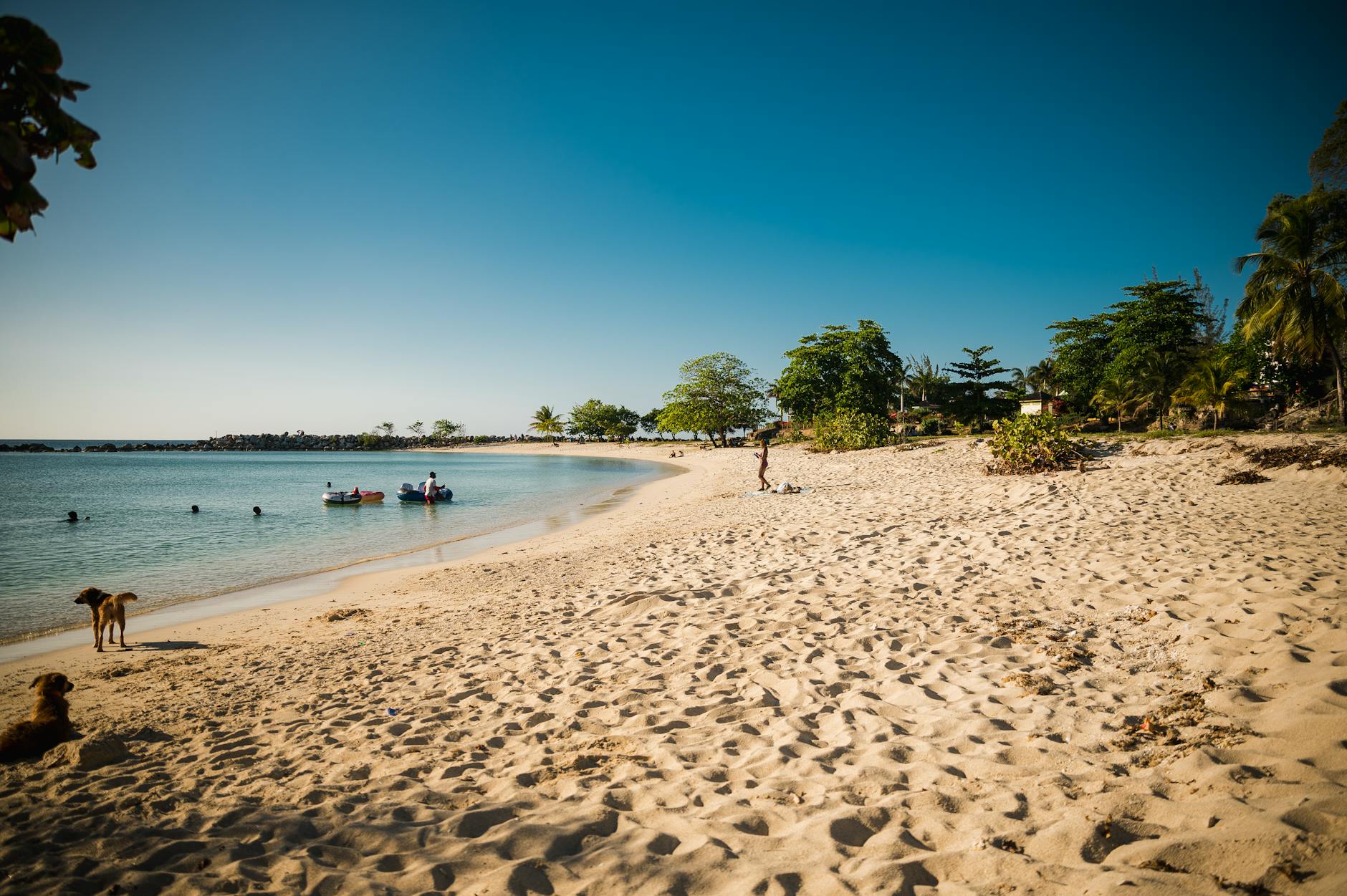
Enjoy a relaxing day at Montego Bay's scenic beach with clear waters and vibrant atmosphere.
Photo by Dre Dawkcide on Pexels · Pexels License
Joyful parade of people in vibrant cultural costumes celebrating outdoors.
Photo by Asso Myron on Pexels · Pexels License
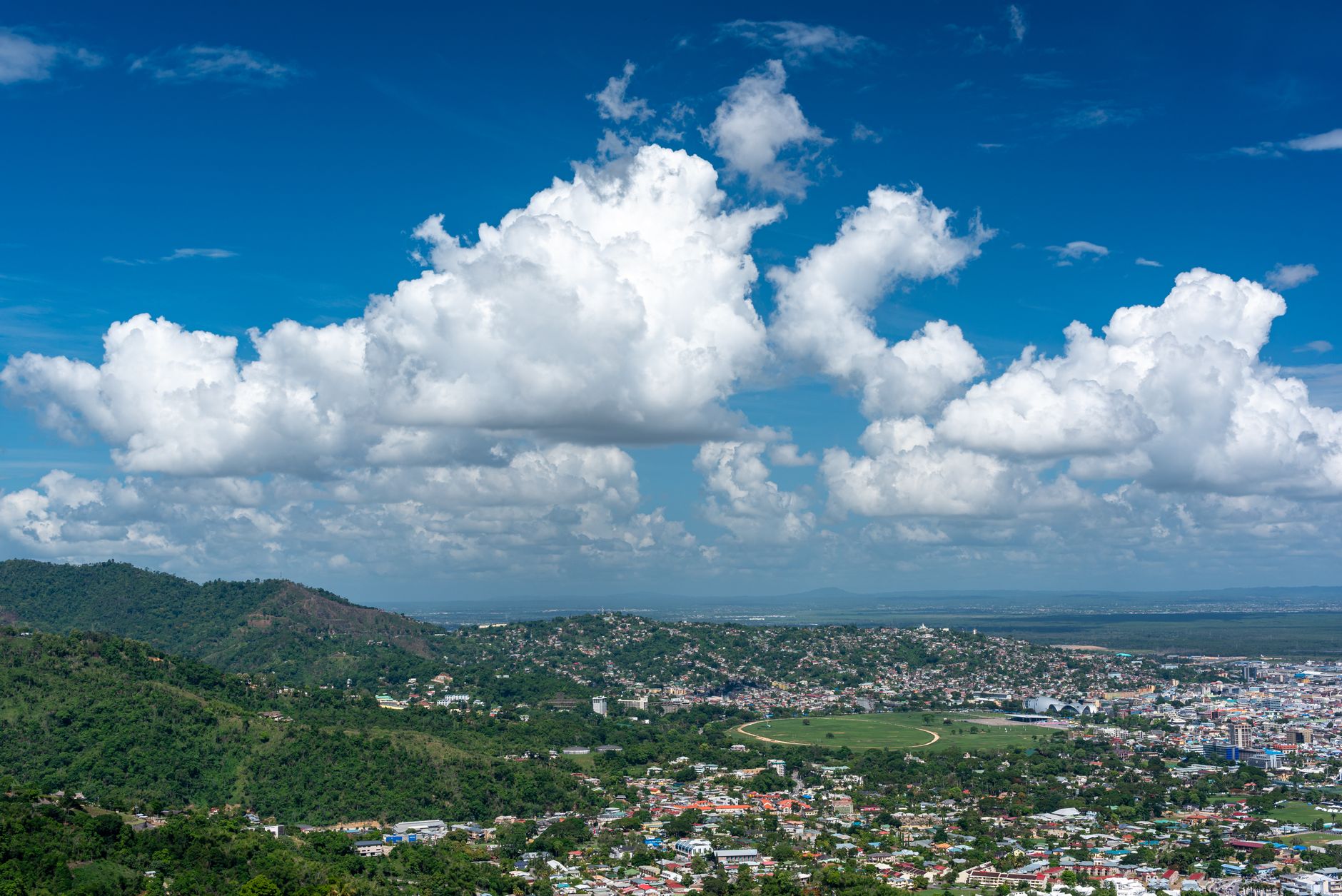
Breathtaking aerial view of Port of Spain with lush hills and clear skies, showcasing Trinidad's vibrant cityscape.
Photo by Dominik Gryzbon on Pexels · Pexels License
A classic Washington State ferry navigating the tranquil waters of Puget Sound.
Photo by Alex Moliski on Pexels · Pexels License
A dog lounging under a palm tree on a coastal pathway in Montego Bay, Jamaica.
Photo by Malcolm Garret on Pexels · Pexels License
Top Monuments in Jamaica
Practical Information
Visa
US passport holders can usually enter Jamaica visa-free for up to 6 months. UK travelers are generally admitted for up to 90 days, while EU stay lengths vary by nationality, so check Jamaica PICA before you book a long stay. All travelers should complete the C5 immigration and customs form and carry proof of onward or return travel.
Currency
Jamaica uses the Jamaican dollar, written as JMD or J$. US dollars are widely accepted in Montego Bay, Negril and Ocho Rios, but local-currency pricing is often better, especially for taxis, small restaurants and route transport. In restaurants, 10-15% is standard if service was not already added to the bill.
Getting There
Most visitors arrive through Sangster International Airport in Montego Bay or Norman Manley International Airport in Kingston. Ian Fleming International Airport near Ocho Rios handles a smaller number of flights and charters. Choose Montego Bay for the west and north coast, and Kingston for the Blue Mountains, Port Antonio and the southeast.
Getting Around
Jamaica works by road, not rail. Knutsford Express is the easiest intercity coach for travelers, while JUTC is more useful around Kingston and on a handful of longer routes. Rental cars make sense for Treasure Beach, Accompong and the Blue Mountains, but avoid intercity driving after dark.
Climate
December through April is the driest stretch and the easiest time for island-wide travel, with lower humidity and steadier beach weather. May and November often offer the best trade-off between price and weather. Hurricane season runs from June 1 to November 30, with the highest risk from August to October.
Connectivity
Mobile coverage is good in Kingston, Montego Bay, Negril and along most of the north coast, then patchier in the Blue Mountains and parts of Portland. Hotels and guesthouses usually offer Wi-Fi, but speeds can dip outside the main resort corridors. A local Digicel or Flow SIM is useful if you plan to move between towns or work remotely.
Safety
Most trips are trouble-free if you use the same judgment you would in any city: book licensed taxis, keep valuables out of sight and ask your hotel which areas to avoid after dark. Kingston, Montego Bay and Spanish Town all have neighborhoods where visitors should be more careful, especially at night. For road travel, daytime transfers are the safer call.
Taste the Country
restaurantAckee and saltfish breakfast
Morning plate. Ackee, saltfish, boiled green banana, yam, fried dumpling. Family table, roadside cookshop, late start after a long night.
restaurantJerk pork at a roadside pan
Chopped on a board, eaten with festival or hard-dough bread, fingers first. Evening ritual. Smoke, pepper, beer, friends talking too loudly.
restaurantEscovitch fish with bammy
Whole fried fish, vinegar, onion, carrot, Scotch bonnet. Beach lunch, Sunday stop, sea still on the skin. Bammy catches the sharp juices.
restaurantPatty with coco bread
Paper bag lunch. Schoolyard logic. Hot beef patty tucked into soft coco bread, eaten standing up before the crust burns your hand.
restaurantSunday rice and peas with oxtail
No rush dish. Rice and peas, thick gravy, butter beans, serious appetite. Best with relatives, or with people who behave like relatives by the second plate.
restaurantMannish water after the dance
Peppery goat soup at dawn or after a session. Tin cup, plastic spoon, noisy company. Restorative force, or at least the promise of it.
restaurantRoast breadfruit with callaloo
Breakfast or light supper. Breadfruit split open, butter melting, callaloo soft with thyme and onion. Eaten slowly, often on a veranda while the day decides what it wants.
Tips for Visitors
Pay in JMD
Use Jamaican dollars for small purchases and taxi rides. US cash is handy, but local-currency prices are usually better outside big hotels.
Book Coaches Early
Reserve Knutsford Express seats before busy weekends and public holidays. The useful departures between Kingston, Montego Bay and Negril do sell out.
Forget Trains
Do not plan around rail. Jamaica has no practical passenger train network for visitors, so every long-distance trip is by road or the occasional domestic flight.
Greet First
Say good morning or good afternoon before asking a question. In Jamaica that is basic respect, not a quaint extra, and people notice when you skip it.
Start Early
Long drives work better in the morning, when roads are calmer and afternoon rain has not started yet. This matters even more on Kingston to Port Antonio or south-coast routes.
Check Added Charges
Hotels and restaurants may add tax and service separately. Read the final bill before tipping again, especially in resort areas around Montego Bay and Ocho Rios.
Buy a SIM
If you are moving between Kingston, Treasure Beach and Port Antonio, a local SIM saves hassle. Hotel Wi-Fi is common, but it is not equally reliable in every town.
Use Licensed Taxis
For airport arrivals, late nights and cross-town rides, use hotel-arranged or licensed taxis. Route taxis are cheap and useful in daylight, but they are not the best first move with luggage.
Explore Jamaica with a personal guide in your pocket
Your Personal Curator, in Your Pocket.
Audio guides for 1,100+ cities across 96 countries. History, stories, and local insight — offline ready.
Audiala App
Available on iOS & Android
Join 50k+ Curators
Frequently Asked
Do US citizens need a visa for Jamaica? add
Usually no. US passport holders can enter Jamaica visa-free for tourist stays of up to 6 months, but you still need a valid passport, proof of onward or return travel, and the completed C5 entry form.
How many days do you need in Jamaica? add
Seven to ten days is the sweet spot for most travelers. That gives you time to combine one city such as Kingston or Montego Bay with a second coast, instead of spending half the trip in transfers.
Is Jamaica expensive for tourists? add
It can be moderate or very expensive depending on where you sleep and how you move around. Budget travelers can manage on about US$50-90 a day, while resort-heavy trips around Montego Bay, Negril and Ocho Rios often climb well past US$200 a day.
Can you use US dollars in Jamaica? add
Yes, especially in resort towns, but you should not rely on them for every purchase. Local transport, roadside food stalls and smaller shops usually work better in Jamaican dollars, and the exchange math is often less painful that way.
What is the best month to visit Jamaica? add
January through March is the safest answer for weather. If you want better prices without stepping deep into hurricane season, May and November are often the smartest compromise.
Is it safe to drive in Jamaica? add
Yes in daylight if you are an experienced, patient driver. Roads can be narrow, signage is uneven once you leave the main corridors, and night driving between cities is the part most travelers should avoid.
What is the best way to get around Jamaica without a car? add
Intercity coach plus pre-booked taxi is the easiest combination. Knutsford Express covers the main traveler routes, and local taxis fill the gaps better than trying to decode the full route-taxi system on arrival.
Do I need cash in Jamaica or can I use cards everywhere? add
You need both. Cards work in hotels, supermarkets and many restaurants, but cash is still the practical tool for tips, small eateries, drivers and beachside vendors.
Should I stay in Kingston or Montego Bay? add
Choose Kingston for music, museums, food and day trips to Port Royal or the Blue Mountains. Choose Montego Bay if you want the easiest airport arrival, resort infrastructure and quick access to Negril, Falmouth and the north coast.
Sources
- verified Passport, Immigration and Citizenship Agency of Jamaica (PICA) — Official visa, nationality and entry requirement source, including country-by-country visa exemptions.
- verified Visit Jamaica — Jamaica Tourist Board travel information, airport guidance and visitor planning basics.
- verified Knutsford Express — Scheduled intercity coach network used by travelers between major Jamaican towns.
- verified JUTC — Government bus operator with Kingston-area services and selected longer-distance routes.
- verified UNESCO World Heritage Centre — Authoritative reference for the Blue and John Crow Mountains site and Port Royal's 2025 inscription.
Last reviewed: