Plan and listen to Porta Santa Croce with Audiala.
Audio guide in your pocket, itinerary in your browser. Built for the way you actually visit.
Introduction
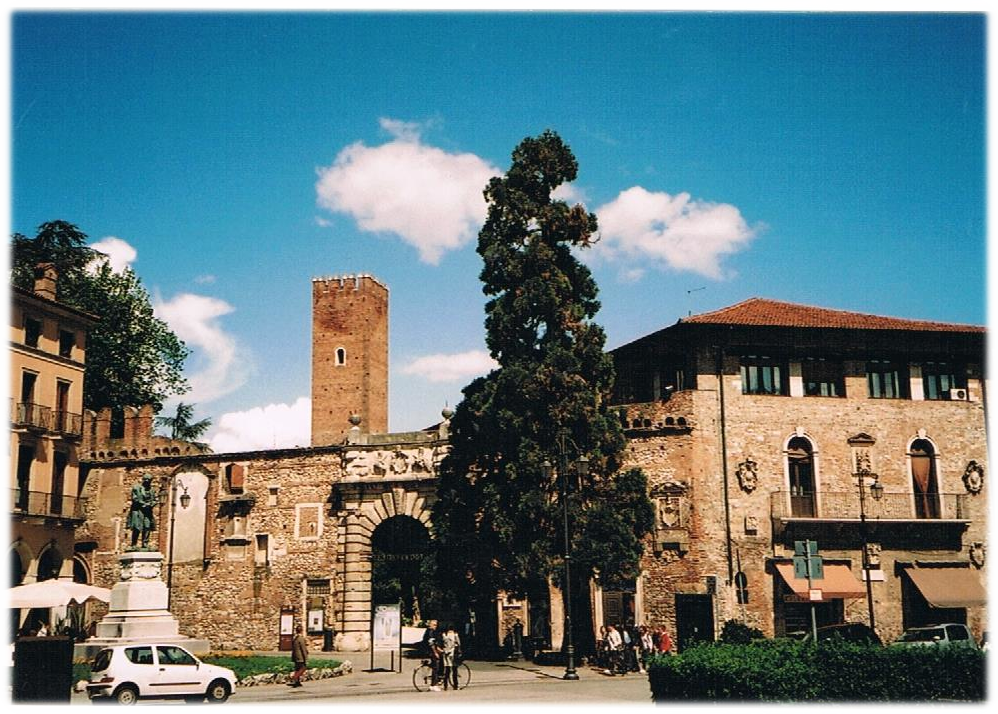
Porta Santa Croce stands as one of Vicenza’s most iconic and best-preserved medieval gateways. This landmark offers visitors a fascinating immersion into the city's military, architectural, and cultural history, reflecting centuries of urban evolution and community life. Built during the Scaligeri rule in the late 14th century, Porta Santa Croce served both as a defensive stronghold and as a ceremonial entrance, marking Vicenza’s expansion and strategic significance in northern Italy (Vicenzanews, Italianostra).
Nestled near the Bacchiglione River, the gate is a notable example of medieval engineering with its robust masonry, towers, and remnants of its original drawbridge mechanisms. Beyond its military purpose, the site is tightly connected to the Crociferi religious order, whose charitable institutions profoundly shaped the neighborhood’s social fabric (Wikipedia).
This guide explores Porta Santa Croce’s layered history, architectural features, recent restoration efforts, and practical visitor information, including opening hours and ticket policies. It also highlights nearby attractions and offers tips to maximize your visit to Vicenza’s UNESCO-listed heritage sites.
Historical Background: Medieval Foundations and Urban Evolution
Early Fortifications
Vicenza’s defensive structures evolved over centuries, starting with settlements at the confluence of the Astico and Retrone rivers. By the 10th and 11th centuries, prominent rulers empowered the city’s bishops to erect walls and castles, resulting in a fortified urban core with key gates and towers (Vicenzanews).
Scaligeri Era and the Construction of Porta Santa Croce
The most significant developments occurred under the Scaligeri of Verona (1311–1387), who expanded Vicenza’s outer defenses and built new gates, including Porta Santa Croce. Constructed between 1381 and 1385, the gate became a cornerstone of the city’s fortifications, controlling access from the west and safeguarding the expanding suburbs (Ecovicentino).
Later Developments: Visconti and Venetian Influence
The Visconti and, later, the Venetian Republic further enhanced Vicenza’s fortifications in the 15th century, introducing innovations such as cylindrical towers to counter new artillery threats. While some planned expansions were halted during the plague of 1630, the city’s fortification system continued to adapt and evolve (Italy Heritage).
Architectural Features and Military Engineering
Porta Santa Croce is a remarkable example of late medieval military architecture. The structure consists of:
- Lower Section: A roofless passage with broad round arches (arcate a tutto sesto) for traffic and ceremonial entry.
- Defensive Tower: A taller, pavilion-roofed tower that functioned as a lookout and guard station.
- Materials: The gate is constructed from local Berici stone, brick fragments, and marble slabs, reflecting regional building techniques (Italianostra).
- Drawbridge Mechanisms: While the original drawbridges are gone, anchoring recesses (scassi) remain visible, attesting to the gate’s defensive function.
- Integration: The gate connects seamlessly to the city’s outer walls, with remaining moats and the Seriola canal providing additional protection (Gilberto Padovan Editore).
Porta Santa Croce is the most intact of Vicenza’s surviving gates, retaining its original layout and structural elements. Nearby, restored small towers (torrioncini) and the Bacchiglione River bridge illustrate the comprehensive defense network of medieval Vicenza.
Restoration and Conservation Efforts
Recent restoration campaigns, completed in early 2025, focused on both the medieval gate and its 19th-century annexes. Efforts included:
- Structural Consolidation: Stabilizing historic masonry and reconstructing damaged roofing.
- Surface Cleaning: Removing later accretions to reveal original stonework and architectural details.
- Restoration of Defensive Features: Conserving drawbridge recesses and adjacent towers (Ecovicentino).
- Community Engagement: The project fostered local pride and helped reintegrate Porta Santa Croce into Vicenza’s cultural itinerary (TViWeb).
Visiting Porta Santa Croce: Hours, Tickets, and Accessibility
Opening Hours
- Outdoor Access: Porta Santa Croce is an open-air monument, accessible to the public at any time, year-round.
- Guided Tours and Facilities: Official guided tours and visitor facilities typically operate from 9:00 AM to 6:00 PM. Check local tourism websites for current schedules.
Tickets
- Admission: Free to access the gate and its immediate surroundings.
- Tours & Exhibitions: Special tours or events may require advance booking and a small fee.
Accessibility
- General Access: The area is pedestrian-friendly, with paved pathways suitable for most visitors.
- Mobility: Some uneven cobblestone surfaces may present challenges; wheelchair access is generally possible but caution is advised.
Travel Tips
- Best Time to Visit: Early mornings or late afternoons offer optimal lighting for photography and a quieter atmosphere.
- What to Bring: Comfortable walking shoes and a camera for capturing the site’s details.
Guided Tours and Special Events
- Guided Tours: Offered by local agencies and the Vicenza Tourism Office, these tours provide detailed historical context and access to areas not always open to the public.
- Special Events: Medieval reenactments and cultural festivals occasionally take place at the gate, enhancing the visitor experience.
- Photographic Spots: The towers, river views, and adjacent Renaissance gardens (Giardino Salvi) are particularly photogenic.
Nearby Attractions
Porta Santa Croce’s location makes it an excellent starting point for exploring Vicenza’s other historical sites:
- Giardino Salvi: Renaissance gardens adjacent to the gate.
- Church of Santa Croce: Linked to the Crociferi order and local religious history (Wikipedia).
- Ospedale di Santa Croce: Historic hospital building nearby.
- Piazza dei Signori: The city’s main square, featuring the Basilica Palladiana.
- Teatro Olimpico: UNESCO-listed Renaissance theater.
- Villa Rotonda: Palladian masterpiece a short distance away (Places of Juma).
- Shop & Dine: Corso A. Fogazzaro offers local shops and cafes.
Frequently Asked Questions (FAQ)
Q: What are Porta Santa Croce’s visiting hours?
A: The gate is accessible outdoors 24/7. Guided tours typically run from 9:00 AM to 6:00 PM.
Q: Is there an entrance fee?
A: No. Access is free. Guided tours or nearby museums may require tickets.
Q: Are guided tours available?
A: Yes, through local agencies and the Vicenza Tourism Office.
Q: Is Porta Santa Croce wheelchair accessible?
A: Yes, with paved paths, though some areas have uneven surfaces.
Q: What else can I see nearby?
A: Giardino Salvi, Church of Santa Croce, Piazza dei Signori, Teatro Olimpico, and more.
Listen to the full story in the app
The whole Porta Santa Croce,
told well.
Audio guides for 1,100+ cities across 96 countries. History, stories, and local insight — offline ready.

Verified, and shown.
Researched and written by the Audiala editorial team from historical records, architectural archives, and local expertise.
Researched from Wikidata, Wikipedia & official sources · fact-checked · How we make our guides →