Introduction
The equestrian statue of Bartolomeo Colleoni in Venice is an emblem of the city's storied past and artistic grandeur. Located in Campo Santi Giovanni e Paolo, this statue stands as a testament to Bartolomeo Colleoni, a notable condottiero of the Renaissance era. Born in 1400, Colleoni's military career and strategic prowess earned him a revered place in Venetian history (Wikipedia). His contributions were significant, culminating in his appointment as captain-general for life in 1455 (Britannica).
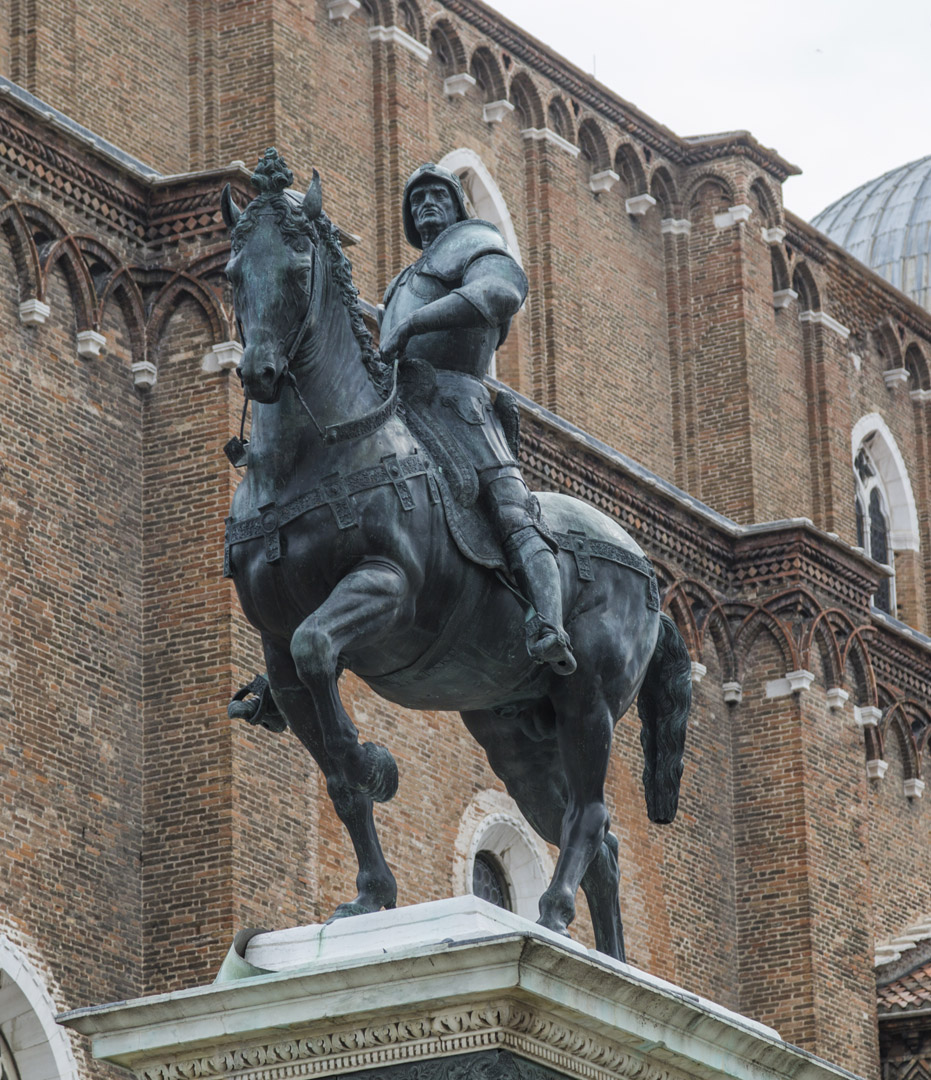
Crafted by the illustrious Renaissance artist Andrea del Verrocchio between 1480 and 1488, the statue showcases Colleoni in a commanding pose, symbolizing his military might and leadership. The dynamic composition and lifelike representation set a new standard for equestrian statues in the Renaissance (Wikiwand). Visitors to Venice are drawn to this statue not only for its artistic excellence but also for its historical significance.
Historical Background
Bartolomeo Colleoni: The Man Behind the Statue
Bartolomeo Colleoni (1400 – 1475) was a prominent Italian condottiero, a professional military leader who commanded mercenary troops during the Renaissance. Born in Solza, near Bergamo, Colleoni hailed from a noble family that had been exiled by the Visconti of Milan. His father, Paolo Colleoni, seized the castle of Trezzo but was assassinated by his cousins, likely under orders from Filippo Maria Visconti, Duke of Milan (Wikipedia).
Colleoni's military career began in the service of various condottieri, including Braccio da Montone and Carmagnola. His prowess on the battlefield earned him a reputation as one of the foremost tacticians and disciplinarians of the 15th century. He served both the Venetian and Milanese states at different times, but his most significant contributions were to the Republic of Venice, where he was appointed captain-general for life in 1455 (Britannica).
Military Achievements and Innovations
Colleoni was a pioneer in the use of field artillery tactics. He innovatively assigned light field pieces to the rear of his infantry or cavalry, allowing them to be fired through prearranged gaps in the forward units. This strategic placement significantly enhanced the effectiveness of his troops in battle (Wikipedia).
Throughout his career, Colleoni recaptured numerous towns and districts for Venice from the Milanese. Notable victories include battles at Brescia, Verona, and on the Lake of Garda. His leadership was instrumental in maintaining Venetian dominance in the region during a period of intense military conflict (Wikipedia).
Patron of the Arts and Legacy
Beyond his military exploits, Colleoni was also a notable patron of the arts. He invested in the refurbishment of the Roman baths at Trescore Balneario and commissioned various works of art. His most enduring legacy, however, is the equestrian statue created by Andrea del Verrocchio, which stands in Campo Santi Giovanni e Paolo in Venice (Wikipedia).
The Equestrian Statue: A Renaissance Masterpiece
The equestrian statue of Bartolomeo Colleoni, created by Andrea del Verrocchio between 1480 and 1488, is a significant work of Renaissance art. Standing at a height of 395 cm (excluding the pedestal), the statue portrays Colleoni in a commanding pose, symbolizing his military prowess and leadership. It is the second major equestrian statue of the Italian Renaissance, following Donatello's statue of Gattamelata (Wikiwand).
Verrocchio, a renowned sculptor and painter, was commissioned to create the statue as a tribute to Colleoni's contributions to Venice. The statue was cast in bronze after Verrocchio's death by Alessandro Leopardi. Although Colleoni had requested that the statue be placed in Piazza San Marco, it was ultimately installed near the Scuola Grande of St Mark outside the Church of SS Giovanni e Paolo, as no monument was permitted in the piazza (Wikipedia).
Colleoni's Final Years and Death
In his later years, Colleoni retired to the castle of Malpaga, which he had purchased and restored. Despite his frequent changes of allegiance, he was known for his integrity and did not engage in the raping and robbery that characterized many other soldiers of fortune. He devoted his time to agricultural improvements and charitable works on his vast estates (Wikipedia).
Colleoni passed away in 1475 at Malpaga. In his will, he left a substantial sum to the Republic of Venice for the Turkish war, with the stipulation that an equestrian statue of himself be erected in Piazza San Marco. Although his wish was not fully realized, the statue remains a testament to his enduring legacy and the high regard in which he was held by the Venetian Republic (Wikipedia).
Significance of the Statue Today
Today, the equestrian statue of Bartolomeo Colleoni is not only a remarkable piece of Renaissance art but also a symbol of Venice's rich history and cultural heritage. It stands as a tribute to a man who played a crucial role in the military and political landscape of 15th-century Italy. Visitors to Venice can admire the statue in Campo Santi Giovanni e Paolo, where it continues to inspire awe and admiration for its artistic and historical significance (Wikiwand).
Visitor Tips
For those planning to visit the statue, it is advisable to go early in the morning to avoid the crowds and enjoy a peaceful atmosphere. August can be particularly busy due to the summer holidays, so early visits can also provide better opportunities for photography without the throngs of tourists (Venice Insider Guide).
Visiting Hours and Tickets
The statue can be viewed at any time as it is located in a public square. There is no entrance fee to see the statue. However, visitors interested in a guided tour can check local tour providers for available options. It's recommended to book these tours in advance, especially during peak tourist seasons.
Accessibility and Nearby Attractions
The statue is accessible to visitors with disabilities, and the area around Campo Santi Giovanni e Paolo is relatively flat and easy to navigate. Nearby attractions include the Church of SS Giovanni e Paolo, the Scuola Grande of St Mark, and the famous Rialto Bridge. Exploring these sites can provide a comprehensive experience of Venice's historical and cultural heritage.
Best Times to Visit
The best times to visit the statue are during the early morning or late afternoon, avoiding the midday heat and peak tourist crowds. Spring and autumn offer mild weather, making these seasons ideal for visiting Venice and its historical sites.
How to Get There
The statue is located in Campo Santi Giovanni e Paolo, which is easily accessible by foot from various parts of Venice. Visitors can also take a vaporetto (water bus) to the nearby Rialto stop and walk to the statue. Detailed directions can be found on local maps and tourist guides.
Unique Photographic Spots
For photography enthusiasts, the best angles of the statue can be captured from the front, highlighting Colleoni's commanding pose against the backdrop of the historic buildings. Early morning light provides a soft glow, enhancing the details of the bronze sculpture.
FAQ
What are the visiting hours for the Bartolomeo Colleoni statue?
The statue is located in a public square and can be viewed at any time.
Where can I buy tickets for the Bartolomeo Colleoni statue?
There is no entrance fee to view the statue, but guided tours can be booked through local tour providers.
What are the best times to visit the Bartolomeo Colleoni statue?
Early morning or late afternoon are the best times to visit to avoid crowds and enjoy better lighting for photography.
Listen to the full story in the app
Your Personal Curator, in Your Pocket.
Audio guides for 1,100+ cities across 96 countries. History, stories, and local insight — offline ready.
Audiala App
Available on iOS & Android
Join 50k+ Curators
Sources
- verified
- verified
- verified
- verified
- verified
- verified
- verified
- verified
- verified
- verified
- verified
- verified
- verified
Last reviewed: