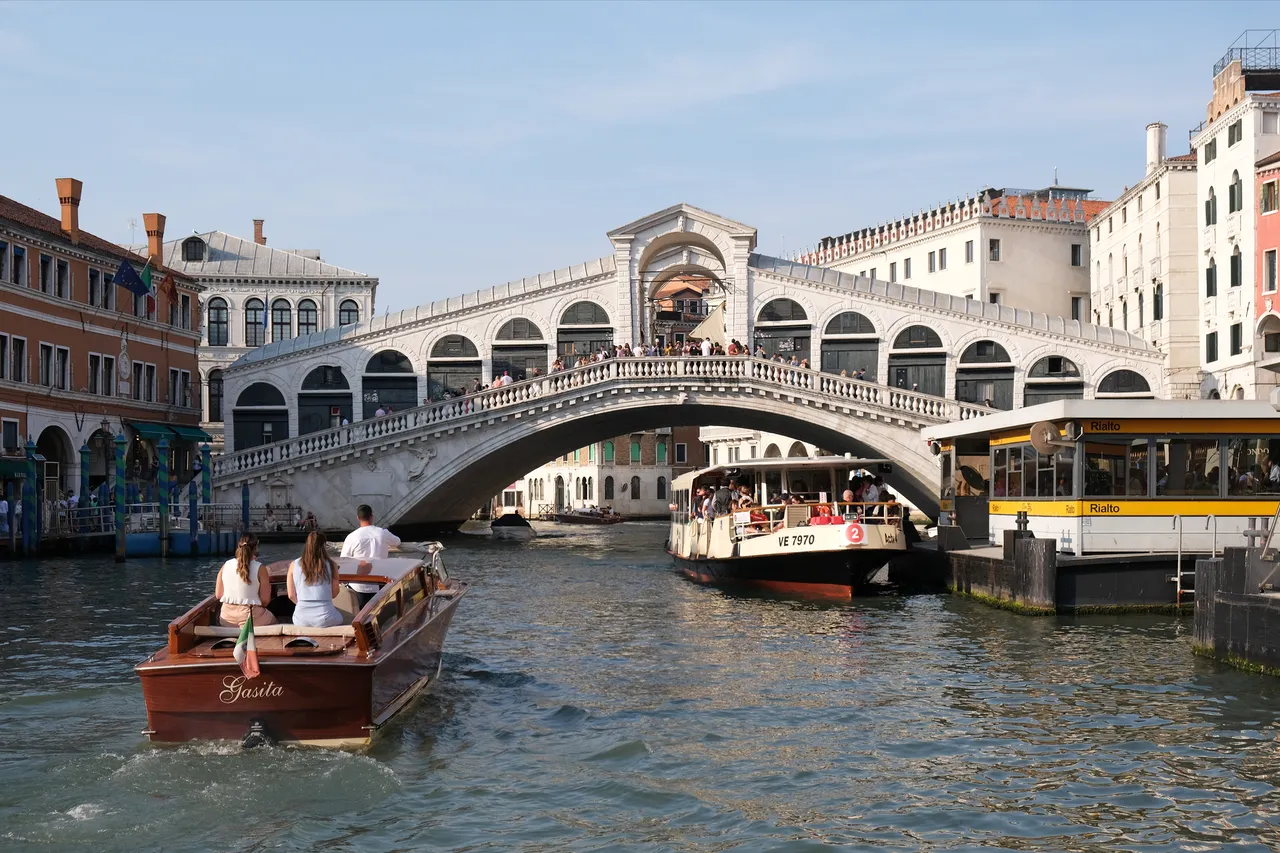
An introduction.
Researched by the Audiala editorial team from historical records, architectural archives, and local expertise.
MMost tourists think Michelangelo designed the Rialto Bridge. He didn't. The man who beat Palladio, Sansovino, and Vignola for Venice's most contested commission was a 76-year-old state engineer named Antonio da Ponte, and his peer Vincenzo Scamozzi publicly predicted the structure would collapse. Scamozzi was wrong. Today the arch spans Venice's Grand Canal in a single 28-meter sweep of Istrian limestone. Pink at dusk. Come to Italy's most-photographed bridge for the view; stay for the carved revenge buried in its stones.
For 673 years this was the only dry crossing of the Grand Canal. One bridge. Every step of commerce between the political seat at San Marco and the financial pulse at Rialto funneled here, until Ponte dell'Accademia opened in 1854. Then the chokehold loosened. Myth didn't.
Stand on the central walkway any morning and the bridge still does its old job. Couriers shoulder past with hand-trolleys. Fishmongers shout in Veneziano at the banchi on the north bank — a market that has run there since 1097, three generations deep in some families. Same dialect. Same dawn shift.
Come at 7 AM when the Erbaria stalls open and the market still belongs to Venetians. Or after dark. The limestone empties of crowds; even the gondoliers go home. Walk south fifteen minutes to Chiesa Di San Pantalon for the largest oil-on-canvas painting in the world. Ten minutes north sits Santi Giovanni E Paolo, the Pantheon of Venetian doges.
ROCKY'S ITALY: Venice - The Rialto Bridge
Rocky Ruggiero01 What to see.
The central portico and its 421 cipher
Antonio da Ponte's impossible single arch
The mockers' capitals — Venice's rudest joke in stone
02 In pictures.


Watch & Explore Rialto Bridge.
Plan and listen to Rialto Bridge with Audiala.
Audio guide in your pocket, itinerary in your browser. Built for the way you actually visit.
Tickets & tours.
These are guided options from our partners — same price as booking direct.
Prices are indicative — final pricing and availability are confirmed at checkout. Audiala may earn a commission from bookings made through these links.
Also on GetYourGuide
More tours for Rialto Bridge
Curated from GetYourGuide. Same price as official, free cancellation on most.
 GetYourGuide
Venice: Grand Canal Boat Tour
from
€45
 GetYourGuide
Venice: City Center Walking Tour with Gondola Ride Option
from
€15
 GetYourGuide
Venice: Photoshoot at The Grand Canal & Rialto Bridge
from
€58
 GetYourGuide
From Milan: Venice Full-Day Guided Tour With Boat Ride
from
€159
Prices shown are indicative — final pricing and availability are confirmed at checkout. Audiala may receive a commission from bookings made via these links.
03 Visitor logistics.
The practical scaffolding for a good visit — kept short.
Getting There
Walk — primary access. ~20 min from Santa Lucia train station, 6–7 min from Piazza San Marco. By water: vaporetto stop 'Rialto' (lines 1 and 2) on the San Marco side, 'Rialto Mercato' (line 1) on the market side. Single ACTV ticket €9.50, 75-min validity. No cars in historic centre — park at Piazzale Roma or Tronchetto, then walk or boat in.
Opening Hours
As of 2026, the bridge is public infrastructure — open 24/7, free, no gates, no tickets. Shops on the bridge keep typical Venice retail hours (~10:00–19:30). The adjacent Rialto fish market (Pescheria) runs Tue–Sat ~07:30–12:00, closed Sunday and Monday.
Time Needed
Quick crossing with photos: 10–15 min. Standard visit including shops, both viewpoints, and a market peek: 30–45 min. Thorough morning — bridge, Pescheria, San Giacomo di Rialto, plus a bacaro stop: 1.5–2 hours. Add 20–30 min in peak season for crowd flow.
Accessibility
The bridge is not wheelchair accessible — stepped marble climb on both sides, no ramp, no elevator, no central handrails. Surface gets slippery when wet; strollers must be carried. Wheelchair users cross the Grand Canal here via vaporetto lines 1 or 2 instead — boarding pontoons at Rialto are level-access, and Disability Card holders ride at reduced fare.
Cost & Venice Access Fee
The bridge itself is free. Separate Venice city access fee runs from 3 April 2026 on selected peak days (08:30–16:00 only): €5 if booked ≥4 days ahead via Venezia Unica, €10 within 3 days or same-day. Exempt: under-14s, overnight guests, residents, disability cardholders. Fines €25–€150 if caught without the QR.
04 Tips for visitors.
Small things that change the day.
Cross at Dawn
Be on the bridge before 09:00 or after 20:00. Between 10:00 and 20:00 in peak season, foot traffic seizes up — locals describe a sweat tunnel you can't move through. Early light also gives you the empty-stone shot every guidebook uses.
Shoot From, Not On
The famous photo of the bridge isn't taken on it — it's taken from Riva del Vin on the San Polo side, or from a vaporetto on line 1. Tripods on the deck obstruct flow during peak hours and police will move you on. Drones are banned over the historic centre without ENAC permit.
Pickpocket Hotspot
Rialto Bridge and its vaporetto stop are Venice's number-one pickpocket zone — crews work the steps where tourists slow and bunch, and the boarding crush at the pontoon. Front pocket only, bag zipped and forward, no phone in a back pocket while you're framing the shot.
Don't Eat On The Bridge
Skip every restaurant with a six-language menu board and a tout outside the first 200m of either approach — overpriced, mediocre, and cover charges run €5–8/person. Walk five minutes into San Polo for the real thing. Sitting on the bridge steps to eat is fineable €100–500 under Venice's decoro rules.
Bacari Crawl, San Polo Side
Cicchetti and an ombra (small wine, €1.50–3) is how Venetians actually eat near here. All'Arco near the market is the locals' budget pick (€2–4 per cicchetto, 10:00–14:30, closed Sun); Cantina Do Mori (1462, where Casanova drank) and Cantina Do Spade (1488) are nearby. Sit-down splurge with a canal view: Bancogiro.
Market Before 10am
The Pescheria and Erbaria are genuine working markets until about 10:30 — fishmongers shouting in Venetian, restaurant chefs picking moeche (soft-shell crab) in spring and autumn. After 11:00 it tips touristy. Closed all day Sunday and Monday for fish.
Use The Traghetto
If you don't need the bridge itself, skip the crowd entirely — take a traghetto (standing gondola ferry) for €2 at San Tomà or Santa Sofia. Faster than the bridge stairs, no scrum, and you cross the Grand Canal upright in a working gondola.
Bracelet & Petition Scams
Bridge approaches attract the friendship-bracelet trick (string knotted on your wrist, then €10–20 demanded), the 'free' rose handoff, and clipboard petitioners working as pickpocket distractions. Keep hands in pockets, don't accept anything offered, walk through without slowing.
Where to Eat
Don't Leave Without Trying
L' Bacaro de' Bischeri
quick biteOrder: The Vasari, which features a fragrant and rich truffle cream.
This is the go-to spot for a quick, high-quality bite near the Rialto. The staff are incredibly friendly and the ingredients are fresh enough to keep the locals queuing out the door.
Bakarò
local favoriteOrder: The carbonara is widely considered the best in the city—perfectly creamy and full of flavor.
A true Venetian institution that balances a vintage, brick-clad atmosphere with elevated comfort food. It captures the authentic hum of locals laughing and enjoying life, making it a must-visit.
Impronta Restaurant Venice
local favoriteOrder: The gnocchi with duck ragù is rich and perfectly cooked, followed by their heavenly tiramisu.
Located away from the heavy tourist crush, this spot offers a contemporary, relaxed vibe with seasonal ingredients that feel both creative and deeply rooted in tradition.
Il Refettorio
fine diningOrder: The tiramisu is an absolute essential here, frequently cited as not to be missed.
This is a genuine gastronomic gem that avoids the 'tourist trap' label often found near the bridge. The intimate atmosphere and meticulous attention to detail make it perfect for a final, memorable dinner.
Dining Tips
- check Tipping is not mandatory; simply round up the bill or leave a small amount if the service is exceptional.
- check Look for the 'coperto' on your bill, which is a standard cover charge for bread and table settings.
- check Carry cash for smaller bacari, as they often prefer it for quick cicchetti and wine rounds.
- check Ask 'Il conto, per favore' to request your bill, as it will not be brought to you automatically.
- check If you are unsure about card payments, just ask 'Posso pagare con la carta?' before you order.
- check The Rialto fish market is best visited early, between 7:30 AM and 12:00 PM, Tuesday through Saturday.
Restaurant data powered by Google
05 What the Bridge Was Always For
Forget the architecture for a moment. Rialto's reason for existing — across pontoon, wood, and stone, across more than 800 years of rebuilding — has never changed. It's the market on the north bank.
Records date that market to 1097, when the Orio family donated their landholdings to public patrimony. A bridge had to reach it. The first crossing — Nicolò Barattieri's pontoon in 1181 — gave way to a wooden span with a drawbridge in 1255, then to the stone arch that still stands. Four modes. One destination.
Antonio da Ponte's Eighty-Eight-Year Argument
Tourists assume the stone bridge was always going to look like this — single white arch, classical, inevitable. It wasn't. Palladio submitted a graceful three-arch fantasy that Canaletto would later paint as if real; Sansovino, Vignola, and Scamozzi each drew their own. Senate killed every plan.
Records show 88 years of debate. From 1503 to 1591, four bridge collapses, two plagues, and two Doge's Palace fires kept derailing the project. The Senate finally chose on 28 January 1588. They passed over Palladio, Sansovino, and Vignola for a 76-year-old state engineer named Antonio da Ponte. Total outsider. Six months in, Senator Marcantonio Barbaro — leader of the rejected three-arch lobby — moved to halt construction, claiming the piers had already failed. Da Ponte fought back. He produced structural models within weeks. Work resumed.
Why did Da Ponte win? Because the celebrity multi-arch designs would have blocked the cargo boats reaching the Fontego dei Tedeschi warehouse upstream — and the bridge existed to serve the market, not the other way around. Function first. A single 28-meter span on 12,000 elm and larch piles driven into lagoon mud was the engineering bet that kept commerce moving. Scamozzi predicted ruin. The arch has stood 434 years. When you cross it now, you're crossing infrastructure that was always, stubbornly, about the trolleys of fish below.
What Changed
What Endured
Listen to the full story in the app
The whole Rialto Bridge,
told well.
Audio guides for 1,100+ cities across 96 countries. History, stories, and local insight — offline ready.
06 Frequently asked.
The questions travellers send us most about Rialto Bridge.
Is the Rialto Bridge worth visiting?
Yes, but cross it at dawn or after 22:00, not midday. Between 10:00 and 20:00 in season the central passage becomes a shoulder-to-shoulder scrum where you can barely move. Empty, the single 28m Istrian-stone arch over the Grand Canal is one of the great Renaissance engineering sights in Europe — Antonio da Ponte built it 1588–1591 on roughly 12,000 elm and larch piles and it still stands.
How long do you need at the Rialto Bridge?
15 minutes to cross and photograph, 45 minutes if you want to browse the shops and look at both sides properly. Add another hour if you pair it with the adjacent Mercato di Rialto and a cicchetti stop in San Polo, which is the way locals actually use the area.
How much does it cost to visit the Rialto Bridge?
Nothing. The bridge is a public street, open 24/7, no tickets, no queue, no booking. The only fee that may apply is Venice's separate city access charge (€5 booked ahead, €10 last-minute) on selected peak days from 3 April 2026, 08:30–16:00, bookable at cda.veneziaunica.it.
What is the best time to visit the Rialto Bridge?
Before 09:00 or after 20:00. Pre-7am the stone is empty, the light is soft, and the Pescheria fishmongers are setting up below — Venice at its most honest. Sunset looks lovely in photos but is the worst crush of the day; you'll spend it being elbowed.
How do I get to the Rialto Bridge?
Walk, or take vaporetto lines 1 or 2 to the "Rialto" stop (line 1 also stops at "Rialto Mercato" on the San Polo side). It's about 20 minutes on foot from Santa Lucia train station and 6–7 minutes from Piazza San Marco through the Mercerie. No cars enter the historic centre — park at Piazzale Roma or Tronchetto.
Is the Rialto Bridge wheelchair accessible?
No. It's a steep stepped Renaissance bridge with no ramp and no lift, and the Comune di Venezia does not list it among the city's accessible bridges. Cross the Grand Canal instead on vaporetto line 1 or 2 — the boarding pontoons are level-access and disability cardholders ride at reduced fare.
What should I not miss at the Rialto Bridge?
Three things hidden in plain sight. The Annunciation reliefs on the south side (Gabriel, dove, Mary) point at Venice's mythical founding date of 25 March 421 — the Latin inscription naming Doge Pasquale Cicogna spells out the cipher "urbis condite 1170" (1591 minus 1170). At the San Polo foot, the Palazzo dei Camerlenghi carries crude bas-reliefs mocking two doubters who bet their genitals the bridge would collapse. And look down — the central steps are visibly dished from four centuries of feet.
What is around the Rialto Bridge?
The Mercato di Rialto fish and produce stalls (Tue–Sat ~07:30–12:00, closed Sun and Mon for fish), Campo San Giacometo with its claimant for oldest church in Venice, and a dense web of bacari serving cicchetti and ombre — All'Arco, Cantina Do Mori (open since 1462), Cantina Do Spade. Eat anywhere two minutes off the bridge and you'll pay half what tourist-trap menus on the approaches charge. Worth pairing with a wander through nearby Venice churches like Chiesa Di San Pantalon.
Verified, and shown.
Researched and written by the Audiala editorial team from historical records, architectural archives, and local expertise.
Construction history, dimensions, design competition, Antonio da Ponte authorship, sculptural program.
Confirmed bridge is open 24/7, free, with walking distances from station and San Marco.
2026 Venice access fee dates, prices (€5/€10), exemptions, and 08:30–16:00 window.
Official portal to book the Venice city access QR code.
Official list of bridges with stepped ramps; Rialto is not included.
Accessibility constraints around stepped bridges and accessible vaporetto routes.
Public water-bus operator — lines 1 and 2 stops at Rialto and Rialto Mercato.
Sculptural program, Annunciation reliefs, the 421 cipher inscription, mocking capitals.
Devil's pact legend and physical layout of the three lanes and shops.
Doge's processional use, Scamozzi prediction, original commercial vocation of the area.
Etymology of Rivoaltus, surrounding guild streets (Naranzaria, Erbaria, Casaria).
Decline statistics for fish, produce, butcher and goldsmith stalls; civic safeguarding debate.
Trader testimonies, opening rhythm, Tue–Sat hours, closed Sunday and Monday for fish.
Bag storage partners near the bridge at €5/bag/day.
Restaurant landscape and ratings around the bridge approaches.
Engineering analysis of the ~12,000 oak/larch piles and bridge dimensions.
World Heritage inscription context for Venice and lagoon vulnerability framing.
Researched from Wikidata, Wikipedia & official sources · fact-checked · How we make our guides →