Introduction
Palazzo Barbaro Wolkoff, located in Venice's Dorsoduro district along the iconic Grand Canal, is a striking yet often overlooked treasure in the city's architectural and cultural landscape. With its distinctive red brick façade and pronounced verticality, this palazzo represents the evolution of Venetian architecture from its early Venetian-Byzantine roots to later Gothic renovations. Though it remains a private residence without public access, Palazzo Barbaro Wolkoff is celebrated for its historical significance and its connections to renowned figures such as Russian polymath Alexander Wolkoff-Muromtsev and Italian actress Eleonora Duse. This guide explores the palazzo’s origins, architectural features, cultural associations, visitor information, and its role within Venice’s broader tapestry of historical sites (ItalyScapes, Ermak Vagus, Wikipedia).
Origins and Architectural Evolution
Early History and Location
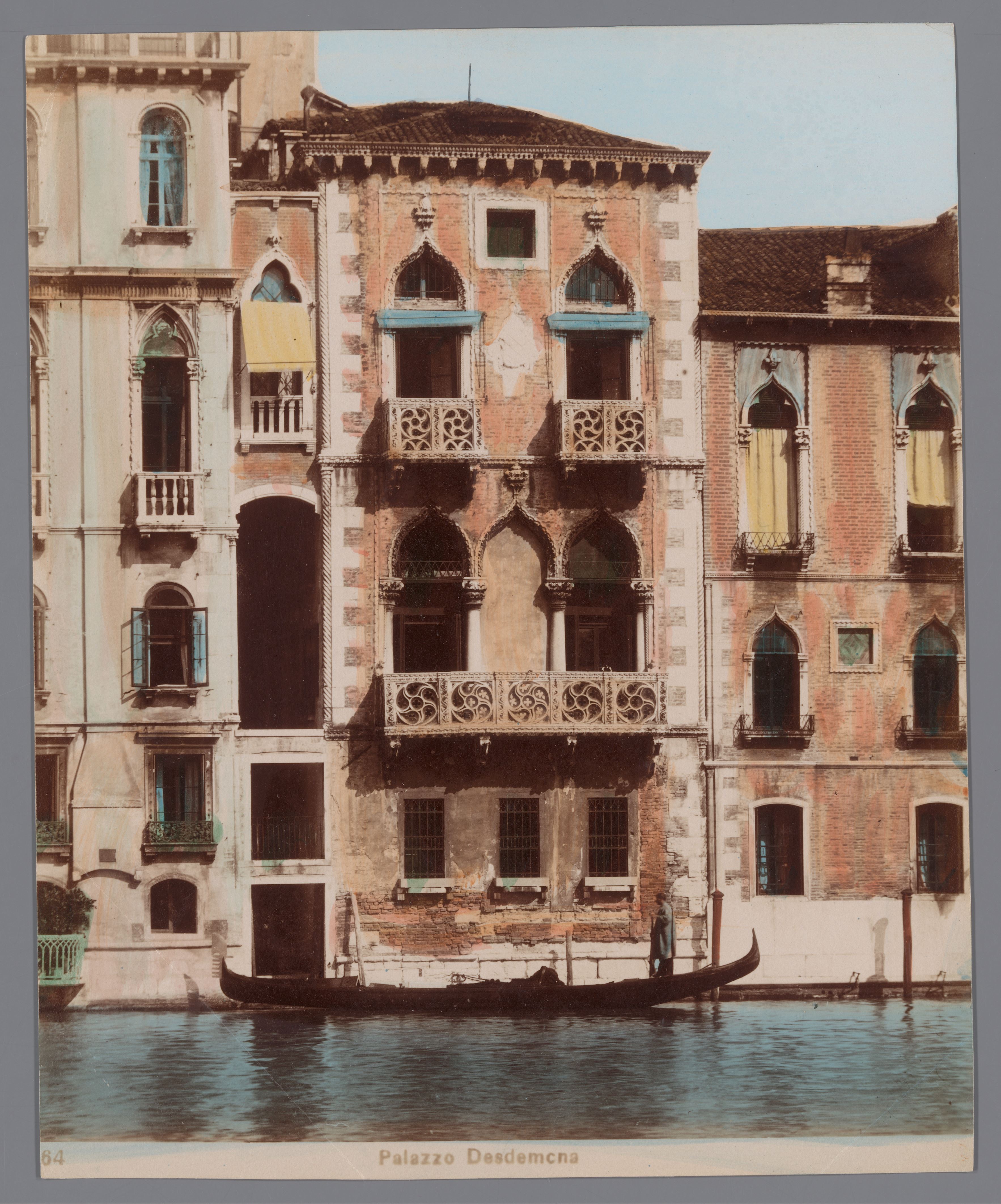
Palazzo Barbaro Wolkoff’s origins date to the medieval period, likely before the 14th century, and its initial construction was in the Venetian-Byzantine style. Situated between the famed Palazzo Dario and Palazzo Salviati in the Dorsoduro sestiere, the palazzo’s earliest features include arched windows and marble-encrusted oculi, reflecting the influence of Byzantine Venice (ermakvagus.com; italyscapes.com; wikipedia).
The building is traditionally associated with the Barbaro family, a patrician lineage influential in Venice’s political, commercial, and artistic life. The precise origins of the “Barbaro” name in this context are debated, but it is likely connected to the family’s historic presence in the neighboring area (ermakvagus.com).
Architectural Features
Palazzo Barbaro Wolkoff stands out for its unique combination of styles and its adaptation to Venice’s dense urban environment. The palazzo underwent significant Gothic renovations in the 15th century, adding pointed arches and intricate window tracery. Its five-story red brick façade—with a ground floor, mezzanine, piano nobile (main floor), and two upper stories—emphasizes verticality and asymmetry, setting it apart from its more ornate, stone-clad neighbors (italyscapes.com; byemyself.com).
Distinctive features include a hexafora (six-light window) on the main floor, asymmetrical window groupings, and later additions such as circular patere and a family coat of arms. The building’s narrow plot led to the absence of a courtyard, with a likely internal light well providing daylight to the interior (aroundus.com).
Notable Residents and Artistic Legacy
Alexander Wolkoff-Muromtsev
In 1883, Alexander Wolkoff-Muromtsev, a Russian watercolorist, botanist, and chemist, purchased the palazzo. He lived there with his daughter, supporting himself by selling Venetian watercolors to collectors including Pavel Tretyakov and Empress Alexandra Feodorovna of Russia (everybodywiki). Although sometimes described as a meeting place for artists and intellectuals, the palazzo was primarily a private residence rather than a public salon (ermakvagus.com).
Eleonora Duse
The palazzo’s cultural profile rose further in 1894, when acclaimed Italian actress Eleonora Duse resided on the top floor as Wolkoff-Muromtsev’s guest. Her presence attracted attention from the international art world and emphasized Venice’s role as a gathering place for creatives (wikipedia; italyscapes.com).
Artistic Impressions
Palazzo Barbaro Wolkoff’s façade has inspired artists beyond its residents. Claude Monet painted the building in 1908, capturing its play of light and color from a gondola on the Grand Canal (byemyself.com).
Role in Venetian Culture and History
The palazzo exemplifies Venice’s architectural evolution and adaptation to its lagoon environment. Its combination of Byzantine and Gothic elements illustrates the city’s enduring openness to artistic and cultural exchange. While less prominent than neighboring palaces like Palazzo Dario or the Palazzi Barbaro in San Marco, which were known for salons and legends, Palazzo Barbaro Wolkoff has preserved its historic character as a private residence, contributing quietly to Venice’s cosmopolitan heritage (parametric-architecture.com).
Visiting Palazzo Barbaro Wolkoff: Key Information
Public Access
Palazzo Barbaro Wolkoff is not open to the public and does not offer regular tours, tickets, or visitor facilities (italyscapes.com). There are no posted visiting hours.
How to View
Visitors can best admire the palazzo’s façade from a vaporetto (Line 1 or 2) on the Grand Canal or from the waterfront in Dorsoduro. The building’s vertical red-brick façade and Gothic windows make it an excellent subject for photography.
Accessibility
As a private residence, there is no public accessibility information. The surrounding Dorsoduro district is walkable, but Venice’s terrain includes bridges and cobblestone streets.
Nearby Attractions
The Dorsoduro district offers a variety of cultural sites:
- Palazzo Dario: Known for its colorful marble façade and mysterious legends (italyscapes.com).
- Palazzo Salviati: Renowned for its mosaic decorations.
- Gallerie dell’Accademia: Venice’s premier art museum, a short walk away.
- Peggy Guggenheim Collection: Modern art museum on the Grand Canal.
These sites are open to the public and offer guided tours.
Practical Tips and FAQs
Travel Tips
- For the best views, use a vaporetto along the Grand Canal.
- Consider guided walking tours that focus on Venetian architecture.
- Check official Venice tourism resources for updates on Dorsoduro events.
Frequently Asked Questions
Can I go inside Palazzo Barbaro Wolkoff?
No, it is a private residence and not open to public tours.
Are there tickets available?
No tickets are available, as the palazzo is not open to visitors.
Where is it located?
On the Grand Canal in the Dorsoduro district, between Palazzo Dario and Palazzo Salviati.
What architectural features make it unique?
Its blend of Venetian-Byzantine and Gothic elements, pronounced verticality, and red-brick façade.
Are any artists associated with the palazzo?
Yes, Alexander Wolkoff-Muromtsev lived there, and Claude Monet painted its façade.
Listen to the full story in the app
Your Personal Curator, in Your Pocket.
Audio guides for 1,100+ cities across 96 countries. History, stories, and local insight — offline ready.
Audiala App
Available on iOS & Android
Join 50k+ Curators
Sources
- verified
- verified
- verified
- verified
- verified
Last reviewed: