An introduction.
Researched by the Audiala editorial team from historical records, architectural archives, and local expertise.
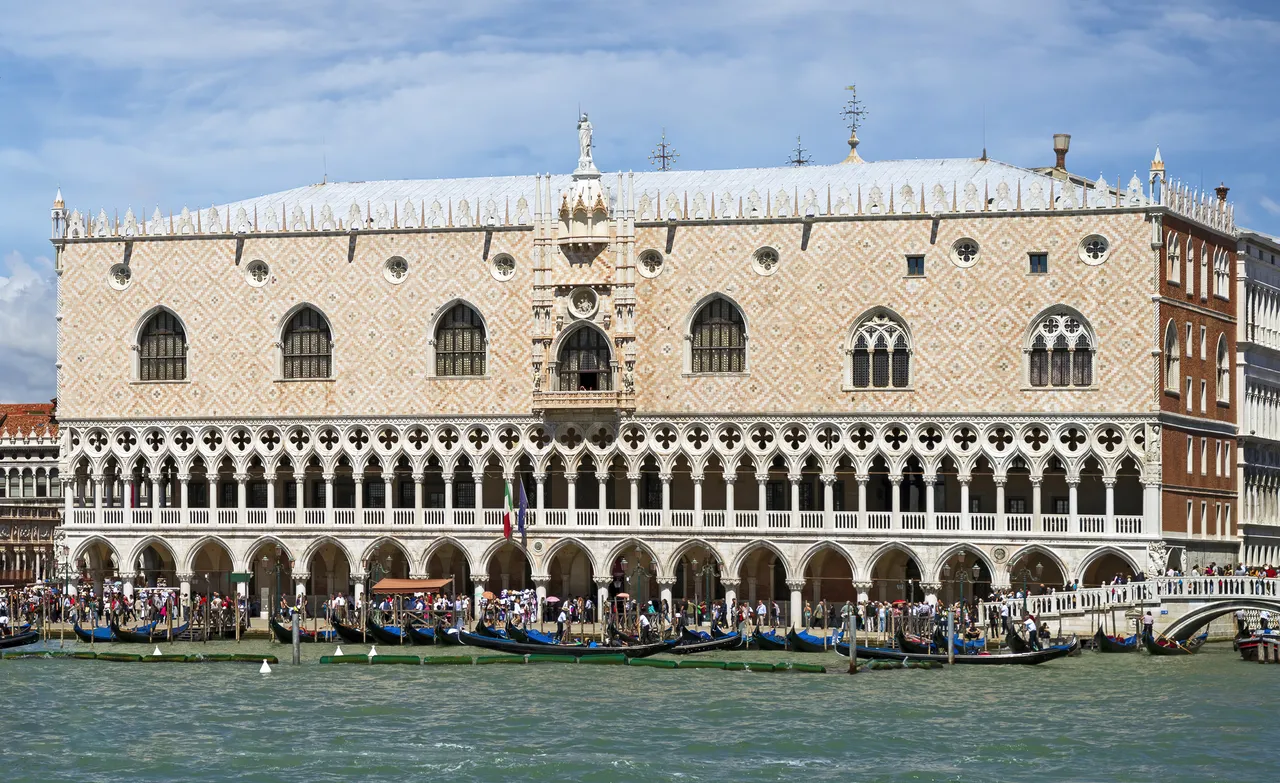
HHow do you fit an entire republic inside one building? Venice's Doge's Palace squeezed parliament, supreme court, prison cells, secret police, and the doge's bedroom into a single Gothic block on the lagoon — no separation of powers, no walls between branches, the man on trial for treason and the magistrates who would judge him eating dinner two floors apart. Today the palace's pink-and-white façade catches the Adriatic light at the head of Piazzetta San Marco, gondolas knocking the molo where doges once sailed off to marry the sea. Come for the building where Europe's longest-lasting republic both lived and died.
The Maggior Consiglio Hall is 53 metres long and 25 wide — bigger than a Roman basilica, big enough to seat all 2,500 voting nobles of Venice's 18th-century parliament with room to spare. Tintoretto's Il Paradiso covers the end wall: 22 metres across, the largest oil painting on canvas before the 20th century. Jacopo painted it at 70 with his son Domenico in 1588, replacing a Guariento fresco the fire of 1577 had erased.
Five fires shaped the building you see — 976, 1106, 1483, 1574, and the catastrophe of 20 December 1577, which destroyed work by Bellini, Carpaccio, Pisanello, Gentile da Fabriano, and Titian in a single night. After the embers cooled, the Senate weighed Andrea Palladio's offer to rebuild in clean neo-classical white. They voted no. The Republic wanted its obsolete Gothic back — Gothic was what Venice looked like to itself, and looking like itself mattered more than looking modern.
Today the palace works as the spine of Venice's ritual calendar more than as a museum. Civil weddings in the Sala del Piovego. The Festa della Sensa departing the molo every Ascension Sunday. UNESCO conservation panels in the Sala dello Scrutinio. The palace stopped being a government in 1797. It never stopped being a stage.
How to See St Mark's in Venice + Doge's Palace
the tour guy01 What to see.
Sala del Maggior Consiglio
Climb the Scala d'Oro and the room opens like a held breath: 53 meters by 25, longer than an Olympic pool, ceilinged in gold. This is where 1,200 patricians voted the Republic into being each session. Tintoretto's Paradiso (1588–92) covers the wall behind the throne — roughly 500 figures swarming toward light, one of the largest oil paintings ever made.
Look up at the frieze of doges circling below the ceiling. Seventy-six portraits. One is a black painted veil where a face should be: Marin Faliero, beheaded in 1355 for conspiring against the Republic, his memory legally erased. The Latin caption translates as here is the place of Marin Faliero, decapitated for his crimes. A blank square doing the work of an executioner, six and a half centuries on.
The Pozzi and the Bridge of Sighs
The Pozzi — the wells — sit at ground level, mineral-damp, lagoon water seeping into the stone. Cells the size of a single bed, each fitted with a wooden cot, a shelf, a lidded bucket. Prisoners scratched their names and dates into the plaster; you can still read them at arm's length, sixteenth-century handwriting steady as a clerk's.
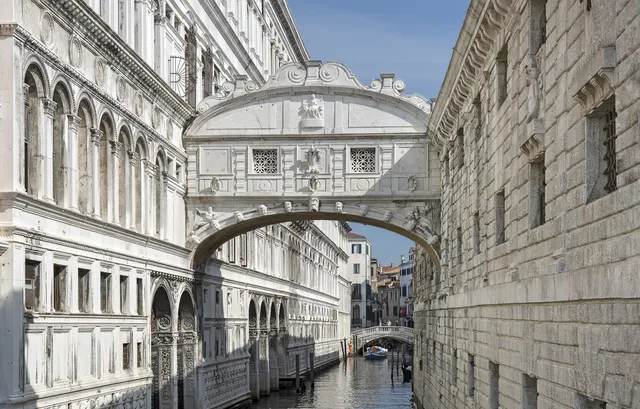
The walk out crosses Antonio Contin's 1600 Bridge of Sighs, white Istrian stone vaulted overhead, two stone-grilled windows the size of a paperback. That slot of sky over the lagoon was, by tradition, the last view of Venice condemned men got. Footsteps echo strangely in the enclosed span — your own and no one else's, suddenly loud.
Detail hunt: things most visitors walk past
Watch & Explore Doge's Palace.
Plan and listen to Doge's Palace with Audiala.
Audio guide in your pocket, itinerary in your browser. Built for the way you actually visit.
Tickets & tours.
These are guided options from our partners — same price as booking direct.
Prices are indicative — final pricing and availability are confirmed at checkout. Audiala may earn a commission from bookings made through these links.
Also on GetYourGuide
More tours for Doge's Palace
Curated from GetYourGuide. Same price as official, free cancellation on most.
 GetYourGuide
Doge's Palace Reserved Entry Ticket
from
€35
 GetYourGuide
Venice: St. Mark's Basilica, Doge's Palace & Bridge of Sighs
from
€43
 GetYourGuide
Doge’s Palace & St. Mark’s Basilica Tickets + Tour Options
from
€72
 GetYourGuide
Doge's Palace Skip-the-Line Tour with Prisons
from
€43
Prices shown are indicative — final pricing and availability are confirmed at checkout. Audiala may receive a commission from bookings made via these links.
03 Visitor logistics.
The practical scaffolding for a good visit — kept short.
Getting There
Vaporetto San Zaccaria stop is 2 minutes' walk — Lines 1, 4.1, 5.1, or 5.2 from Santa Lucia rail or Piazzale Roma (10–15 min on water). Walking from Santa Lucia takes about 30 minutes through Cannaregio. Public entrance is Porta del Frumento on the Piazzetta side, not the lagoon façade.
Opening Hours
As of 2026, daily 09:00–19:00 from 1 April–31 October (last entry 18:00), and 09:00–18:00 from 1 November–31 March (last entry 17:00). Every Friday and Saturday from 1 May–26 September 2026, the palace stays open until 23:00 with last entry at 22:00 — the quietest, best-lit visit of the year.
Time Needed
Plan 1.5 hours for a brisk run through the Doge's Apartments, council halls, and prisons. Two hours lets you sit with Tintoretto's Paradiso in the Sala del Maggior Consiglio. Add 1.25–1.5 hours on top if you book the Secret Itineraries tour through Casanova's cell and the lead-roof Piombi.
Cost & Tickets
As of 2026, the St Mark's Square Museums combo is €35 full / €15 reduced and is the only way in — it also covers Correr, the Marciana Library rooms, and the Archaeological Museum, with the MUVE audioguide free. Reduced applies to ages 6–14, students under 25, and 65+. Disabled visitors plus one companion enter free at the ticket office.
Accessibility
One of the few major Venetian sites with a working elevator and step-free routes through the state rooms. The prisons, Armoury, and Bridge of Sighs are not accessible — narrow staircases and original stone thresholds. Map your vaporetto stop carefully: San Zaccaria has the gentlest landing, while bridges between other stops have steps.
04 Tips for visitors.
Small things that change the day.
Go Friday Night
From May to late September 2026, Friday and Saturday late openings until 23:00 empty the place out — coach groups leave by 17:00, and the Sala del Maggior Consiglio in low evening light is a different building. Book the 20:00 slot.
Camera Rules
Handheld photos fine, no flash near the paintings, and no tripods or selfie sticks inside. The famous Bridge of Sighs shot is taken from Ponte della Paglia outside — from within the bridge itself you only get two small grilled windows.
Pigeon-Grain Scam
A man in a white apron will press corn into your hand on the Piazzetta and demand €20 once pigeons land. Feeding pigeons has been illegal in Venice since 2008. Keep your hands closed and walk on.
Vaporetto Ticket Trap
Real ACTV single fare is €9.50 from official booths or the AVM Venezia app. Anyone offering €15 "discount cards" near Ferrovia or Piazzale Roma is selling stolen or expired passes — you'll be fined on board.
Eat Off the Piazza
Skip everything with a photo menu in the San Marco–Rialto corridor. Walk 10 minutes into Castello for honest mid-range trattorias, or cross to the Rialto market for cicchetti at All'Arco, Cantina Do Mori, or Do Spade — €1.50–3 a bite, €3 for an ombra of wine.
Caffè Florian Math
Coffee at Florian (1720) or Quadri on the square runs €10–15 at a table once the orchestra surcharge hits. Stand at the inside bar instead — by Italian law the banco price must be posted on the wall, and it's a third of the cost.
Combo With the Basilica
If you're pairing this with St Mark's Basilica next door, dress for the basilica's stricter code — shoulders and knees covered, no flip-flops. The palace itself is flexible, but you won't want to queue twice to swap a shawl.
Secret Itineraries Caveat
The 09:00 and 09:30 guided runs through the Chamber of the Inquisitors and Casanova's cell sell out weeks ahead — English slots first. Worth it for the lead-roof prisons, but it's brisk and tight; do the main palace separately, not rushed onto the end.
Where to Eat
Don't Leave Without Trying
Hostaria Osottoosopra
local favoriteOrder: The Bigoli with anchovy and onion sauce or the Spaghetti allo scoglio.
A true staple that balances local traditions with incredible execution; their homemade bread is so good you'll be doing 'scarpetta' until the plate is clean.
Osteria Al Squero
quick biteOrder: An 'original' Spritz paired with a selection of fresh cicchetti.
The quintessential Venetian experience—grab a glass of wine and cicchetti and stand by the canal to watch the historic gondola repairs across the water.
El Magazen
fine diningOrder: The breaded egg with truffles and the spectacular panna cotta.
A beautifully run, intimate spot where the husband-and-wife team treat you like family, offering thoughtful, flavor-forward dishes with delightful complimentary surprises between courses.
Santo Mare Venice
fine diningOrder: The lobster and the pistachio gelato for dessert.
A refined, Michelin-standard experience tucked away near San Marco, known for its elegant atmosphere and impeccable, knowledgeable service.
Dining Tips
- check Lunch is typically 12:00–2:30pm; locals eat dinner starting around 8:00pm.
- check Look for 'bacari' to enjoy cicchetti standing at the counter like a local.
- check A service charge (coperto) is often included; small cash tips are appreciated but not mandatory.
- check Since 2025, you can leave tips via credit card, though cash remains preferred for small bar tabs.
- check Reservations are highly recommended for dinner at traditional restaurants.
- check The Rialto Fish Market (Pescheria) is closed on Sundays and Mondays.
Restaurant data powered by Google
05 A Stage That Never Closed
For nearly 800 years the palace was the working office of a republic — courts, council, prison, residence, treasury, secret archive — all under one roof. The Republic ended on 12 May 1797, the day Napoleon's terms reached the lagoon and the Maggior Consiglio voted itself out of existence in its own hall, 537 to 7. The doge handed his cap to a servant and walked home. The building's ritual life, however, did not stop with the politics.
Civic functions migrated. Processions kept their routes. At Piazzetta the molo still sees an annual marriage to the sea, the Sala del Piovego still hosts weddings, the Sala dello Scrutinio still hosts vote-taking — only now the votes are UNESCO panels and city council. What the Republic spent eight centuries building, Venice has spent two more centuries refusing to abandon.
The Marriage That Outlived the Groom
Every Ascension Sunday a procession leaves Piazzetta San Marco, follows the old Bucintoro route to the channel of San Nicolò at the Lido, and the mayor of Venice throws a gold ring into the lagoon, reciting Desponsamus te, mare, in signum veri perpetuique dominii — "We wed thee, sea, in sign of true and perpetual dominion." Tourists film it on phones. It reads as one more piece of civic theatre.
But the Latin is wrong for modern ceremonial-Italian — too archaic, too specific. The route is wrong for tourism: twelve kilometres out to the Lido channel, no one films the casting itself, and the mayor's words are older than the building he has just left.
In the year 1000 Doge Pietro II Orseolo sailed from this exact molo to break a Dalmatian pirate confederation that had been strangling Venetian shipping. He won. Each Ascension Day after, the Republic blessed the lagoon in thanks. In 1177, after Pope Alexander III and Frederick Barbarossa signed the Peace of Venice inside San Marco, records show the pope handed Doge Sebastiano Ziani a gold ring and granted Venice the right to wed the sea. Every doge after Ziani sailed in the gilded Bucintoro from this molo and threw a ring. They did it for over six centuries. Napoleon ended the Republic in 1797 and burned the Bucintoro for its gold leaf. The rite paused for a hundred and fifty years, then came back in 1965 — mayor instead of doge, motorboat instead of barge. Same Latin, same ring, same molo.
Stand at the Piazzetta water-gate now. The two columns rising from the quay are the same columns death sentences were read between, the columns the Bucintoro tied up at, the columns the modern procession passes today. You're not looking at a museum entrance — you're looking at a 1,025-year stage door.
What Changed
What Endured
Listen to the full story in the app
The whole Doge's Palace,
told well.
Audio guides for 1,100+ cities across 96 countries. History, stories, and local insight — offline ready.
06 Frequently asked.
The questions travellers send us most about Doge's Palace.
Is the Doge's Palace worth visiting?
Yes — it's the single building where the Venetian Republic governed itself for 1,100 years, and walking it is the only way to grasp how Venice actually worked. Tintoretto's Paradiso in the Sala del Maggior Consiglio is one of the largest oil paintings on canvas anywhere, and the prison cells across the Bridge of Sighs add a darker counterweight to all the gold. Skip it only if you genuinely don't care about history or art.
How long do you need at the Doge's Palace?
Plan 1.5 to 2 hours for the standard route. Add another 1h15 if you book the Secret Itineraries tour, which covers the Pozzi cells, torture chamber, and Casanova's Piombi attic. Rushing under an hour means missing the institutional halls entirely.
How do I get to the Doge's Palace from Santa Lucia station?
Take vaporetto Line 1 to Vallaresso or Line 4.1/5.1 to San Zaccaria — about 10–15 minutes on the water. Walking the same route through the calli takes roughly 30 minutes and crosses several stepped bridges. The public entrance is the Porta del Frumento on the Piazzetta San Marco side.
What is the best time to visit the Doge's Palace?
First entry at 09:00 or the last two hours before close — coach groups clear out by late afternoon. From 1 May to 26 September 2026 the palace stays open Friday and Saturday until 23:00 (last entry 22:00), and evening slots are dramatically quieter. Midweek beats weekends in any season.
How much is a ticket to the Doge's Palace?
€35 full / €15 reduced for the St Mark's Square Museums combo, which is the only way in and also covers the Correr, Archaeological Museum, and Marciana Library. The Secret Itineraries guided tour is roughly €28 on top and includes everything else. Children under 6, Venice residents, and disabled visitors with one companion enter free.
Can you visit the Doge's Palace for free?
Not for general international visitors — free Sundays apply only to residents of the 44 Metropolitan City of Venice municipalities plus Mogliano Veneto. Free entry otherwise covers under-6s, ICOM members, licensed Italian guides, and disabled visitors with one companion. Everyone else pays the €35/€15 combo ticket.
What should I not miss at the Doge's Palace?
The blacked-out portrait of Doge Marin Faliero in the Sala del Maggior Consiglio frieze — beheaded for treason in 1355, his face covered with a painted veil and the Latin inscription Hic est locus Marini Faletri decapitati pro criminibus. Also the two red Verona marble columns on the upper Piazzetta loggia, where death sentences were read, and the prisoner graffiti scratched into the Pozzi cell walls. Walking Venice afterwards feels different once you've seen the room where the Republic voted itself out of existence in 1797.
Is the Bridge of Sighs really about lovers?
No — the romantic legend is 20th-century tourism marketing, popularised by the 1979 film A Little Romance. Lord Byron coined the name Ponte dei Sospiri in 1818 imagining condemned prisoners' last view of the lagoon, but by the time Antonio Contin built the bridge in 1600–1603 the Inquisition had largely wound down and most crossing it were debtors and petty criminals.
Verified, and shown.
Researched and written by the Audiala editorial team from historical records, architectural archives, and local expertise.
Official opening hours, 2026 extended summer hours, free admission days, Secret Itineraries schedule
Authoritative history of the palace, doge ritual phrases, fall of Republic 1797
Sala del Maggior Consiglio dimensions, Tintoretto Paradiso, Sala dello Scrutinio detail
Secret Itineraries and Hidden Treasures tour content: Pozzi, Piombi, torture chamber, Chiesetta
Wheelchair access, elevator routes, areas not accessible (Prisons, Armoury, Bridge of Sighs)
€35/€15 St Mark's Square Museums combo ticket pricing and reductions
Founding 810, Ziani 1172–78, Gothic 1340, Foscari 1424, Porta della Carta 1438–42, fires 1483/1577, museum since 1923
Bridge of Sighs construction 1600–1603 by Antonio Contin, two red columns death-sentence tradition, Byron naming
World Heritage inscription 1987, Fragile Venice study, conservation status
Vaporetto lines from Santa Lucia and Piazzale Roma, Alilaguna airport access
Festa della Sensa origin year 1000, 1177 elevation to marriage rite, ducal procession from palace molo
San Marco area pickpocketing, café overcharging, advice to avoid Piazza restaurants
Secret Itineraries tour duration, content, child age restrictions
Recommended visit duration, queue times, vaporetto walking times from Santa Lucia
Researched from Wikidata, Wikipedia & official sources · fact-checked · How we make our guides →