An introduction.
Researched by the Audiala editorial team from historical records, architectural archives, and local expertise.
HHow does a passage built to march prisoners to their cells become the place where couples kiss in gondolas for eternal love? The answer involves Lord Byron, a 1979 Hollywood film, and a doge who never saw it finished. Cross through the Bridge of Sighs in Venice, Italy — accessible only on the Doge's Palace tour — and you walk 425 years of Venetians changing their minds about what this white stone arch is for.
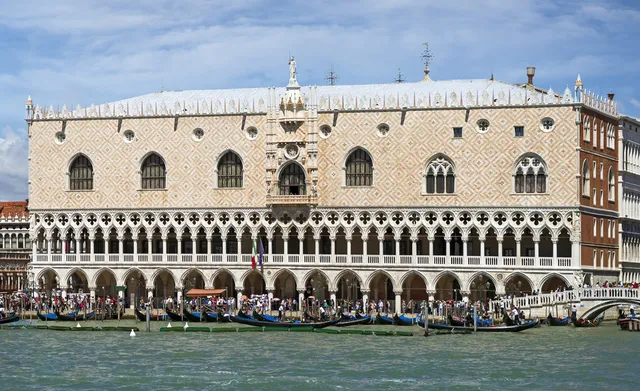
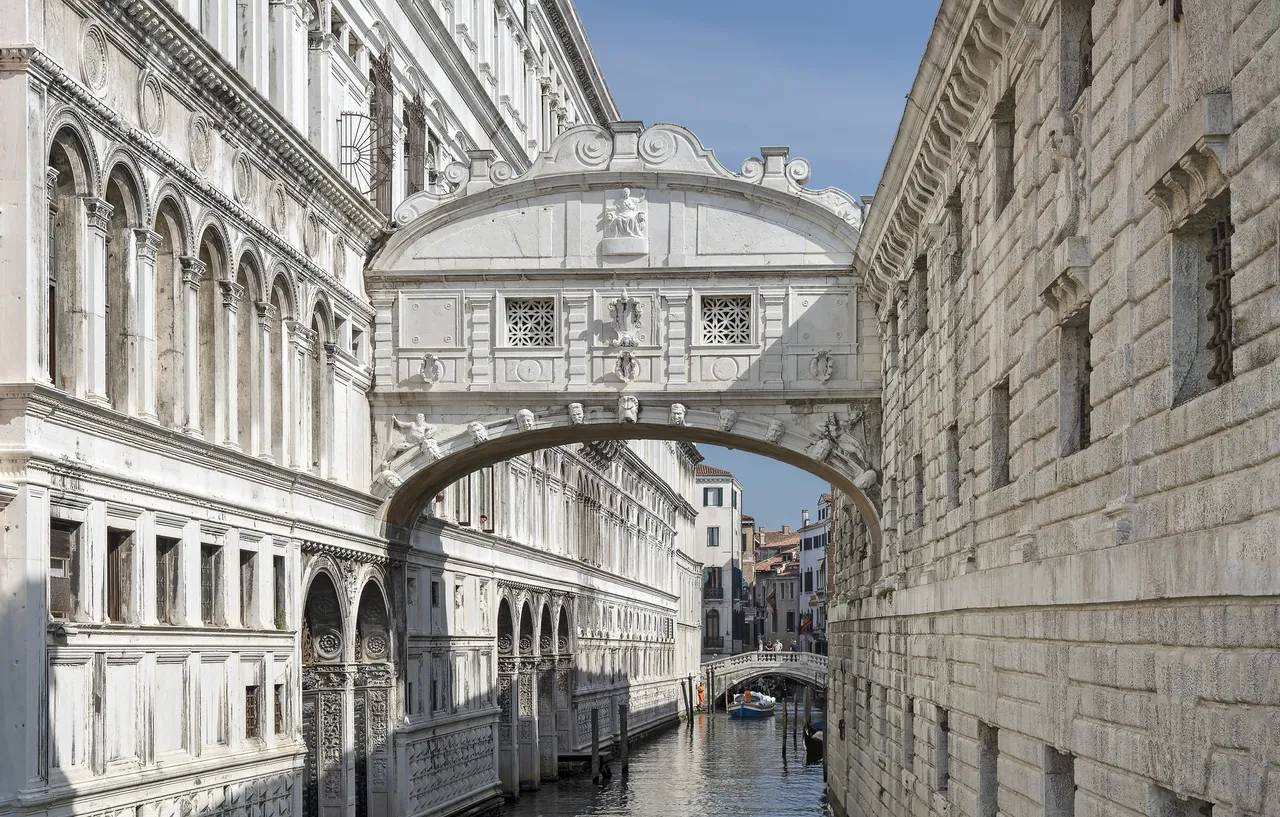
Today the bridge floats above Rio di Palazzo, a single Istrian-stone arch linking the Doge's Palace to the Prigioni Nuove. Two narrow corridors run inside, separated by a thick wall. Small lattice windows on either side — geometric perforations cut so a prisoner could see Venice but never reach it.
From Ponte della Paglia, the postcard view shows the canal-facing façade with its allegory of Justice and the Grimani coat of arms — both routinely cropped out of selfies. Doge Marino Grimani commissioned the bridge during his 1595–1605 reign and died before its completion in 1603. His arms remain on the stone. The doges who came after do not.
You cannot walk the bridge from outside. Access runs through the Doge's Palace ticket, and the Itinerari Segreti tour traces the path prisoners took — torture room, inquisition chamber, the bridge itself. Look through the grilles at the Isola di San Giorgio Maggiore. That sliver of lagoon was the last Venice many men ever saw.
01 What to see.
The Pierced-Stone Windows
The Justice Façade and the Grimani Arms
Walk it from the inside — Itinerari Segreti
Plan and listen to Bridge of Sighs with Audiala.
Audio guide in your pocket, itinerary in your browser. Built for the way you actually visit.
Tickets & tours.
These are guided options from our partners — same price as booking direct.
Prices are indicative — final pricing and availability are confirmed at checkout. Audiala may earn a commission from bookings made through these links.
Also on GetYourGuide
More tours for Bridge of Sighs
Curated from GetYourGuide. Same price as official, free cancellation on most.
 GetYourGuide
Doge's Palace Reserved Entry Ticket
from
€35
 GetYourGuide
Venice: St. Mark's Basilica, Doge's Palace & Bridge of Sighs
from
€43
 GetYourGuide
Doge’s Palace & St. Mark’s Basilica Tickets + Tour Options
from
€72
 GetYourGuide
Venice: Crafted Gondola Under Breathtaking Bridge of Sighs™
from
€39
Prices shown are indicative — final pricing and availability are confirmed at checkout. Audiala may receive a commission from bookings made via these links.
03 Visitor logistics.
The practical scaffolding for a good visit — kept short.
Getting There
Vaporetto to San Zaccaria (Lines 1, 2, 4.1, 5.1, 5.2) drops you 5 minutes east of the bridge along Riva degli Schiavoni. From Santa Lucia station take Line 1 (slow, scenic, ~45 min) or Line 2 to Vallaresso. On foot from Rialto, follow yellow 'San Marco' signs through the calli — 10–15 min.
Opening Hours
As of 2026, the bridge interior is reachable only via Doge's Palace, open daily 09:00–19:00 (last entry 18:00). Fridays and Saturdays from 1 May to 26 September extend to 23:00, last entry 22:00. Walk-in tickets without a time slot only admitted from 12:00 onward.
Time Needed
Exterior photo from Ponte della Paglia: 5–10 min. Doge's Palace standard route including the bridge crossing and Prigioni Nuove: 1.5–2 hours, 2.5–3 if you read every label. Add 75–90 min for the Secret Itineraries tour through the Piombi and Inquisitors' rooms.
Tickets
No standalone bridge ticket exists — entry rolls into the Doge's Palace admission, around €30, or the St. Mark's Square Museums combo from ~€35 (adds Museo Correr, Archaeological Museum, Marciana Library). Book a timed slot online; walk-up queues regularly run an hour in high season. Free for under-6s, disabled visitors plus one helper, and ICOM members.
Accessibility
The Doge's Palace standard route is partially accessible, but the bridge interior, Prisons, Armoury, and Secret Itineraries are not — narrow corridors and a tight descending staircase from the Hall of the Magistrate of Laws. Disabled visitors plus one helper enter free. Adapted-boat exterior tours run through third-party operators on the Rio di Palazzo.
04 Tips for visitors.
Small things that change the day.
Skip Ponte della Paglia
The classic postcard angle from Ponte della Paglia is a shoving match by 10am. Walk around to Ponte della Canonica behind the Basilica — same bridge, morning light on the Istrian stone, almost nobody there.
Pickpocket Chokepoint
Ponte della Paglia is a confirmed pickpocket hotspot — bag-slashers work the crowd while you frame the shot. Front pockets only, zip your bag, and keep cards on your body, not in an outer compartment.
Eat West of Rialto
Within 200m of the bridge it's photo menus, cover charges, and €25 mediocre pasta. Walk 10 min to San Polo for All'Arco or Cantina Do Mori (cicheti €1.50–4 each, ombra of wine €2), or Osteria alle Testiere in Castello for fish (book ahead, €40–60).
First Slot or Last
Book the 9:00 entry to walk the bridge interior before the corridors clog. The two parallel passages are tight enough that a tour group ahead of you means shuffling in single file past the perforated windows.
Secret Itineraries Tour
The €32 Itinerari Segreti tour is the only way into the Piombi cells Casanova escaped from in 1756, the Inquisitors' Chamber, and the bridge from the prison side. Book weeks ahead — small groups, sells out, minimum age 6.
Avoid Euronet ATMs
The blue and yellow non-bank ATMs near San Marco charge fees up to 29%. Use a bank-branded ATM (Intesa Sanpaolo, UniCredit) or pay by card — accepted nearly everywhere, including bacari.
Gondola Reality Check
Official rate under the bridge is ~€90 for 30 min day, €110 night. Hawkers near Riva degli Schiavoni quote inflated numbers. Confirm price and route in writing before stepping in, and ask if the Rio di Palazzo passage is included.
Don't Sit on the Steps
Eating or sitting on the steps of Piazza San Marco draws fines up to €450 under city ordinance. Feeding pigeons is also banned. Take your tramezzino to Riva degli Schiavoni and lean on the railing instead.
Where to Eat
Don't Leave Without Trying
Osteria Al Squero
local favoriteOrder: The 'original' Spritz paired with a variety of fresh cicchetti.
This is the quintessential Venetian experience. You grab a glass of wine and cicchetti and stand by the canal to watch the craftsmen at the historic gondola repair shop across the water.
Bacarretto
local favoriteOrder: The caponata and the carbonara with tuna — both are absolute standouts.
A tiny, vibrant spot that feels like a direct flight to Sicily. It’s rare to find such high-quality, authentic cooking at these prices in Venice.
Impronta Restaurant Venice
fine diningOrder: The gnocchi with duck ragù and the heavenly tiramisu.
It offers a sophisticated, modern twist on traditional flavors in a cozy atmosphere that feels worlds away from the heavy tourist traffic.
Brunch Cafe
cafeOrder: The fluffy egg white pancakes with mango and coconut sauce.
A rare gem in Venice that masters the brunch game. It’s incredibly welcoming, accommodating of dietary needs, and serves a perfect macchiato.
Dining Tips
- check Tipping is not expected; a small 'coperto' is added to your bill for service/bread.
- check If you want to tip, carry small cash notes as most venues do not accept tips via card.
- check Restaurants usually close between 3:00 PM and 7:30 PM; plan your meals accordingly.
- check Dinner service typically starts from 7:30 PM onward.
- check The Rialto Market is best visited early, between 7:30 AM and 11:00 AM.
- check Many traditional restaurants and bars are closed on Sundays and Mondays.
- check Cash is essential for small cicchetti bars (bacari) and market stalls.
Restaurant data powered by Google
05 The View Through the Grille
For 316 years, the bridge had one job: move people from court to cell. The Republic fell in 1797. Napoleon came and went, then Austria, then Italy. Prisoners changed nationalities. The function did not.
Even after 1919, when the Prigioni Nuove reportedly closed, the bridge kept doing a version of the same thing. Ticketed visitors retrace the prisoner's walk on the Doge's Palace Secret Itinerary, pause at the same lattice grilles, and lean into the same narrow view of the lagoon. The institution died. Its gesture survived.
Silvio Pellico's Window
The story most guides tell is straightforward: prisoners crossed the bridge, sighed at their last view of Venice, and were swallowed by the cells beyond. Lord Byron canonized the image in Childe Harold's Pilgrimage in 1818 — 'a palace and a prison on each hand' — and tourists have repeated it ever since.
The trouble is the windows. Records show the openings on either side measure roughly the size of a hand, fitted with a stone-lattice grille cut from a single block of Istrian limestone. The geometry blocks both face and arm. What you can see is a sliver.
On a winter day in 1820, the Italian patriot Silvio Pellico crossed this bridge under Austrian guard, condemned for carbonaro conspiracy. According to Le mie prigioni, his 1832 prison memoir, what struck him on the crossing was not panorama but the deliberate cruelty of the grille — designed so a prisoner could see Venice without ever touching it. His book sold across Europe and became a Risorgimento weapon. Scholars argue the Austrians lost the propaganda war on the strength of one man's sigh through one stone window.
Stand at the same grille now, on the Itinerari Segreti tour, and the geometry tells you everything. The lattice is a frame for longing, not a viewfinder. Builders meant the bridge to break men with a glimpse. That is what it kept on doing.
What Changed
What Endured
Listen to the full story in the app
The whole Bridge of Sighs,
told well.
Audio guides for 1,100+ cities across 96 countries. History, stories, and local insight — offline ready.
06 Frequently asked.
The questions travellers send us most about Bridge of Sighs.
Is the Bridge of Sighs worth visiting?
Yes, but know what you're paying for. The exterior view from Ponte della Paglia is free and takes five minutes; the interior crossing is a ninety-second walk through two narrow stone corridors, accessible only with a Doge's Palace ticket. Worth it if you're already touring the palace — not worth a separate trip just for the bridge.
How long do you need at the Bridge of Sighs?
Five to ten minutes for the exterior photo, plus 1.5–2 hours if you do the full Doge's Palace route that includes the bridge crossing and Prigioni Nuove. Add 75 minutes if you book the Itinerari Segreti tour, which takes you through the Piombi cells and the Inquisitors' rooms.
How do I get to the Bridge of Sighs from Venice train station?
Take vaporetto Line 1 or Line 2 from Ferrovia (Santa Lucia) to San Zaccaria — about 25–40 minutes depending on line. From there it's a 5-minute walk along Riva degli Schiavoni to Ponte della Paglia, the classic viewing spot. Walking the whole way through the calli takes around 30 minutes.
What is the best time to visit the Bridge of Sighs?
First slot at 09:00 when the Doge's Palace opens, or last admission at 18:00 in winter (22:00 on summer Fridays and Saturdays from 1 May to 26 September). Morning light hits the east-facing Istrian-stone façade and the corridors photograph without crowd-shoving. Avoid midday in summer — the interior is tight and the queue regularly tops an hour.
Can you visit the Bridge of Sighs for free?
The exterior, yes — Ponte della Paglia and the quieter Ponte della Canonica round the back are open 24/7 and cost nothing. The interior crossing requires a Doge's Palace ticket (around €30, more with online booking fees). Venetian residents, under-6s, ICOM members, and disabled visitors with one helper enter free.
Did Casanova really escape across the Bridge of Sighs?
No — that's the most repeated guidebook error. Giacomo Casanova escaped on the night of 31 October 1756 by cutting through the lead roof tiles of the Piombi cells above the Doge's Palace, then walking out the front door at dawn. He never crossed the bridge during the escape; the Piombi sit in the palace attic, not on the prison side.
What should I not miss at the Bridge of Sighs?
The pierced-stone tracery windows — geometric perforations carved from pietra d'Istria, not iron bars, deliberately too narrow to pass a hand through. The east window frames San Giorgio Maggiore's dome; the west window shows only prison wall, an asymmetry that's intentional cruelty. Outside, look below the carved figure of Justice for the Grimani coat of arms most photographers crop out.
Why is it called the Bridge of Sighs?
Lord Byron popularized the name in English in Childe Harold's Pilgrimage (1818), but the Venetian name "Ponte dei Sospiri" was already attested in late 18th-century dialect. The romantic story of doomed prisoners sighing at their last lagoon view is mostly 19th-century invention — by 1600 the Republic rarely sentenced to death, and most who crossed served minor terms in the Prigioni Nuove.
Verified, and shown.
Researched and written by the Audiala editorial team from historical records, architectural archives, and local expertise.
Official source for Itinerari Segreti tour scope, opening hours, last admission, accessibility, and free-entry categories.
Construction dates (1600–1603), architect Antonio Contin, Byron attribution, A Little Romance kiss-legend origin, replicas at Oxford/Cambridge/Pittsburgh.
1577 palace fire trigger, Doge Marino Grimani commission, Casanova escape from Piombi (not bridge), only fully covered bridge in Venice.
Pietra d'Istria material properties, allegory of Justice and Grimani arms on façade, two parallel corridors layout, stone-lattice window views.
Antonio Contin lineage (nephew of Antonio da Ponte), Casanova arrest 1755, Silvio Pellico imprisonment, Byron Childe Harold quote.
Interior sensory detail — barrel-vault echo, prisoner graffiti, stonemasons' marks, dimensions and acoustic isolation.
1919 Prigioni Nuove decommissioning, local pushback against romantic Byron framing, drunken Noah sculpture context.
1979 A Little Romance origin of kiss legend, ten macaron faces ward-evil tradition, Offenbach 1861 opera reference.
Italian-language naming history (Pasqualin 2019 — name attested late 18th century before Byron), construction window 1600–1603.
Best external viewpoints — Ponte della Paglia vs the quieter Ponte della Canonica, gondola underneath route.
Byron Childe Harold IV recitation tradition by guides, museum-only access for the interior crossing.
Researched from Wikidata, Wikipedia & official sources · fact-checked · How we make our guides →