Plan and listen to Turin Cathedral with Audiala.
Audio guide in your pocket, itinerary in your browser. Built for the way you actually visit.
Introduction
Nestled in the heart of Turin, Italy, the Turin Cathedral—officially the Cathedral of Saint John the Baptist (Duomo di San Giovanni Battista)—is a celebrated monument uniting Renaissance clarity with Baroque grandeur. As the city’s principal place of worship and the home of the world-renowned Shroud of Turin, this cathedral is a treasure trove of architectural, artistic, and spiritual significance. Its origins date back to early Christian worship in the 4th century CE, while the present structure, commissioned by Bishop Domenico della Rovere and designed by Amedeo di Francesco da Settignano, was erected in the late 15th century (The Catholic Travel Guide).
Among its most iconic features is the Chapel of the Holy Shroud, a Baroque masterpiece designed by Guarino Guarini in the 17th century to house the Shroud of Turin. This relic, believed by many to be the burial cloth of Jesus Christ, has inspired centuries of devotion and scientific inquiry (My Wanderlusty Life; oracioncristiana.org). The cathedral’s central location—adjacent to the Royal Palace and near the Museo Egizio—makes it an essential stop for anyone exploring Turin’s rich cultural and historical landscape (The Fun Plan; The Crazy Tourist).
This guide provides detailed information on visiting hours, ticketing, accessibility, guided tours, and practical travel tips, ensuring you make the most of your visit, whether you are drawn by faith, history, or architectural beauty (sindone.org; italianvisits.com).

Early Foundations and Construction
The site of Turin Cathedral has been a focal point of Christian worship since at least the 4th century CE. Archaeological evidence reveals that three early Christian churches once stood here. The current Renaissance cathedral, dedicated to Saint John the Baptist, was built between 1491 and 1498 under Bishop Domenico della Rovere’s commission and the direction of Amedeo di Francesco da Settignano (The Catholic Travel Guide; Budget Your Trip).
The Chapel of the Holy Shroud
The acquisition of the Shroud of Turin by the House of Savoy in the late 16th century was a turning point. To house this revered relic, the Chapel of the Holy Shroud (Cappella della Sacra Sindone) was constructed between 1668 and 1694, designed by Guarini. The chapel physically connects the cathedral to the Royal Palace, symbolizing the unity of sacred and sovereign power (My Wanderlusty Life).
Modern Events and Restoration
In 1997, a devastating fire damaged the chapel. Restoration efforts meticulously used original materials and techniques to preserve Guarini’s Baroque vision. Today, both the cathedral and the chapel have been fully restored, continuing to attract pilgrims and visitors worldwide (The Catholic Travel Guide).
Architectural Features
Renaissance Façade and Layout
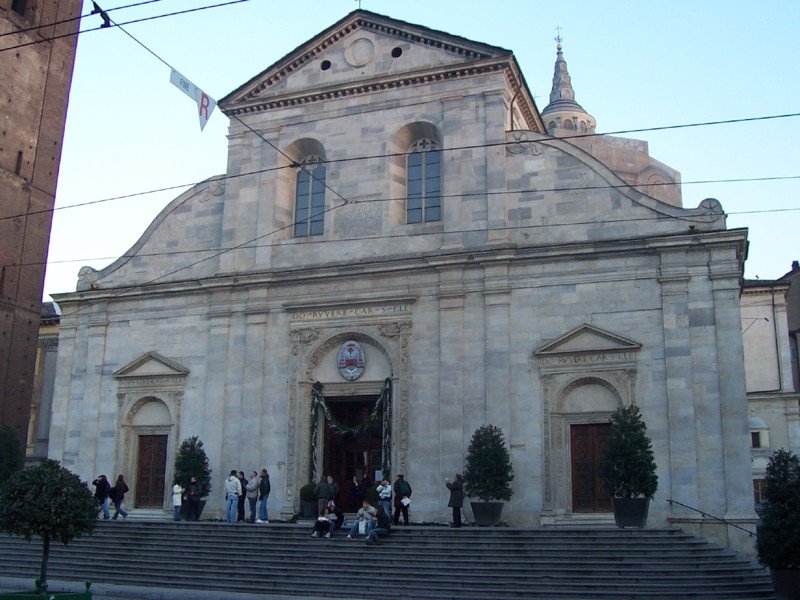
The cathedral boasts a white marble Renaissance façade, characterized by harmonious proportions and elegant restraint. Three portals, each framed by pilasters and topped with triangular pediments, mark the entrance. The Latin cross floor plan features a single nave, two side aisles, and a transept, reflecting Renaissance ideals of symmetry and clarity (The Fun Plan).
Bell Tower
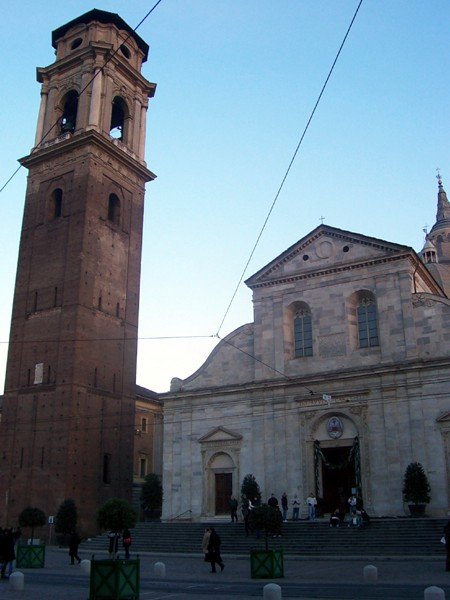
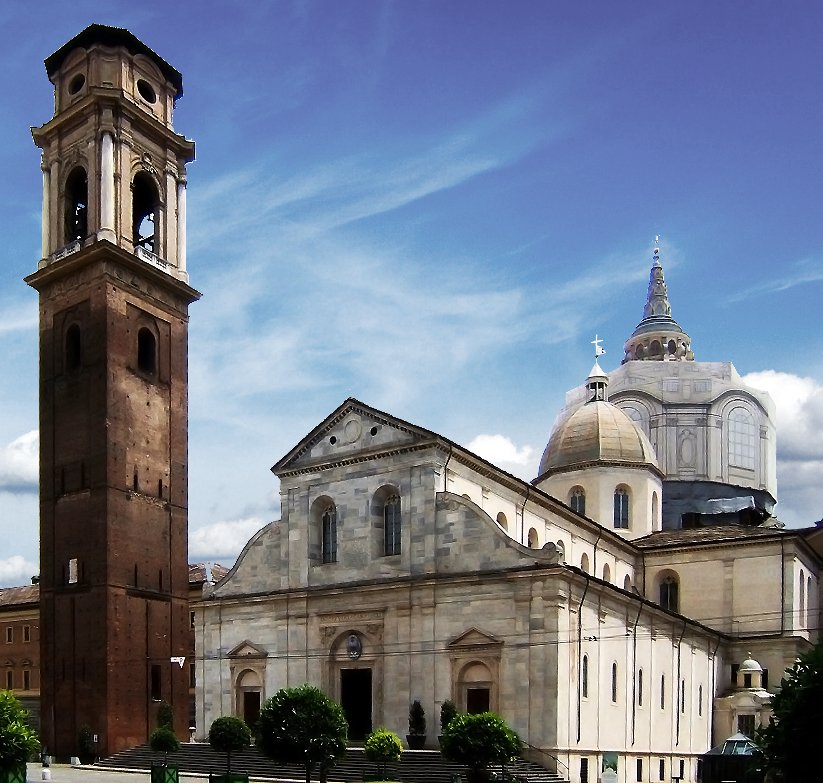
The freestanding bell tower, dating from 1468–1470, predates the present cathedral. Notable for its robust brickwork and verticality, the tower offers a 210-step climb to an observation deck with panoramic vistas of Turin and the nearby Alps (My Wanderlusty Life; The Crazy Tourist).
Guarini’s Dome
Guarini’s dome over the Chapel of the Holy Shroud is a Baroque engineering marvel. Its interlacing arches and windows create dramatic light effects, culminating in a lantern that bathes the chapel in natural light (The Fun Plan). This innovative design influenced Baroque architecture across Europe.
Interior Decoration and Artistic Highlights
The interior, although understated compared to other Italian cathedrals, features a polychrome marble main altar, Renaissance and Baroque stucco decorations, and significant artworks from the 16th to 18th centuries. The Chapel of the Holy Shroud stands out for its black marble columns, gilding, and elaborate stuccowork (Budget Your Trip).
Integration with the Royal Palace
The cathedral’s connection to the Royal Palace—via the Chapel of the Holy Shroud—highlights the historical bond between the House of Savoy and the church (My Wanderlusty Life).
Restoration and Preservation
Restorations following the 1997 fire prioritized historical authenticity, using marble from the original quarries and maintaining Guarini’s vision (The Catholic Travel Guide).
Visitor Information
Visiting Hours
- Cathedral: Open daily, generally from 7:00 AM to 12:30 PM and 3:00 PM to 7:00 PM. Hours may vary on holidays and special events.
- Chapel of the Holy Shroud: Typically follows cathedral hours, but may have restricted access during religious ceremonies or events.
For up-to-date visiting hours, consult the official website.
Tickets and Admission
- Cathedral Entry: Free for individual visitors; donations appreciated.
- Chapel of the Holy Shroud: Included with cathedral entry except during special exhibitions, when tickets may be required.
- Special Exhibitions (e.g., Jubilee 2025): Advance ticket reservation is strongly recommended due to high demand.
Accessibility
- Wheelchair ramps are available at the main entrance.
- Some historic areas, such as the bell tower, may not be accessible to those with mobility challenges.
Guided Tours and Tips
- Guided tours are available in multiple languages, focusing on architecture, history, or religious heritage.
- Book in advance, especially during peak seasons and special events (italianvisits.com).
- Modest dress is required; silence and respectful behavior are expected.
Nearby Attractions
- Royal Palace of Turin: Adjacent to the cathedral.
- Piazza Castello: Central square with cafes and shops.
- Museo Egizio: World-class Egyptian museum nearby.
Special Events and Photography
- Photography is generally allowed without flash, except during services or in restricted areas.
- The dome and bell tower offer excellent photo opportunities.
The Shroud of Turin: History, Science, and Visiting
Historical Background
The Shroud of Turin is a linen cloth measuring about 4.4 by 1.1 meters, bearing the faint image of a crucified man (oracioncristiana.org). Its earliest undisputed record dates to the 14th century in Lirey, France, from where it was acquired by the House of Savoy and eventually moved to Turin in 1578 (nawas.com; en.italy4.me).
Religious and Cultural Significance
For many Christians, the Shroud is a tangible connection to Jesus Christ’s Passion and Resurrection. The Catholic Church encourages veneration but does not officially declare the Shroud’s authenticity, instead regarding it as an “icon of the Passion” (italyfocusguide.com; visitaretorino.it).
Scientific Investigations
Scientific study has focused on the Shroud’s age and the origin of its image. Carbon-14 dating in 1988 dated it to the Middle Ages, but questions remain about possible contamination and repair patches. The image itself is not painted or printed, and its formation remains a mystery (thecultureexplorer.beehiiv.com; thebestofturin.com).
Location, Visiting Hours, and Tickets
- The Shroud is housed in a climate-controlled case within the Chapel of the Holy Shroud at the cathedral (thebestofturin.com).
- Public displays (“ostensions”) are rare, announced years in advance, and require advance ticketing (visitaretorino.it; nawas.com).
- Outside these exhibitions, a high-quality replica is on view, and visitors can learn about the Shroud’s history through multimedia displays.
- For the latest on upcoming exhibitions, visit the official Holy Shroud website.
Museum of the Holy Shroud (Museo della Sindone)
Located at Via San Domenico 28, the museum offers detailed exhibitions on the Shroud’s history, scientific analysis, and cultural impact (thebestofturin.com; en.italy4.me). Open daily from 3:00 pm to 6:00 pm, it features replicas, scientific equipment, multimedia presentations, and documents tracing the Shroud’s journey (InturinToday; Veronika’s Adventure).
Frequently Asked Questions (FAQs)
Q: What are the opening hours of Turin Cathedral?
A: Generally, 7:00 AM–12:30 PM and 3:00 PM–7:00 PM daily; check the official website for updates.
Q: Is there an admission fee?
A: Entry is free for individuals; donations are appreciated. Tickets may be needed for special exhibitions.
Q: Can I see the Shroud of Turin?
A: The original Shroud is displayed only during rare public exhibitions; a replica is available at other times.
Q: Are guided tours available?
A: Yes, tours in multiple languages can be booked in advance.
Q: Is the cathedral accessible for disabled visitors?
A: The main entrance is accessible, though some historic areas have limited access.
Q: How do I buy tickets for the Museum of the Holy Shroud?
A: Tickets are available at the museum entrance; guided tours can be booked online for an enhanced experience.
Listen to the full story in the app
The whole Turin Cathedral,
told well.
Audio guides for 1,100+ cities across 96 countries. History, stories, and local insight — offline ready.
Verified, and shown.
Researched and written by the Audiala editorial team from historical records, architectural archives, and local expertise.
Researched from Wikidata, Wikipedia & official sources · fact-checked · How we make our guides →