Trieste
Italy Updated Apr 2026
The Bora wind does not ask permission. It leaves a sharp salt crust on the marble facades of Trieste, Italy. Come to trace Habsburg trade routes, then linger in the quiet corners the Adriatic has reclaimed.
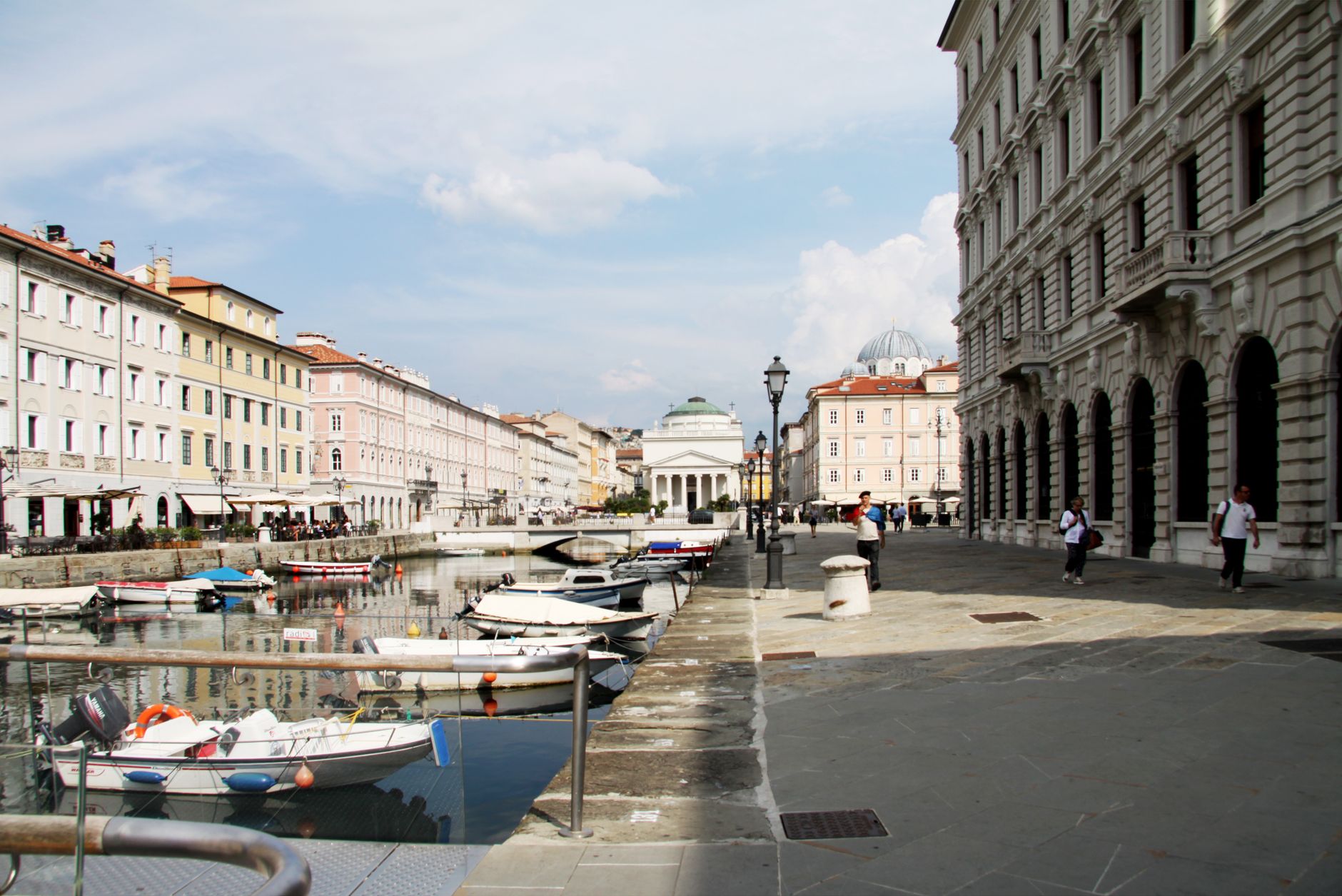 Photo: sergio pirola / Pexels
- Attractions
- 12
- Trip length
- 3–4 days
- Best season
- May–June or September–October
Why Trieste
Built from cited sources · see the method · How we make our guides →
Habsburg planners designed this city as a stage for imperial commerce. The sea kept rewriting the street grid. Grand neoclassical palaces from the eighteenth century share narrow blocks with Serbian Orthodox churches, while James Joyce drafted Ulysses at a mirrored café table.
Dinner here operates on a deliberately slower clock. You will order jota at a historic buffet counter, watching steam rise from sauerkraut and smoked pork while the owner scrapes a heavy copper pot. The pace forces you to linger.
Piazza Unità d'Italia
Europe’s largest sea-facing square opens directly onto the Adriatic, framed by Habsburg palaces that still hold their imperial posture. Walk out to the 250-meter Molo Audace at dusk to feel the wind strip the humidity from the air.Castello di Miramare
Archduke Maximilian’s nineteenth-century coastal retreat sits inside 22 hectares of botanical gardens. Skip the main gate. Follow the Sentiero Svizzero trail down to a quiet limestone cove where the water stays clear.Literary Coffee Culture
Trieste’s free-port history turned it into a caffeine crossroads where James Joyce drafted early chapters at 1914 tables. Order a nero in B for an espresso in a glass. Locals still skip cappuccino after lunch.Karst Plateau Trails
Limestone sinkholes and dry valleys stretch across a UNESCO-recognized karst terrain that drops into the sea. The Sentiero Rilke traces two kilometers of sheer cliffs above Duino. The Alps fade into sea fog from marker twelve.
Neighborhoods
Where to wander, by quarter — each with its own rhythm.
Centro & Borgo Teresiano
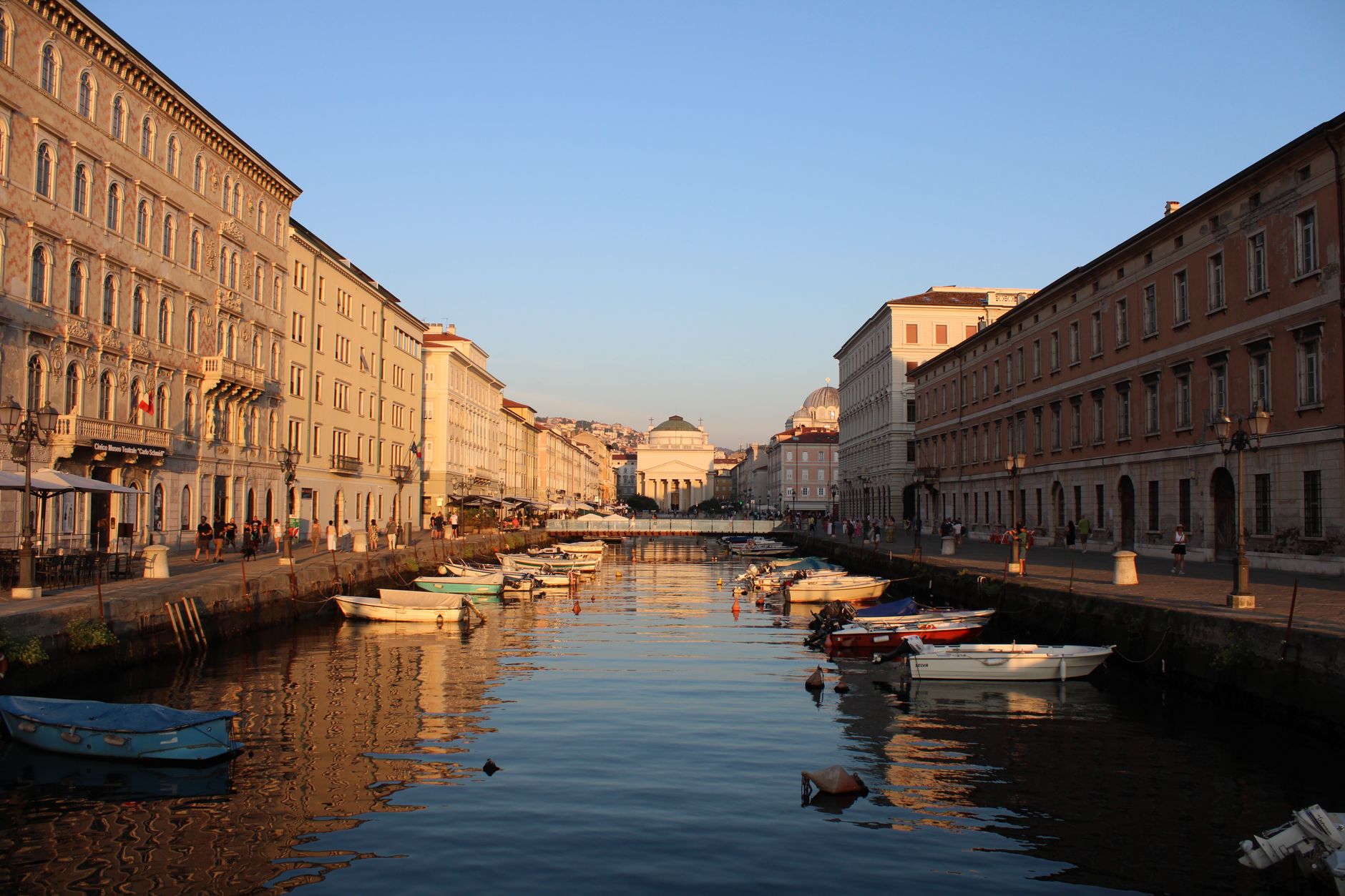
The Canal Grande cuts through this district like a glass blade, reflecting the pale neoclassical facades of eighteenth-century warehouses. You will sit under striped awnings at Caffè San Marco, tracing the exact spots where local intellectuals once argued over unfinished manuscripts. The evening light hits the water at 19:30.Cavana
Medieval alleys collapse into tight squares, but the district has traded maritime workshops for cocktail bars and acoustic jazz sets. Students and young professionals pack Via Torino after dark, trading quiet conversation over glasses of local Terrano red. It feels noticeably younger than the port.San Giusto & Castello Hill
Steep staircases pull you upward from the water, past Roman theatre foundations and the brutalist concrete sweep of the Monte Grisa sanctuary. Summer terraces here catch the coastal breeze while locals linger over long dinners. The climb earns you the Gulf.Contrada di Riborgo & Ghetto Ebraico
A narrow labyrinth of limestone buildings preserves a centuries-old overlap of Jewish, Serbian Orthodox, and Armenian heritage. You will find steaming plates of capuzi garbi at corner buffets and the quiet hum of independent bookshops tucked behind unmarked doors. History here wears a working coat.San Vito & Viale XX Settembre
A tree-lined pedestrian corridor anchors this district’s shift from quiet residential blocks to an evening aperitivo hub. Indie cinemas share walls with board game cafés, while a driving school hides a proper cocktail bar behind frosted glass. The neighborhood refuses to take itself too seriously.
Plan your trip
Before you go
- Getting There
- Fly into Trieste – Friuli Venezia Giulia Airport (TRS), located 35 kilometers northeast of the center. As of 2026, APT Gorizia Line 51 departs hourly from outside arrivals and reaches Piazza Oberdan in roughly 45 minutes. Direct rail service does not exist. Transfer at Ronchi dei Legionari or Monfalcone stations for a Trenitalia regional train to Trieste Centrale.
- Getting Around
- The city operates without a metro or active tram network. Trieste Trasporti runs over 50 bus routes, and the 2026 24-hour pass runs €5.50. Purchase tickets at tabaccherie before boarding, then walk the flat historic center or catch Bus 6 to Miramare.
- Climate & Best Time
- Winters hover near 5°C and bring the Bora, a northeasterly wind that can gust past 100 km/h but leaves the sky glass-clear. Summers average 25°C with surprisingly low coastal humidity. Target May through June or September to avoid October’s rain peak.
- Language & Currency
- Italian dominates daily life, though Slovenian holds official status and Triestino dialect colors casual conversation. English and German work well in the center, but cash remains essential at century-old kiosks. Card terminals function at hotels while independent bars still run on paper notes.
A City Forged at the Edge of Empires
From Roman outpost to Habsburg gateway and modern borderland
- 177 BCE
Roman Legions Claim the Karst
Roman armies pushed across the Julian foothills and planted their standards on the limestone ridge. The settlement of Tergeste replaced scattered hillforts with straight streets and a grid that forced the wind into predictable patterns. Local Illyrian traders learned Latin not by choice, but by necessity.
- 52 BCE
Caesar Grants Municipal Status
Julius Caesar elevated the outpost to a municipium, handing local elites the right to vote in Roman elections. Stone replaced timber for civic buildings, and the first tax collectors set up shop near the harbor. The city suddenly mattered to emperors who needed Adriatic grain moving north.
- c. 80 CE
The Roman Theatre Opens
Builders carved six thousand seats directly into the hillside, facing the sea. Actors projected their lines over the crash of waves, while merchants in the galleries discussed silk prices from Alexandria. The acoustics still catch a whisper when the modern crowds clear out at dusk.
- 1096
Merchants Outvote the Bishops
Trade wealth finally fractured the church’s grip on civic administration. A council of shipowners and wool brokers drafted statutes that prioritized harbor tariffs over tithes. The cathedral’s shadow lengthened, but the counting houses drew the real crowds.
- 1382
The Habsburg Pact Seals the Port
Venetian warships choked the Adriatic, so Trieste’s council rode inland to offer allegiance to Leopold III of Habsburg. The October treaty traded nominal independence for military protection and tax exemptions. Five centuries of imperial paperwork began with a wax seal.
- 1468
Castello di San Giusto Takes Shape
Engineers layered limestone and brick over the old Roman temple foundations, raising triangular bastions to withstand cannon fire. The fortress looked down on the terracotta roofs, a permanent reminder that peace here required heavy stone. Cannons sat idle for decades, but the garrison kept the galleons honest.
Show the full timeline (20 moments)
- 1719
Charles VI Declares a Free Port
Emperor Charles VI signed a decree exempting all foreign merchants from customs duties, and the harbor woke up overnight. Greek, Jewish, and Armenian traders built warehouses along the new quays, filling the air with coffee, tar, and salt. Trieste stopped being a provincial stopover and started acting like a Mediterranean clearinghouse.
- 1856
Maximilian Breaks Ground on Miramare
Archduke Ferdinand Maximilian commissioned a white limestone palace on a jagged promontory, importing exotic cedars to soften the Karst wind. He wanted a retreat from Vienna’s court politics, but the sea kept him restless. The archduke left for Mexico in 1864 and never saw the finished marble staircases.
- 1857
The Vienna Railway Arrives
Steam locomotives finally bridged the Alps, cutting the journey to the imperial capital from days to hours. Freight cars rolled into the station loaded with Bohemian glass and Silesian coal, bound for ships waiting in the bay. The city’s skyline sprouted telegraph poles and iron warehouses almost overnight.
- 1861
Italo Svevo Enters the City
Aron Hector Schmitz was born into a glassware merchant family that kept ledgers in German and spoke Italian at dinner. He spent his life navigating the quiet anxieties of Trieste’s commercial bourgeoisie, eventually penning Zeno’s Conscience in a cramped office overlooking the harbor. His prose captured the exact weight of a ledger book pressing on a restless mind.
- 1882
Guglielmo Oberdan Faces the Firing Squad
The young irredentist plotted to assassinate Emperor Franz Joseph during a royal inspection of the naval yards. Austrian authorities intercepted him, and the December execution turned a failed plot into a martyr’s legend. Street names changed overnight, and his name became a shorthand for the border’s unresolved tensions.
- 1883
Umberto Saba Is Born
The future poet entered a city where three languages tangled in every market stall. He later opened a secondhand bookshop on Via San Nicolò, trading volumes and gossip while drafting verses that mapped Trieste’s psychological contours. His notebooks smell faintly of damp paper and harbor salt even today.
- 1904
James Joyce Arrives at Berlitz
The Irish teacher stepped off a train carrying a battered manuscript and a desperate need for steady income. He rented rooms near the Piazza della Borsa, taught English to local merchants, and began drafting early chapters of Ulysses in a cramped study. The bora wind rattled his windows while he mapped Dublin from a thousand miles away.
- 1905
Piazza Unità d’Italia Takes Its Final Form
Architects demolished medieval clutter to create a sweeping neoclassical terrace facing the Adriatic. The municipal palace, the Lloyd Triestino headquarters, and the government building locked into a uniform cornice line that caught the morning light. The square became a stage where imperial parades and modern protests shared the same paving stones.
- 1918
Italian Troops End Habsburg Rule
Bersaglieri cyclists rolled into the main square as the dual monarchy collapsed under the weight of the Isonzo Front. The imperial flags came down, and Italian customs officers immediately set up checkpoints on the old harbor walls. The free port’s tax exemptions vanished overnight, replaced by border tariffs and military patrols.
- 1924
The University Opens Its Doors
Scholars converted a former naval academy into lecture halls, hoping to anchor the city’s fading intellectual prestige. Students in wool coats debated philosophy while the harbor cranes swung overhead. The institution survived fascist purges and wartime bombings to become a permanent fixture on the Karst slope.
- 1947
The UN Carves Out a Free Territory
Allied diplomats drew a temporary line on the map, splitting the city into an Anglo-American zone and a Yugoslav sector. Passport checks appeared on side streets, and families divided by the new border smuggled coffee and letters through alleyways. The arrangement lasted seven uneasy years, long enough to shape a generation’s understanding of belonging.
- 1954
The London Memorandum Returns Trieste
Foreign ministers signed a document that handed Zone A back to Italian civilian administration, ending nearly a decade of military oversight. Yugoslav troops withdrew past the Dragonja River, and Italian mayors finally regained control of the municipal budget. The city exhaled, though the psychological border remained visible in shop signs and surnames.
- 1964
ICTP Brings Physicists to Trieste
Researchers established an international center dedicated to theoretical science, deliberately placing it far from Cold War capitals. Abdus Salam recruited scholars from the Global South, turning a quiet hillside into a hub for quantum mechanics and climate modeling. Equations drafted in Trieste coffeehouses now underpin modern particle physics.
- 1969
The First Barcolana Regatta Begins
A handful of sailing clubs gathered amateur crews in the Gulf of Trieste, hoping to test their boats against the autumn bora. The race swelled into a chaotic spectacle of twenty thousand yachts and dinghies sharing the same choppy water. The harbor smells of wet canvas and espresso when the starting gun fires every October.
Who lived here
-
Modernist Novelist · 1882–1941
James Augustine Aloysius Joyce
Lived and taught here 1904–1915, 1919–1920
Joyce drafted early chapters of Ulysses while navigating Trieste’s damp waterfront streets and teaching English at the Berlitz School. The city’s polyglot chaos sharpened his ear for dialect, while its literary cafés gave him the intellectual space to break from Irish provincialism. He would likely recognize the same quiet defiance in today’s bookstore owners who still quote his prose.
-
Modernist Novelist · 1861–1928
Aron Hector Schmitz
Born and raised here
Svevo spent his life chronicling Trieste’s bourgeois anxieties from behind the counter of his family’s paint business. His friendship with Joyce, who became his English tutor, pushed his experimental prose into international recognition. Walking the Canal Grande today still feels like stepping into the hesitant, introspective world of Zeno Cosini.
-
Poet · 1883–1957
Umberto Poli
Born here, operated antiquarian bookshop
Saba ran an antiquarian bookshop on Via San Nicolò that became a quiet sanctuary for the city’s intellectuals. His poetry captures the exact quality of Adriatic light hitting the harbor, translating Trieste’s melancholy into enduring verse. The shop’s original shelves still hold the same dog-eared volumes he sorted between customers.
-
Writer & Academic · born 1939
Claudio Magris
Born here, taught at University of Trieste
Magris has spent decades mapping the invisible borders between Central Europe and the Mediterranean through essays and novels. His academic work at the University of Trieste anchors the city’s ongoing dialogue about multicultural identity. He would likely nod at how the port still functions as a living archive of shifting empires.
Where to Eat
Where locals actually book dinner — not the tourist menus.
Insider tips
Small things that change how the city treats you.
Stand for Coffee
Order espresso at the bar counter before 10:30 AM to pay the local price of €1.10. Sitting at a marble table in historic cafés automatically triggers a table service surcharge.Buy Transit Tickets Early
Purchase your Trieste Trasporti tickets at tabaccherie or kiosks before boarding, as drivers do not sell them on board. Route 6 runs directly from the central station to Miramare Castle.Eat at Historic Buffets
Visit Buffet da Pepi in Piazza del Ponte Rosso for an authentic Triestine experience of standing-room sausages, sauerkraut, and horseradish. Expect communal tables and cash-only counters.Pack for the Bora
The northeasterly Bora wind frequently drops temperatures by 10°C in winter and early spring. Bring a windproof jacket and secure loose items near the waterfront promenade.Navigate Night Safely
Stick to illuminated main streets like Piazza Unità and the Rive after dark, avoiding poorly lit alleys near the central train station. The historic center remains exceptionally safe.
Gallery
The city, as it actually looks.



Frequently asked
Is Trieste worth visiting?
Yes, especially if you prefer literary history and Habsburg architecture over crowded Renaissance squares. The city offers a slower, more intellectual pace with affordable seafood and direct access to the Karst plateau.
How many days in Trieste?
Three full days cover the historic center, Miramare Castle, and a day trip to the Karst trails or Aquileia. Add a fourth day if you want to hike the Walk of Peace or explore nearby Slovenia.
How to get from Trieste airport to the city center?
Take the APT Gorizia Line 51 bus directly outside the arrivals terminal. The ride to Trieste Centrale takes roughly 45 minutes and costs under €5, leaving your budget intact for waterfront dinners.
Is Trieste safe for tourists?
Absolutely, it consistently ranks among Italy’s safest cities with minimal violent crime. Exercise standard pickpocket awareness in crowded markets and avoid dimly lit side streets near the train station after 22:00.
What is the best time to visit Trieste?
May through June or September through October offer mild temperatures and fewer Bora wind disruptions. July and August bring warm Adriatic weather, though the city grows busier with domestic tourists.
Pick up where you left off
Saved and recently read places — kept on this device only.
Photo credits (9)
- sergio pirola — Pexels License (https://www.pexels.com/license/) — Source: https://www.pexels.com/photo/6475009/
- Dragan Cenic — Pexels License (https://www.pexels.com/license/) — Source: https://www.pexels.com/photo/33275584/
- Valter Celato — Pexels License (https://www.pexels.com/license/) — Source: https://www.pexels.com/photo/13745510/
- Mick De Paola — Pexels License (https://www.pexels.com/license/) — Source: https://www.pexels.com/photo/33254746/
- Ana Kenk — Pexels License (https://www.pexels.com/license/) — Source: https://www.pexels.com/photo/36478680/
- Mick De Paola — Pexels License (https://www.pexels.com/license/) — Source: https://www.pexels.com/photo/33254749/
- Ana Kenk — Pexels License (https://www.pexels.com/license/) — Source: https://www.pexels.com/photo/36478662/
- Giuseppe Di Maria — Pexels License (https://www.pexels.com/license/) — Source: https://www.pexels.com/photo/18851227/
- Oscar Ruiz — Pexels License (https://www.pexels.com/license/) — Source: https://www.pexels.com/photo/14527537/
Photos may have been resized or cropped.