Hadrian's Villa
TivoliItaly 41° N · 12° E Updated Jul 2026
This 'villa' once spread across 120 hectares: an emperor's private ideal city of baths, pools, and dreamlike ruins scattered across Tivoli's plain today.
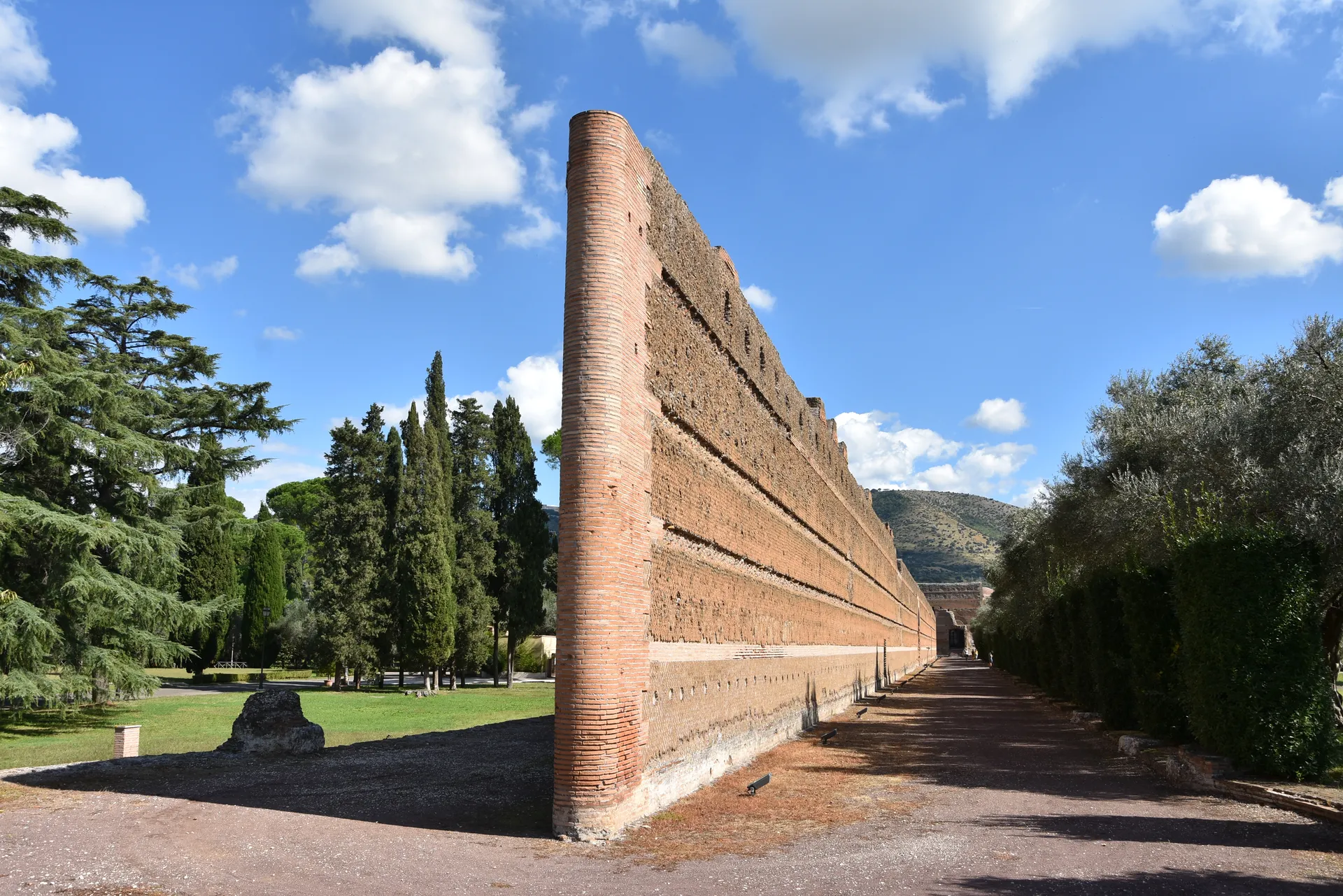 Photo: Patrik Kunec · CC BY-SA 4.0
Why does Hadrian's Villa in Tivoli, Italy, feel less like a ruin than the wreckage of an emperor's mind made visible? That's the reason to come: not for one postcard view, but to walk through 120 hectares of ambition, grief, and architectural experimentation spread across the Roman countryside like a private world too large for Rome itself. Today, in Tivoli, Italy, you move between cypress shade, broken colonnades, long reflecting pools, and brick walls warmed by the sun, while cicadas rasp over a silence once filled by servants, scholars, courtiers, and the emperor himself.
Most first-time visitors expect a palace. The place refuses that idea almost at once. Records and archaeology show a scattered complex of baths, libraries, dining suites, gardens, service quarters, and underground routes, more like an imperial city in fragments than a country house.
The scale hits late. About 40 hectares are open to visitors now, already larger than many historic centers, while the ancient estate stretched across at least 120 hectares, roughly 296 acres, an area closer to a small town than a villa.
And the best reason to visit is this: Hadrian's Villa lets you watch power turn personal. Greek elegance, Egyptian memory, Roman engineering, and private sorrow all sit in the same soil, so every pool and portico starts to feel like an argument the emperor was having with the world.
What to see
-
Canopus and the Serapeum
The surprise at Hadrian’s Villa is that its grandest room behaves like a stage set for heat: a long pool almost 120 meters in length, about as long as a football field, pulls your eye toward the Serapeum, where Hadrian’s guests once reclined on a semicircular dining couch with water running around them. Stand here in late afternoon and the place still works on the senses the way it was meant to, with glare flashing off the basin, stone warming underfoot, and the curved recess at the end holding a pocket of shade and echo that feels more Egyptian fantasy than Roman country house. Records and architecture point to a summer banqueting hall rather than a working temple, which changes the mood completely: this was power dressed up as pleasure. -
Maritime Theatre
Hadrian built himself a retreat inside the retreat, and that is why the Maritime Theatre stays with people longer than the famous pool: a circular canal encloses a tiny island house, once reached by two little rotating bridges whose traces still survive on the canal floor. It feels almost unnervingly controlled. You walk around the ring of columns, hear birds and your own steps bounce off brick and water, and begin to see the emperor less as a marble bust and more as a man obsessed with privacy, geometry, and the luxury of being almost unreachable. -
Walk the Villa as Hadrian Intended
Don’t rush from headline ruin to headline ruin; the villa makes sense when you feel its shifts in scale, from the vast Pecile court, roughly 230 by 96 meters and large enough to swallow a city square, to the intimate Small Baths where clamp holes and scraps of red plaster still whisper about vanished marble. End at Roccabruna if your legs hold out. The path through the olive grove grows quieter, the crowds thin, and the whole estate stops looking like a pile of ruins and starts reading as what UNESCO called it: an ideal city, engineered so servants moved below ground while the emperor’s world above stayed serene.
Plan your visit
- Getting There
- From Rome, take Metro B to Ponte Mammolo, then the blue Co.Tra.L bus toward Tivoli via Prenestina; the ride usually takes 40-50 minutes, and the "Villa Adriana" stop leaves you about 300 meters from the gate on Largo Marguerite Yourcenar, 1. The train route works too: Roma Tiburtina to Tivoli in about 35-45 minutes, then CAT bus 4 for roughly 15 minutes from near the station or Piazza Garibaldi.
- Opening Hours
- As of 2026, Hadrian's Villa opens daily from 9:00 AM until one hour before sunset, with Monday opening later at 2:00 PM. January 1 and December 25 are closed, and the winter cutoff is stricter: from October 1 to February 28, last admission is 3:00 PM.
- Time Needed
- Give it 2 hours if you want the headline ruins: the Canopus, Maritime Theater exterior, Piazza d'Oro, and the museum. Give it 3-4 hours for a proper visit across about 40 hectares of open archaeological ground, an area roughly the size of 56 football pitches.
- Accessibility
- Access is partial, not generous. The entrance, ticket office, and some flatter garden routes work for wheelchairs, but many pavilions, terraces, sunken pools, and underground passages remain blocked by gravel, steps, and changes in level; staff can point you toward the easier routes.
- Cost & Tickets
- As of 2026, the standard ticket is about €14, reduced entry for EU visitors aged 18-25 is about €4, and under-18s enter free; the first Sunday of each month and April 25 are also free-admission days. The combined Villae ticket, about €25, covers Hadrian's Villa and Villa d'Este for 3 consecutive days, which makes far more sense than buying two separate tickets if you're staying in Tivoli.
History
Hadrian Builds a Second Rome, Then Something Stranger
Publius Aelius Hadrianus, emperor from 117 to 138 AD, inherited the largest empire Rome had ever controlled and seems to have trusted almost none of its habits. Official sources and brick stamps date the main building phases of Hadrian's Villa to about 118 to 138 AD, and the place reads as his answer to Rome: less ceremonial, more experimental, and far more intimate.
This was not retreat in the lazy sense. Hadrian was a restless traveler, a ruler with a taste for Greek culture, engineering, and architectural risk, and most scholars think his hand shaped the design more directly than was usual for a Roman emperor. Walk here with that in mind and the ruins stop looking decorative. They start looking argumentative.
The turning point
The Emperor, the Dead Favorite, and the Villa That Changed Meaning
At first glance, Hadrian's Villa seems to tell a simple story: an emperor built himself the grandest country residence in the Roman world, a polished escape from the noise of Rome. The pools, porticoes, and formal vistas support that reading, and many visitors still see the site as a luxurious machine for leisure.
But one detail keeps resisting that version. After Antinous, Hadrian's young companion, died in the Nile in 130 AD, Egyptian forms begin to matter here in a different way, especially around the Canopus and Serapeum. According to documented ancient and museum evidence, Antinous was then deified, which means Hadrian's private grief became a public act of power as well as mourning.
That is the turning point. What had looked like a brilliant imperial residence also became a memorial landscape. Hadrian had more at stake than comfort: his authority, his image as a cultured ruler, and the fate of a beloved figure he refused to let vanish into rumor or water. The revelation changes the whole site, because the villa's mixture of Roman planning, Greek taste, and Egyptian evocation no longer reads as eclectic collecting. It reads as biography in stone.
Look at the long water of the Canopus after that, and it stops being just beautiful. It becomes grief staged with imperial resources, a man powerful enough to reorder architecture itself because he could not reorder what had happened.
Early Life & Vision
Legacy & Influence
Tips for visitors
Beat The Heat
Arrive at opening if you're visiting between June and September. Much of the central site sits in hard, open light, and 40 hectares of pale stone and dust can feel like walking through a skillet by noon.Photo Rules
Personal photography is allowed, but flash in the museum is usually off-limits, and drones, tripods, and monopods need prior written authorization. The best light comes early, when the Canopus pool holds a cleaner reflection and tour groups haven't started crowding the edges.Mind The Roads
The real nuisance here isn't petty theft but the approach roads around Via Tiburtina and the district bus stops. Double-check that your Co.Tra.L bus stops at "Villa Adriana," because a wrong drop-off can leave you beside fast traffic with poor pedestrian cover.Lunch Nearby
For a quick cheap stop, Pizzeria la Pergola is the sensible pick; Quadrifoglio Bar Cucina Espressa also works if you want something fast and local rather than polished. Villa Esedra suits a mid-range sit-down meal near the site, while Aromatiko is the splurge option if you want seafood and don't mind paying for it.Pair It Wisely
Combine Hadrian's Villa with Villa d'Este only if you start early and buy the 3-day combo ticket, because transit between Tivoli's sites eats more time than guidebooks admit. Rushing both in one hot afternoon turns an imperial retreat the size of a small town into a box-ticking exercise.Pack Light
No official left-luggage service operates on site, and large bags can become a nuisance fast on uneven paths and shallow steps. Bring water, a hat, and small change for toilets; leave your suitcase in Rome or at your hotel, because this is a ruin made for walking, not dragging.
Frequently asked
Is Hadrian's Villa worth visiting?
Yes, especially if you want Roman ruins with room to breathe rather than one more cramped museum circuit. This was not a single house but an imperial complex spread across 120 hectares, roughly 170 football pitches, with only part of it open today. What stays with you is the swing in scale: echoing bath chambers, long pools that catch the light, and empty brick shells that still feel engineered for power.
How long do you need at Hadrian's Villa?
Give it at least 3 hours if you want the place to make sense. A quick 2-hour pass can cover the Canopus, the Maritime Theatre, and a few major courts, but the visitable area still runs to about 40 hectares, around 56 football pitches, so distance is part of the experience. Rushing this site is like speed-reading a very good novel and only remembering the chapter titles.
How do I get to Hadrian's Villa from Tivoli?
The simplest route is CAT Bus 4 from Tivoli toward Villa Adriana. The ride takes about 15 minutes, then you get off at the Villa Adriana stop near the entrance on Largo Marguerite Yourcenar. A taxi is easier if the heat is rising, because the roads around the site are more suburban edge than pretty old-town stroll.
How do I get to Hadrian's Villa from Rome?
The easiest public transport route is Metro B to Ponte Mammolo, then a Co.Tra.L bus to the Villa Adriana stop. The bus ride usually takes about 40 to 50 minutes, and the last stretch is a short walk to the entrance. You can also take a train from Roma Tiburtina to Tivoli and switch to CAT Bus 4, which works well if you plan to see more of Tivoli in the same day.
What is the best time to visit Hadrian's Villa?
Spring and early autumn are the best bets, and early morning is the smartest hour year-round. This is a huge open-air site with gravel paths, slopes, and long exposed stretches, so midday summer sun can feel brutal while the first light gives the pools and brickwork a softer edge. If evening openings are running, they change the whole mood: less glare, longer shadows, and a ruin that finally starts to whisper instead of shout.
Can you visit Hadrian's Villa for free?
Yes, but only in specific cases. The site is free on the first Sunday of each month and on a few national free-entry days, while standard admission is usually paid; under-18s also enter free, and some disability and professional categories qualify as well. Check the official ticket page before you go, because hours and admission rules shift with the season.
What should I not miss at Hadrian's Villa?
Do not miss the Canopus, the Maritime Theatre, the Pecile, and the Small Baths. The Canopus gives you Hadrian at his most theatrical, all water glare and reflected columns, while the Maritime Theatre is stranger and better: a private island retreat reached by tiny rotating bridges, like solitude turned into architecture. Also look for the small physical clues most people walk past, especially the bridge traces in the Maritime Theatre canal and the clamp holes in the Small Baths where marble used to hang.
Sources & attribution 12
- UNESCO World Heritage Centre — Confirmed UNESCO status, overall significance, construction date range, and the 120-hectare scale with about 30 surviving buildings.
- Villae Official English Site — Provided the official overview, visitable area of about 40 hectares, historical framing, and site layout context.
- Villae Official Italian Site — Supported official details on terrain, visitor warnings, and institutional framing in Italian.
- Villae Opening Time and Tickets — Used for opening hours, last-entry patterns, closures, and ticketing guidance.
- Tivoli Tickets Directions Page — Used for practical arrival details, entrance location, and transport orientation.
- Villa Adriana Specialist Site: Canopus — Provided details on the Canopus and Serapeum as a water-cooled dining setting with strong sensory character.
- Villa Adriana Specialist Site: Maritime Theatre — Provided the circular-island design, rotating bridge traces, and the building's unusual private-retreat character.
- Villa Adriana Specialist Site: Pecile — Supplied dimensions and physical details for the Pecile, including the long court and surviving beam holes.
- Villae Reopening Note for Small Baths and Hospitalia — Used for the Small Baths reopening and for details on tactile supports and the character of the bath interiors.
- Villa Adriana Specialist Site: Small Baths — Provided close-up architectural details for the Small Baths, including surviving traces that help visitors read vanished marble decoration.
- Community Rick Steves Forum — Used cautiously for transport friction and the practical reality that getting to the site can be more awkward than guidebooks imply.
- Stay Roma C Blog — Used for practical timing estimates and route context for visitors combining Tivoli logistics with a day trip from Rome.
Built from cited sources · see the method · How we make our guides →
Pick up where you left off
Saved and recently read places — kept on this device only.
Photo credits (4)
- The long wall of the porticus of the Pecile, Hadrian's Villa, Tivoli (22702279093) — Carole Raddato from FRANKFURT, Germany — CC BY-SA 2.0 (https://creativecommons.org/licenses/by-sa/2.0/) — Source: https://commons.wikimedia.org/wiki/File:The_long_wall_of_the_porticus_of_the_Pecile,_Hadrian's_Villa,_Tivoli_(22702279093).jpg
- The Antinoeion, Hadrian's Villa (16036504998) — Carole Raddato from FRANKFURT, Germany — CC BY-SA 2.0 (https://creativecommons.org/licenses/by-sa/2.0/) — Source: https://commons.wikimedia.org/wiki/File:The_Antinoeion,_Hadrian's_Villa_(16036504998).jpg
- Tivoli as seen from Villa Adriana — Lars Frietman — CC BY-SA 3.0 (https://creativecommons.org/licenses/by-sa/3.0/) — Source: https://commons.wikimedia.org/wiki/File:Tivoli_as_seen_from_Villa_Adriana.jpg
- Tivoli - Wall of the Poikile of Hadrian's Villa (Villa Adriana) - 2019 — Patrik Kunec — CC BY-SA 4.0 (https://creativecommons.org/licenses/by-sa/4.0/) — Source: https://commons.wikimedia.org/wiki/File:Tivoli_-_Wall_of_the_Poikile_of_Hadrian's_Villa_(Villa_Adriana)_-_2019.jpg
Photos may have been resized or cropped.