


Place
Italy Updated Jul 2026
Water hits stone all day in Tivoli, Italy: it hisses through the Hundred Fountains at Villa d'Este, then drops in a white roar into the Aniene gorge a few minutes away. Rome is only about 30 kilometers west, yet Tivoli feels cut from rougher material, a town of cliff edges, olive slopes, Roman ruins, and gardens built to show off what water can do. The surprise isn't that emperors and cardinals came here. It's that the place still has enough force to make their ambitions feel temporary.
 Photo: Duc Tinh Ngo / Pexels
Built from cited sources · see the method · How we make our guides →
Tivoli works better as an overnight stay than a rushed excursion. Villa Adriana spreads across such a broad archaeological plain that it feels less like a ruin and more like a broken city, while Villa d'Este asks for late afternoon, when the low sun catches the spray and turns the terraces gold. Then comes Villa Gregoriana, all wet rock, cave air, and chestnut shade. Different mood entirely.
The historic center holds the town together. Medieval lanes fold around Piazza del Duomo, small bars pour espresso for locals standing at the counter, and dinner still leans Tiburtine when the kitchen cares about where it is: pizzutello grapes in season, Terre Tiburtine olive oil, lamb, fresh pasta, bread with a dark wood-fired crust. Skip the first place advertising itself to bus groups and walk deeper into the grid.
Water explains more about Tivoli than any monument plaque does. Floods forced engineers to reshape the river, popes turned hydraulics into theater, and the cliffs gave Roman builders a stage they never stopped using. That is the city's real trick: Tivoli makes grandeur feel geological, as if the villas and temples were only one more layer laid onto the rock.
Not every monument, just the ones we'd walk you past ourselves.
Where to wander, by quarter — each with its own rhythm.
Before you go
From legendary Tibur to UNESCO-listed Tivoli
Legend holds that Catillus of Arcadia arrived here after long wars in Greece and founded Tibur with his sons Tiburtus, Coras, and Catillus. The story is myth, not record, but it tells you how Tivoli wanted to be seen: older than Rome, proud before Rome, and never entirely willing to bow.
Archaeology points to an early fortified settlement above the Aniene, near what is now the San Paolo area. The site mattered for one hard, practical reason: it watched a river crossing and the routes that carried flocks between the Roman plain and the Abruzzo uplands.
Tibur entered the shifting alliance system of the Latin cities at a moment when Rome was still only one power among several. That made the town a political player, not a hill village, and it helps explain the swagger behind Virgil's later phrase, Tibur Superbum.
The Sanctuary of Hercules Victor rose beside the old Tiburtine route as a religious complex on an almost theatrical scale. Traders, pilgrims, and mule trains would have arrived to the smell of sacrifice and the racket of commerce, because in Roman Italy piety and business rarely kept separate rooms.
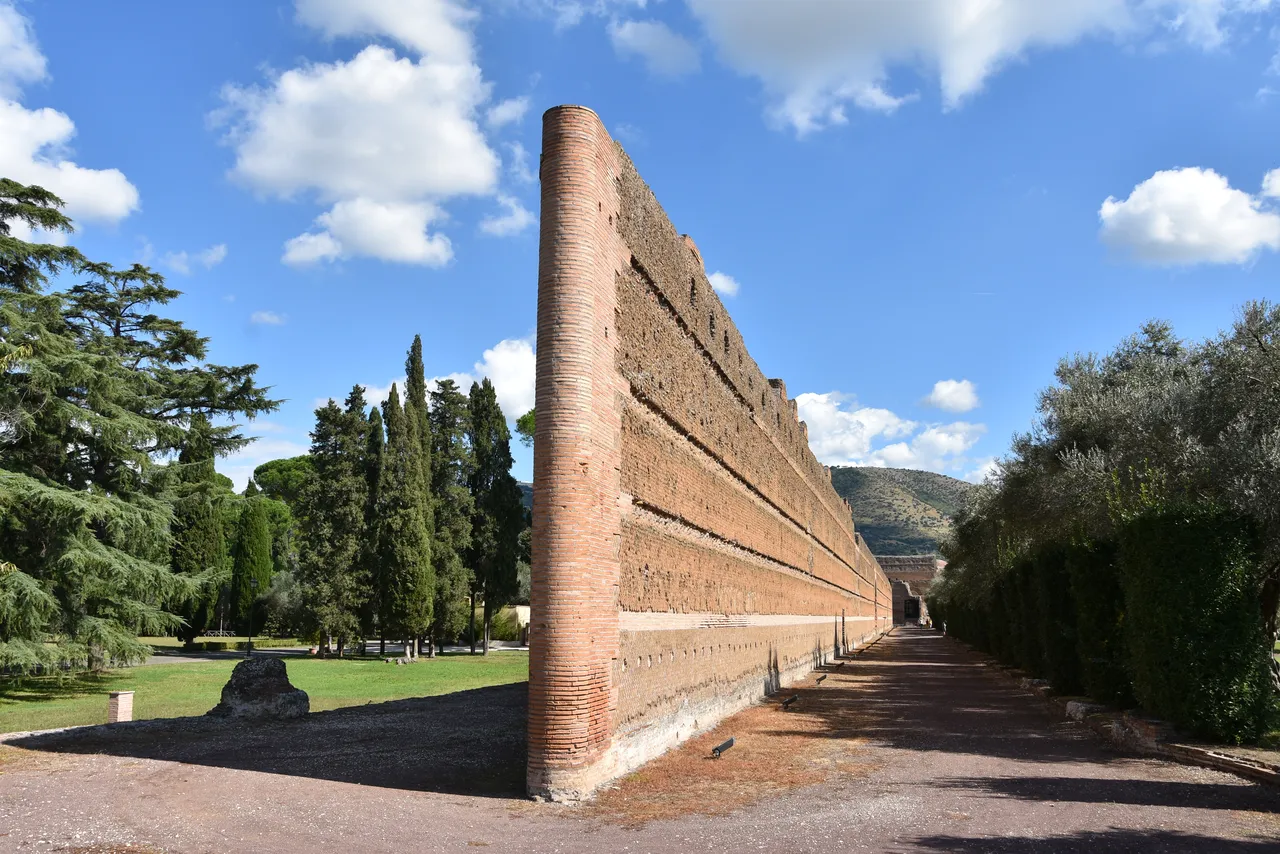
Emperor Hadrian began building his vast villa outside Tivoli around 118, turning the countryside into an imperial laboratory of pools, libraries, baths, theaters, and borrowed memories from across the empire. It does not feel like a country house. It feels like a broken city built for one man who had seen too much of the world to settle for a single style.
By the year of Hadrian's death, the villa had become one of the largest and strangest imperial residences in the Roman world, spread across roughly 120 hectares. Tivoli's later fame would keep circling back here, to those brick vaults, long reflecting pools, and service tunnels hidden under the feet of emperors.
Local tradition and later records connect Pope Simplicius to Tivoli, giving the town a place in the highest rank of late antique Christianity. His age was one of collapse and repair, when bishops and popes often mattered more than generals in keeping urban life from coming apart.
During the Gothic War, the Ostrogothic king Totila took and devastated Tivoli. The old Roman order was already fraying; this was the sound of it cracking, with walls broken, property seized, and civic life forced to begin again on smaller, harsher terms.
An earthquake, remembered in local tradition as devastating, damaged the town badly enough to alter its later form. Rebuilding pushed Tivoli toward new walls and a tighter medieval fabric, the kind of urban knot you still feel in the steep lanes around Castrovetere.
Tivoli aligned itself with Henry IV in the long struggle between empire and papacy, staking out a hard Ghibelline position. That choice bought protection at times and enemies all the time, especially in Rome, which never loved a strong neighbor upriver.
Roman forces defeated Tivoli and compelled terms that cut into its autonomy and territory. Medieval politics here were never abstract. They were fought ridge by ridge, gate by gate, and the loser paid in stone, land, and pride.
Pope Pius II ordered the construction of the Rocca Pia, a fortress whose message was plain even before the walls were finished. This was not a castle built to flatter Tivoli. It was built to watch it.
When Cardinal Ippolito II d'Este took charge in Tivoli, he brought ambition on a princely scale and a taste for spectacle sharpened at Europe's courts. The town gave him cliffs, water, and Roman fragments. He turned them into one of the Renaissance's great acts of garden theater.
By the 1560s, Pirro Ligorio's design for Villa d'Este was taking full shape: terraces, stairways, cascades, and fountains driven by gravity rather than pumps. Water did the performance work here, hissing through pipes, dropping into basins, and even powering the famous organ whose notes still sound slightly improbable.
The painter Philipp Peter Roos made Tivoli so central to his life and work that posterity renamed him after it. His pastoral scenes, thick with animals, dust, and evening light, helped turn Tivoli into an imagined countryside for northern Europe as much as a real town east of Rome.
Giovanni Battista Piranesi's views of Tivoli's temples, ravines, and ruins gave the city a second life on paper. Travelers arrived primed by those etched shadows, expecting sublime decay, and Tivoli learned to live with being admired through someone else's dramatic eye.
After destructive flooding, Pope Gregory XVI ordered the diversion of the Aniene through tunnels blasted into Monte Catillo. The engineering solved a real danger, then did something rarer: it made a disaster legible as beauty, creating the gorge, paths, caves, and great waterfall of what became Villa Gregoriana.
Franz Liszt began spending long periods at Villa d'Este as the guest of Cardinal Gustav Adolf Hohenlohe. Tivoli entered his late music as sound and atmosphere: water falling in the dark, chapel stillness, and that peculiar mix of grandeur and solitude the town does better than almost anywhere.
With the capture of Rome and the collapse of papal temporal power, Tivoli passed into the Kingdom of Italy. The shift was political, but it was urban too: the town began to belong to a modern nation-state rather than to a patchwork of ecclesiastical authority and local bargaining.
The future Nobel physicist Emilio Segrè was born in Tivoli, a reminder that this place is not only about emperors and cardinals. A town known for waterfalls and ruins also produced a scientist who helped identify new elements and, later, the antiproton. History can be rude that way.
Allied bombing in May 1944 hit rail and strategic targets but tore into the city as wars usually do, without much respect for tidy categories. The damage scarred streets, infrastructure, and memory, leaving twentieth-century wounds in a place visitors often misread as safely enclosed in older centuries.
UNESCO inscribed Villa Adriana in 1999, recognizing the site as more than an Italian ruin and more than an emperor's retreat. The designation confirmed what the place had been saying in brick and water for nearly two millennia: power leaves architecture behind, and architecture keeps talking.
Two years later, Villa d'Este also entered the UNESCO World Heritage list for its influence on European garden design and hydraulic engineering. Fair enough. Few places make water behave with such elegance while still letting you sense the labor, calculation, and vanity behind the show.
After years of neglect and careful restoration by FAI, Villa Gregoriana reopened as a public park in 2005. Tivoli recovered one of its wildest chapters here: not a polished garden, but a gorge of wet stone, fern shade, and roaring water that makes the whole city's history feel physically grounded.
Roman emperor · 76–138
Built his villa near Tivoli around AD 120
Hadrian turned the countryside outside Tivoli into an imperial thought experiment: baths, pools, theaters, service tunnels, and fragments of the places he admired across the empire. He would still recognize the appetite for spectacle here, though he might be annoyed that visitors now cross his estate with water bottles and camera phones instead of senators.
Cardinal and patron · 1509–1572
Governor of Tivoli from 1550; patron of Villa d'Este
Ippolito II d'Este arrived with rank, money, and the kind of ambition that prefers terraces to modest courtyards. Villa d'Este is his argument in stone and water: a palace garden designed to impress diplomats, rivals, and anyone else with eyes.
Composer and pianist · 1811–1886
Stayed repeatedly at Villa d'Este from 1865
Liszt came to Villa d'Este in his later years and found something rare: a place where religious intensity and theatrical beauty did not cancel each other out. The fountains and shaded walks fed music that feels suspended between prayer and performance, which suits Tivoli perfectly.
Physicist · 1905–1989
Born here
Emilio Segre, later a Nobel laureate for work that led to the discovery of the antiproton, began life in Tivoli before his career moved into the hard light of twentieth-century physics. A town built on Roman engineering and hydraulic obsession seems a fitting birthplace for someone who spent his life asking matter what it was made of.
Painter · 1655–1706
Settled here in 1684; known as Rosa da Tivoli
Roos settled in Tivoli so completely that the town entered his name. His animal paintings and pastoral scenes belong to the rougher countryside around the city, where olive groves, dust, and working life mattered more than polished court elegance.
Etcher and engraver · 1720–1778
Closely associated with Tivoli through his views of its ruins
Piranesi helped teach Europe how to look at Tivoli. In his prints, broken temples, cliffs, and masonry become almost theatrical, which is fair enough because Tivoli often looks staged by someone with a weakness for drama and crumbling stone.
Where locals actually book dinner — not the tourist menus.
These long, pointed table grapes are Tivoli's local obsession, sweet but not cloying, with a snap that makes supermarket grapes taste tired. If you're here in late summer, buy them from a market stall and eat them cold.
The hills around Tivoli produce olive oil with a grassy bite and a peppery finish that suits bruschetta, beans, and grilled meat. A good trattoria will put the bottle on the table without making a speech about it.
Porcini pasta shows up often in Tivoli's older restaurants, especially when the weather cools. The appeal is the smell first: butter, earth, steam, then the mushrooms themselves, meaty enough to carry the whole plate.
Roman-style lamb chops belong here too, given Tivoli's proximity to Rome and Lazio's pastoral cooking. They arrive hot enough to sting your fingers, charred at the edges, usually with rosemary, salt, and very little fuss.
For a quick lunch between sites, porchetta is the move: warm roast pork, fennel, crackling, and bread that takes the juices without collapsing. Eat it standing up if you can. It tastes better that way.
These fried rice croquettes are more Roman than specifically Tiburtine, but they are common, cheap, and worth your attention when you need something fast. The best ones crack open to reveal tomato-scented rice and a thread of mozzarella.
Sour-cherry tart turns up across Lazio, and Tivoli does it well when bakeries bother to keep the filling sharp rather than sugary. Order a slice in the afternoon with coffee; the tart fruit cuts through the day's heat.
Local wine lists often lean toward nearby Lazio bottles rather than international showpieces, which is the right instinct. A simple white from the Castelli Romani works beautifully after a long walk through fountains, dust, and stone.
Small things that change how the city treats you.
Yes, especially if you want more than a quick Rome day trip. Tivoli layers two UNESCO sites, a gorge carved by the Aniene, a romantic waterfall park, and a medieval hill town into one small place, which gives it much more texture than the usual single-monument stop.
Two days is the sweet spot. One day works for Villa d'Este and a rushed look at the center, but Hadrian's Villa and Villa Gregoriana deserve their own time unless you enjoy sprinting through archaeology and stairs.
Yes, and many people do. But an overnight stay makes far more sense if you want Villa Adriana, Villa d'Este, and Villa Gregoriana without spending half the day on transfers between the historic center and the Villa Adriana-Tivoli Terme side.
The usual route is a regional train from Rome to Tivoli or a Cotral bus from Rome Tiburtina or Ponte Mammolo. Trains are simple for the city center, while buses can be handy for Villa Adriana, but either way you need to validate your ticket before boarding.
The historic center is walkable, but it is not flat. Cobblestones, stairs, and steep lanes are part of the deal, and Villa Gregoriana adds rugged paths, so Tivoli feels better in good shoes than on paper.
Generally yes, with the usual care around stations, crowded transport, and major sites. The bigger risk for many visitors is physical rather than criminal: slippery paths, cliff edges, and heat exposure at Villa Gregoriana and Hadrian's Villa.
Tivoli can be moderate if you plan it well. Regional transport from Rome is inexpensive, but site tickets add up fast, so you save money by eating away from the entrances, using Lazio transport passes, and spreading the big sights over two days instead of paying for rushed taxis and overpriced snacks.
Spring and early fall are the best months. April through June and September through October bring softer light, greener gardens, and temperatures that make long walks through Villa Adriana feel civilized.
Saved and recently read places — kept on this device only.
Photos may have been resized or cropped.