Ortigia free to wander; Neapolis archaeological park €17
Access
Ortigia largely walkable; cobblestones and steps at major sites
Best season
May-June (classical theatre season at the Greek Theatre)
How does a building stay sacred for 2,500 years without a single day off? Walk into Syracuse's Cathedral on any Sicilian morning and the answer is hiding in plain sight — twelve fluted Doric columns from 480 BC built directly into the nave walls, a Greek temple to Athena still doing the work it was made for, just under different management. This is why Syracuse, perched on the Ionian coast of Italy, is not a ruin you visit. It's a city that never stopped using its monuments.
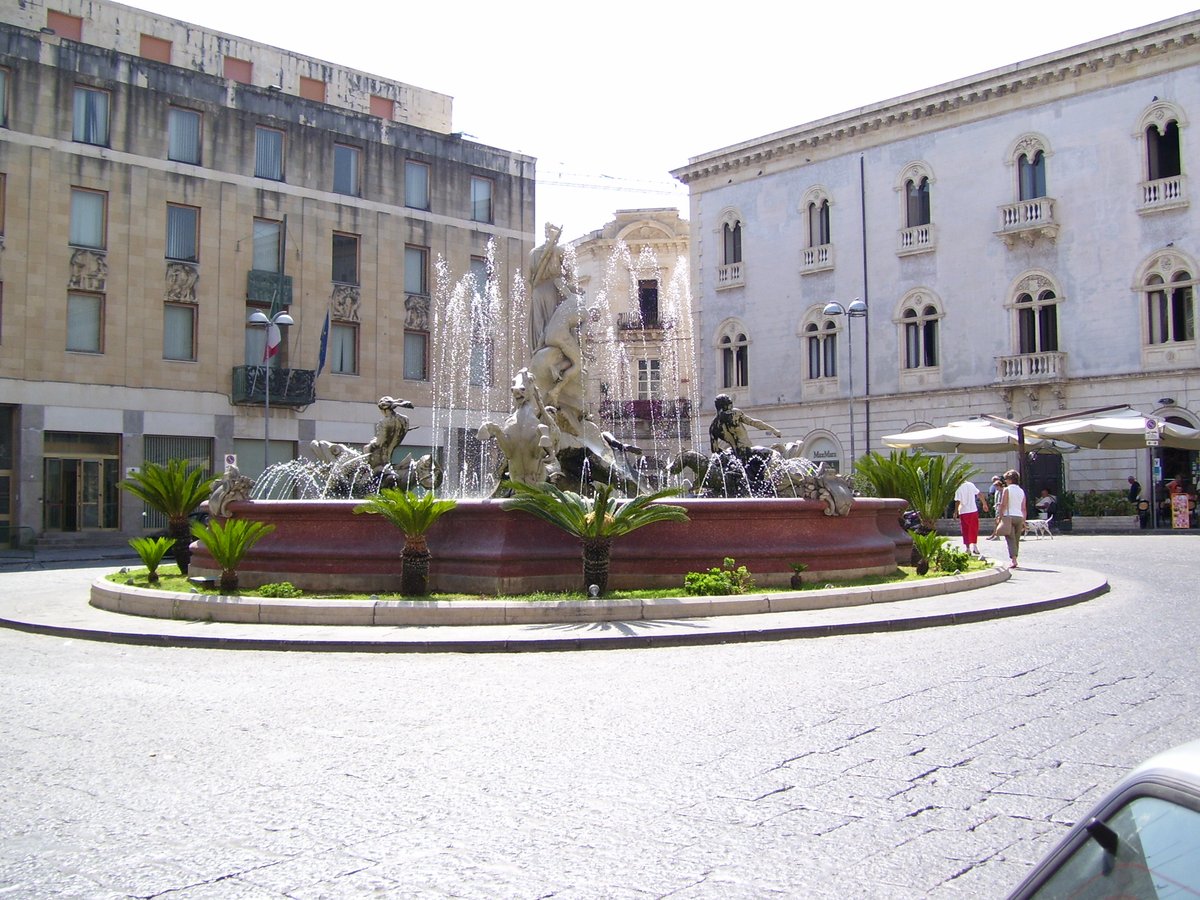
What you see today is layered in seven occupations, each visible if you look carefully. Ortygia, the oval island that holds the historic core, measures barely 1 km long — the length of a slow harbor walk — yet packs a Greek temple, a Hohenstaufen fortress, a Sicilian Baroque cathedral, and a freshwater spring where mythology says the nymph Arethusa surfaced after fleeing the river god Alpheus across the Ionian Sea. The air smells of caciocavallo, sea salt, and frying arancini. Every twenty minutes, somewhere, a church bell.
Cross the bridge to the mainland and the Neapolis archaeological park opens up: a 3rd-century BC Greek theatre carved into the hillside, still used every summer for live performances of Aeschylus and Sophocles before audiences in the thousands; a Roman amphitheatre cut into bedrock; and the foundation of Hiero II's sacrificial altar, originally 198 metres long — longer than two football pitches laid end to end. Cicero called Syracuse 'the greatest Greek city and the most beautiful of them all.' He wasn't being diplomatic.
Come for the archaeology and you'll stay for the December nights, when the silver simulacrum of Santa Lucia leaves the Cathedral by candlelight and the whole city walks behind it. Or for the May feast, when doves are released over Piazza Duomo to commemorate a 1646 famine miracle. Or for a glass of Nero d'Avola at a dockside table on Lungomare Alfeo, watching fishing boats unload the same waters Archimedes once defended with burning mirrors and grappling cranes.
Researched by the Audiala editorial team from historical records, architectural archives, and local expertise.
What to see
The Cathedral That Used to Be a Temple
Walk into Syracuse's Duomo and look up at the left wall. Those aren't decorative columns. They're the actual fluted shafts of the Temple of Athena, raised in the 5th century BC after Gelon flattened Carthage at Himera, still load-bearing 2,500 years later. Byzantine masons in the 6th century AD simply bricked between them and called it a basilica.
The Doric rhythm is irregular on purpose — Greek architects spaced corner columns closer to correct an optical illusion the eye would otherwise distort. You can feel that asymmetry underfoot if you trace the nave slowly. Then the 1693 earthquake shook the façade off the building and Sicilian Baroque rebuilt it in white pietra di Siracusa, all volutes and broken pediments, while the Greek bones held.
Go at 5pm. The piazza's elliptical paving turns rose-gold, the white stone catches fire, and inside it stays cool enough to forget the heat outside. Antonello da Messina's San Zosimo waits in a side chapel, mostly ignored by people photographing the columns.
Castello Maniace and the Sea Wall
Frederick II built this fortress between 1232 and 1240 at the southern tip of Ortigia, where the island runs out of land and the Ionian takes over. Square plan, four corner towers, a pointed limestone portal flanked by bronze rams — one original, one copy, both staring down anyone who approached from the water. Named for George Maniakes, the Byzantine commander who'd taken the city back from Arab rule two centuries earlier.
Inside, the ribbed cross vaults spring from polygonal column bases carved with foliage and animal heads. The geometry is austere, almost abstract, and the wind funnels through the entrance niches with a sound that locals will tell you hasn't changed since the 13th century. The seaward terrace is the cleanest horizon in Syracuse — nothing between you and Calabria but salt air.
Go near closing. The crowds drain by 5:30, the limestone goes amber, and you can hear the sea against the foundations the way a sentry would have in 1240.
An Ortigia Slow Walk: Apollo to Arethusa
Start at the Tempio di Apollo on the bridge end of the island — early 6th century BC, the oldest Doric temple in Sicily, with an inscription on the eastern step that still names its architect: Kleomede, son of Knidieidas. From there, cut south through the morning market on Via De Benedictis. Vendors stack swordfish heads on ice and shout prices in dialect. Buy a cartoccio of fried anchovies and keep walking.
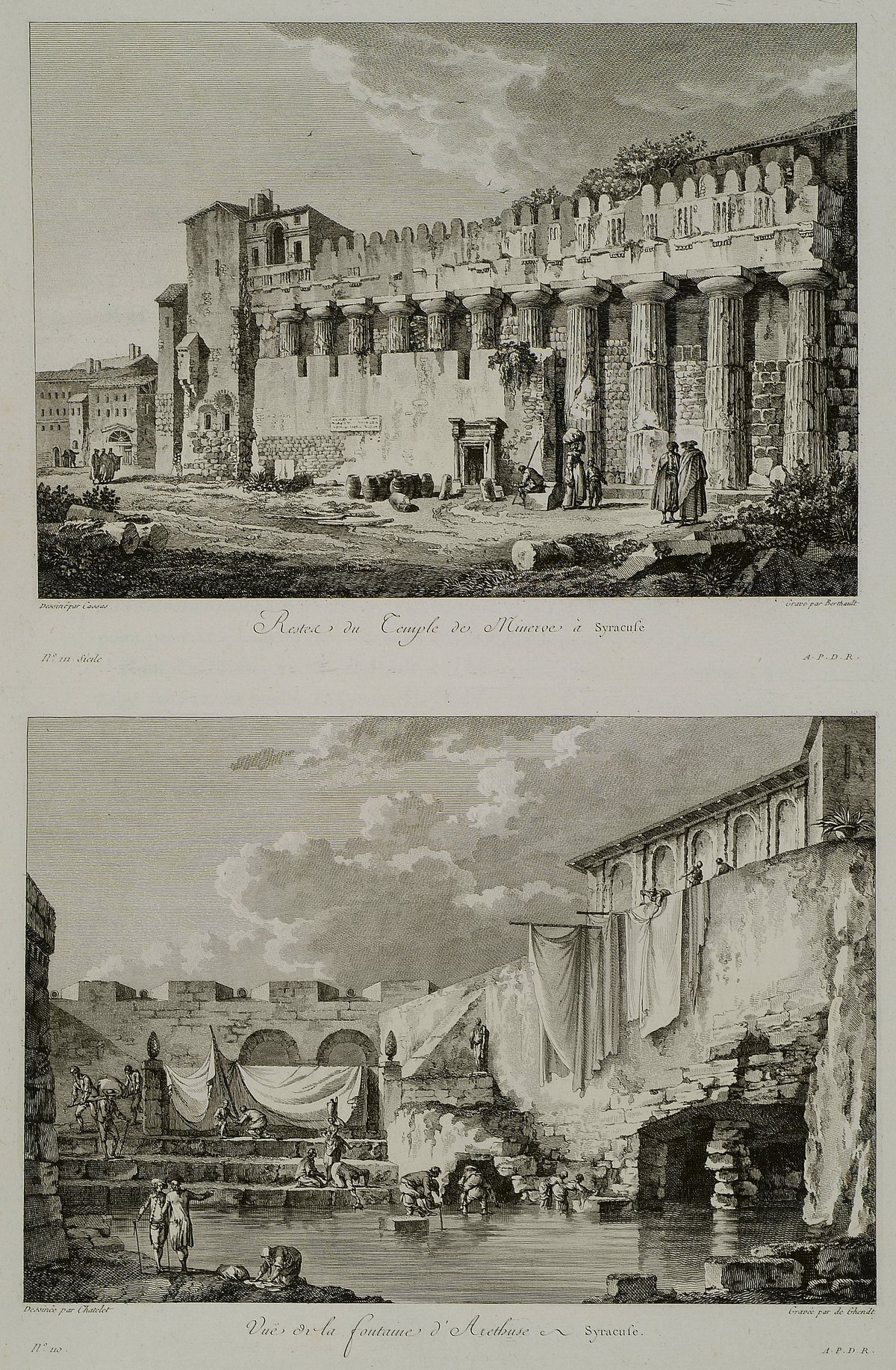
Duck into the Jewish quarter via Vicolo Bagnara. Catalan-Gothic doorways, citrus courtyards, almost no foot traffic by mid-afternoon. The 6th-century AD mikveh sits 18 metres below the Casa Bianca — book ahead, the water stays at constant temperature year-round. End at Fonte Aretusa, where freshwater bubbles up through papyrus reeds a stone's throw from the salt sea. Pindar wrote about this spring in 470 BC. The papyrus is still there.
Plan your visit
Getting There
Catania-Fontanarossa airport (CTA) sits 65 km north; SAIS Autolinee runs direct buses to Syracuse's terminal in about 1h15. Drivers should skip Ortigia entirely — park at Parcheggio Elorina on the mainland and ride the free Navetta Blu shuttle (every 20 minutes, daily 17:00–02:00, Sundays from 08:00). The historic island is ZTL: drive in casually and the cameras will fine you.
Opening Hours
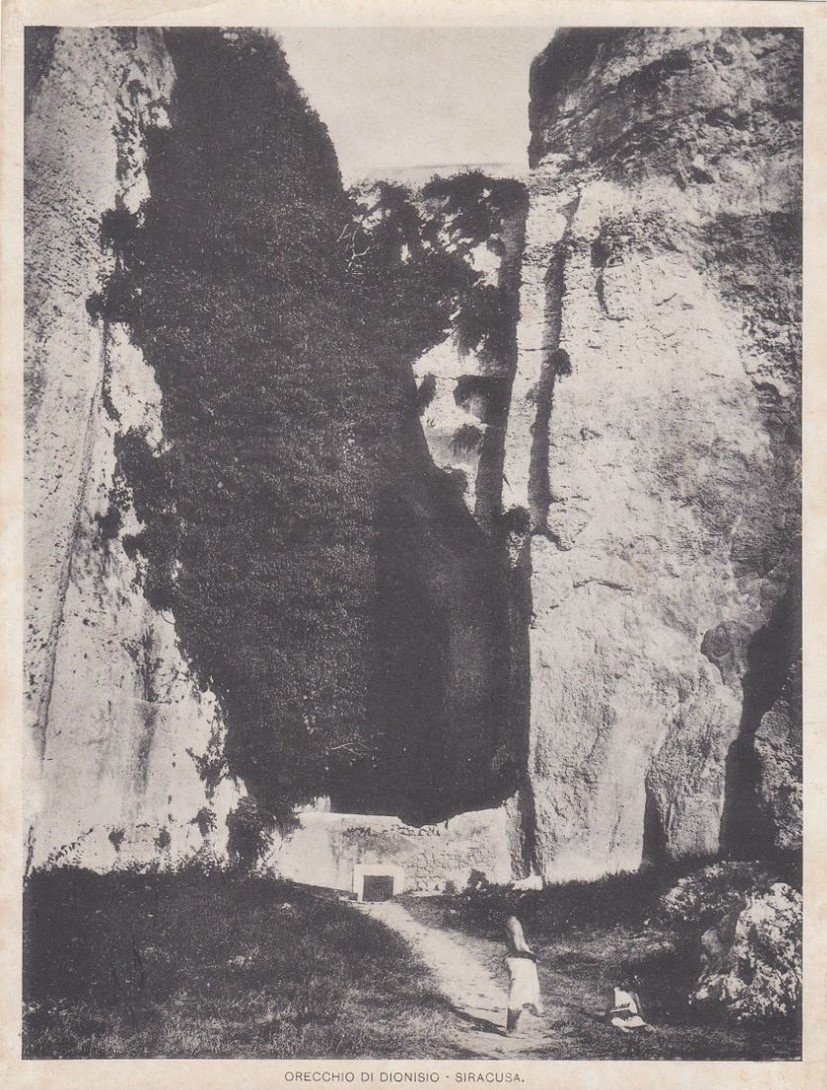
As of 2026, the Neapolis Archaeological Park (Greek Theatre, Roman Amphitheatre, Ear of Dionysius) opens daily around 08:30, closing 17:00–17:30 in winter and stretching to 19:30 mid-summer. The Paolo Orsi Museum and Castello Maniace follow standard state hours (~09:00–19:00) and may close Mondays. Verify on parcoarcheologicosiracusa.it before travel — Italian state sites tweak schedules every year.
Time Needed
Three to four hours covers Ortigia's greatest hits: Piazza Duomo, the Cathedral, Arethusa Spring, Castello Maniace exterior. A full day adds Neapolis (allow 2 hours) and the Paolo Orsi Museum (1.5 hours). To do it properly — catacombs, a classical play at the Greek Theatre, the morning market, sunset on the Alfeo promenade — give yourself two to three days.
Accessibility
Free entry for disabled visitors plus carer at Neapolis. Ortigia has ramps at the Cathedral (via the Archbishopric courtyard), tactile Braille maps, and accessible restrooms at Bar del Duomo. The archaeological park has improved paths around the Ear of Dionysius and Latomia, but limestone slopes are uneven — bring an electric chair, not a manual one. The Paolo Orsi Museum is fully accessible with tactile exhibits.
Tickets & Booking
Combined Neapolis + Paolo Orsi tickets typically run €12–€16 in 2026, single sites €8–€10. Free admission on the first Sunday of each month under the Italian Ministry policy. Pre-book timed entry through the regional heritage portal — third-party skip-the-line services are usually a waste. Skip the Siracusa Open Tour hop-on bus; 2025–2026 reviews are brutal about cancellations and broken audio.
History
The Temple That Never Stopped Working
Most ancient cities recycle their pasts as ruins, fenced off and ticketed. Syracuse does something stranger. It keeps using them. The Cathedral is still the seat of an archbishop. The Greek Theatre is still a working stage. The processional streets still carry processions. Empires arrived in waves — Corinthian Greek, Roman, Byzantine, Arab, Norman, Hohenstaufen, Aragonese, Spanish, Italian — and each one renamed the buildings rather than tearing them down.
What endures here is not stone. It's function. To understand Syracuse, follow what people have continued to do on the same patches of ground for roughly a hundred generations.
The turning point
Twenty-Five Centuries of Continuous Worship
From Piazza Duomo, the Cathedral looks like pure Sicilian Baroque — honey-pale limestone, twisting Corinthian flourishes by architect Andrea Palma, finished in the 1750s after the 1693 Val di Noto earthquake collapsed the medieval façade. Step inside and the math stops working. Twelve massive Doric columns line the nave walls, fluted, weather-grooved, older than any Baroque chisel could fake — and they aren't decorative cladding. They're load-bearing.
Records show this is literally the Temple of Athena, commissioned in 480 BC by the tyrant Gelon to thank the goddess for his victory over Carthage at the Battle of Himera. Gelon had gambled everything on that battlefield — his army, his fragile alliance with Theron of Akragas, the legitimacy of a tyranny installed only five years earlier. Winning bought him a kingdom and a debt to Athena he discharged in marble and gold. When Christian Syracuse arrived seven centuries later, they didn't demolish the temple. They walled it in. The cella became the nave. The peristyle became the outer wall. Under Arab rule (878–1085 AD) it briefly served as a mosque; under the Normans, a church again; today, the seat of the Archbishop of Syracuse.
Roughly 2,500 years of continuous sacred use, all under the same roof. Once you know this, the Cathedral stops being a Baroque church with curiously old columns. It becomes a 5th-century BC Greek temple still doing the work it was built for — just under management that has changed hands six or seven times.
What Changed
The rulers, and almost everything they touched on the surface. Romans took the city in 212 BC after a brutal two-year siege that ended with Archimedes cut down over a geometry diagram. Byzantine Emperor Constans II briefly moved the capital of the Roman Empire here in 663 AD, then was murdered in his bathhouse with a soap dish. Arab forces captured Syracuse in 878 AD; Norman troops under Roger I retook it in 1088. The 1693 earthquake flattened most of the medieval city and triggered the Baroque rebuild that now defines Ortygia's skyline. Each layer left dialect words, recipes, street names, and a different patron's coat of arms above the door.
What Endured
The processional routes. Every 13 December, the silver simulacrum of Santa Lucia — Syracuse's patron saint, murdered here in 304 AD — leaves the Cathedral for the Basilica of Santa Lucia al Sepolcro, escorted by twelve candelabra and devotees crying 'Sarausana jè!' ('She is a Syracusan'). Some walk barefoot. Many cry. The route follows streets first surveyed by Corinthian colonists in the 7th century BC, and ends at the chapel where her body lay before Venetian raiders carried it off in 1204. The May feast adds quail and dove releases over Piazza Duomo, commemorating a 1646 famine miracle. The schedule has held, with minor adjustments, for centuries.
Tips for visitors
Cathedral Etiquette
The Duomo is an active church built into the columns of a 5th-century BC temple of Athena — cover shoulders and knees, no hats, keep your voice down. Liturgical schedules trump tourist hours, so opening times can shift on feast days.
Don't Drive Into Ortigia
The ZTL cameras catch non-residents automatically and the fine arrives months later. Park at Elorina or Molo S. Antonio on the mainland and walk the 15–20 minutes across Ponte Umbertino, or take the free evening shuttle.
Avoid the Ape-Calessini
Those little three-wheeled tourist taxis touting tours around Ortigia are frequently unlicensed — local police seized two in March 2024 and sanctioned another in September 2025. If you want a tour, book through a registered guide, not a kerbside driver.
Where to Eat
Budget: Tito Mare for fried market seafood near the Apollo temple, or Caffè Apollo for granita and arancini. Mid-range: Trattoria Do Scogghiu for old-school Ortigia cooking, or Cortile Botà around €27 a head. Splurge: Cortile Spirito Santo near Castello Maniace, the city's Michelin star.
Market Before 11am
The Mercato di Ortigia by the Apollo temple runs mornings only and is best before tour groups land — fresh anchovies, swordfish, capers, almond pastries, and the theatrical vanniate selling shouts. Ask for Limone di Siracusa IGP and u strattu tomato concentrate to take home.
Catch a Greek Tragedy
INDA's 61st classical season runs May 8 to June 28, 2026 in the Greek Theatre — Aeschylus and Sophocles staged in the same hollowed-out hillside where they've been performed for 2,500 years. Book months ahead; evening shows alter park access on performance days.
Santa Lucia, Not a Show
December 13 is the city's emotional core — the saint's statue processes from the Duomo to Borgata Santa Lucia and stays through the octave to December 20. The chant Sarausana je matters more than your photograph. Watch quietly; locals find the procession reserved, then suddenly emotional.
Shoulder Season Wins
July–August packs Ortigia to the point that residents formed a committee against overtourism in June 2024. April–May and late September–October give you the same light, working market rhythms, and a city that still feels lived-in rather than overrun.
Where to Eat
local_dining
Don't Leave Without Trying
Frittura di paranzaInvoltini di pesce spadaSarde a beccaficoPasta alla NormaCaponataGranita with briocheCannoli
Bistrot al Bagatto - La Taverna dei Destini Incrociati
local favorite
Contemporary Sicilian€€star4.8(241)
Order: The ricotta dessert, which is frequently cited as a must-try finish to a meal.
With its quirky decor and open kitchen, this spot feels like a true local find. The staff are incredibly warm, and the fresh, carefully prepared dishes make it a standout for a memorable dinner.
Order: The fresh catch of the day, which highlights the local seafood bounty.
Situated on a charming piazza near the water, this restaurant captures the essence of Ortigia. It’s beloved for its incredibly friendly service and romantic, authentic atmosphere.
Order: Their homemade desserts and signature pasta dishes, which are highly praised for their depth of flavor.
This is a rare gem in Sicily with a beautifully decorated interior and a warm, inviting vibe. The owners put genuine passion into every plate, making it one of the most highly-rated experiences in the city.
Order: The scrambled eggs and the scone—locals claim it's the best they've ever had.
A cozy, detail-oriented spot perfect for a high-quality breakfast. It’s a refreshing, modern take on the morning meal that stands out for its fresh, homemade ingredients.
Syracuse - The Powerful Greek City-State on the Island of Sicily
See U in History / Mythology6 min16K
SYRACUSE SICILY Travel Guide: The Hidden ITALIAN Gem You NEED to Visit | SICILY Travel
Stay Fabulous15 min5K
Frequently asked
Is Syracuse Sicily worth visiting?
Yes — Cicero called it the greatest and most beautiful Greek city, and the layered ruins back him up. You get a 5th-century BC Doric temple wearing a Baroque costume (the Cathedral), a Greek theatre still staging Aeschylus every May, and an island core barely 1 km² where 3,889 residents still live their rituals. UNESCO inscribed it in 2005 for exactly this reason: a stratigraphic record of Greek, Roman, Byzantine, Arab, Norman, and Spanish layers compressed into one walkable city.
How long do you need in Syracuse?
Two to three days, minimum. One day handles Ortigia's highlights — Piazza Duomo, the Cathedral, Fonte Aretusa, Castello Maniace — but the Neapolis Archaeological Park alone needs two hours, the Paolo Orsi museum another ninety minutes, and the catacombs of San Giovanni half a day. Three days lets you catch a sunset on the Alfeo promenade, eat your way through the Ortigia market twice, and consider a boat tour or day trip to Pantalica.
How do I get to Syracuse from Catania?
Direct SAIS Autolinee buses run from Catania Fontanarossa airport to Syracuse's bus terminal in roughly 75 minutes. Trains from Catania Centrale also serve Siracusa station, though the bus is usually faster and drops you closer to Ortigia. From the bus terminal, walk twenty minutes across Ponte Umbertino onto the island, or grab the free Navetta Blu shuttle from Parcheggio Elorina.
What is the best time to visit Syracuse?
Late April through early June, or September into October. May and June bring the INDA classical season at the Greek Theatre — the 61st edition runs 8 May to 28 June 2026 — and the Santa Lucia di Maggio feast on the first two Sundays of May, when devotees release quail in Piazza Duomo. Avoid July and August unless you tolerate 38°C limestone radiating heat; winter is quiet but catacombs turn damp and some sites cut hours.
Can you visit Syracuse for free?
Partly. The first Sunday of each month is free at state-run sites including the Neapolis Archaeological Park, and entry is always free for visitors with disabilities plus a carer. Wandering Ortigia itself costs nothing — Piazza Duomo, Fonte Aretusa, the Tempio di Apollo ruins, and the Alfeo seawall are all open-air. The Cathedral interior is free, though donations are welcomed during active worship.
What should I not miss in Syracuse?
The Cathedral, because it is literally the 480 BC Temple of Athena with Doric columns still embedded in the nave walls — Baroque plaster never replaced them, just hid them. Then the Ear of Dionysius, where Caravaggio coined the name in 1608, and the Ara di Ierone II, a 198-metre sacrificial altar quarried for stone in 1526 by a Spanish viceroy. Time your visit for the 13 December Santa Lucia procession if you can — locals cry "Sarausana jè!" as the silver simulacrum leaves the Cathedral barefoot.
Is Ortigia the same as Syracuse?
No, and locals will correct you. Ortigia is the small island that holds Syracuse's historic core; Syracuse (Siracusa) is the wider city, including the Neapolis archaeological zone, the Borgata Santa Lucia quarter, and the Madonna delle Lacrime sanctuary on the mainland. Residents formed the "Ortigia Cittadinanza Resistente" committee in June 2024 partly because guidebooks keep blurring the two and treating their neighbourhood as a postcard.
Can you drive into Ortigia?
Not really — the island is a ZTL (limited traffic zone) with automated cameras and steep fines for non-residents. Park at Parcheggio Elorina on the mainland and take the free Navetta Blu shuttle (daily 17:00–02:00, every 20 minutes; Sundays from 08:00). Parcheggio Talete sits closer but fills early and its payment machines are notoriously temperamental.
Sources & attribution18
Researched and written by the Audiala editorial team from historical records, architectural archives, and local expertise. Last updated May 2026.
Visit Sicily — Syracuse — Regional tourism portal covering Ortigia attractions, the Greek Theatre, and the Ortigia market.
Visit Sicily — Feast of Saint Lucy — Detailed schedule of the December Santa Lucia cycle including the 30 November opening, 13 December procession, and 20 December return.
Strictly necessary cookies keep the site working. Analytics (PostHog, Google Analytics) measures how each visitor uses our pages. Marketing loads YouTube videos and walking-route maps without a tap and lets Google Analytics set advertising cookies. We never sell your data. You can change this any time from the footer.
Privacy
Cookie preferences
Pick what you're okay with. You can change this any time from the footer.
Strictly necessary
Always on
Sign-in, language, navigation. Always on.
Product analytics
PostHog (EU) and Google Analytics record which pages you view and how you use them, under a random identifier stored in your browser. Helps us see which pages work and which need fixing. Google's ad personalisation stays off. No selling.
Marketing
Loads YouTube videos and the walking-route maps (OpenFreeMap) without a tap; without it, they load only when you tap them. If analytics is also on, Google Analytics may set advertising cookies. Ad personalisation stays off.