
Place
Italy Updated Oct 2026
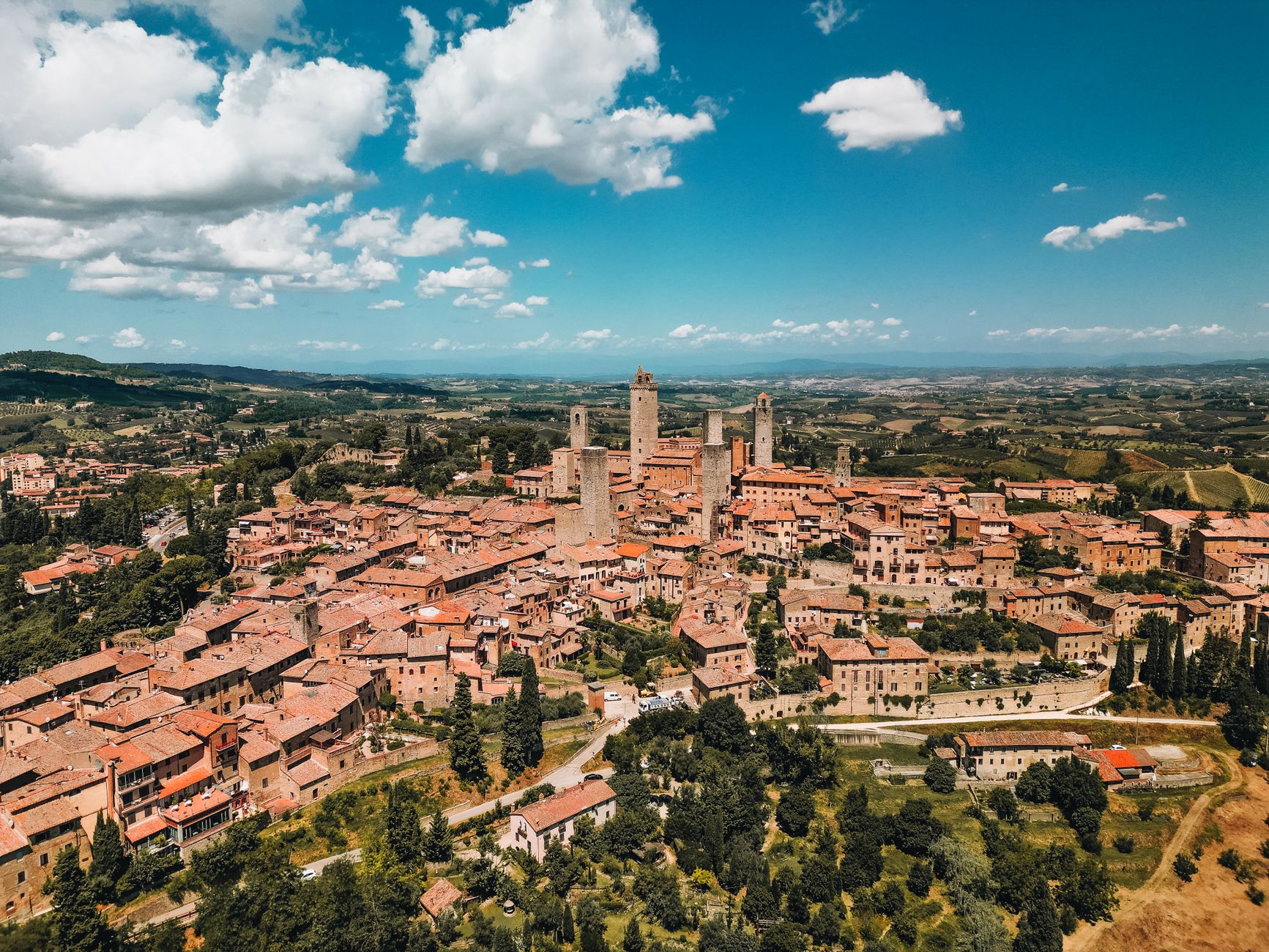
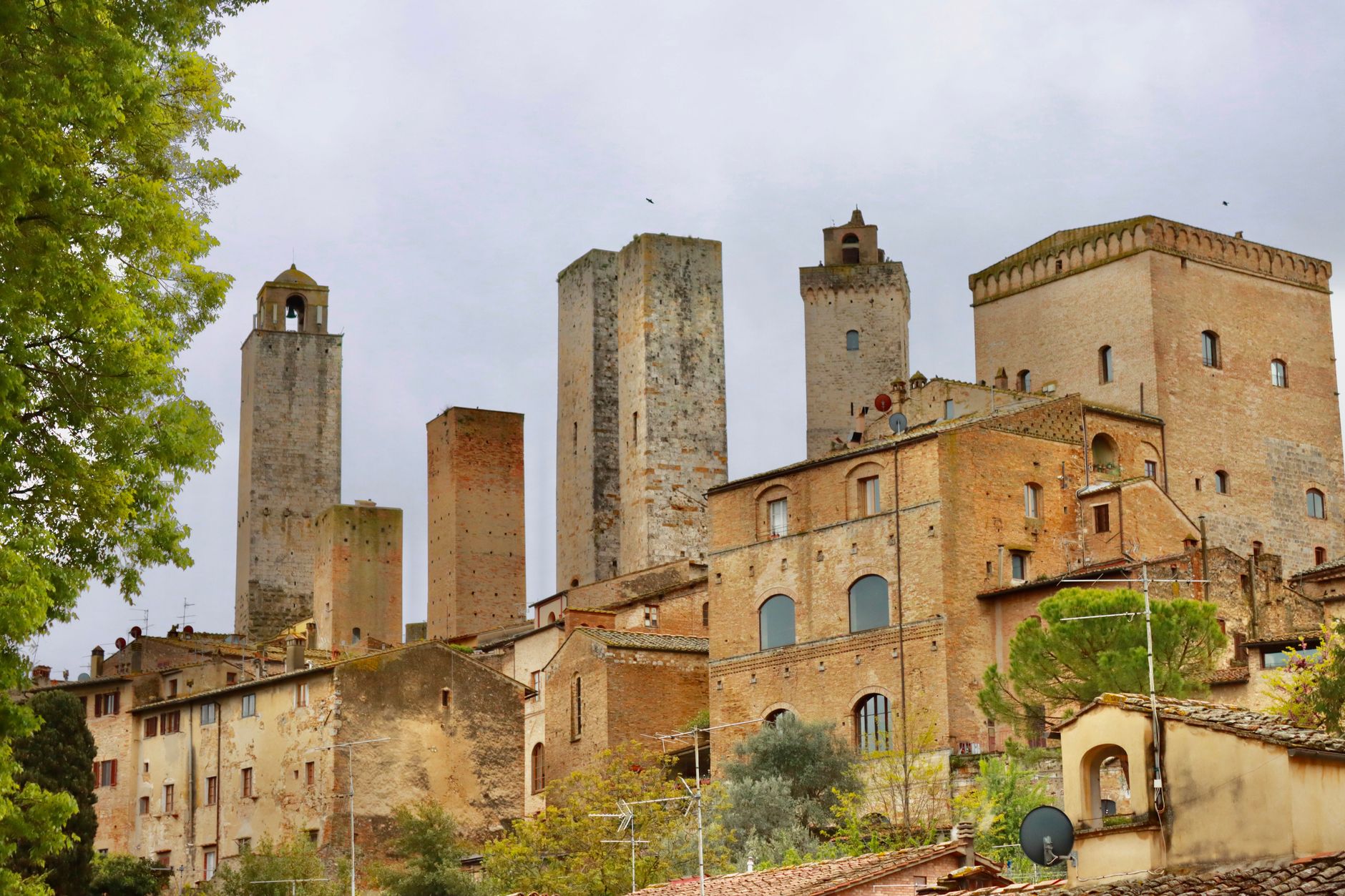
At dusk, San Gimignano’s stone towers hold the last gold light above the Val d’Elsa, while church bells carry across the vineyards. In this hill town in Italy, 14 of the roughly 72 towers built by rival families still puncture the skyline. The countryside feels remarkably close.
 Photo: Siegfried Poepperl / Pexels
Built from cited sources · see the method · How we make our guides →
Inside the Collegiata di Santa Maria Assunta, bare stone gives way to painted walls: Bartolo di Fredi’s Old Testament scenes, Taddeo di Bartolo’s Last Judgment, and Ghirlandaio’s luminous frescoes in the Chapel of Santa Fina. The contrast between the plain Romanesque exterior and the color within is part of the pleasure.
San Gimignano grew along the Via Francigena, the pilgrimage road that brought travelers, trade, and money through its gates. In the Palazzo Comunale, the Sala di Dante recalls the poet’s diplomatic visit in 1300; outside, narrow lanes still funnel toward the same hilltop squares.
The town’s old trade in saffron and Vernaccia wine still reaches the table, alongside pici and wild-boar ragù. And behind a medieval façade on Via del Castello, Galleria Continua occupies a former 1950s cinema—a reminder that San Gimignano is more than a preserved skyline.
Not every monument, just the ones we'd walk you past ourselves.


Where to wander, by quarter — each with its own rhythm.
Before you go
Curated from places in this city. Same price as official sites.


Prices shown are indicative — final pricing and availability are confirmed at checkout. Audiala may receive a commission from bookings made via these links.
From an Etruscan hill settlement to a medieval town above the Via Francigena
Archaeological finds point to Etruscan settlement in the hills around the site of San Gimignano. The town’s high position above the Elsa Valley offered a clear view across the surrounding routes and farmland.
Local tradition links the town’s name to Saint Geminianus, the fourth-century bishop of Modena. Legend says his apparition protected the settlement from invaders; the story belongs to devotion, not documented military history.
Early records identify San Gimignano as a castle and estate under the bishops of Volterra. The name had entered the documents, though the town was still shaped more by feudal authority than civic government.
San Gimignano grew along the Via Francigena, the route carrying pilgrims and merchants south toward Rome. Wool, cloth, saffron, and Vernaccia wine helped turn passing traffic into local wealth.
Pope Eugenius III consecrated the church of Santa Maria Assunta on November 21. Its Romanesque stone exterior gives little away: inside, later generations covered the walls with painted biblical stories.
San Gimignano broke from the bishops of Volterra and formed a self-governing commune, appointing its own podestà. Civic power now had a home in the town’s public buildings—and would soon compete with the ambitions of powerful families.
Fina dei Ciardi was born in San Gimignano and became one of the town’s most beloved saints. Hagiographic accounts describe her enduring a paralyzing illness from childhood; her relics now rest in the chapel built in her honor inside the Collegiata.
Guelphs gained control of the commune and partly dismantled its earlier fortifications. As rival families raised tower-houses above the streets, municipal rules barred private towers from exceeding the height of the public Torre Rognosa.
After the Ghibelline victory over Florence at Montaperti, Ghibelline supporters took control in San Gimignano. The commune repaired and extended its walls, giving the town a harder outline as well as a new political direction.
Born in San Gimignano, Folgore made the town part of his name and its knightly culture part of his poetry. His sonnet sequences celebrate the pleasures of the months and days—jousts, hunts, and the polished rituals of courtly life.
An octagonal travertine cistern was built at the center of what became Piazza della Cisterna. Its well made a practical necessity into a civic landmark, where the slope of the square still draws the eye toward the stone rim.
Construction began on the Palazzo Comunale, also called the Palazzo del Popolo, giving the commune a grand civic seat beside the Collegiata. Its halls would serve both government and public ceremony, with painted walls carrying the city’s claims to authority.
On May 8, Dante Alighieri visited as an envoy of the Tuscan Guelph League and spoke to the town council. The chamber is now known as the Sala di Dante; Lippo Memmi’s later Maestà watches over the room where political alliances were argued.
The commune completed Torre Grossa beside the Palazzo Comunale, raising it 54 meters above the streets. Its height announced civic power in the same language private families had used for generations: stone, visibility, and a commanding view.
Lippo Memmi painted the Maestà in the town hall’s council chamber, presenting the Virgin enthroned amid saints and attendants. The fresco turned a room of government into a statement of sacred protection and local standing.
The plague struck San Gimignano and killed a large share of its population; some accounts estimate as many as two-thirds. Fewer hands remained for fields, workshops, and trade, and the commune’s economic strength sharply contracted.
Weakened by plague, economic strain, and conflict between powerful families, the commune surrendered its independence to Florence. Florentine forces built the Rocca di Montestaffoli as a garrison, a blunt reminder of who now held the keys.
Sienese painter Bartolo di Fredi covered the Collegiata’s left nave wall with scenes from the Old Testament. The long sequence asks worshippers to read the stories in order, turning a church wall into a painted book.
Taddeo di Bartolo painted the Last Judgment on the inner façade of the Collegiata. Above the entrance, the immense scene met worshippers as they entered and left, placing everyday life beneath the weight of final judgment.
Benozzo Gozzoli came to San Gimignano and worked there through 1467, painting a 17-scene cycle of Saint Augustine’s life in Sant’Agostino. In the same period, he painted a Saint Sebastian in the Collegiata, leaving the town with two very different acts of devotion.
Architect Giuliano da Maiano expanded the Collegiata and designed the Chapel of Santa Fina. His brother Benedetto created the marble altar and tomb, giving the town’s young patron saint a carefully framed place at the heart of its principal church.
Pope Sixtus IV raised Santa Maria Assunta to the rank of a collegiate church. The title affirmed the church’s standing, while its walls continued to gather art commissioned from painters and sculptors across Tuscany.
Domenico Ghirlandaio painted the chapel’s scenes of Santa Fina’s vision and funeral, with help from Sebastiano Mainardi. Look closely and the sacred story opens onto the town itself: San Gimignano’s towers appear among its people and buildings.
San Gimignano became part of the Grand Duchy of Tuscany under Medici rule. With its political importance reduced, the town’s economy slowed; that long pause helped spare much of its medieval street plan from wholesale rebuilding.
After the 1860 plebiscite, San Gimignano became part of the Kingdom of Italy. The new state brought political change, but the town’s old towers and narrow streets remained largely outside the reach of industrial transformation.
During the Allied advance, artillery fire damaged the Collegiata’s roof, vaults, and façade. The scars reached the church’s interior too, interrupting the painted stories that had watched over the town for centuries.
Restoration work repaired wartime damage to the Collegiata and exposed the remains of an earlier, three-apsed church beneath the nave. The discovery pushed the building’s history back to the tenth century, before the Romanesque church took shape.
Vernaccia di San Gimignano became Italy’s first wine to receive DOC recognition. The designation put a formal mark on a local product whose reputation had grown alongside the town’s trade and pilgrimage traffic.
UNESCO inscribed San Gimignano’s historic centre as a World Heritage Site, citing its medieval architecture, towers, and art. Fourteen towers survive from the town’s great age of tower-building, a fraction of the roughly 72 once associated with its skyline.
Poet · 1265–1321
Received here on a diplomatic mission in 1300
San Gimignano received Dante as a Florentine envoy in 1300, a visit remembered in the Sala di Dante inside Palazzo Comunale. He might recognize the old civic pride in today’s tower-lined skyline, though the rival families’ weapons have given way to cameras.
Saint · c. 1238–1253
Lived and died here
Fina’s story remains close to the town: the chapel named for her holds Domenico Ghirlandaio’s frescoes depicting her life and miracles. In its quieter light, San Gimignano’s grand civic history narrows to one local devotion.
Painter · 1420–1497
Painted the fresco cycle at Sant’Agostino in 1464–1465
Gozzoli painted the choir frescoes of the life of Saint Augustine in the church of Sant’Agostino in 1464–1465. His work gives the quieter northern side of town a reason to linger, away from the crush around the main piazzas.
Where locals actually book dinner — not the tourist menus.
Small things that change how the city treats you.
The city, as it actually looks.


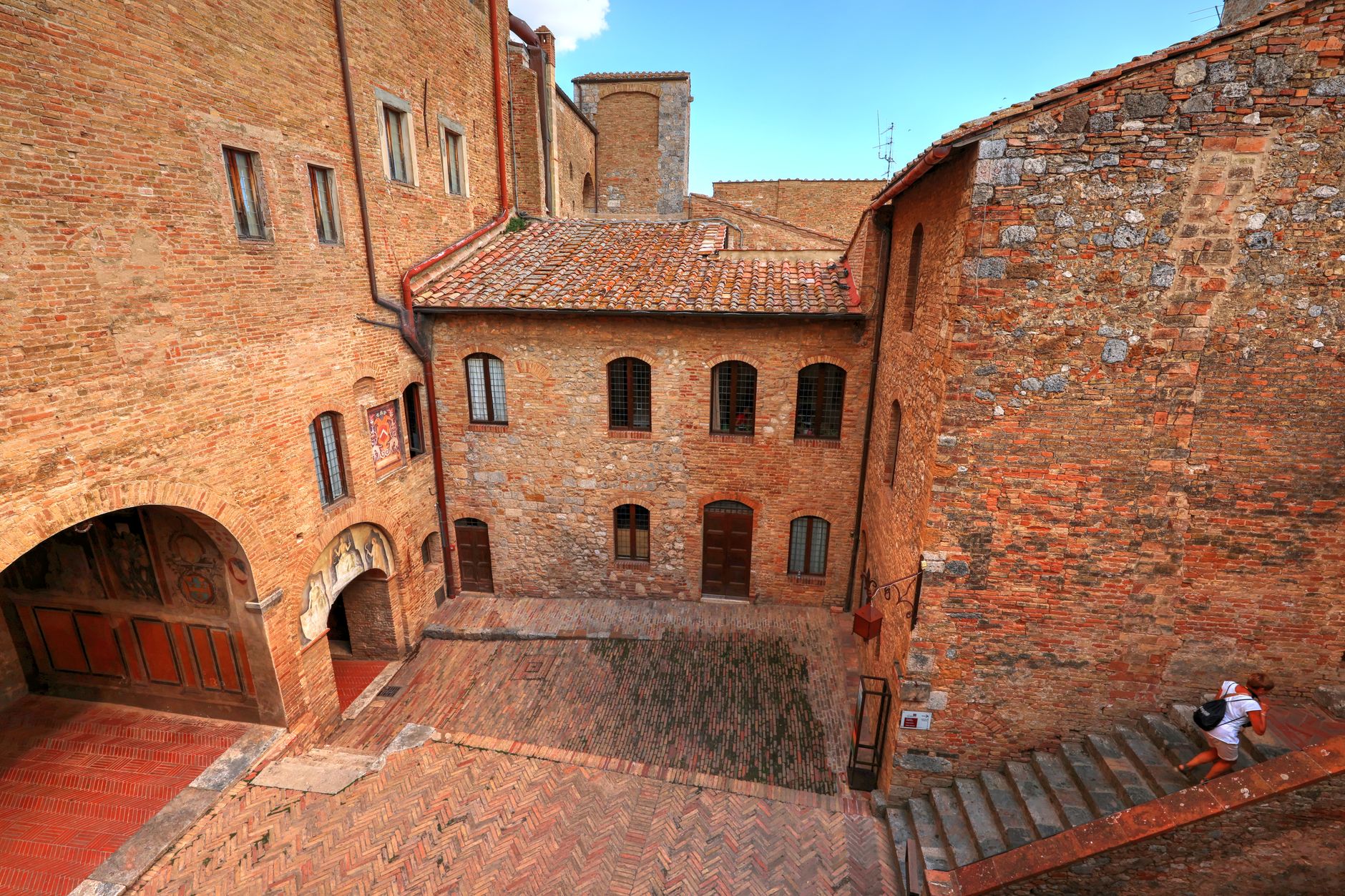


Yes, especially if you enjoy medieval architecture and painted churches. Fourteen medieval towers still shape the skyline, while the Collegiata’s frescoes reward a closer look; the busiest hours can feel crowded.
One full day covers the main squares, the Collegiata, Palazzo Comunale and Torre Grossa. Stay two days if you want time for the museums, a slower evening walk or a stretch of the Via Francigena.
Take a regional train from Florence to Poggibonsi-San Gimignano, then transfer to bus 130 for the town. The train journey takes about 45–60 minutes, and the bus ride from Poggibonsi takes roughly 20–25 minutes; check schedules before travelling.
No, San Gimignano has no train station. The usual rail connection is Poggibonsi-San Gimignano station, followed by regional bus 130 into town.
The historic center is best explored on foot, but watch your step on its sloping stone streets and cobbles. Cars are restricted by a camera-enforced ZTL, so do not drive through the town gates unless you have confirmed authorization.
The listed adult price is €15, with a reduced €12 price for ages 6–17. It covers several civic museums, the Duomo complex and Torre Grossa for 2–3 consecutive days; check the official ticket information for current prices and opening hours.
Yes, summer day-trip crowds are concentrated around the central squares, especially from about 10:30 a.m. to 4:30 p.m. Arriving early or staying overnight gives you quieter hours in the lanes.
8 places to discover
Saved and recently read places — kept on this device only.
Photos may have been resized or cropped.