An introduction.
Researched by the Audiala editorial team from historical records, architectural archives, and local expertise.
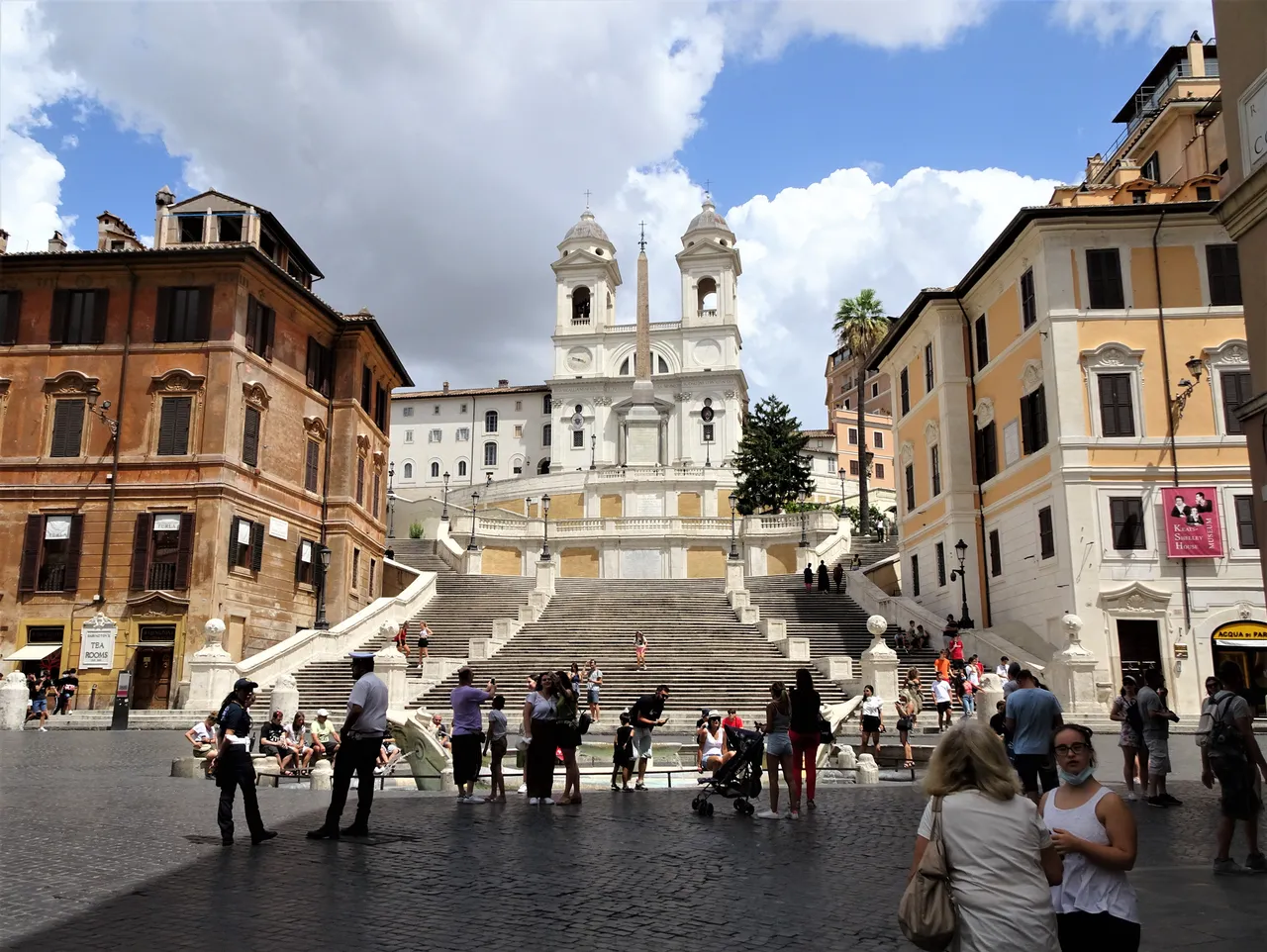
WWhy are they called the Spanish Steps when Spain paid nothing? The money came from a French diplomat's will, the architect was Roman, the pope who finally approved the design was Italian, and the only Spaniard in the story was an ambassador who happened to live at the bottom. Today the Scalinata di Trinità dei Monti pours 135-odd travertine steps down a 29-metre slope between Piazza di Spagna and the twin-towered church of Trinità dei Monti, in the heart of Rome, Italy — and you should come for the lie hiding in the name.
Stand at the foot in late afternoon. The travertine glows gold, the half-sunken Barcaccia fountain by the Berninis gurgles at your feet, and the crowd thins toward the top where the obelisk pierces the sky. Romans call them the scalinata — the stairway — and never anything Spanish. The name stuck only because the Spanish Embassy to the Holy See sat in Palazzo Monaldeschi at the base, a postal accident of diplomatic geography.
What you are climbing is a peace treaty in stone. Three flights, three ramps each, converging into a single ascent toward the church above — a Trinitarian geometry encoded in the design by Francesco de Sanctis. The cippi at the base carry Conti family eagles next to Bourbon fleurs-de-lys, side by side, marking the moment a 60-year fight between the papacy and the French crown finally ended in a stairway.
Sit if you dare. A 2019 ordinance bans it (fines run €250–400) even though de Sanctis built stone benches and low walls every twelve steps for exactly that purpose. The contradiction is the modern Roman experience here — design intent versus crowd-control reality, Instagram backdrop versus civic stage. On 8 December the steps reclaim themselves: the fire brigade climbs a 30-metre ladder at dawn to lay flowers in the arms of the Madonna at the base, and the pope arrives by afternoon. Come for the view, stay for the riddle the name keeps telling.
Hidden Gems of ROME : Spanish Steps Neighborhood
the tour guy01 What to see.
The Butterfly Staircase Itself
Francesco de Sanctis finished the steps in 1726, and his trick was geometry disguised as theatre. 135 travertine treads climb 29 metres up the Pincio shoulder, but he split them into 11 ramps of 12 steps each — concave then convex, fanning out then pinching back like a butterfly opening its wings. The grouping by threes is a wink at Trinità dei Monti above; the balustrade landings double as rest stops where Romans have been pausing to look out over the rooftops for 300 years.
Get close to the stone. Roman travertine from the Tivoli quarries, pitted with natural voids, dished into shallow grooves at the centre of each tread by three centuries of footfall. Run your fingers across — you can feel the bowl. Bvlgari paid €1.5 million in 2015–16 to scrub away the grime and chewing gum, and the cream-pink tone now glows almost rose at sunrise. No sitting since 2019, by the way; the carabinieri will fine you. Stand, lean, look — that's the deal.
Trinità dei Monti and Its Two Clocks
Most visitors photograph the steps and walk back down. Climb to the top instead. The twin bell towers of Trinità dei Monti carry two clock faces — one set to Roman time, the other to Paris time, a leftover from the church's French patronage that almost nobody notices. Below them sits the Sallustian Obelisk, a 1st-century Roman copy of an Egyptian original with hieroglyphs re-carved by Roman hands, dragged here by Pius VI in 1789.
Duck inside the church. Six side chapels, ogival cross-vaults that are rare in Rome, and Daniele da Volterra's Deposition — Michelangelo's pupil painted his master's face into the Assumption on the same wall. In a quieter chapel, the Mater Admirabilis fresco from 1844: a novice's adolescent Virgin so brightly coloured the Mother Superior covered her with a cloth, until Pius IX yanked it off in 1846 and gasped the name that stuck. Stones for the whole building came by ship from Narbonne, paid for by Louis XII.
Walk it: Condotti to the Obelisk Terrace
Start at the base where via dei Condotti meets Piazza di Spagna. This is the cannocchiale — the telescope — a deliberate sightline that frames the steps, the church façade and the obelisk in one long aligned shot. Stand where the luxury shopfronts end and look up; De Sanctis designed the summit to be fully visible from here. Dawn before 7am gets you the empty version.
Drop your eyes to the Fontana della Barcaccia at your feet. Pietro Bernini and his son Gian Lorenzo half-sank a marble boat in 1627 because the Acqua Vergine — the same 19 BC aqueduct feeding the Trevi — had pressure too weak for a tall jet. Listen: it gurgles rather than splashes. Then climb slowly, stopping at each balustrade landing. At the very top, walk past the obelisk to the small terrace and look back down — Bernini's boat at the apex of your view, the dome of St Peter's floating in the western haze. Mid-April through mid-May, 450 pots of azaleas line the ramps in white and lilac, a tradition since the 1950s; the rest of the year, it's the smell of warm travertine and espresso drifting from Antico Caffè Greco around the corner.
Watch & Explore Spanish Steps.
Plan and listen to Spanish Steps with Audiala.
Audio guide in your pocket, itinerary in your browser. Built for the way you actually visit.
Tickets & tours.
These are guided options from our partners — same price as booking direct.
Prices are indicative — final pricing and availability are confirmed at checkout. Audiala may earn a commission from bookings made through these links.
03 Visitor logistics.
The practical scaffolding for a good visit — kept short.
Getting There
Metro A to Spagna station — exits straight into Piazza di Spagna at the base, with an elevator option to the top near Trinità dei Monti. Bus 119 (small electric) stops at the piazza's north end; tram 2 and buses 89/490/495/590 reach Flaminio, a 12-minute walk down Via del Babuino. Skip driving — the whole zone is camera-enforced ZTL and the nearest garage is under Villa Borghese.
Opening Hours
Open 24/7, year-round, no gates and no tickets — it's a public staircase, not a museum. Trinità dei Monti church at the top keeps separate hours; guided convent tours run Tuesday and Thursday at 09:00 through the Fraternité Monastique de Jérusalem (book ahead via trinitadeimonti.net). As of 2026, no seasonal closures apply to the steps themselves.
Time Needed
Photo stop and climb: 15–20 minutes. Standard visit with the Barcaccia fountain, the climb, and the Pincio view above: 30–45 minutes. Add the Keats-Shelley House, the church interior, and a tea at Babington's and you're at 1.5–2 hours.
Accessibility
The 135 travertine steps are not wheelchair-accessible, but the bypass is unusually good: Spagna metro has a working elevator that delivers you near the top, and Viale Trinità dei Monti from Villa Borghese is flat. The piazza at the base is paved and step-free; the surrounding sampietrini cobblestones get uneven on Via dei Condotti and Via del Babuino.
Cost & Tickets
Free. The steps, the Barcaccia fountain, and the church nave cost nothing. Budget separately for the Keats-Shelley House at the base, and for a Roma BIT transit ticket (€1.50 for 100 minutes, €7 for 24 hours as of 2026).
04 Tips for visitors.
Small things that change the day.
Don't Sit Down
Sitting, lying, eating, or dragging suitcases on the steps has been banned since August 2019, with vigili urbani patrolling and fines from €160 to €400. The Audrey Hepburn gelato moment from Roman Holiday is now technically illegal — eat before you arrive.
Pincio Beats The Steps
Walk two minutes past Trinità dei Monti to the Pincio terrace for the better Rome panorama — same dome-studded skyline, no crowd, no whistles, and locals' preferred sunset spot. The actual steps photograph best at 7–8am or after 10pm when they empty out.
Azaleas In April
Every April–May the Comune cascades roughly 600 pink azalea pots down the staircase for the Mostra delle Azalee — peak photogenic, peak crowded. December 8 brings the Pope and the Roman fire brigade laying a wreath on the Madonna atop the Colonna dell'Immacolata at the base.
Pickpocket Hot Zone
Dense crowds plus distracted gawkers make this one of Rome's busiest lift spots. Watch for the rose-pusher and friendship-bracelet scams at the base, the fake deaf-mute petition (a distraction for a partner), and gladiator-photo touts — decline anything pushed into your hand and keep wallets in front pockets.
Eat Off The Piazza
The Via Condotti restaurants with picture menus charge tourist prices. Walk three blocks: Pollarolo on Via di Ripetta and Maccheroni on Piazza delle Coppelle do honest Roman trattoria food (€25–40). For the splurge with the view, Imàgo at the Hassler rooftop holds a Michelin star directly above the steps.
Historic Cafés
Antico Caffè Greco at Via dei Condotti 86 has poured coffee since 1760 — Goethe, Byron, and Keats sat here, and you'll pay for the privilege. Babington's Tea Rooms at the foot of the steps have served English tea since 1893; expect €20+ for a pot.
Photography Rules
Selfies and handheld shots are fine. Tripods on the steps technically need a Sovrintendenza Capitolina permit and vigili can ask you to fold up; drones are banned across central Rome's historic ZTL with no exceptions. No flash inside Trinità dei Monti church at the top.
Combine Nearby
The Trevi Fountain is seven minutes via Via dei Due Macelli, and the Pantheon sits 15 minutes west through Via dei Condotti. Villa Borghese starts five minutes uphill from the top — chain them in that order to walk downhill into the historic core.
Where to Eat
Don't Leave Without Trying
Caffè Gotico
cafeOrder: The hot chocolate is a must—rich, silky, and perfect alongside their fresh morning pastries.
This is the antithesis of modern, curated Rome; it’s a stubborn, eccentric, and authentic corner of the city where the owner actually remembers your order.
Ristorante Donna Roma
local favoriteOrder: The seafood spaghetti and the seasonal porcini mushroom dishes are local favorites.
A reliable, welcoming family-run spot just steps from the Spanish Steps that makes you feel like a regular rather than a tourist.
Más Italian Taste
local favoriteOrder: The ricotta and spinach ravioli are standout dishes, made with fresh, perfectly al dente pasta.
Small and intimate, this restaurant serves genuinely passionate Italian food that feels like a trip to the heart of Rome’s culinary tradition.
Café Ginori
fine diningOrder: Their homemade cookies and a perfect cappuccino are the highlights of their menu.
Located inside the Hotel de la Ville, this is a chic, professional spot perfect for a refined meal when you want to linger and enjoy the atmosphere.
Dining Tips
- check Tipping is not expected. If service is not included and you are very pleased, leave a small cash tip of €1-€5.
- check Always carry some cash, as smaller trattorias and cafes still prefer it for smaller transactions.
- check Dinner in Rome starts late; don't expect to sit down for dinner before 20:00.
- check Look for 'coperto' or 'servizio' on the menu; these are standard charges and not tips.
- check Avoid restaurants that pressure you to leave a five-star review on the spot.
Restaurant data powered by Google
05 A Stairway Paid For By a Will Nobody Could Execute
Records show the idea predates the steps by 164 years. As early as 1559 there was talk of a grand stair connecting the papal city below to the French church on the Pincio shoulder above; Pope Gregory XIII reportedly wanted one "similar to Aracœli" in the 1570s. Nothing happened. The slope sat unbuilt because the land sat contested — the church above belonged to France, the piazza below belonged to the popes, and neither side trusted the other with a public stair connecting them.
The breakthrough came not from a king or a pope but from a clerk who died with savings he could not spend. The fight over his money lasted 57 years.
The Diplomat Who Funded a Stairway and Started a War
On the surface, the Scalinata is a baroque flourish: travertine, symmetry, papal commission, mid-1720s. The kind of monument that flows from money and power working together. The plaque at the base names the architect Francesco de Sanctis, the pope Innocent XIII, the years 1723–1726. Clean story.
Then the dates stop adding up. Why does the founding bequest date to 1660 — sixty-three years before the first stone? Why do French royal symbols appear on a papal monument? And why, when you read the original 1660 design, does it feature an enormous equestrian statue of Louis XIV at the top — a French king lording over Rome from a Roman hill?
The buried truth is a name almost nobody mentions: Étienne Gueffier. A minor secretary at the French embassy to the Holy See — not the ambassador, just an attaché — who spent his career in the shadow of cardinals and died in 1660 leaving roughly 20,000 scudi for a stair he would never see. A clerk's lifetime savings, suddenly the largest piece of French money loose in papal Rome. Cardinal Mazarin pounced. His agents drew up a plan with Louis XIV mounted in bronze at the summit, a French king crowning a French church above a papal piazza. Pope Alexander VII refused. Mazarin died in 1661, the pope in 1667, Gueffier's nephew sued for half the money, and the project froze. For Gueffier himself the stakes had been simple — a clerk's bid for posterity. Instead his bequest became the spark of a six-decade Franco-papal sovereignty fight, fought in lawyers' chambers while the slope stayed dirt. The turning point came in 1717, when Pope Clement XI Albani opened a public competition. De Sanctis won (Filippo Juvarra and Alessandro Specchi lost; Specchi was wrongly credited for 150 years). Innocent XIII finally approved the design. The compromise is carved into the cippi at the base — Conti eagles for the pope, fleurs-de-lys for France — a peace treaty in stone.
Now look again at the steps. The triple ramps converging into one are not pure baroque exuberance — they are diplomatic geometry, a French ascent and a papal descent meeting in the middle. The asymmetry between staircase and church facade (de Sanctis curved the ramps to fake an axis with Via Condotti) is the architect smoothing a fight that ran longer than his own working life. You are not climbing a stair. You are climbing a settlement.
The Poet Who Died at Number 26
Bulgari, Maseratis, and a €1.5 Million Bath
Listen to the full story in the app
The whole Spanish Steps,
told well.
Audio guides for 1,100+ cities across 96 countries. History, stories, and local insight — offline ready.
06 Frequently asked.
The questions travellers send us most about Spanish Steps.
Is the Spanish Steps worth visiting?
Yes, but go for the architecture and the view, not for sitting around. The 135 travertine steps fan out in an 11-ramp butterfly that took 60 years of Franco-papal squabbling to build, and the top terrace gives you rooftops of Campo Marzio with St Peter's dome on the horizon. Skip it midday in summer when crowds clog the ramps.
How long do you need at the Spanish Steps?
Plan 30–45 minutes for a proper visit. That covers the climb, photos of Bernini's half-sunken Barcaccia fountain at the base, and the view from the obelisk terrace at the top. Add another hour if you want the Keats-Shelley House museum or the interior of Trinità dei Monti.
How do I get to the Spanish Steps from Termini?
Take Metro Line A (orange) two stops to Spagna — the exit opens straight into Piazza di Spagna at the foot of the steps. Journey runs about 5 minutes. Bus 119 also stops at the northern end of the piazza, and the station has elevator access if you want to bypass the climb entirely.
Can you sit on the Spanish Steps?
No. A 2019 city ordinance bans sitting, eating, drinking, and dragging suitcases on the steps, with fines from €160 to €400. Vigili urbani patrol with whistles and enforce within seconds. If you want to rest with a view, walk two minutes uphill to the Pincio terrace — free benches, better panorama, no fine.
What is the best time to visit the Spanish Steps?
Dawn, between 6:30 and 8:00, when the travertine catches pink-gold light and the ramps are nearly empty. Mid-April to mid-May brings the Mostra delle Azalee — around 200 azalea pots from the San Sisto municipal nursery line the steps, a tradition since the 1950s. December 8 is the Immacolata, when Roman firemen climb a 30-metre ladder to lay flowers on the Marian column at dawn.
Why are they called the Spanish Steps?
The name comes from the Spanish Embassy to the Holy See, which has sat at Palazzo Monaldeschi at the base since the 17th century. Spain paid nothing toward construction. The money came from a French diplomat named Étienne Gueffier who died in 1660 and left his savings for the project, the design from Roman architect Francesco de Sanctis, and the commission from Pope Innocent XIII — Italians simply call them the Scalinata di Trinità dei Monti.
What should I not miss at the Spanish Steps?
Look for the cippi — the stone posts at the base — where Conti family eagles sit beside Bourbon fleurs-de-lys, a Franco-papal peace treaty carved in stone. Then climb to the top and find the two clocks on the Trinità dei Monti towers: one shows Roman time, one Paris time. The Sallustian obelisk above the staircase is a 1st-century Roman fake of an Egyptian original, hieroglyphs and all.
Are the Spanish Steps free to visit?
Yes, completely free, open 24/7 with no gates or tickets. The staircase is public urban infrastructure. Trinità dei Monti church at the top is also free for prayer; guided convent tours run by the Fraternité Monastique de Jérusalem need advance booking. The nearby Trevi Fountain is a 7-minute walk and equally free.
Verified, and shown.
Researched and written by the Audiala editorial team from historical records, architectural archives, and local expertise.
Bilingual marker text from the Sovrintendenza confirming construction dates 1723–1726, Gueffier 1660 bequest, Clement XI 1717 competition, and de Sanctis attribution.
Scholarly entry on the staircase: Bernini's rejected 1660 plan, Specchi vs. de Sanctis attribution dispute, optical-axis correction between Via Condotti and the church.
Local Roman source on the 1717 competition, Trinitarian numerology in the ramp design, 1988 Springsteen busking story, 2007 Toyota incident, and step-count dispute.
2024 Paris Cour des Comptes report claiming French ownership and Sovrintendenza rejection.
Italian Superintendent's response to the French ownership claim.
May 2022 Saudi tourist Maserati incident, €25K damage, two cracked steps.
2016 controversy over Paolo Bulgari's proposed protective fence after the €1.5M restoration.
Keats death at #26 Piazza di Spagna, twin clocks of Trinità dei Monti, Barcaccia low-pressure engineering.
Material history: Tivoli travertine, 135 steps, 29m vertical rise.
Butterfly/tenaglia plan, 11 ramps × 12 steps, balustrade landings.
Verified Gueffier 1660 bequest details and tour-guide history.
Official Comune di Roma page on the staircase, ramp structure, azalea tradition.
De Sanctis design analysis, Trinitarian numerology, scenographic reveal.
Travertine patina, Barcaccia engineering details, 2015–2016 Bulgari restoration.
Twin clocks (Rome and Paris time), 1816 façade inscription palimpsest, Mater Admirabilis fresco, Daniele da Volterra paintings inside the church.
Spring azalea display details and tradition history.
April–May azalea ritual, Antico Semenzaio di San Sisto.
2019 ordinance banning sitting on the steps, fines, enforcement context.
Mass schedule, Eucharistic Adoration times, guided convent visits.
Emmanuel Community parish info, 2016 Franco-Vatican agreement.
One of 5 French national churches in Rome.
Pope Leo XIV's December 8 2025 visit to the Marian column at Piazza di Spagna.
1856 column erection by fireman Machi, 1949 origin of dawn floral homage tradition, 2025 ceremony.
30,000 attendees at 2025 papal homage, Jubilee theme context.
Rose, friendship-bracelet, fake-petition, and gladiator-photo scams in tourist zones.
Local opinion: Pincio terrace as preferred panorama alternative.
Origin of the 'Spanish' name from the embassy at Palazzo Monaldeschi.
Tercentenary history feature on construction and legend.
Researched from Wikidata, Wikipedia & official sources · fact-checked · How we make our guides →