Plan and listen to Sant'Onofrio with Audiala.
Audio guide in your pocket, itinerary in your browser. Built for the way you actually visit.
Introduction
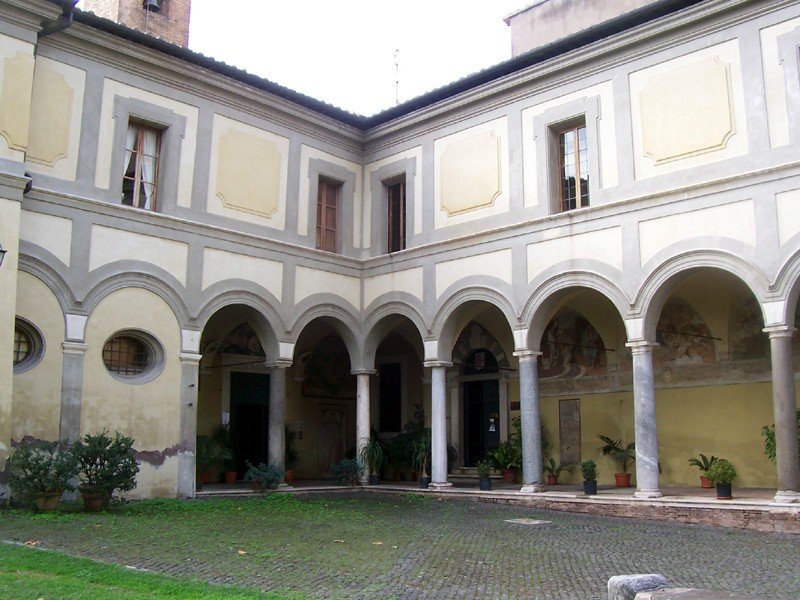
Perched atop Janiculum Hill, Sant’Onofrio al Gianicolo is one of Rome’s most enchanting historical sites. Founded in the early 15th century by the hermit Nicola da Forca Palena, this church and monastery are a testament to centuries of spiritual devotion, Renaissance artistry, and cultural heritage. Visitors can explore serene cloisters adorned with frescoes by Baldassarre Peruzzi and Domenichino, and visit the room and tomb of the celebrated poet Torquato Tasso. As the mother church of the Equestrian Order of the Holy Sepulchre of Jerusalem, Sant’Onofrio maintains a vital role in the Catholic tradition, offering free admission, guided tours, and tranquil gardens with panoramic views of Rome. This guide provides detailed information about Sant’Onofrio’s history, visiting hours, accessibility, nearby attractions, and travel tips, ensuring a rewarding and insightful visit (Turismo Roma; Franciscan Friars of the Atonement; Vatican News).

Origins and Foundation
Sant’Onofrio’s origins date to 1419, when Nicola da Forca Palena established a hermitage on Janiculum Hill as a retreat for contemplation and prayer. Supported by alms, the sanctuary soon grew into a small monastic community, becoming the seat of the Congregation of the Poor Hermits of St. Jerome (Franciscan Friars of the Atonement; Turismo Roma). In 1439, work began on a larger church and adjoining monastery, with the Salita di Sant’Onofrio constructed in 1446 to provide easier access (Turismo Roma).
Dedication and Patronage
Dedicated to St. Onuphrius, a 4th-century Egyptian ascetic, the church reflects the eremitic ideals of its founders. The dedication is evident in the church’s iconography and cloister frescoes depicting the saint’s life (Turismo Roma). In modern times, Sant’Onofrio serves as a titular church, currently assigned to Cardinal Pierbattista Pizzaballa, the Latin Patriarch of Jerusalem (Wikipedia; Pillar Catholic).
Architectural Evolution
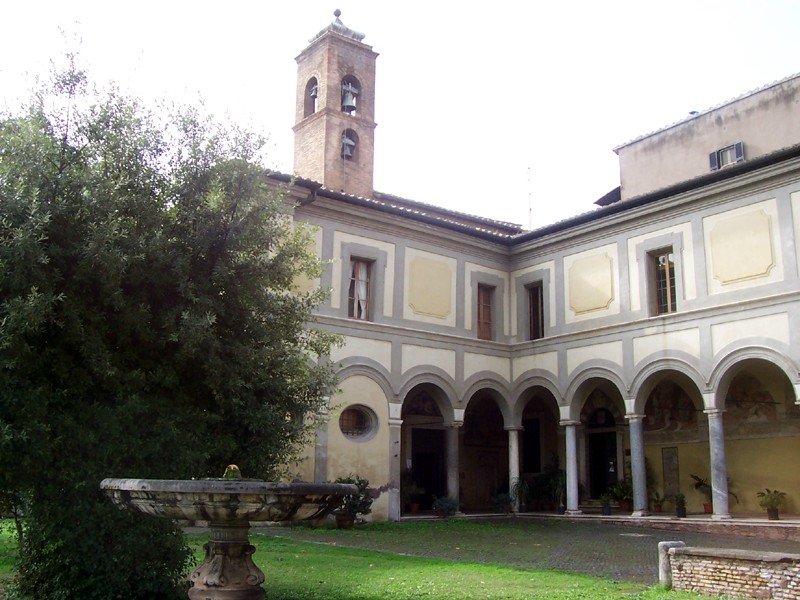
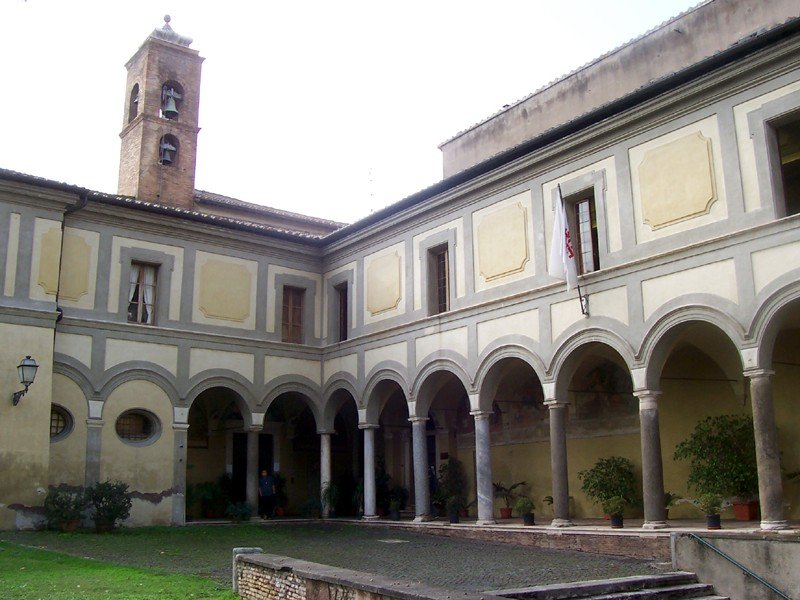
Sant’Onofrio’s architectural evolution reflects centuries of artistic innovation. The single-nave church, completed in the 16th century, is fronted by a Renaissance portico frescoed by Domenichino. The tranquil cloister, built soon after the church’s foundation, is decorated with frescoes by the Cavalier d’Arpino and his school, completed for the Jubilee of 1600 (Turismo Roma). The churchyard’s fountain incorporates fragments from Rome’s past, while the original tomb slab of Nicola da Forca Palena is displayed near the entrance.
Artistic and Literary Heritage
Sant’Onofrio is celebrated for its remarkable art and association with Italian literature. The Chapel of Our Lady of the Rosary is adorned with Baroque frescoes, while the main altar features an altarpiece by the school of Antoniazzo Romano. Most notably, the monastery preserves the room and tomb of Torquato Tasso, who died here in 1595 on the eve of his crowning as poet laureate by Pope Clement VIII. The Tasso Museum displays manuscripts, editions, and his death mask, making Sant’Onofrio a pilgrimage site for literary enthusiasts (Pillar Catholic; Turismo Roma).
Role as the Mother Church of the Order of the Holy Sepulchre
Sant’Onofrio is the official mother church of the Equestrian Order of the Holy Sepulchre of Jerusalem, a papal order dedicated to supporting Christian communities in the Holy Land. A side chapel honors the Order, and the tomb of Grand Master Nicola Canali is located on site (Wikipedia; Liturgical Arts Journal; Order of the Holy Sepulchre).
Modern History and Administration
The monastery briefly served as a pediatric hospital (Bambino Gesù) in the late 19th century. Since 1946, the Franciscan Friars of the Atonement, a community committed to Christian unity, have cared for Sant’Onofrio, ensuring its preservation and welcoming pilgrims and English-speaking visitors (Wikipedia; Pillar Catholic).
Visiting Hours, Tickets, and Accessibility
Visiting Hours (as of June 2025):
- Monday to Saturday: 8:00 AM – 12:00 PM and 4:00 PM – 7:00 PM
- Sundays and Religious Holidays: 9:00 AM – 12:00 PM
Admission:
Entry is free; donations are welcomed to support maintenance and preservation. Guided tours may be available via local tour operators or the church administration (Tourist in Rom).
Accessibility:
The moderate uphill approach and entrance steps may limit wheelchair access. Some areas of the cloister may not be accessible to those with mobility challenges.
Travel Tips and Directions
Address:
Piazza di Sant’Onofrio, 2, 00165 Roma RM, Italy
Getting There:
- Bus: Lines 23, 280, 40, 62, 64, 870 stop at S. Onofrio/Bambin Gesù (Moovit).
- Train: Roma San Pietro station (FL3, FL5) is a 17-minute walk.
- Metro: Ottaviano (Line A) is about 13 minutes’ walk.
- Taxi: Drop-offs possible near the base of Salita di Sant’Onofrio.
On Foot:
A scenic 15-minute walk from St. Peter’s Basilica or Trastevere. The gentle uphill climb is paved, but comfortable shoes are recommended.
Nearby Attractions and Guided Tours
- Janiculum Hill: Stunning panoramic views and the Garibaldi Monument.
- Trastevere: Lively district with dining and historic churches.
- Castel Sant’Angelo: Iconic fortress on the Tiber.
- Vatican City: St. Peter’s Basilica and Vatican Museums within walking distance.
Guided tours of Sant’Onofrio, often including the cloister, Tasso Museum, and the Order’s chapel, can be arranged through local providers or the church. Advance booking is recommended, especially in peak seasons.
Restoration and Preservation
Sant’Onofrio has undergone significant restoration, particularly ahead of jubilees and in response to time’s passage. Efforts focus on preserving frescoes, structural stability, and the site’s Renaissance and Baroque character (Vatican News).
Historical Significance in the Roman Context
Though less renowned than Rome’s grand basilicas, Sant’Onofrio encapsulates the city’s religious and cultural evolution: the development of hermitic and monastic movements, integration of art and literature in sacred spaces, and enduring connections with the Holy Land. Its location offers tranquil retreat and panoramic city views (Lonely Planet).
Frequently Asked Questions (FAQ)
Q: Are tickets required to visit Sant’Onofrio?
A: No, admission is free; donations are appreciated.
Q: What are the visiting hours?
A: Monday to Saturday: 8:00 AM–12:00 PM and 4:00 PM–7:00 PM; Sunday and holidays: 9:00 AM–12:00 PM (verify before your visit).
Q: Is Sant’Onofrio wheelchair accessible?
A: The approach and steps may limit access; some areas are not wheelchair accessible.
Q: Are guided tours available?
A: Yes, through local providers or the church; book ahead, especially in high season.
Q: Can I take photos?
A: Yes, non-flash photography is allowed except during services; always respect signage and staff instructions.
Q: What is the best time to visit?
A: Early mornings or late afternoons, especially in spring and autumn, for tranquility and ideal light.
Listen to the full story in the app
The whole Sant'Onofrio,
told well.
Audio guides for 1,100+ cities across 96 countries. History, stories, and local insight — offline ready.
Verified, and shown.
Researched and written by the Audiala editorial team from historical records, architectural archives, and local expertise.
Researched from Wikidata, Wikipedia & official sources · fact-checked · How we make our guides →