Plan and listen to Santa Maria In Trastevere with Audiala.
Audio guide in your pocket, itinerary in your browser. Built for the way you actually visit.
Introduction
Santa Maria in Trastevere is one of Rome’s oldest and most cherished churches, located in the vibrant Trastevere district. With origins dating back to the early third century, the basilica is revered for its deep historical roots, artistic treasures, and enduring significance in the Christian community. This guide offers a detailed overview of Santa Maria in Trastevere’s history, visiting hours, ticketing, artistic highlights, accessibility, and nearby attractions, ensuring you have all the information needed for a memorable visit (Wikipedia; Through Eternity).

Early Foundations
Santa Maria in Trastevere is widely considered one of the oldest Christian churches in Rome. Tradition holds that Pope Callixtus I founded the original sanctuary between 221 and 227 CE, at a time when Christianity was not yet officially recognized by the Roman Empire (Wikipedia; rome.us). The church’s site in Trastevere, a multiethnic neighborhood across the Tiber from the city center, became a focal point for early Christians and immigrants.
A local legend recounts that on the night of Christ’s birth, a spring of pure oil emerged at this location, an event known as the fons olei. This miracle—commemorated by a column near the altar—symbolizes divine favor and helped establish the church’s spiritual allure (rome.us).
Expansion and Early Significance
The original structure, likely a house-church (titulus), was rebuilt on a grander scale by Pope Julius I around 340 CE. This early basilica is among the first in Rome dedicated to the Virgin Mary, a distinction inscribed on the episcopal throne (Wikipedia; turismoroma.it). Over the centuries, the church underwent multiple restorations, reflecting its resilience through periods of turmoil and its importance to the Christian faithful.
Medieval Transformation and Artistic Flourishing
12th-Century Reconstruction
The most significant transformation occurred during the 12th century under Pope Innocent II (1130–1143). Rebuilt between 1140 and 1143, the current basilica incorporated Romanesque features and spolia—granite columns repurposed from the Baths of Caracalla, symbolizing the Christianization of Rome’s ancient heritage (rome.us; Wikipedia). The church’s bell tower and central layout are products of this period.
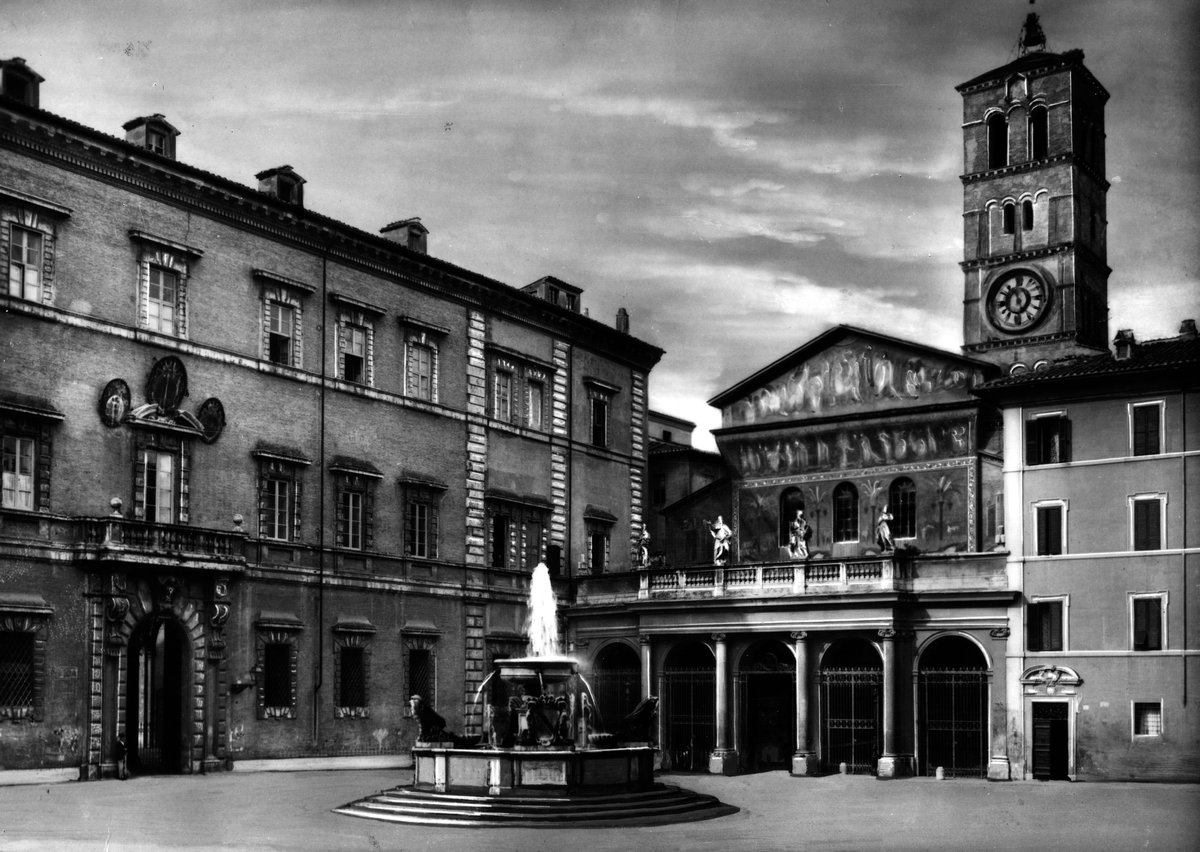
The façade’s striking mosaic, depicting the Madonna della Clemenza with ten wise virgins, and the Romanesque bell tower became defining features of the building (rome.us).
Mosaics and Artistic Masterpieces
Santa Maria in Trastevere’s mosaics are among the finest in Rome. The apse mosaic, commissioned by Innocent II, shows Christ and the Virgin enthroned in majesty, accompanied by saints and a rare papal portrait. These mosaics, with their vivid gold backgrounds and intricate iconography, express both Byzantine and medieval Roman artistry (italia.it; Wikipedia).
Beneath the apse, Pietro Cavallini’s 1291 cycle of six mosaics illustrates key events from the Virgin Mary’s life—such as the Annunciation and Nativity—marking a transition toward Renaissance naturalism with expressive figures and spatial depth (Through Eternity; historytools.org).
The basilica also features a beautiful coffered ceiling by Domenichino (1617), Cosmatesque floors, and chapels adorned with Baroque and Renaissance artworks.
Visiting Santa Maria in Trastevere: Practical Information
Location and Getting There
Santa Maria in Trastevere is centrally located at Piazza Santa Maria in Trastevere, 1, 00153 Roma RM, Italy. The church is easily accessible on foot from Rome’s historic center and the Vatican. Tram line 8 from Piazza Venezia and several buses (23, 280) stop nearby. The Trastevere train station is within walking distance (turismoroma.it).
Opening Hours
- Daily: 7:30 AM to 9:00 PM
- Note: Hours may change during religious holidays or special events. Check official sources before your visit.
Tickets and Entry
- Admission: Free (no tickets required)
- Donations: Welcome and support the church’s maintenance and charitable work
- Guided Tours: Available for a fee; book in advance with local operators or on-site
Accessibility
- Wheelchair Access: Ramps at the main entrance; some chapels may have steps, but assistance is available
- Restrooms: Not available inside; use nearby cafes
- Mobility: Cobblestone streets in the area can be uneven
Dress Code and Etiquette
- Modest clothing required (shoulders and knees covered)
- Photography without flash permitted; no tripods
- Silence appreciated during services and prayer times
Best Times to Visit
- Morning: Quiet and ideal for viewing mosaics in natural light
- Late Afternoon/Evening: The façade mosaics glow at sunset; the piazza is lively
- Winter: Fewer crowds; festive decorations during Christmas
Artistic and Architectural Features
Façade and Piazza
The church faces the bustling Piazza Santa Maria in Trastevere, a hub of local life with Rome’s oldest public fountain and lively cafes. The 18th-century façade by Carlo Fontana features a mosaic frieze referencing the wise virgins and a Romanesque bell tower.
Interior Highlights
- Columns: 22 granite columns from ancient Roman buildings line the nave
- Apse Mosaic: Depicts Christ and the Virgin Mary enthroned, saints, and Pope Innocent II
- Cavallini Mosaics: Scenes from the Virgin’s life; a highlight of Roman medieval art
- Ceiling: Domenichino’s coffered ceiling with Assumption of the Virgin panel
- Cosmatesque Floor: Intricate marble mosaics
- Chapels: Baroque Avila Chapel, Altemps Chapel with Madonna della Clemenza icon
Spiritual Atmosphere
The basilica’s serene interior, bathed in golden light from mosaics and high clerestory windows, offers a contemplative escape from the lively piazza outside.
Community Role and Modern Significance
Santa Maria in Trastevere remains an active parish and community hub, hosting religious services, cultural events, and charitable activities. It played a significant role in papal history and continues to attract pilgrims, especially during Jubilee Years (Rome.us). Its location in Trastevere ensures a vibrant atmosphere, blending ancient history with local culture (thetouristchecklist.com).
Nearby Attractions & Travel Tips
- Villa Farnesina: Renaissance villa with Raphael frescoes
- Janiculum Hill: Panoramic city views
- Tiber River Promenade: Scenic walks along the river
- Trastevere Streets: Artisan shops, local markets, and Roman trattorias
Tip: Wear comfortable shoes, as Trastevere’s cobbled streets can be uneven.
Frequently Asked Questions (FAQ)
Q: What are the visiting hours?
A: 7:30 AM to 9:00 PM daily; check for variations on holidays.
Q: Is entry free?
A: Yes, but donations are appreciated.
Q: Are guided tours available?
A: Yes, bookable through local operators or at the church.
Q: Is the church accessible for wheelchair users?
A: Yes, with ramps and assistance available.
Q: Can I take photos?
A: Yes, without flash or tripods.
Q: What is the best time to visit?
A: Early morning or late afternoon for fewer crowds and better lighting.
Summary and Final Tips
Santa Maria in Trastevere is a living testament to Rome’s Christian legacy and artistic innovation. With its legendary origins, stunning mosaics, and vibrant community setting, it offers a unique window into nearly two millennia of Roman history. Free admission, generous visiting hours, and proximity to other local attractions make it a must-see for any visitor to Rome. For a deeper experience, consider guided tours and exploring the surrounding Trastevere neighborhood (TrastevereRome.com; rome.us).
Stay updated on opening hours and special events through official resources and enhance your visit with the Audiala app for personalized tours and insider tips.
Tickets & tours.
These are guided options from our partners — same price as booking direct.
Prices are indicative — final pricing and availability are confirmed at checkout. Audiala may earn a commission from bookings made through these links.
Listen to the full story in the app
The whole Santa Maria In Trastevere,
told well.
Audio guides for 1,100+ cities across 96 countries. History, stories, and local insight — offline ready.
Verified, and shown.
Researched and written by the Audiala editorial team from historical records, architectural archives, and local expertise.
Researched from Wikidata, Wikipedia & official sources · fact-checked · How we make our guides →