An introduction.
Researched by the Audiala editorial team from historical records, architectural archives, and local expertise.
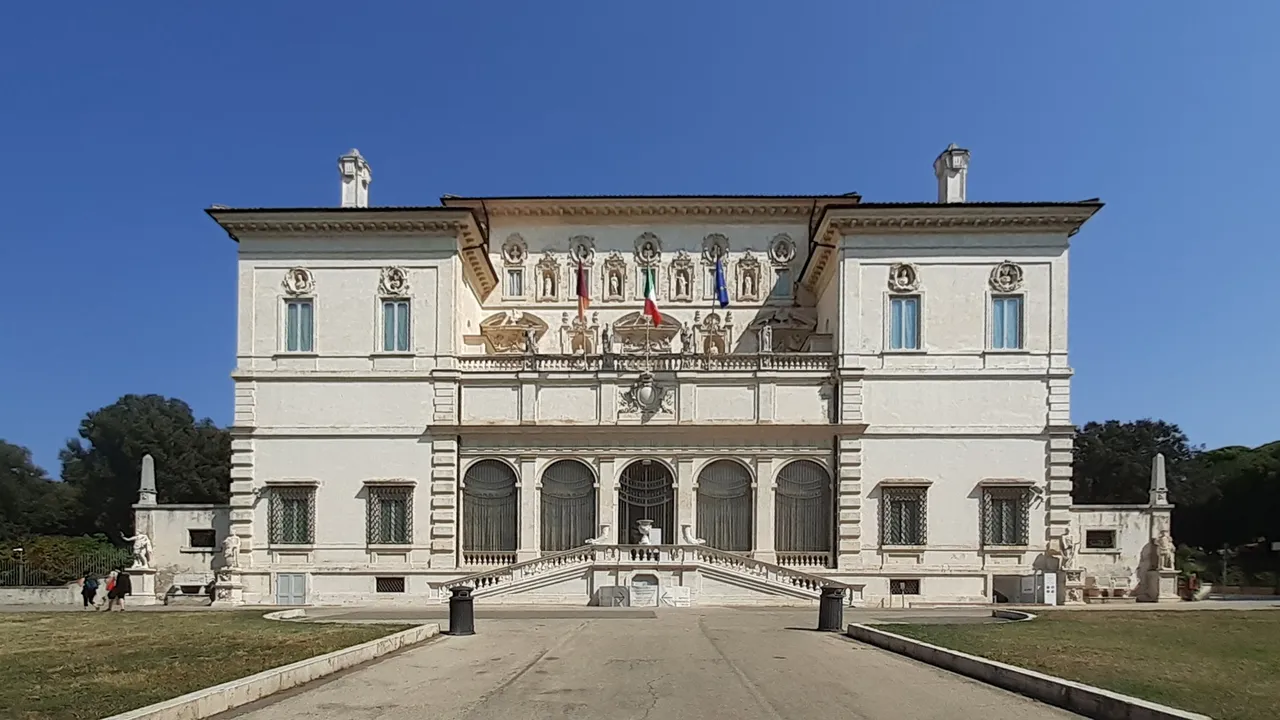
HHow does a 24-year-old sculptor end up carving his own snarling face onto a biblical hero — while a cardinal holds the mirror? That's the kind of question the Galleria Borghese answers, and it's why this small casino on the edge of Rome holds the densest concentration of Bernini and Caravaggio anywhere on earth. The villa sits in the green calm above Piazza del Popolo, a salmon-and-travertine box studded with 144 Roman bas-reliefs and 70 ancient busts mortared straight into the façade.
Inside, twenty rooms, two floors, two hours. The state caps entry at 180 visitors per slot, which means you walk through Bernini's Apollo and Daphne with breathing space — a privilege almost extinct in central Rome. Light from the gardens hits Proserpina's marble thigh and you can see Pluto's fingers actually denting the stone.
The collection itself is a crime scene reorganized as a museum. Almost every masterpiece here arrived through extortion, theft, papal arm-twisting, or sequestration during the brief, ferocious window when one cardinal had a pope for an uncle and used him without restraint. That cardinal was Scipione Borghese, and the villa is what he built to outlive his uncle's death.
Come for the six Caravaggios — more than any museum on the planet. Stay for Canova's reclining Pauline Bonaparte, Titian's Sacred and Profane Love, Raphael's Deposition (lowered over the walls of Perugia in 1608), and the realization that the antiquities you came to see mostly aren't the originals. Napoleon took those in 1808.
TOP 10 BEST MUSEUMS IN ROME - A Must-See Cultural Destination!
Italy Travel01 What to see.
Bernini's Apollo and Daphne
Sala 3, ground floor. Stand on the right side near the window in late afternoon and watch what no photograph captures: light passes through the marble leaves sprouting from Daphne's fingertips. Bernini was 24. The stone is shaved so thin it reads like alabaster, almost like skin held to a candle.
He carved this between 1622 and 1625 for Cardinal Scipione Borghese, who wanted myth made flesh. Walk a slow circle. The drama only resolves from one angle — Apollo's hand on her hip, her scream, bark climbing her thigh — and Bernini knew exactly which angle that was.
Then cross to Sala 4 for the Rape of Proserpina (1621–22). Look at Pluto's left hand. His fingers sink into her thigh as if the marble had forgotten it was marble. Romans call it burro non marmo — butter, not stone.
Caravaggio's six, upstairs
The Pinacoteca holds six Caravaggios in two small rooms — more than anywhere else on earth. Cardinal Scipione got them the way he got everything: in 1607 he had ~100 paintings sequestered from the studio of Cavalier d'Arpino on a tax pretext, sweeping up early Caravaggios in the haul.
Go straight to David with the Head of Goliath (c. 1610). The severed head Caravaggio painted is his own face — sent to Cardinal Scipione from exile, asking for a pardon for the murder he'd committed in 1606. He died before the answer arrived.
Nearby hangs the Madonna dei Palafrenieri (1605), rejected by St. Peter's after a single day on the wall. Scipione bought it for almost nothing. The toddler Christ is naked, the Virgin's neckline low, the snake too vivid — the Confraternita couldn't stomach it. The cardinal could.
The details most visitors miss
Three things to find before you leave. In Sala 1, walk fully behind Canova's Paolina Borghese as Venus Victrix (1805–08): the wooden plinth hides a hand-cranked rotation mechanism so the marble could be turned by candlelight. Her husband Camillo reportedly forbade anyone from seeing her again — even Canova.
In the entrance Salone, look down. The 4th-century AD floor mosaic of gladiators spearing beasts came from the Borghese estate at Torrenova and was set into the pavement in the 19th century. You're walking on 1,700-year-old blood sport while Mariano Rossi's 1779 ceiling dissolves overhead into Romulus ascending to Olympus.
Last stop: the Cappella. It's the only room where the original Scipione-era 17th-century paintwork survives untouched by the 1770s Asprucci redecoration. Then exit into the Villa Borghese gardens and walk ten minutes west to the Pincio terrace for sunset over the dome of St. Peter's.
Plan and listen to Galleria Borghese with Audiala.
Audio guide in your pocket, itinerary in your browser. Built for the way you actually visit.
Tickets & tours.
These are guided options from our partners — same price as booking direct.
Prices are indicative — final pricing and availability are confirmed at checkout. Audiala may earn a commission from bookings made through these links.
03 Visitor logistics.
The practical scaffolding for a good visit — kept short.
Getting There
Metro A to Flaminio gives the prettiest approach — 20 min uphill through the park from Piazza del Popolo. Spagna stop also ~20 min via the Pincio. Buses 52, 53, 116, 910 stop near Porta Pinciana; trams 3 and 19 drop at Bioparco. No car access to the entrance — park is partly ZTL, use the Galoppatoio underground lot.
Opening Hours
As of 2026, Tue–Sun 9:00–19:00 with last entry at 17:45. Closed Mondays, 25 December, 1 January. Ticket office opens 8:30 and closes one hour before the museum. Periodic evening slots 18:45–20:00 surface on the official site.
Time Needed
Visits are capped at exactly 2 hours per timed slot — 180 people per slot, rigidly enforced. The 17:45 slot runs ~1h15. Hit Bernini on the ground floor first (Apollo and Daphne, Proserpina, David), then Caravaggio, then upstairs for Raphael and Titian. Add 1–3h for the gardens if you want them.
Cost & Tickets
As of 2026, full ticket €16 + €2 mandatory booking fee = €18; the 17:45 slot drops to €13 total. EU 18–25 pay €2 booking only; under-18 free but still must reserve. First Sunday of every month free — tickets release exactly 10 days ahead on gebart.it and vanish in minutes. Roma Pass valid but requires separate booking via romapass.ticketone.it.
Bag Limits
Anything bigger than a 21×15 cm pouch must go to the free cloakroom — no backpacks, shoppers, or luggage past the gate. Arrive 30 min early to clear cloakroom and security without eating into your 2-hour slot. Bounce storage near the park runs from €3.50/day for bigger bags.
Plan Your Visit
Planning ahead? Art Visit Guide's Borghese Gallery tickets guide covers entrances, timing and ticket tiers.
04 Tips for visitors.
Small things that change the day.
Book Three Weeks Out
Slots cap at 180 visitors and weekends sell out 2–4 weeks ahead, especially during the Penni-Raphael show running through 3 May 2026. Book directly on gebart.it — third-party resellers mark up the same timed ticket by 50–200%.
Phantom Sold-Out Slots
Romans complain the official calendar shows weeks as fully booked when slots are actually available — refresh at odd hours and check again 10 days out for the next batch. If gebart.it shows nothing, try calling +39 06 32810 weekday mornings.
Enter From Flaminio
Skip the Spagna route and come from Piazza del Popolo through the Pincio — gentler climb, better views, fewer scooters. The walk down the Pincio terrace at sunset afterward is the best free thing in the neighborhood.
Photos Yes, Flash No
Personal photography is allowed without flash, tripods, or selfie sticks. Temporary loan exhibitions sometimes override this with a blanket no-photo rule — check the sign at the entrance before raising your phone in the Caravaggio room.
Don't Eat at Via Veneto
Restaurants ringing the park gates are tourist traps — inflated prices, frozen pasta. Walk down to Piazza del Popolo for I Goliardi (Roman classics, mid-range) or Babette (bistro, mid). Splurge: Le Jardin at Hotel de Russie or Rimessa Roscioli (~€70pp). Aperitivo with park views at Terrazza Nainer.
Combine With the Park
Your ticket only covers the gallery — Villa Borghese gardens are free and worth 1–3h on their own. Hit Museo Carlo Bilotti (free, in the Aranciera) or GNAM on Viale delle Belle Arti for more art, or just walk to the Spanish Steps and Piazza Navona downhill.
Watch Bus 116 and Metro A
Bus 116 (the electric mini through the park) and Metro A around Spagna and Flaminio are pickpocket favorites. Skip taxi touts at Termini insisting on flat fares — demand the meter or walk to the official rank.
Morning Light, Marble Skin
Book the 9:00 or 10:00 slot — raking morning light through the ground-floor windows turns Bernini's Daphne into translucent flesh. By afternoon the rooms get crowded and the marble flattens out under fluorescent fill.
Where to Eat
Don't Leave Without Trying
Grains - cafè bistrot
local favoriteOrder: The homemade gnocchi and the avocado salmon toast are absolute standouts.
This is a hidden gem where the hosts make you feel like family; it is widely considered the best spot in the area for a high-quality espresso and a satisfying, freshly prepared meal.
Babette
fine diningOrder: The truffle ravioli and the tender beef Wellington are consistently impressive.
Tucked away in a tranquil courtyard, Babette offers a sophisticated, rustic-chic atmosphere that feels like a quiet escape from the Roman bustle.
Terrazza 121
local favoriteOrder: Ask for the smoked pasta recommendation and pair it with one of their expertly crafted gin and tonics.
With a beautiful, greenery-filled terrace and a retractable roof, this spot provides a perfect, relaxed ambiance for a cocktail or a meal accompanied by live music.
Trecaffè - Via dei due Macelli
quick biteOrder: The avocado toast with feta and a traditional hazelnut maritozzo for a sweet finish.
A high-energy, popular artisan coffee shop that is ideal for a quick, reliable breakfast or a light lunch while exploring the city center.
Dining Tips
- check Tipping is not expected or required; service is generally included in the bill.
- check Expect a 'coperto' charge (usually €1–3) on your bill for bread and table service; this is standard practice in Rome.
- check Lunch is typically served 12:00–14:30 and dinner from 19:30–22:00; avoid looking for full meals outside these windows.
- check Cash is still useful for small bars and street food, though cards are widely accepted in central Rome.
- check Reservations are recommended for popular trattorie, especially for weekend dinners.
Restaurant data powered by Google
05 The Cardinal's Insurance Policy
The Borghese were Sienese latecomers to Rome until 1605, when Camillo Borghese was elected Pope Paul V. The pontificate lasted sixteen years. His nephew Scipione Caffarelli-Borghese (records show 1577 or 1579 — even the Ministry of Culture can't decide) had that same window to build something permanent out of borrowed power.
Construction on the casino began in 1607 under Flaminio Ponzio, finished after his death by the Flemish architect Giovanni Vasanzio. The collection moved in by March 1613. Gardens, aviary, and the Uccelliera followed through 1620. Scipione poured papal-era taxes, sequestered estates, and outright stolen artworks into a single building on the Pincian hill — and in 1633, the year he died, signed a fideicommissum legally binding every Borghese heir to keep the collection intact forever. He didn't trust his own descendants. He was right not to.
The Night the Raphael Came Over the Wall
The official story most guides tell: Cardinal Scipione was a refined Renaissance patron who lovingly assembled great art. The villa is presented as connoisseurship made visible. Walk into Sala IX and a label tells you Raphael's Deposition entered the collection in 1608.
But that date doesn't add up. The Deposition wasn't for sale. Painted in 1507 for Atalanta Baglioni's chapel in the convent of San Francesco al Prato in Perugia, it had hung there for a century as the altarpiece — a memorial to her murdered son. So how did a Roman cardinal acquire an immovable Umbrian devotional object in a single year?
He stole it. On the night of 18–19 March 1608, agents acting on Scipione's orders entered the convent, removed the altarpiece, and lowered it over Perugia's city walls. Pope Paul V then issued a motu proprio retroactively declaring the painting his nephew's "private property." Perugia rioted. The pope ignored them. Documented papal cover-up of an art heist — and not the only one. In 1607 Scipione had Cavalier d'Arpino arrested on a fabricated weapons charge; the "fine" was roughly 100 paintings seized from the artist's studio, including early Caravaggios that hang here today.
Stand in front of the Deposition now and the surface beauty doesn't change — Raphael's pyramidal composition, the dead weight of Christ's body, Mary's collapse. What changes is the room. You're not looking at a gift, a purchase, or a bequest. You're looking at the spoils of a four-year window when one family controlled the Vatican and used it like a private acquisitions department. Every great work in the next ten rooms arrived under similar pressure.
1808: When Napoleon Emptied the Salone
From Private Casino to State Museum
Listen to the full story in the app
The whole Galleria Borghese,
told well.
Audio guides for 1,100+ cities across 96 countries. History, stories, and local insight — offline ready.
06 Frequently asked.
The questions travellers send us most about Galleria Borghese.
Is Galleria Borghese worth visiting?
Yes — it holds the densest concentration of Bernini sculptures anywhere plus six Caravaggios in a 17th-century villa most Romans consider the connoisseur's pick over the Vatican. The 180-person timed slots mean you see Apollo and Daphne without elbows in your ribs. Two hours, one jewel-box, no crowd crush.
How long do you need at Galleria Borghese?
Exactly two hours — the slot is fixed and rigidly enforced. Start with Bernini on the ground floor (rooms 2-4), give Caravaggio the upper floor, skip nothing on the way. The 17:45 slot only gives you about 75 minutes before 19:00 close.
How do I get to Galleria Borghese from central Rome?
Metro A to Spagna then a 15-20 minute walk up through the Pincio gardens, or Flaminio for a 20-minute walk via Piazza del Popolo. Buses 52, 53, 116 and 910 stop near the park; trams 3 and 19 stop at Bioparco/Viale delle Belle Arti. No car access — the villa sits inside a partly-ZTL park.
Do you need to book Galleria Borghese in advance?
Yes — booking is mandatory for every ticket, including free ones, and slots fill 2-4 weeks ahead for weekends and holidays. Book through gebart.it (the official channel) for €16 plus a €2 non-refundable fee. The site shows phantom sold-outs sometimes, so check again the morning of.
Can you visit Galleria Borghese for free?
Yes, on the first Sunday of every month plus 25 April, 2 June and 4 November — but you still pay the €2 booking fee and tickets only release 10 days before, selling out within hours. Under-18s, EU 18-25s (€0 ticket), and EU students in art-history fields get free entry year-round with mandatory booking. The Roma Pass also covers entry, booked separately via romapass.ticketone.it.
What should I not miss at Galleria Borghese?
Walk around the back of Bernini's Rape of Proserpina to see Pluto's fingers sinking into marble thigh — flesh under stone. In Apollo and Daphne, stand right of the sculpture so window light passes through the marble leaves. Upstairs, find Caravaggio's David with the Head of Goliath: Goliath's severed face is Caravaggio's own self-portrait, painted while he was on the run for murder.
What is the best time to visit Galleria Borghese?
Morning slots (9:00 or 10:00) for fresh light through the windows hitting the Bernini marbles, weekdays for thinner crowds. Autumn brings golden light on the ochre façade and fewer queues; winter low sun rakes Apollo and Daphne dramatically. Avoid the first Sunday of each month unless you've booked exactly 10 days ahead.
Are photos allowed in Galleria Borghese?
Yes, personal photos are permitted without flash, tripods or selfie sticks. Temporary loan exhibitions can override this — the Caravaggio + Master of Hartford show triggered a full no-photo regime, so check the policy at the entrance. Bag limit inside is 21×15 cm; everything bigger goes to the free cloakroom.
Verified, and shown.
Researched and written by the Audiala editorial team from historical records, architectural archives, and local expertise.
Official MiC site — 2026 hours, ticket categories, free-entry rules, mandatory booking conditions
Italian-language official page confirming opening hours, closures and ticket pricing
Authorized ticketing portal — slot times, 180-person cap, booking fees, free WiFi
2026 prices, last-slot discount, AR experience, free-entry calendar, Roma Capitale resident exclusion
Booking channels, last-minute box-office policy, temporary exhibition surcharges
Walking distances from Piazza di Spagna and Piazza del Popolo, transport orientation
Accessibility info — interior elevator, partial garden access for wheelchair users
Bus lines (61, 116, 117, 119, 120, 150, 490, 495) within 500m of park entrances
Off-site bag storage from €3.50/day for visitors with luggage too large for the cloakroom
Top-rated nearby restaurants — Enea, MAMACRI, I Goliardi, ratings and review counts
Third-party guided-tour pricing reference for bundled timed-entry products
Researched from Wikidata, Wikipedia & official sources · fact-checked · How we make our guides →