TThe reason Romans once called someone worthless traces back to the water pouring from this very wall. Fontana dell'Acqua Paola — the Fontanone — stands on Rome's Janiculum Hill in Italy, a 17th-century monument so grand it became the prototype for the Trevi Fountain, yet so associated with mediocre lake water that it spawned a genuine insult. Come for the cascading arches and stay for what might be the finest panoramic view of the city's rooftops, domes, and terra-cotta sprawl.
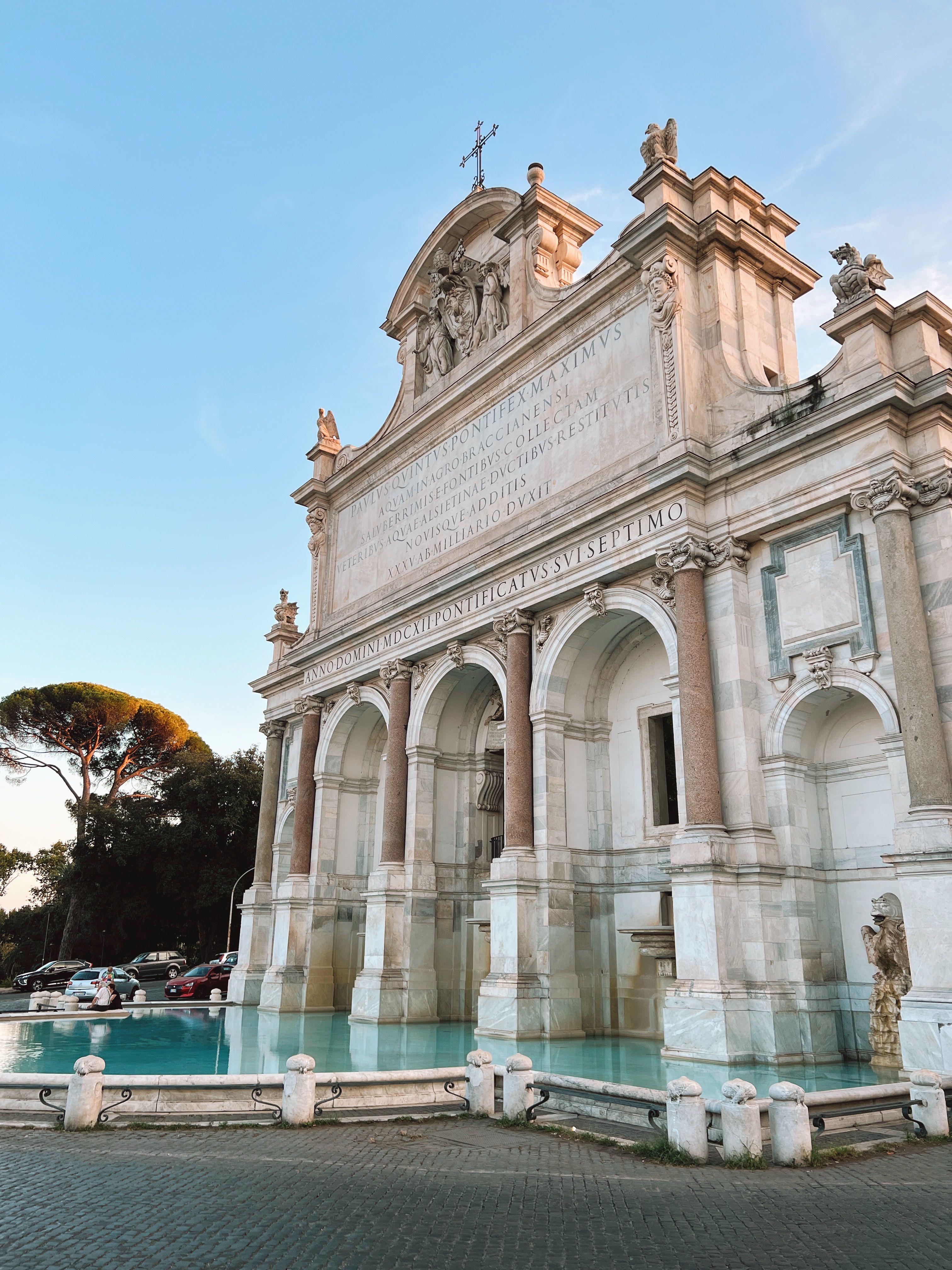
Five monumental arches of white and gray marble rise like a triumphal gate to nowhere — or rather, to the sky above Trastevere. Water crashes through the three central openings into a basin wide enough to park a small fleet of Fiats, while the two flanking arches dribble through grotesque masks that look vaguely offended by the whole arrangement. The scale is deliberate. This was a pope's way of saying he'd brought ancient Rome back to life.
The terrace in front of the fountain doubles as an open-air balcony over the city. On clear evenings, the dome of St. Peter's catches the last amber light while the roofline of Rome stretches east toward the Alban Hills. Couples, buskers, and dog-walkers share the space with equal claim. No ticket, no queue, no closing time.
What most visitors miss is the structure's back story — literally. Rectangular windows near the top of the facade aren't decorative filler. They're portholes into the botanical gardens behind the fountain, a green pocket of the Janiculum that almost nobody thinks to look for. The Fontanone rewards people who walk around it, not just those who stand in front.
01 What to See
The Monumental Facade
The fountain lies to you. Right there on the attic, a massive Latin inscription declares that Pope Paul V restored the ancient Aqua Alsietina. He didn't — it was the Aqua Traiana, built in 109 AD, and nobody bothered to correct the marble. That kind of confident error tells you everything about Baroque Rome: the gesture mattered more than the footnote. Below the inscription, five arches modeled on a Roman triumphal arch span roughly 25 meters — wider than a tennis court is long — faced in white and polychrome marble stripped directly from the Roman Forum and the Temple of Minerva. The six granite columns holding the whole thing together came from Old St. Peter's Basilica, four of them red, two gray, repurposed with the casual audacity of a pope who believed recycling ancient glory was his birthright.
Architects Giovanni Fontana and Flaminio Ponzio completed the structure by 1612, and Carlo Fontana added the sweeping hemicycle basin in the 1690s. Water pours through the three central arches at 117 liters per second — enough to fill a bathtub every four seconds — creating a wall of sound that drowns out traffic and conversation alike. The two smaller side arches deserve a closer look: water spills from hybrid creatures, part wolf, part dragon, that most visitors walk right past while fixated on the central cascade. Those Borghese dragons and eagles repeat across the attic too, carved in bas-relief, a family brand stamped onto public infrastructure with zero subtlety.
The Secret Garden (Retro-Fontanone)
Behind the fountain, through an entrance at Via Garibaldi 30, a 17th-century garden hides in plain sight. Most people standing at the basin have no idea it exists. The space contains a nymphaeum — a decorative grotto built for contemplation — along with scattered lapidary fragments: Roman sarcophagi, carved capitals, pieces of a city that kept rebuilding itself on top of its own bones. A loggia along one wall displays historic inscriptions and papal coats of arms, and among them sits something genuinely rare: a marble-carved map tracing the conduits of the Aqua Virgo aqueduct, the kind of artifact that would anchor an entire museum room elsewhere.
Access is only by guided group tour, booked through Rome's 060608 service line between 9:00 and 19:00. Entry costs €4 full price, €3 reduced, and holders of the MIC card or Rome residents often get in free. The tramontana wind that sweeps across the exposed Janiculum made this garden historically difficult to maintain as a botanical space, which is partly why it feels so raw and unmanicured compared to Rome's more famous gardens. That roughness is the appeal. The air is cooler here than in Trastevere below, and in summer the mist drifting over the fountain wall makes the temperature drop feel almost theatrical.
Sunset on the Terrace: A Walking Route from Trastevere
Start in Piazza Trilussa, where a smaller fountain — reassembled here by architect Vescovali in 1898 — once served as the Acqua Paola's downstream twin. From there, climb Via Garibaldi. The hill is steep enough that Romans historically considered it a separate neighborhood from the city below, and your calves will understand why. Budget 15 minutes for the ascent, or grab a bus if the Roman heat has already won.
The terrace in front of the Fontanone rewards the effort with one of the city's great panoramic views — the dome of St. Peter's sits at eye level to the north, while the rooftops of Rome spread east toward the Vittoriano and the distant Alban Hills. Arrive an hour before sunset. The western light hits the marble facade directly, turning the weathered stone from gray-white to warm gold, and the water in the basin catches the shifting colors of the sky. Locals gather here with wine and takeaway pizza — this is not a tourist-dominated spot after dark, but a Roman one. And if someone tells you the water is worthless, they're quoting a genuine old Roman insult: "Vali come l'Acqua Paola" — "You're worth as much as the Acqua Paola" — because lake water was considered inferior to mountain springs. The fountain has been absorbing that slight for four centuries. It doesn't seem bothered.
02 Explore Fontana Dell'Acqua Paola in Pictures
 Fontana Dell'Acqua Paola: Iconic Baroque Fountain in Rome, Italy
 Panoramic View of Rome and Fontana Dell'Acqua Paola, Italy
 Fontana Dell'Acqua Paola: Iconic Baroque Fountain in Rome, Italy
 Fontana Dell'Acqua Paola: Iconic Baroque Fountain in Rome, Italy
 Fontana Dell'Acqua Paola: Iconic Baroque Fountain in Rome, Italy
 Fontana Dell'Acqua Paola: Iconic Baroque Fountain in Rome, Italy
 Fontana Dell'Acqua Paola in Rome, Italy: Iconic Roman Fountain
 Fontana Dell'Acqua Paola: Iconic Baroque Fountain in Rome, Italy
 Carabinieri Officers at Fontana Dell'Acqua Paola, Rome, Italy
 Fontana Dell'Acqua Paola: Iconic Baroque Fountain in Rome, Italy
 Fontana Dell'Acqua Paola: Iconic Baroque Fountain in Rome, Italy
 Fontana Dell'Acqua Paola: Iconic Baroque Fountain in Rome, Italy
Plan and listen to Fontana Dell'Acqua Paola with Audiala
Audio guide in your pocket, itinerary in your browser. Built for the way you actually visit.
Book Fontana Dell'Acqua Paola


Prices shown are indicative — final pricing and availability are confirmed at checkout. Audiala may receive a commission from bookings made via these links.
03 Visitor Logistics
Getting There
Opening Hours
Time Needed
Accessibility
05 Tips for Visitors
Come at Sunset
Drone Ban Zone
Watch the Dark Walk
Eat Downhill, Not Here
Don't Climb or Splash
The Sorrentino Connection
Where to Eat
Don't Leave Without Trying
Dining Tips
- check Most restaurants in this area fall into the €€–€€€ price range.
- check For quick bites, look for 'Pizza al Taglio' (pizza by the slice) on streets leading down from the fountain into Trastevere.
- check The Janiculum Hill is primarily residential and parkland; for more dining variety, head down into the heart of Trastevere district.
- check Campo de' Fiori Market (approximately 15–20 minutes walking) is the most famous historical market in Rome for fresh produce and local delicacies.
- check High-quality local cheeses, cured meats, and prepared foods can be found in Trastevere's gastronomies (delicatessens).
Restaurant data powered by Google
04 Historical Context
A Pope, a Tax on Wine, and Water That Became an Insult
Rome's relationship with water has always been political. The emperors built aqueducts to prove they could bend nature to the city's needs; the popes who inherited the ruins understood the same logic. When the Aqua Traiana — Emperor Trajan's aqueduct, completed in 109 AD — fell into disrepair, the neighborhoods of Trastevere and the Vatican lost their primary water supply. For over a thousand years, that side of the Tiber relied on wells and the river itself.
By 1610, Pope Paul V saw an opportunity that was equal parts public works and personal branding. Restoring the ancient aqueduct and capping it with a monumental fountain would solve a genuine infrastructure crisis while carving his family name into the Roman skyline forever. He commissioned architects Flaminio Ponzio and Giovanni Fontana to design a show-fountain modeled on a Roman triumphal arch. The result, completed around 1612, stands roughly 20 meters tall — about the height of a six-story apartment building — and carries the Borghese coat of arms in stone eagles and dragons across its attic.
Camillo Borghese and the Wine Tax That Built a Monument
Pope Paul V — born Camillo Borghese — was playing a game with centuries-long stakes. By restoring the Aqua Traiana, he could place himself in a direct lineage with Emperor Trajan, the ruler who first brought water across the Roman countryside in 109 AD. The inscription he ordered carved into the fountain's facade even claims he restored the ancient Aqua Alsietina, a different and far inferior aqueduct. Whether this was a deliberate piece of propaganda or a genuine historical error remains debated, but the effect was the same: Paul V's name, rendered in capital letters taller than a man's hand, dominates the monument.
The turning point came with the bill. To fund the massive engineering project — miles of restored conduit from Lake Bracciano, plus the fountain itself — Paul V imposed a specific tax on wine sold in Rome. In a city where wine was cheaper than clean water, this hit hard. Contemporary accounts describe public resentment that simmered for years. The irony was sharp: Romans were paying through their cups for water they considered second-rate, sourced from a lake rather than a mountain spring.
That resentment crystallized into language. The expression "Vali come l'Acqua Paola" — "You're worth as much as the Acqua Paola" — became a Roman insult, a way of calling someone or something essentially worthless. Paul V got his monument and his immortality. But the people who paid for it made sure the water would never be confused with greatness.
The Bathhouse Scandal of 1707
Carlo Fontana's Basin and the Fendi Restoration
Listen to the full story in the app
06 Frequently Asked
Is Fontana dell'Acqua Paola worth visiting? add
Yes — and not primarily for the fountain itself, but for the panoramic terrace in front of it, which offers one of the finest views of the Roman skyline. The fountain is genuinely monumental, wider than a tennis court, built with marble stripped from the Roman Forum and granite columns salvaged from the original St. Peter's Basilica. Come at sunset, when the white stone catches the last light and the dome of St. Peter's glows on the horizon. Unlike the Trevi Fountain, you won't be fighting through crowds.
Can you visit Fontana dell'Acqua Paola for free? add
The fountain and its panoramic terrace are completely free and open 24 hours a day, seven days a week. The one exception is the "secret garden" behind the fountain, which costs around €4 and requires a reservation through Rome's municipal call center at 060608. That garden contains a 17th-century nymphaeum and carved marble maps of ancient aqueduct routes — worth the small fee if you can get a slot.
How do I get to Fontana dell'Acqua Paola from Trastevere? add
Walk uphill via Via Garibaldi from the heart of Trastevere — it takes about 15 minutes but involves a steep climb. Bus 115 (from Piazza del Popolo) and bus 870 (from Piazza Venezia) stop nearby and spare you the incline. There's no direct Metro access. If you have mobility concerns, a taxi to the Gianicolo is the simplest option; on-street parking is extremely limited and complicated by ZTL restricted-traffic zones.
What is the best time to visit Fontana dell'Acqua Paola? add
Sunset is the clear winner. The fountain faces east, so the warm light hits the marble facade directly while the city below shifts into golden hour — photographers and Roman couples know this, which is why the terrace fills up around dusk. Early morning is the opposite experience: near-empty, cool air, and the sound of 117 liters of water per second echoing off stone with almost no one around to hear it.
How long do you need at Fontana dell'Acqua Paola? add
A quick visit takes 15 to 20 minutes — enough for photos and a look at the architecture. If you combine it with the panoramic terrace, a walk to the nearby Garibaldi monument, and a pre-booked visit to the secret garden behind the fountain, budget 45 minutes to an hour. Pair it with a stroll down into Trastevere for dinner and you've built a full evening.
What should I not miss at Fontana dell'Acqua Paola? add
Don't just stare at the three central waterfalls — look at the two smaller side arches, where hybrid wolf-dragon statues spout water from their mouths. These creatures fuse Rome's founding symbol with the Borghese family crest, and almost everyone walks past them. Also read the massive Latin inscription on the attic: it claims to restore the ancient Aqua Alsietina, which historians say is flat-out wrong. The water actually comes from the Aqua Traiana — the inscription is papal propaganda carved in stone.
What is the history of Fontana dell'Acqua Paola in Rome? add
Pope Paul V commissioned it in 1610 to celebrate the restoration of Emperor Trajan's ancient aqueduct, which brought water from Lake Bracciano to Trastevere and the Vatican. Architects Giovanni Fontana and Flaminio Ponzio built it between 1610 and 1614, using marble looted from the Roman Forum and columns from the old St. Peter's Basilica. In 1690, Carlo Fontana added the large semicircular basin you see today. The project was funded by a special tax on wine, which made Romans so resentful that the phrase "Vali come l'Acqua Paola" — "You're worth as much as the Acqua Paola" — became a genuine insult.
Was Fontana dell'Acqua Paola in any movies? add
It features prominently in the opening scene of Paolo Sorrentino's 2013 film La Grande Bellezza (The Great Beauty), which won the Academy Award for Best Foreign Language Film. The fountain also appears in the James Bond film Spectre. These appearances cemented its status as a cinematic icon of Rome, though locals had claimed it as a favorite gathering spot long before any camera showed up.
-
verified
Wikipedia - Fontana dell'Acqua Paola
General history, construction timeline, the Alsietina inscription error, the 1707 bathing ordinance, and the wine tax funding detail.
-
verified
Archeoroma
Construction dates (1610–1614), architectural details, and historical overview of the aqueduct restoration.
-
verified
Turismo Roma (Official Rome Tourism Portal)
Visitor access information, the 1690 basin addition by Carlo Fontana, and the Piazza Trilussa fountain relocation history.
-
verified
Sovrintendenza Capitolina ai Beni Culturali
Official municipal heritage source for architectural details, the secret garden, spolia materials, and the Alsietina inscription error.
-
verified
RomaGuideTour
Cultural context on the 'Vali come l'Acqua Paola' insult and details about the secret garden behind the fountain.
-
verified
Harper's Bazaar Italia
Best visiting times, cinema appearances (La Grande Bellezza, Spectre), and cultural significance.
-
verified
TripAdvisor - Fontana dell'Acqua Paola Reviews
Visitor reports on spolia from the Temple of Minerva, panoramic views, safety notes for nighttime visits, and the local cultural identity of the fountain.
-
verified
Romehints.com
Corroboration of the 1612 completion date and architect attribution to Flaminio Ponzio and Giovanni Fontana.
-
verified
Hotel Santa Prisca (Rome Cultural Guide)
Sensory details about the fountain's sound and cooling mist, and the 1612 completion date reference.
-
verified
Comune di Roma
Information on the secret garden access, booking procedures, and ticketing for guided visits.
verified Verified
Last reviewed: