An introduction.
Researched by the Audiala editorial team from historical records, architectural archives, and local expertise.
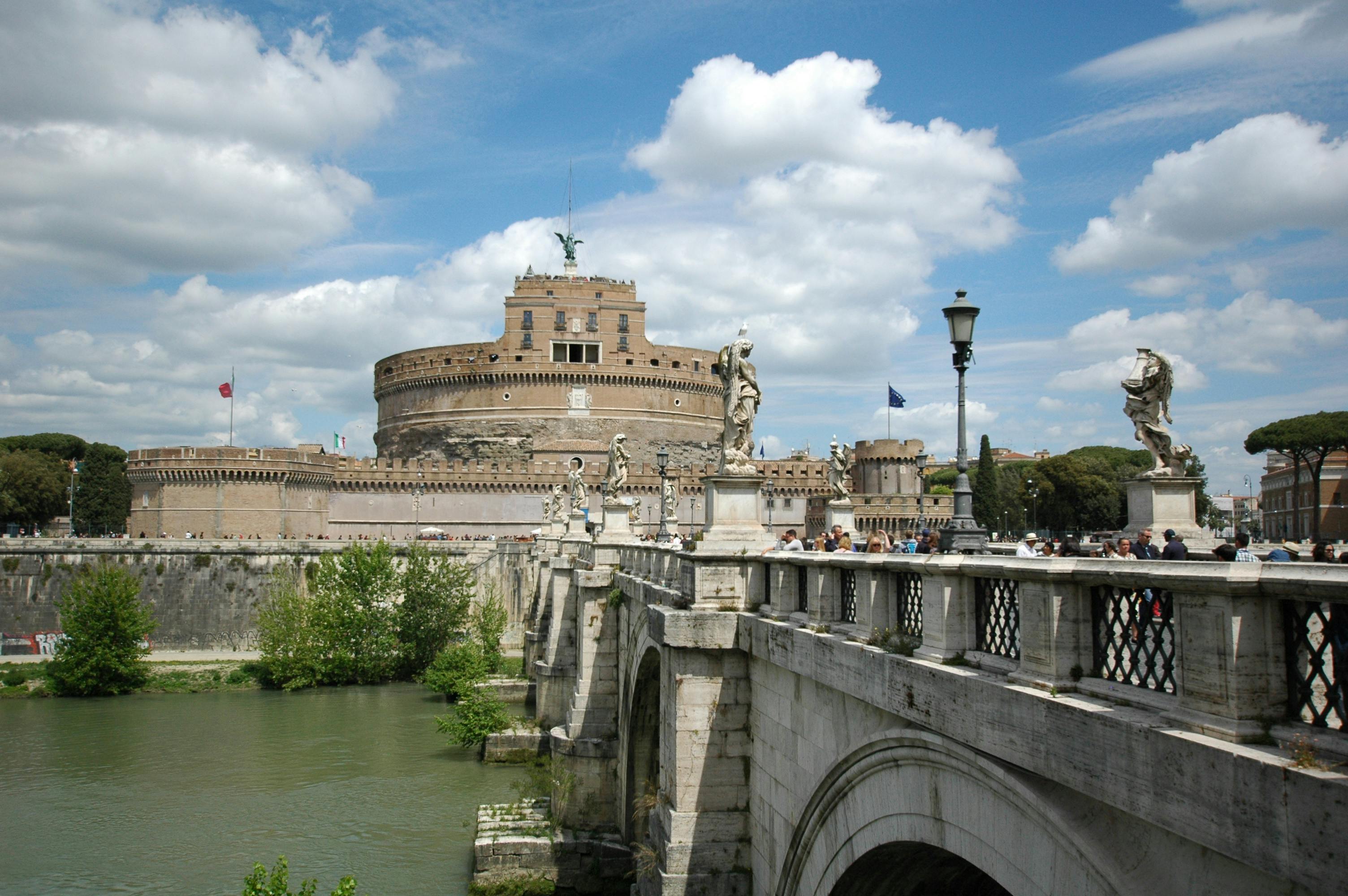
WWhy does Rome's grimmest fortress wear the name of an angel? Castel Sant'Angelo in Rome, Italy, begins as a contradiction: a tomb turned fortress turned papal bolt-hole, and that's exactly why you should visit. Today you cross the Tiber and see a massive brick cylinder the color of warm dust, crowned by a bronze archangel, with cannon terraces, echoing ramps, and the whole sweep between St. Peter's and the river laid out beneath you.
Most people come expecting a castle. Records show the core was built as Emperor Hadrian's mausoleum and completed in 139 AD, a funerary monument so large it once dominated the Roman skyline; then later centuries wrapped it in walls, bastions, prisons, chapels, and papal apartments until the original idea almost vanished inside the shell.
That layered confusion is the reason to go. Few buildings in Rome let you feel the city changing under your feet so clearly: cool Roman masonry below, dim military corridors in the middle, painted Renaissance rooms above, and finally the terrace where the wind smells faintly of river water and traffic and the dome of St. Peter's seems close enough to touch.
Walk the helical ramp slowly. Its gradient was gentle enough for funeral carts hauling stone coffins heavier than elephants, and that single upward spiral tells the whole story better than any wall label: Rome rarely tears down power when it can reuse it.
Rome Italy - Here's What I Found Inside The CASTLE SANT'ANGELO.
Amazing Walking Tour Of Rome Italy01 What to see.
The Helical Ramp and Roman Core
The Terrace of the Angel
Bridge to Bastion Walk
Plan and listen to Castel Sant'Angelo with Audiala.
Audio guide in your pocket, itinerary in your browser. Built for the way you actually visit.
03 Visitor logistics.
The practical scaffolding for a good visit — kept short.
Getting There
Castel Sant'Angelo sits at Lungotevere Castello 50 on the Tiber bend, a 10-15 minute walk from St Peter's Square via Via della Conciliazione or from Piazza Navona via Corso Vittorio Emanuele II and Ponte Sant'Angelo. For transit, the cleanest official route is bus 40 from Termini to Ponte Vittorio Emanuele, while Metro A to Lepanto or Ottaviano leaves you a 15-20 minute walk; driving is a headache because of central Rome's ZTL restrictions and thin parking.
Opening Hours
As of 2026, the museum usually opens Tuesday to Sunday from 9:00 to 19:30, with last entry at 18:30; Monday is the regular closing day. The standard annual closures are 25 December and 1 January unless an extraordinary opening is announced, and some interiors remain affected in 2026, with the Sala di Amore e Psiche and the Farnese rooms still listed as closed on official notices.
Time Needed
Give it 60-90 minutes if you want the core route and the terrace, where Rome suddenly spreads out like a map scratched into old stone. Most visitors need 2-3 hours, and 3 or more makes sense if you read the prison and papal rooms properly, pause at the terrace cafe, and let the building's switch from tomb to fortress to museum sink in.
Cost & Tickets
As of 2026, full admission is €16, reduced entry for EU visitors aged 18-25 is €2, and under-18s enter free along with other statutory free categories. The first Sunday of each month is free but everyone joins the same queue, tickets are nominative, you need the original ID that matches the booking, and the safest buy is an official timed ticket through the museum's own channel rather than a random reseller.
Accessibility
Officially, accessibility remains partial, with the museum warning that some visitors with disabilities may enjoy only part of the monument and exterior areas. Expect ramps, worn stone, narrow historic passages, and a lot of vertical movement; some reports mention lift-assisted access to selected levels, but if mobility matters, contact the museum before you go rather than trusting the building to behave like a modern gallery.
04 Tips for visitors.
Small things that change the day.
Photo Rules
Casual photography is generally accepted, but treat flash and tripods as off-limits unless staff tell you otherwise. Professional shoots need advance authorization, and drones near the Vatican and central Rome are a bad idea without formal clearance.
Watch Your Pockets
The real nuisance here is pickpocketing, especially on bus 64, around Metro A, in the queue, and on the bridge where everyone stops to photograph Bernini's angels. Keep your phone and wallet zipped away before you reach Ponte Sant'Angelo; thieves like pilgrims and distracted camera hands.
Eat One Street Back
Skip the tourist-trap terraces right on the main flow and walk into Borgo Pio instead. Cremilla is a good budget gelato stop, Passpartout is a reliable mid-range lunch around €25, and Les Etoiles is the splurge move when you want dinner with the dome and castle trading glances across the rooftops.
Best Light
Go at opening or in the last 90 minutes of the day, when the river light turns soft and the stone loses its midday glare. Late June brings the old Girandola fireworks tradition around 29 June, but ordinary summer afternoons can feel like walking inside a sun-warmed kiln.
Free Day Tradeoff
The first Sunday of each month saves you €16 as of 2026, but you pay in time because free tickets are collected on site and the queue becomes one long Roman lesson in patience. If your schedule is tight, buy a timed official ticket and spend the saved hour inside the prison cells or on the terrace instead.
Travel Light
Don't show up with a suitcase or oversized bag: the castle has no cloakroom, and staff are not running a mercy service for overpacked day-trippers. Bring the original ID tied to your nominative ticket, and if you need storage, sort it before arrival around Via Ulpiano or Via Crescenzio.
Vatican Same Day
Castel Sant'Angelo has no strict church-style dress code, but if you're pairing it with the Sistine Chapel, dress for the Vatican from the start: covered shoulders and knees save arguments later. Inside the castle, keep voices low in the chapels and formal rooms; this place was a mausoleum before it became anyone's viewpoint.
Pair The Walk
The best pairing is not another rushed ticketed stop but a walk: come from the Sistine Chapel via Via della Conciliazione or leave toward Piazza Navona across Ponte Sant'Angelo. That route lets the castle do what it does best, which is explain how imperial Rome and papal Rome ended up sharing the same chunk of riverbank.
Where to Eat
Don't Leave Without Trying
Tonnarello | Paglia
local favoriteOrder: The rich, authentic Carbonara or their signature Tonnarello with meatballs.
A legendary spot that captures the lively, authentic spirit of Rome. Despite the popularity, the service remains warm and professional, making it a must-visit for classic pasta lovers.
Osteria Di Ponte
local favoriteOrder: The Bucatini all'Amatriciana or the perfectly cooked Cacio e Pepe, prepared without cream.
This is where you go for a proper, no-nonsense Roman meal. The service is incredibly attentive, and they take immense pride in preparing pasta dishes 'the right way'.
Bottega Tredici
fine diningOrder: The cod ravioli, which is creative, surprising, and perfectly executed.
A refined, non-touristy gem that balances creative, seasonal cooking with traditional roots. Their tasting menu with wine pairing is an exceptional way to wrap up a trip.
Barnum Roma
cafeOrder: The turmeric bread topped with hummus, avocado, and chickpeas for a fresh, vibrant brunch.
This chic, bustling cafe is a standout for high-quality coffee and inventive, fresh food. It's the perfect spot to recharge with a great matcha or a thoughtful, healthy breakfast.
Dining Tips
- check Roman restaurants typically operate with a split-shift: lunch service is generally 12:00–15:00 and dinner is 19:00–23:00.
- check Many traditional trattorias prefer direct phone or in-person reservations; some explicitly do not accept bookings via social media.
- check When visiting sites like Castel Sant'Angelo, note that museum-internal cafes are only accessible with a valid museum ticket.
- check The area near the monument is divided into distinct zones: Borgo (traditional osterie), Prati (modern bistros), and the riverside (casual terraces).
Restaurant data powered by Google
05 The Fortress Rome Kept Reusing
Castel Sant'Angelo changed its job again and again, but one habit endured: when Rome felt threatened, ceremonial, or in need of a public sign, people turned to this building. Records show Hadrian commissioned it as a dynastic mausoleum in the 2nd century; by the 5th century emperors and then popes were using the same mass of brick as a shield, a lookout, a treasury, and a stage.
That continuity matters more than the labels. Tomb, fortress, prison, museum: all true, all incomplete. The deeper constant is visibility, because this great drum by the Tiber kept serving as the place where power protected itself and where the city watched for proof that danger had passed.
The Angel Was Never Just Decoration
At first glance, the angel on top looks like the final flourish on an old papal fortress, a handsome emblem added to make the place legible. Many visitors accept that surface story and move on, treating the statue as symbolic wallpaper above the terraces.
But the details don't line up. Tradition places the naming moment in 590, when Pope Gregory I led a penitential procession during plague and saw the Archangel Michael sheathing his sword above the mausoleum, yet the bronze angel you see today was made only in 1753 by Peter Anton von Verschaffelt. The image is old; the object is not.
That gap is the revelation. The castle's continuity does not live in one ancient statue preserved intact, but in a repeated Roman need to look at this rooftop for reassurance. Gregory's personal stakes were brutal: if the plague continued, his authority as bishop of Rome would look powerless before a terrified city. According to tradition, the turning point came when the angel lowered his sword, and the mausoleum's identity shifted from imperial tomb to a place where Rome read survival itself.
Knowing that changes your gaze. The terrace stops being a scenic platform and becomes a public signal point, the spot where fear, politics, and faith were projected onto the skyline. Even the annual Girandola fireworks on 29 June make more sense then: Romans are still gathering by the river to watch this building announce that the city endures.
What Changed
What Endured
Listen to the full story in the app
The whole Castel Sant'Angelo,
told well.
Audio guides for 1,100+ cities across 96 countries. History, stories, and local insight — offline ready.
06 Frequently asked.
The questions travellers send us most about Castel Sant'Angelo.
Is Castel Sant'Angelo worth visiting?
Yes, especially if you want one Roman monument that changes character floor by floor. You start in Hadrian's 2nd-century mausoleum, climb a helical ramp built for funeral processions, pass prison cells and papal rooms, then step onto a terrace where St Peter's dome seems close enough to touch across the river.
How long do you need at Castel Sant'Angelo?
Plan on 2 to 3 hours for a proper visit. An hour gets you the main route and the terrace, but the place rewards lingering: the ramp echoes under your footsteps, the frescoed papal apartments slow you down, and the roof views can easily steal another 30 minutes.
How do I get to Castel Sant'Angelo from Rome Termini?
The cleanest official route is bus 40 from Termini to Ponte Vittorio Emanuele, then a short walk to Lungotevere Castello 50. You can also take Metro Line A and walk from Lepanto, usually about 15 to 20 minutes through streets that shift from office blocks to the Vatican side of Rome.
What is the best time to visit Castel Sant'Angelo?
Late afternoon is the sweet spot, with softer light on the Tiber and a better chance of catching the terrace at sunset. Summer gives you the sharpest contrast between cool stone interiors and the hot roof, while quieter months in autumn and winter make the fortress feel moodier and far less squeezed by crowds.
Can you visit Castel Sant'Angelo for free?
Yes, on the first Sunday of each month, when entry is free and tickets are collected on site. On regular days the full ticket is 16 euros, reduced entry is 2 euros for EU visitors aged 18 to 25, and under-18s enter free, but free Sundays bring one shared queue and no online booking.
What should I not miss at Castel Sant'Angelo?
Don't rush past the helical ramp, the Cortile dell'Angelo, and the terrace under the bronze archangel. Most people treat the castle like a viewpoint with walls, but the real secret is the building's shape-shifting: a funerary core, a papal panic room, prison scars, and then that blast of sky above the river.
Verified, and shown.
Researched and written by the Audiala editorial team from historical records, architectural archives, and local expertise.
Official opening hours, weekly closure, ticket rules, first-Sunday free entry, and practical visitor notices.
Official museum information on hours, access conditions, tickets, and current route changes inside the monument.
Official visitor-services details covering prices, booking rules, ID requirements, and free-entry procedures.
Public transport confirmation for bus connections from Rome Termini toward the Castel Sant'Angelo area.
City tourism background on the monument's layered history and character as mausoleum, fortress, and museum.
Official city source for terrace atmosphere, panorama, and the appeal of later-day visits.
Recent traveler patterns used to support realistic visit duration estimates beyond the minimum official route.
Italian Ministry of Culture overview used for the monument's identity as a layered site combining Roman, papal, and museum phases.
Researched from Wikidata, Wikipedia & official sources · fact-checked · How we make our guides →