Introduction
The smallest of Rome's seven hills was, for a thousand years, the most powerful place on earth — and the geese who lived there outranked the soldiers. Capitoline Hill, rising just 46 meters above the Tiber in the heart of Italy's capital, is where Roman religion, Roman law, and Roman ego all converged on a single rocky summit. Today it holds Michelangelo's most perfect civic space, the world's oldest public museum, and a view that makes the ruins of the Forum below feel like a personal inheritance.
You'll find no ticket booth, no turnstile, no velvet rope. The Piazza del Campidoglio is open around the clock — a Renaissance masterpiece you can walk across at 3 a.m. with only the replica of Marcus Aurelius for company. That openness is the point. This hill has always been public property, the place where Rome governs itself. The city's mayor still works here, in the Palazzo Senatorio, which sits on the same foundations where Roman senators debated the fate of provinces.
What makes the Capitoline extraordinary isn't just its age — the Colosseum is old too. It's the density of meaning packed into such a compact space. Within a five-minute walk you'll pass the spot where traitors were thrown to their deaths, the temple that anchored Rome's state religion, and the staircase Michelangelo designed to make a pope look good. Each layer sits directly on top of the last, compressed like geological strata.
Come at dusk if you can. The light turns the travertine facades a deep amber, the tourist crowds thin to almost nothing, and you can stand at the terrace behind the Palazzo Senatorio and watch the Forum dissolve into shadow. It's the closest you'll get to time travel without a machine.
Rome Capitoline Hill: Hidden Gems of Ancient Rome
Roma Walking TourWhat to See
Piazza del Campidoglio
Most Renaissance squares try to impress you with size. This one tricks your brain instead. When Pope Paul III commissioned Michelangelo in 1535 to redesign the hilltop for Emperor Charles V's visit, the existing buildings weren't parallel — an awkward mess that would embarrass any architect. Michelangelo's solution was audacious: he made the piazza trapezoidal on purpose, using forced perspective so that from the base of the Cordonata staircase, the narrowing walls appear perfectly symmetrical. Stand at the center of those broad, shallow steps and look up toward the Palazzo Senatorio. The geometry pulls your eye forward like a camera zoom.
The pavement is the other revelation. An intricate twelve-pointed star pattern radiates outward from the equestrian statue of Marcus Aurelius at the center — though what you're looking at is a replica installed in 1997; the 2nd-century bronze original lives safely inside the Capitoline Museums across the square. The oval design was meant to suggest that this hilltop was the caput mundi, the navel of the world. On a winter morning, when low Roman light rakes across the travertine and the tourists are still at breakfast, the white stone glows almost gold against deep pilaster shadows. The silence up here, just minutes from the roar of Via dei Fori Imperiali, feels genuinely strange — as if the hill still remembers being sacred ground.
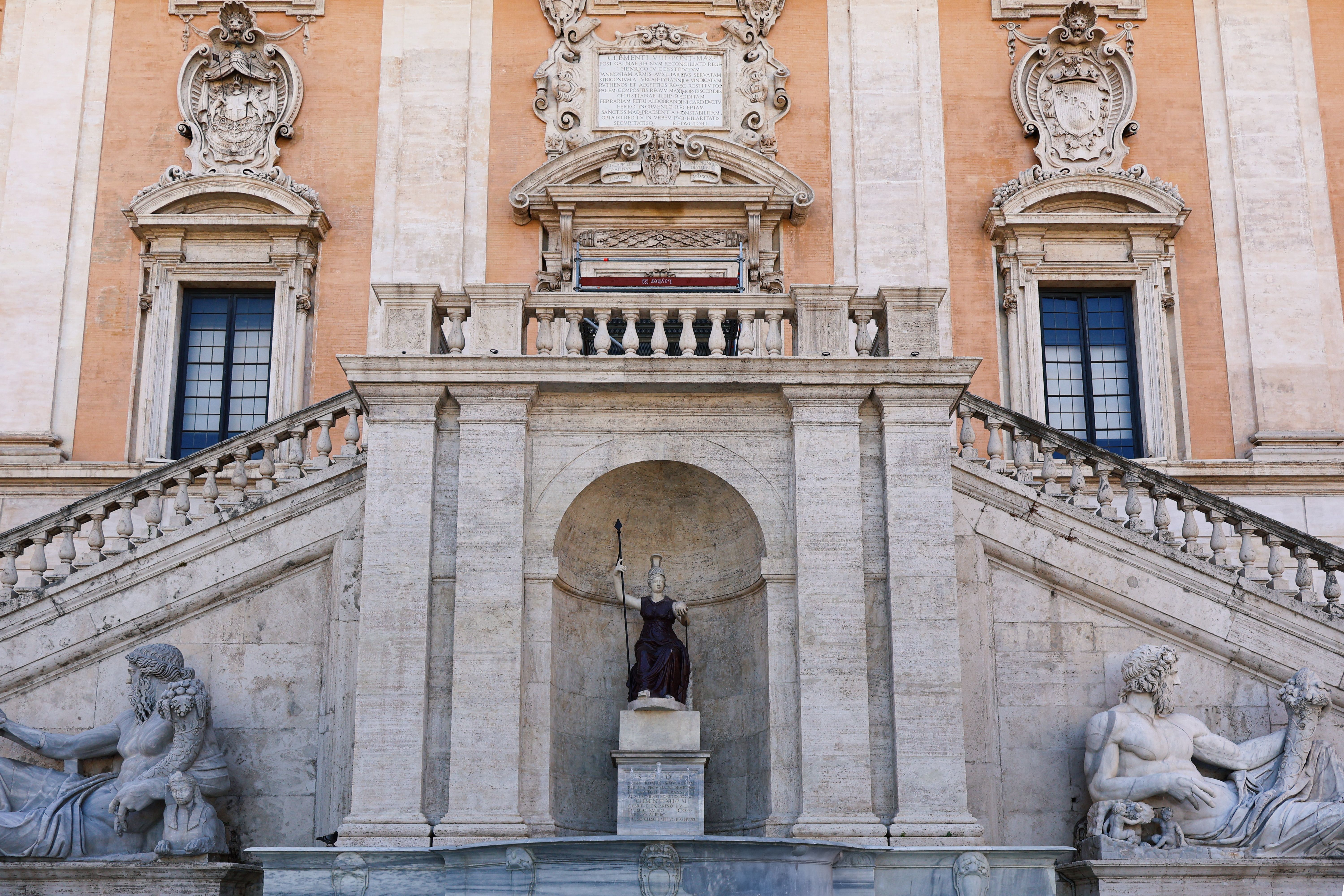
Capitoline Museums
The oldest public museum collection in the world started with a single papal donation. In 1471, Pope Sixtus IV gave the people of Rome a group of bronze statues — including the famous She-Wolf — and they've been accumulating treasures here ever since. The collection splits across two facing palaces: the Palazzo dei Conservatori (completed between 1568 and 1584) and the Palazzo Nuovo (built from 1603 to 1660), connected by an underground gallery that cuts through the ancient Tabularium, Rome's Republican-era state archive. Walking that tunnel, you pass enormous tufa-block walls that predate Julius Caesar, then emerge into a window framing the Roman Forum below. Few transitions in any museum anywhere match it.
Upstairs in the Conservatori, the original Marcus Aurelius bronze stands in a climate-controlled glass hall, his right hand extended in a gesture scholars still debate — mercy? greeting? command? The Dying Gaul waits in the Palazzo Nuovo, his marble body tensed in a pain so specific you can almost hear him exhale. But the piece that stops most people cold is the Capitoline Venus: a 2nd-century marble copy of a lost Greek original, displayed alone in a small octagonal room where the acoustics swallow your footsteps. Book tickets online through the Musei Capitolini site. The inner courtyards, scattered with colossal stone feet and hands from dismembered imperial statues, are often nearly empty even when the main galleries are packed.
The Full Circuit: Cordonata to Forum Overlook
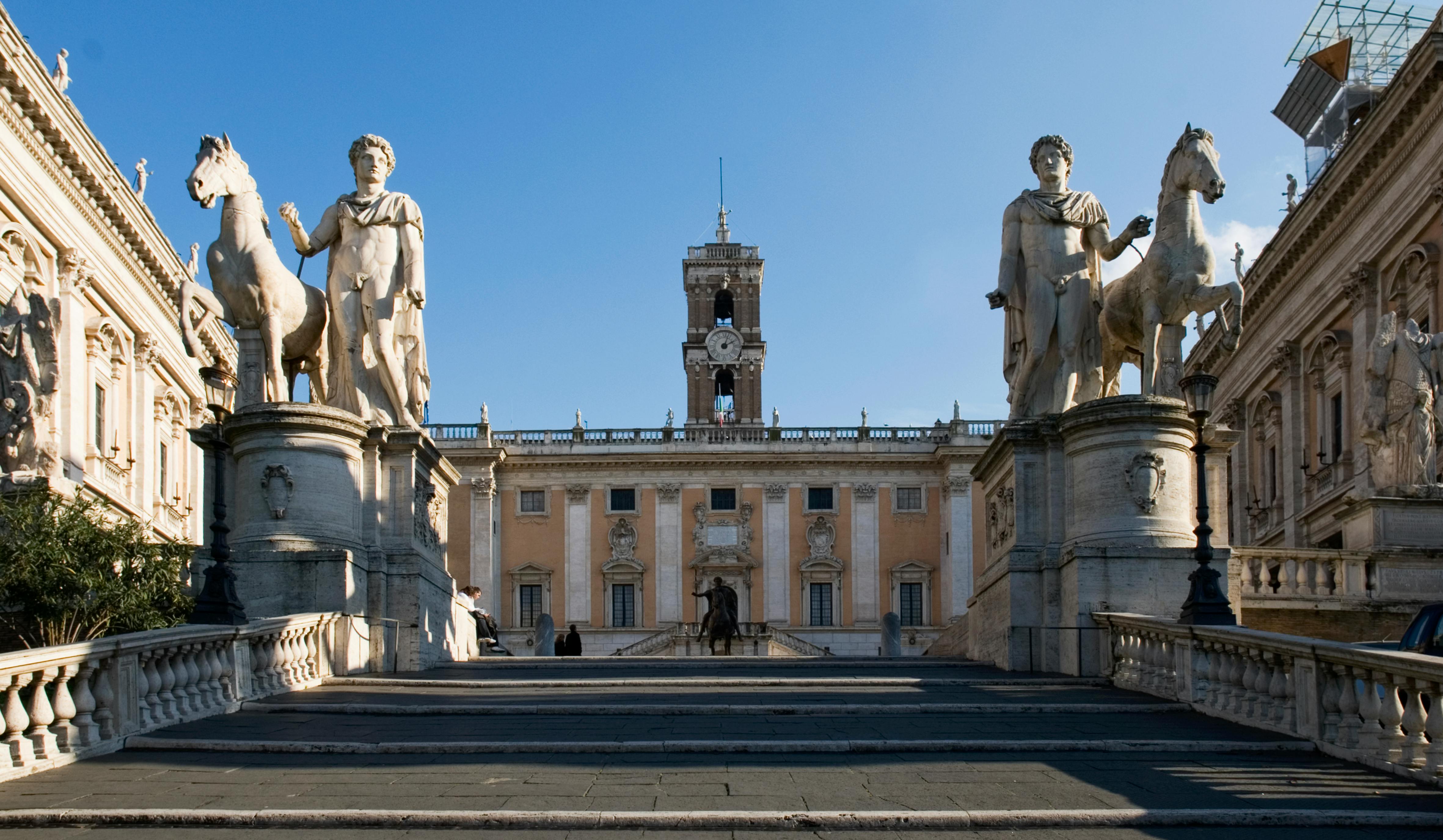
Start at the foot of the Cordonata on Piazza d'Aracoeli and climb slowly — the staircase was designed wide and gentle enough for horses, so the rise barely registers. At the top, the Egyptian-lion fountains and the towering Dioscuri statues greet you; look closely at Castor and Pollux's caps, which carry egg-shaped crests referencing their mythical birth from Leda's eggs. Cross the piazza to the rear of the Palazzo Senatorio and find the terrace overlook: the Roman Forum spreads below you like an architectural cross-section, with the three surviving columns of the Temple of Castor catching the afternoon light and the Colosseum rising beyond the Arch of Titus.
Then loop left toward the southern edge of the hill, where the Tarpeian Rock drops away — a sheer cliff face, roughly 25 meters tall (about eight stories), from which ancient Rome threw convicted traitors. The drop is still vertiginous. Circle back through the quiet side streets behind Santa Maria in Aracoeli, where the 124 steep marble steps up to that church's entrance offer a sharp contrast to Michelangelo's civilized ramp. The whole walk takes about 40 minutes without museum stops, and it compresses nearly 2,800 years of Roman power — from Romulus's legendary asylum for fugitives to the city council offices still operating inside the Palazzo Senatorio today.
Photo Gallery
Explore Capitoline Hill in Pictures

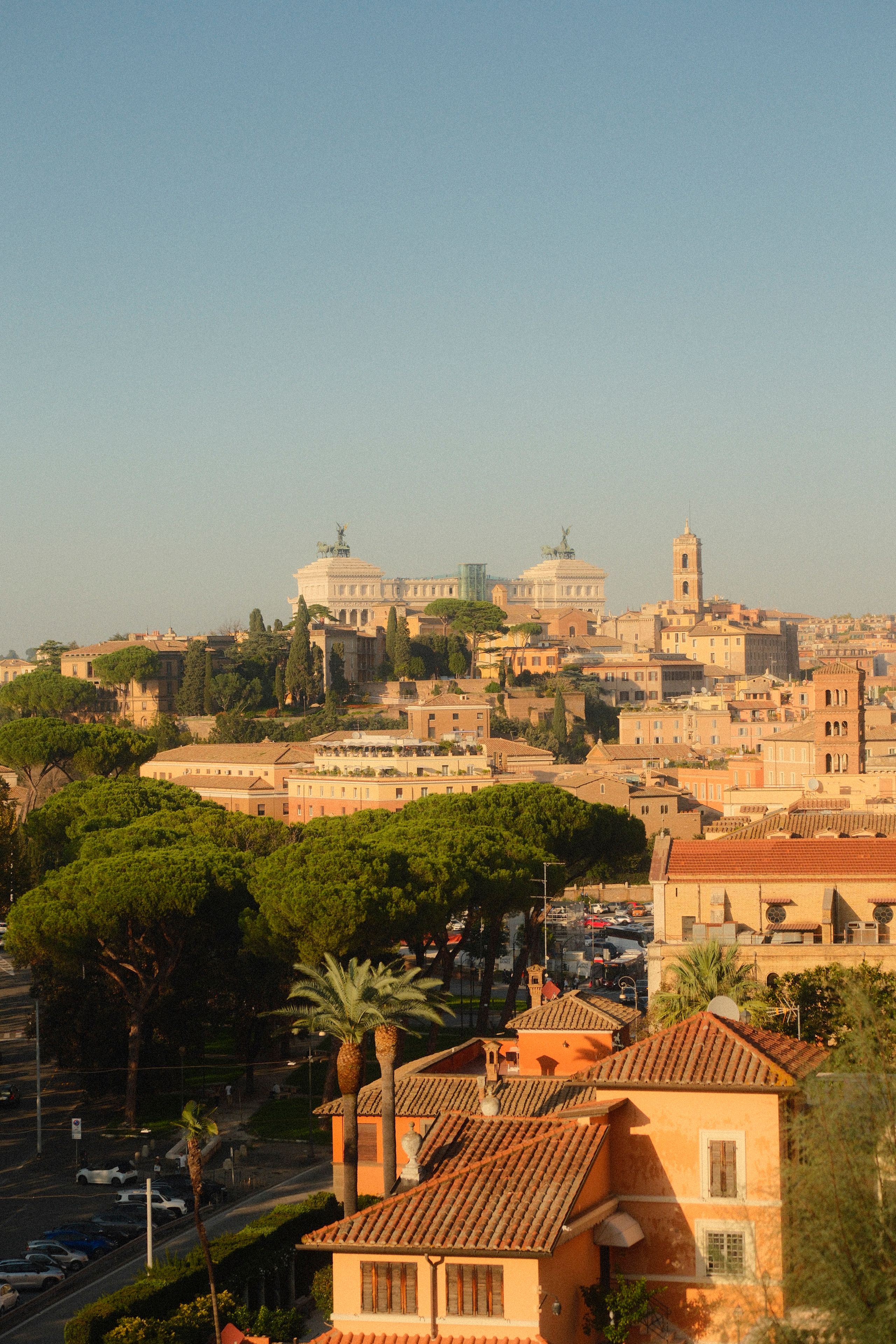
A panoramic view of the iconic Capitoline Hill and the ancient ruins of the Roman Forum under a soft, overcast Roman sky.
Bruna Santos on Pexels · Pexels License

The iconic bronze equestrian statue of Marcus Aurelius stands proudly in the Piazza del Campidoglio on Capitoline Hill in Rome.
C1 Superstar on Pexels · Pexels License

This intricate marble sculpture of a river god is a prominent feature of the historic Capitoline Hill in Rome, Italy.
C1 Superstar on Pexels · Pexels License

Visitors ascend the historic Cordonata staircase leading to the Capitoline Hill, framed by iconic Roman statues and classical architecture.
Claudia Solano on Pexels · Pexels License

A beautiful view of the historic Capitoline Hill and the Roman Forum, showcasing iconic ancient architecture under a dramatic, cloud-filled sky in Rome, Italy.
Maksym Harbar on Pexels · Pexels License

The historic Capitoline Hill in Rome, Italy, showcases Michelangelo's iconic Cordonata staircase flanked by ancient statues of Castor and Pollux.
Tom D'Arby on Pexels · Pexels License
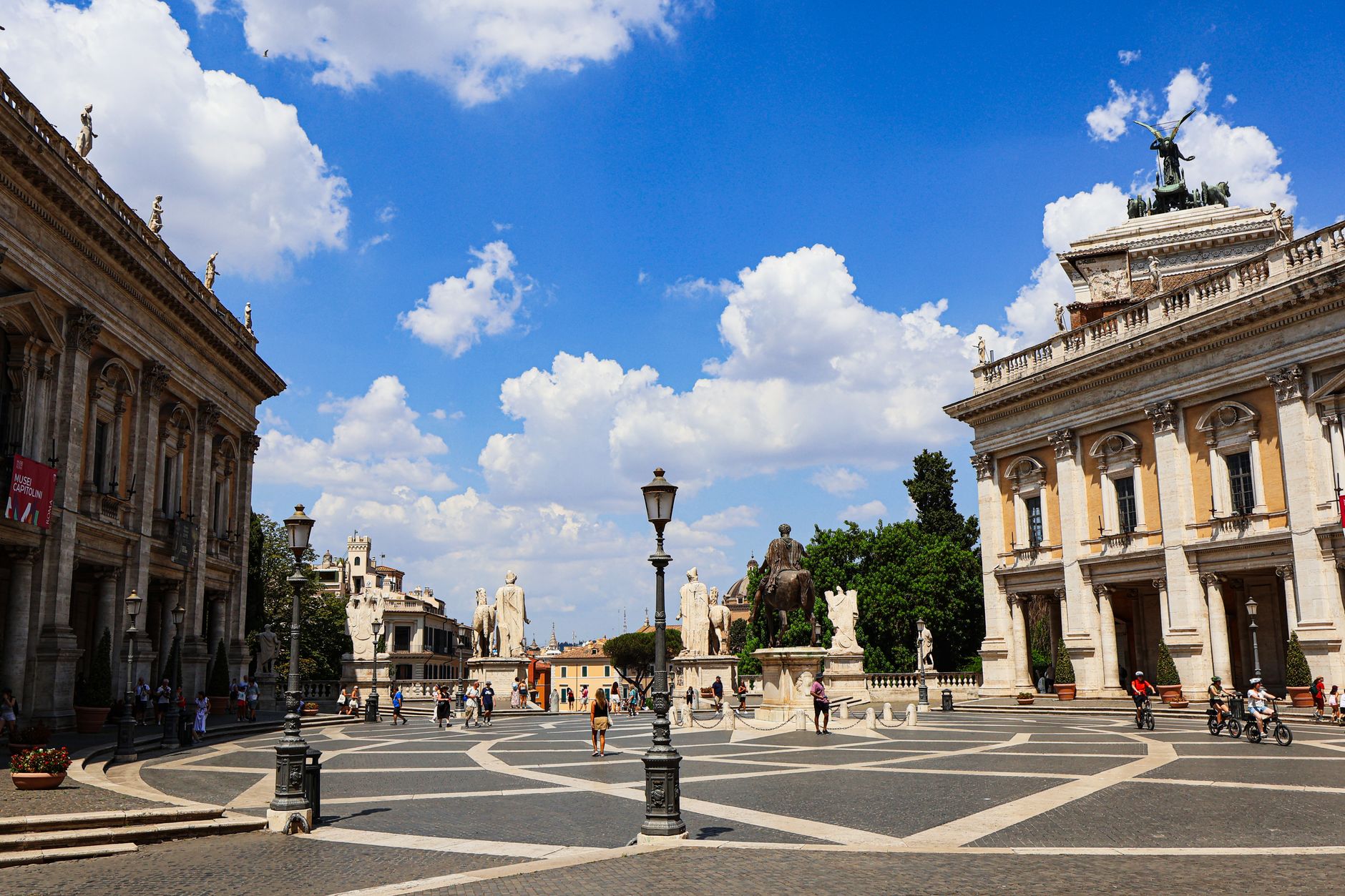
The grand Piazza del Campidoglio on Capitoline Hill, designed by Michelangelo, showcases stunning Renaissance architecture and iconic Roman statues.
C1 Superstar on Pexels · Pexels License
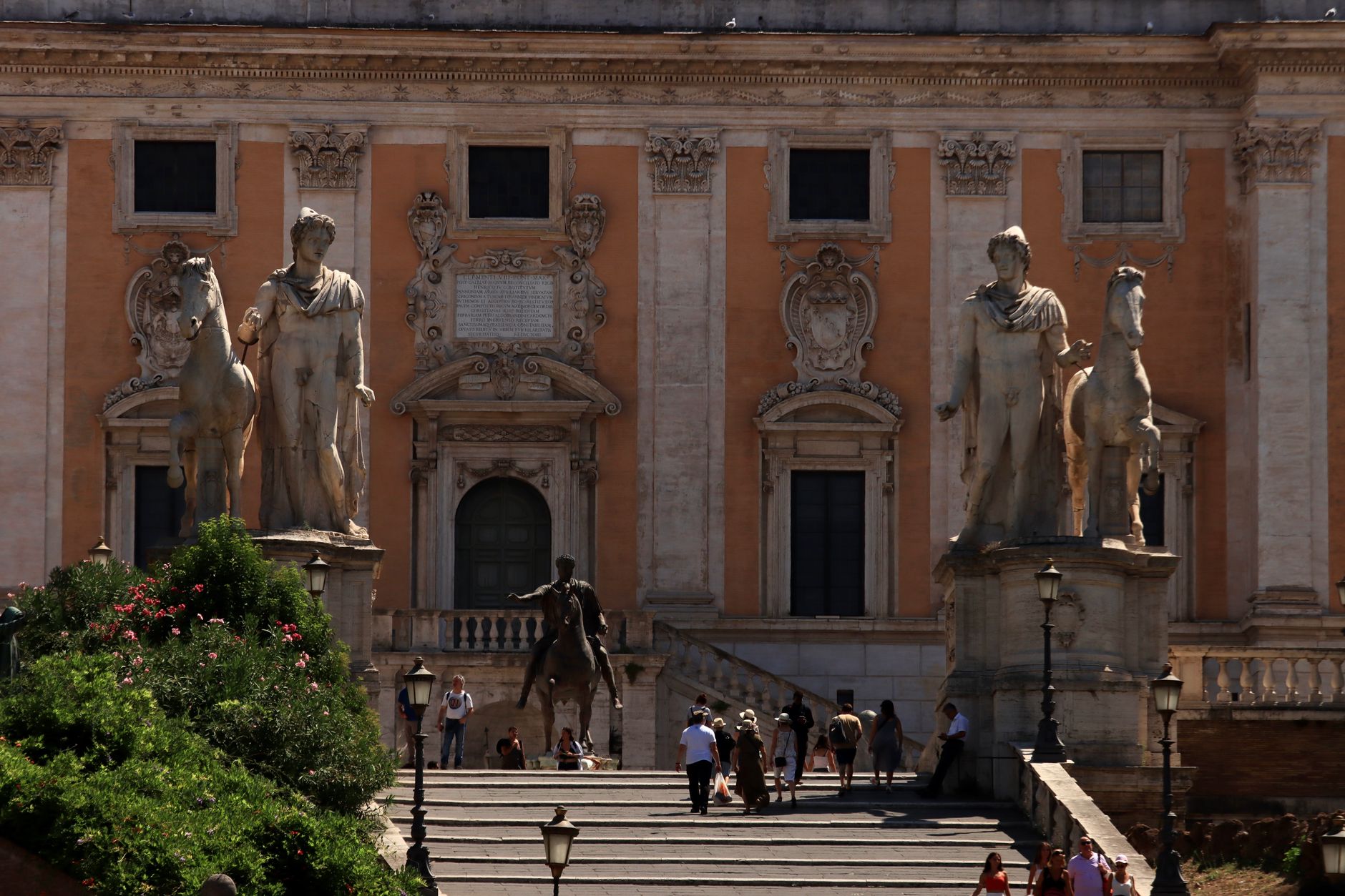
The historic Capitoline Hill in Rome, Italy, showcases grand Renaissance architecture, iconic classical statues, and the famous equestrian statue of Marcus Aurelius.
Efrem Efre on Pexels · Pexels License

A scenic elevated view of the historic Capitoline Hill in Rome, Italy, showcasing a blend of ancient ruins and iconic Renaissance architecture.
Manish Jain on Pexels · Pexels License
Videos
Watch & Explore Capitoline Hill
Ancient Rome in 3D - Detailed virtual reconstruction. Real colors. 2023 year progress.
ROCKY'S ITALY: Rome - Michelangelo’s Capitoline Hill
Rome Explained
Look down at the pavement of the Piazza del Campidoglio: Michelangelo's twelve-pointed oval star pattern is designed to radiate outward from the base of the Marcus Aurelius statue, creating an optical pull toward the centre. Stand at the top of the Cordonata and let your eye follow the geometry — it's far more deliberate than it first appears.
Visitor Logistics
Getting There
From the Colosseo Metro stop (Line B), it's a 10–15 minute walk northwest along Via dei Fori Imperiali — you'll have the Roman Forum on your left the whole way. Dozens of bus lines (40, 64, 70, 81, 87, 170, H) stop at Piazza Venezia, the enormous white-marble landmark at the hill's base. From there, climb Michelangelo's Cordonata — a wide, gently ramped staircase flanked by colossal statues of Castor and Pollux — straight into the piazza. The area is a ZTL (restricted traffic zone), so forget driving.
Opening Hours
The Piazza del Campidoglio is an open public square — accessible 24 hours, every day, free of charge. As of 2026, the Capitoline Museums are open daily 9:30 AM–7:30 PM, with last entry at 6:30 PM. They close on January 1, May 1, and December 25; holiday hours can shift, so check museicapitolini.org before you go.
Time Needed
If you're only here for the piazza, the panoramic terrace, and Michelangelo's geometric pavement, budget 20–30 minutes. Add the Capitoline Museums and you're looking at 2–3 hours for a proper visit — the collection spans ancient bronzes, Renaissance paintings, and an underground tunnel connecting the two palace wings. A quick museum sweep is possible in 90 minutes, but you'll regret rushing past the Dying Gaul.
Accessibility
The Cordonata's broad, shallow steps are manageable for many but not wheelchair-accessible; instead, use the vehicle ramp via Via del Campidoglio on the hill's south side. The museum provides wheelchair access to main rooms and has elevators between floors. The piazza itself is flat and fully paved once you're up top.
Tickets & Costs
As of 2026, standard museum admission is €15, rising to around €19.50 during temporary exhibitions — add €1 for online pre-booking via Vivaticket. Children under 6 enter free, and Rome residents get free entry with valid ID, including on the first Sunday of every month. The Capitolini Card bundles entry with the Centrale Montemartini museum and is valid for 7 days.
Tips for Visitors
Photography Rules
Personal photography is fine throughout the museums and piazza — no flash, no tripods, no selfie sticks. Professional shoots and drones require a permit from the Sovrintendenza Capitolina, which takes weeks to process.
Watch for Scams
The approach from Piazza Venezia is a pickpocket hotspot. Ignore anyone handing you "free" bracelets or asking for petition signatures — both are distraction techniques. The costumed "gladiators" demanding photo fees were officially banned in 2023, but stragglers persist near the Colosseum end of the walk.
Eat in the Ghetto
Skip the tourist traps at the hill's base and walk 5 minutes south into Rome's Jewish Ghetto for some of the city's best food. Nonna Betta and Piperno serve outstanding carciofo alla giudia — a whole artichoke fried until impossibly crisp. For budget bites, grab pizza bianca or rugelach from Forno del Ghetto.
Best Time to Visit
Come at golden hour — the late afternoon light turns the travertine facades warm amber, and the tour-bus crowds thin after 4 PM. Early mornings (museum opening at 9:30) are also excellent; you can have the gallery with the original Marcus Aurelius bronze nearly to yourself.
Free Forum View
Walk past the Palazzo Senatorio to the rear terrace — arguably the best free panorama in Rome, looking directly down over the entire Roman Forum and across to the Palatine Hill. Most visitors never leave the front piazza. This is where locals bring friends visiting for the first time.
Bag Restrictions
Large bags, backpacks, and umbrellas are prohibited inside the museum — there's a free self-managed cloakroom at the entrance. Travel light or plan to check your gear before entering.
Where to Eat
Don't Leave Without Trying
Saporizzo
local favoriteOrder: Pasta all'Amatriciana or Cacio e Pepe — the house versions are stripped down to essentials, the way Romans actually eat them. The guanciale is properly rendered, the pecorino sharp and clean.
This is where Romans come when they want real food without the tourist markup. Right on Piazza d'Aracoeli with 1,355 reviews and a 4.9 rating, Saporizzo punches above its casual weight with authentic Roman classics done right.
DIDDI Bistrot | Ristorante Piazza Venezia
local favoriteOrder: Fresh pasta with seasonal vegetables and Roman preparations — the menu changes with the market. Arrive early for their daily specials before the evening crowd hits.
DIDDI stays open late (until 11 PM) and serves from morning through night, making it reliable whether you're grabbing lunch after the museums or dinner after wandering the centro storico. The kitchen respects Italian ingredients without pretension.
Caffetteria Italia al Vittoriano
quick biteOrder: A proper Italian espresso or cappuccino (morning only) with a cornetto. If you're there at lunch, grab a panino or the daily pasta special.
Located right at the Vittoriano monument with over 2,200 reviews, this is the smart stop for coffee and a quick bite without leaving the archaeological zone. The location is unbeatable for people-watching while you fuel up.
Comet Theater
cafeOrder: Wine by the glass paired with simple Roman aperitivi — cheeses, cured meats, olives. The bar snacks are understated and honest.
A proper Roman bar with theatrical flair (the name gives it away), located on the charming Via del Teatro di Marcello. It's the kind of place where you'll see locals stopping in for an evening drink, not tourists queuing for selfies.
Dining Tips
- check Roman restaurants often close between lunch and dinner service; confirm hours before walking over.
- check Lunch is typically 12:30–3:00 PM; dinner starts around 8:00 PM. Eating earlier or later than locals do will mark you as a tourist.
- check Look for 'Tavola Calda' establishments for quick, pre-prepared hot food served by weight — authentic and affordable.
- check The nearby Jewish Ghetto (short walk from Capitoline) and Monti district are where you'll find the most historic trattorias serving ancient Roman recipes.
Restaurant data powered by Google
Historical Context
Where Geese Outranked Generals
The Capitoline wasn't chosen for its height — it's actually the lowest of Rome's famous seven hills. It was chosen for its cliffs. The southern and eastern faces drop away sharply, making the summit a natural fortress. By the 6th century BC, the Romans had crowned it with the Temple of Jupiter Optimus Maximus, dedicated in 509 BC to the triad of Jupiter, Juno, and Minerva. Records describe a podium roughly 60 meters wide, larger than a modern basketball court, faced in painted terracotta. For the next millennium, every Roman triumph ended here, with the victorious general climbing to Jupiter's temple to lay his laurels at the god's feet.
But the hill had two peaks, not one — the Arx to the north and the Capitolium to the south, separated by a saddle the Romans called the Asylum. According to tradition, Romulus declared this hollow a sanctuary for fugitives and outcasts, a pragmatic immigration policy designed to populate his infant city. The dual-summit geography matters: the temples sat on one peak, the citadel garrison on the other, and the space between them became the contested ground where Rome's grandest stories played out.
Marcus Manlius and the Night the Geese Screamed
In 390 BC, a Gallic army under the chieftain Brennus sacked most of Rome. The survivors retreated to the Capitoline, barricading themselves on the cliff-top citadel with whatever food they could carry. For seven months, the siege held. Then one moonless night, Gallic scouts found a handhold in the rock face and began to climb.
The Roman guards were asleep. The dogs were silent. But the sacred geese kept in Juno's temple on the Arx were not. They erupted in a frenzy of honking that woke Marcus Manlius Capitolinus, a former consul sleeping nearby. Manlius grabbed his sword, ran to the cliff edge, and shoved the first Gaul back down the rock face. Other defenders followed. The assault collapsed. Rome survived because a flock of underfed birds did what trained sentries could not.
The aftermath was bitter. Manlius became a hero — for a while. He later championed the cause of Roman citizens crushed by debt, which put him on a collision course with the Senate. In 384 BC, he was convicted of seeking tyranny and executed by being thrown from the Tarpeian Rock, the same cliff he had once defended. The Roman proverb captures it perfectly: "The Tarpeian Rock is close to the Capitol." Glory and destruction, separated by a few steps of stone.
Tarpeia and the Cliff of Traitors
Legend holds that the Tarpeian Rock takes its name from Tarpeia, daughter of the citadel's commander Spurius Tarpeius, who opened the gates to the Sabines during Rome's earliest wars — supposedly in exchange for "what they wore on their left arms," meaning their gold bracelets. The Sabines obliged by crushing her under their shields instead. For centuries afterward, Romans convicted of treason were hurled from this cliff on the hill's southern edge. Scholars still debate its exact location; ancient descriptions by Dionysius of Halicarnassus place it on the southeast face of the Arx, but the precise drop point has never been confirmed archaeologically. The rock face visible today, scarred by centuries of quarrying, gives little away.
Michelangelo's Quiet Revolution
When Pope Paul III commissioned Michelangelo to redesign the hilltop in 1538, the piazza was a muddy, neglected space used as a cattle market — Romans called it "Monte Caprino," Goat Hill. Michelangelo's stroke of genius was orientation. Every Roman square before his faced the Forum, the old center of power. He turned the Campidoglio to face St. Peter's Basilica and the Vatican, physically redirecting Rome's gaze from its pagan past toward its Christian present. The wide, gently sloping Cordonata staircase he designed replaced the steep medieval steps, allowing dignitaries to ride up on horseback with dignity. He placed the equestrian statue of Marcus Aurelius at the center — an ancient bronze that had survived medieval scrapheaps only because Christians mistakenly believed it depicted Constantine. Michelangelo died in 1564, decades before the piazza was finished, but his geometric pavement pattern, an interlocking twelve-pointed star, still pulls your eye to the center exactly as he intended.
Listen to the full story in the app
Your Personal Curator, in Your Pocket.
Audio guides for 1,100+ cities across 96 countries. History, stories, and local insight — offline ready.
Audiala App
Available on iOS & Android
Join 50k+ Curators
Frequently Asked
Is Capitoline Hill worth visiting? add
Absolutely — it's the political and religious heart of Rome, layered with nearly 2,800 years of history, and the piazza alone is one of Michelangelo's greatest works. The square is free and open around the clock, so you can admire the Renaissance architecture and the replica of the Marcus Aurelius equestrian statue without spending a euro. Walk around to the back of the Palazzo Senatorio for one of the best elevated views directly down into the Roman Forum — it rivals the paid viewpoints and costs nothing.
How long do you need at Capitoline Hill? add
Budget 20–30 minutes for the piazza and its views, or 2.5–3.5 hours if you plan to explore the Capitoline Museums inside. The museums — the oldest public collection in the world, founded in 1471 — house Roman bronzes, portrait busts, and the original Marcus Aurelius statue, so they reward a slow visit. If you're short on time, at least walk the Cordonata staircase up, circle the square, and catch the Forum overlook from behind the Palazzo Senatorio.
How do I get to Capitoline Hill from Rome city center? add
The closest metro stop is Colosseo on Line B, about a 10–15 minute walk via Via dei Fori Imperiali. Alternatively, dozens of bus lines (40, 64, 70, 81, 87, and others) stop at Piazza Venezia, which sits right at the foot of the hill. From Piazza Venezia, climb Michelangelo's Cordonata — the wide, gently ramped staircase flanked by statues of Castor and Pollux — and you're there in under two minutes.
Can you visit Capitoline Hill for free? add
Yes, the Piazza del Campidoglio and the views from the hill are completely free and accessible 24 hours a day. The Capitoline Museums charge €15 for standard admission (more during temporary exhibitions), but Rome residents with valid ID get in free, as do children under 6. On the first Sunday of every month, residents of Rome and its metropolitan area also enjoy free museum entry.
What is the best time to visit Capitoline Hill? add
Early morning is ideal — the travertine facades catch the low light beautifully, and you'll have the square largely to yourself before tour groups arrive around 10 AM. In summer, the white stone radiates serious heat by midday, so aim for before 9 AM or after 5 PM. Winter offers crisper air and sharper architectural shadows, which makes the geometric pavement pattern and the forced-perspective design of the piazza easier to appreciate.
What should I not miss at Capitoline Hill? add
Don't leave without walking to the rear terrace behind the Palazzo Senatorio — the view straight down into the Roman Forum is extraordinary and free. Inside the museums, seek out the original bronze equestrian statue of Marcus Aurelius (the one in the square is a replica) and the fragments of the colossal Constantine statue in the courtyard of the Palazzo dei Conservatori. Also look up at the Dioscuri statues topping the Cordonata: the egg-shaped details on their caps reference their mythical birth from Leda's eggs, a detail almost everyone walks past.
What are the Capitoline Museums opening hours and ticket prices? add
The Capitoline Museums are open daily from 9:30 AM to 7:30 PM, with last admission at 6:30 PM; they close on January 1, May 1, and December 25. Standard tickets cost €15, rising to around €19.50 during temporary exhibitions. You can book online via Vivaticket for a €1 pre-sale fee, which helps you skip the ticket counter queue — a real advantage during peak season.
What is the history of Capitoline Hill in Rome? add
The hill was the religious epicenter of ancient Rome: the Temple of Jupiter Optimus Maximus, dedicated in 509 BC to Jupiter, Juno, and Minerva, stood on its southern summit and was the most important temple in the Republic. In 390 BC, according to tradition, the sacred geese of Juno's temple squawked loud enough to wake sleeping guards and foil a nighttime Gallic assault — saving the city. The hill's modern identity was shaped in 1536 when Pope Paul III commissioned Michelangelo to redesign the entire square, deliberately reorienting it away from the ancient Forum and toward St. Peter's Basilica, symbolically turning Rome's gaze from its pagan past to its Christian future.
Sources
-
verified
From Home to Rome – Discovering the Secrets of the Capitoline Hill
Details on the Asylum legend, Grottoni underground quarries, the live wolf tradition, and the hill's two original summits.
-
verified
Mama Loves Rome – Capitoline Hill Rome
Overview of Michelangelo's 1538 commission, the Cordonata, the Marcus Aurelius statue replica, and general visitor access.
-
verified
UNESCO World Heritage Centre – Historic Centre of Rome
Confirmation of Rome's legendary founding date of 753 BC and World Heritage status.
-
verified
Wikipedia – Temple of Jupiter Optimus Maximus
Historical details on the 509 BC dedication of Rome's most important temple to the Capitoline Triad.
-
verified
Turismo Roma – Tarpeian Rock
Information on the Tarpeia myth, the Sabine betrayal, and Marcus Manlius Capitolinus.
-
verified
RomaToday – Oche del Campidoglio
Account of the 390 BC Gallic siege and the legend of Juno's sacred geese saving the Capitol.
-
verified
Wikipedia – Tarpeian Rock
Background on Tarpeia as a Vestal Virgin and the execution practices at the cliff.
-
verified
Ancient History Blog (Macquarie University) – Tarpeian Rock
Scholarly discussion on the exact location debate and the Gemonian Stairs tradition.
-
verified
Musei Capitolini – Official Site (Avvisi)
Official museum opening hours, closure dates, and visitor advisories.
-
verified
Vivaticket – Musei Capitolini Booking
Online ticket purchasing, pricing details, and pre-sale fee information.
-
verified
Turismo Roma – Roma Accessibile
Wheelchair access and accessibility information for Rome's cultural sites.
-
verified
WGA – Michelangelo: Capitoline Hill
Architectural analysis of the trapezoidal piazza, Giant Order pilasters, and pavement design.
-
verified
Honors AH Archive – Michelangelo Capitoline Hill
Details on the Cordonata design, Dioscuri statues, and the reorientation of the square.
-
verified
Rome Is Love – Piazza del Campidoglio
Description of the Capitoline Museums as the world's oldest public museums.
-
verified
Trip in Art Italy – Hidden Gems in Rome 2026
Sensory description of the square's quiet atmosphere compared to surrounding areas.
-
verified
CNN Travel – Secret Tunnels Rome Capitoline Hill
Report on the Grottoni subterranean tunnels beneath the Capitoline Hill.
-
verified
Roma Città Eterna – Rione Campitelli
Local cultural identity, the Campitelli neighborhood, and the hill's civic significance.
-
verified
From Home to Rome – Stay Safe in Rome: Tourist Scams
Information on gladiator scams, petition scams, and pickpocketing near the Capitoline area.
-
verified
Carpe Diem Tours – Common Scams in Rome
Advice on bracelet and petition scams common near major Roman tourist sites.
-
verified
UNESCO – Rome Site Management Plan
Details on the 2016 conservation management plan for Rome's UNESCO World Heritage site.
-
verified
VisitItaly
Confirmation of the 1471 founding date of the Capitoline Museums collection.
-
verified
ScopriRoma
Supporting confirmation of museum founding dates and Michelangelo's commission timeline.
Last reviewed: