Palazzo Dei Rasponi Del Sale
RavennaItaly 44° N · 12° E Updated Apr 2026
A 1770 palazzo named after a wedding: the 'Del Sale' honors Count Rasponi's daughter-in-law. Now a bank on Ravenna's Piazza del Popolo — baroque facade, no museum inside.
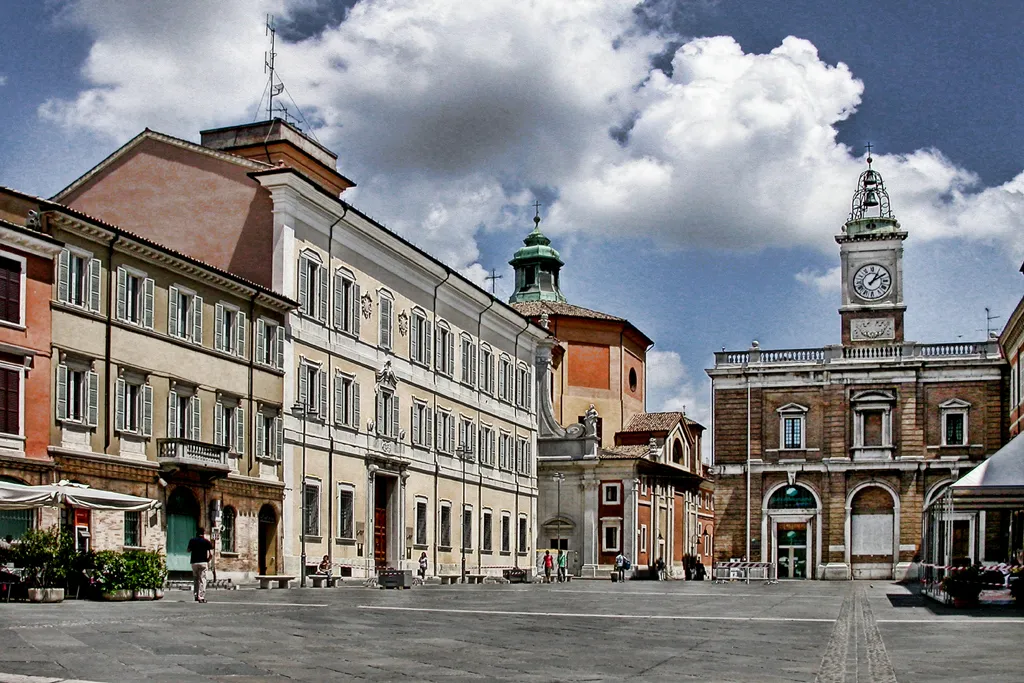 Photo: Veniero Rubboli · CC BY-SA 3.0
- Time needed
- 10–15 minutes (exterior); bank lobby accessible during banking hours
- Entry
- Free (exterior and lobby)
- Access
- Flat piazza approach; ZTL zone — arrive on foot or by bicycle from Piazza della Resistenza parking
- Best season
- Spring (April–May) or autumn (September–October) for comfortable temperatures and uncrowded photography
Most visitors to Ravenna walk right past it without a second glance — a baroque palazzo on Piazza del Popolo that now houses a UniCredit bank branch. Palazzo Dei Rasponi Del Sale stands on the main square of this Italian city famous for Byzantine mosaics, and yet the building tells a different story entirely: one of 18th-century aristocratic ambition, strategic marriages, and a family name that still echoes across half the palaces in town. Come for the facade; stay because it changes how you read the rest of the piazza.
The Rasponi were one of Ravenna's most powerful noble families, and they scattered their name across the city like a signature. This particular branch — the "Del Sale" line — takes its suffix not from the salt trade, as you might guess, but from a bride. When Giuseppe Rasponi married Benedetta del Sale, her family name grafted itself onto the palazzo, a permanent reminder that in Italian aristocracy, marriages were mergers.
Today the building's ground floor smells of printer toner and banking transactions rather than candle wax and intrigue. But step back onto the cobblestones of Piazza del Popolo and look up. The facade remains one of the best examples of civil baroque architecture in Ravenna — restrained, confident, built to impress the square rather than dominate it. A palazzo that knows exactly what it's doing.
A word of warning: don't confuse this building with its flashier cousin, Palazzo Rasponi dalle Teste, which sits about 300 meters southeast on Piazza Kennedy and features 58 carved heads staring down from its windows. Same family, different branch, very different building. The distinction matters if you want to avoid standing in a bank lobby wondering where the exhibition hall is.
What to see
-
The Baroque Facade on Piazza del Popolo
You can't enter the palazzo as a tourist — it's a working bank — but the facade is the main event anyway. Stand near the twin Venetian columns at the piazza's center, about 40 meters away, and you get the full composition: the symmetrical window bays, the restrained baroque detailing, the way the building holds its corner of the square without competing with the Palazzo Comunale across the way. Morning light hits the facade most directly, picking out the stonework's texture in a way that afternoon shade flattens. Barbiani designed this to be seen from the piazza, and the piazza is still the best place to see it. Bring a coffee from one of the surrounding cafes and take your time. -
Piazza del Popolo Itself
The palazzo makes more sense as part of its setting than in isolation. Piazza del Popolo has been Ravenna's main square since the Venetian period, and its dimensions — roughly 60 meters long, about the length of an Olympic swimming pool and a half — create an intimate civic room rather than an overwhelming void. The two granite columns topped with statues of Saint Apollinare and Saint Vitale date to 1483. The arcaded Palazzo Comunale faces the Rasponi palazzo across the square. On a weekday morning, the piazza belongs to locals crossing on errands; by evening, the cafe tables fill and the facades glow amber under the streetlights. The palazzo is one voice in a conversation that's been going on for five centuries. -
Don't Confuse It with Palazzo Rasponi dalle Teste
This confusion is so common it deserves its own entry. If you came looking for the palazzo with 58 carved heads — lions and Moors glaring down from every window — you want Palazzo Rasponi dalle Teste on Piazza Kennedy, a five-minute walk southeast. That building is municipally owned, hosts exhibitions and cultural events, and is actually open to the public. The Del Sale palazzo on Piazza del Popolo is the quieter, more private sibling: beautiful from the outside, inaccessible within. Both belong to the same sprawling Rasponi dynasty, but they serve very different purposes today. Check the Comune di Ravenna website for current exhibition schedules at the dalle Teste building before you walk over.
Plan your visit
- Getting There
- Palazzo Dei Rasponi Del Sale sits directly on Piazza del Popolo, Ravenna's central square — about a 10-minute walk from the train station along Via Diaz. The palazzo is inside the ZTL (limited traffic zone), so driving in is restricted; park at Piazza della Resistenza, roughly 300 meters south, and walk. By bus, most city lines stop within two blocks of the piazza.
- Opening Hours
- As of 2025, the palazzo houses a UniCredit bank branch, so the interior is only accessible during banking hours — typically Monday to Friday, 8:20–13:20 and 14:30–16:00. The facade, which is the real attraction, faces the open piazza and can be admired at any hour. The building is closed to the public on weekends and Italian bank holidays.
- Time Needed
- Studying the baroque facade and its place in the Piazza del Popolo skyline takes about 10–15 minutes. If you step into the bank lobby to glimpse the interior architecture, add another 5 minutes. Most visitors fold this into a broader exploration of the piazza, which deserves 30–45 minutes total with its Venetian columns and arcades.
- Accessibility
- Piazza del Popolo is flat, paved, and fully wheelchair-accessible. The bank entrance has a level threshold. Since the main draw is the exterior facade, visitors with mobility limitations can appreciate the palazzo without any barriers.
History
A Count, a Bride, and a Piazza That Remembers
Ravenna's Piazza del Popolo has been the civic heart of the city since the Venetians reshaped it in the late 15th century. By the 1700s, the square's perimeter was prime real estate for any family wanting to project authority. The Rasponi — already entrenched in Ravenna's power structure for generations — seized the opportunity.
The palazzo that rose on the square around 1770 was not the Rasponi family's first or grandest building in the city. But its position gave it something the others lacked: a daily audience. Everyone who crossed the piazza would see it.
The turning point
Count Fabrizio's Calculated Monument
Count Fabrizio Rasponi commissioned the palazzo, and according to local architectural records, he turned to Domenico Barbiani — an architect whose name appears on several of Ravenna's 18th-century civil buildings. Barbiani designed a facade that was baroque but not excessive, elegant enough to signal wealth without provoking the envy of the city's other noble families. The building's proportions suggest a man who understood that in a city as politically layered as Ravenna, restraint could be its own form of power.
The real drama came a generation later. Fabrizio's son Giuseppe married Benedetta del Sale, and the union permanently altered the palazzo's identity. The "Del Sale" suffix stuck — not as a commercial reference, but as a genealogical watermark. In a city where the Rasponi name already adorned multiple buildings, the addition was practical: it told you which Rasponi lived here. The marriage also brought new wealth into the family, ensuring the palazzo's upkeep through the turbulent decades that followed.
By the 19th century, the building had begun its slow transition from private residence to institutional use. The aristocratic interiors gave way to commercial function, and today the palazzo serves as a bank. The Rasponi family's coat of arms may have faded from daily relevance, but the building's facade — roughly the width of four modern storefronts — still anchors the western edge of Piazza del Popolo.
The Rasponi Web Across Ravenna
Barbiani and Ravenna's Baroque Restraint
Tips for visitors
Don't Confuse the Palazzi
Ravenna has two Rasponi palaces that tourists constantly mix up. If you're looking for the one with 58 sculpted lion and Moor heads on the windows — that's Palazzo Rasponi dalle Teste on Piazza Kennedy, about 400 meters southeast. The one here on Piazza del Popolo is the bank building, elegant but quieter.Morning Light Is Best
The facade of Palazzo Dei Rasponi Del Sale faces the piazza in a way that catches morning sun beautifully. Arrive before 10:00 for the warmest light on the baroque stonework and the fewest tourists blocking your sightline.Frame the Full Piazza
Stand near the two Venetian granite columns at the piazza's center to capture the palazzo facade alongside the medieval Palazzo Comunale arcades — the contrast between the civic Gothic and the 1770 baroque tells Ravenna's whole story in one frame.Eat Off the Square
The cafes lining Piazza del Popolo charge a premium for the view. Walk one block south to Ca' de Vèn on Via Corrado Ricci for piadina and local Sangiovese wine in a frescoed 15th-century hall — mid-range prices, vastly more atmosphere.Combine with Mosaics
The Basilica of San Vitale and the Mausoleum of Galla Placidia are an 8-minute walk north from the piazza. See the palazzo facade first thing in the morning light, then head to the mosaics before the tour groups arrive around 10:30.
Frequently asked
Is Palazzo Dei Rasponi Del Sale worth visiting?
Worth a look from the outside, yes — but walk in expecting a bank, not a museum. The baroque facade on Piazza del Popolo is one of the more composed pieces of 18th-century civil architecture in Ravenna, attributed to Domenico Barbiani and built around 1770. The interior is a functioning UniCredit branch, so the visit lasts about as long as it takes to admire a facade — roughly five minutes, unless you're a serious architectural photographer.
How long do you need at Palazzo Dei Rasponi Del Sale?
Fifteen minutes is generous for the building itself. Budget your real time for Piazza del Popolo as a whole — the square rewards a slower circuit, and the morning light hits the Rasponi Del Sale facade at an angle that makes the baroque detailing read clearly. If you're confusing this with Palazzo Rasponi dalle Teste (the one with 58 decorative heads on Piazza Kennedy), that building warrants 30–45 minutes, especially during an exhibition.
Can you go inside Palazzo Dei Rasponi Del Sale in Ravenna?
You can enter the lobby during standard Italian banking hours, but there's no public cultural access to the upper floors or private rooms. The building has been a UniCredit Bank branch for years, so the experience is less 'noble palazzo' and more 'marble floors, fluorescent lighting, and a queue for the ATM.' For interior access to a Rasponi family palace, Palazzo Rasponi dalle Teste on Piazza Kennedy is the one that opens for exhibitions and events.
What is the difference between Palazzo Rasponi Del Sale and Palazzo Rasponi dalle Teste?
They are two separate buildings from the same aristocratic family, about 400 meters apart — roughly the length of four city buses end to end. Palazzo Dei Rasponi Del Sale sits on Piazza del Popolo and is now a bank; it was built around 1770 by Count Fabrizio Rasponi, and the 'Del Sale' name comes from his son's marriage to Benedetta del Sale. Palazzo Rasponi dalle Teste is on Piazza Kennedy, dates to the late 17th or early 18th century, and takes its name from the 58 carved heads — lions and Moorish faces — decorating its window surrounds; that building is municipally owned and open for public events.
Who built Palazzo Dei Rasponi Del Sale and when?
According to a single Italian heritage source, the palace was built around 1770 on the commission of Count Fabrizio Rasponi, with the design attributed to architect Domenico Barbiani. The 'Del Sale' suffix was added after Fabrizio's son Giuseppe married into the del Sale family — the building essentially carries a wedding in its name. The attribution to Barbiani is plausible but comes from one source, so treat it as credible rather than confirmed.
Where exactly is Palazzo Dei Rasponi Del Sale in Ravenna?
It stands directly on Piazza del Popolo, Ravenna's central square, in the ZTL (limited traffic zone) — which means you'll need to arrive on foot or by bike. The nearest parking is at Piazza della Resistenza, about a 10-minute walk. Don't confuse the address with Palazzo Rasponi dalle Teste, which is on the separate Piazza Kennedy, a few minutes' walk to the northeast.
Is Palazzo Dei Rasponi Del Sale free to visit?
The exterior is free to view at any time, and the bank lobby can be entered during opening hours at no charge. There's no ticketed admission because there's no cultural program hosted here — the building functions as a private bank. If you're after a free architectural experience in Ravenna's historic center, the facade is worth the detour while you're already in Piazza del Popolo.
What is the best time to visit Palazzo Dei Rasponi Del Sale for photos?
Morning hours give you the best light on the facade, when the sun's orientation illuminates the baroque detailing across the Piazza del Popolo frontage. The square is also quietest before 10am, which helps if you want a clean shot without delivery vehicles or cafe furniture in the frame. The palazzo's position on the piazza means afternoon light moves behind the building, leaving the facade in shade by mid-afternoon.
Sources & attribution 10
- Edifici Storici Ravenna — Palazzo Rasponi Del Sale Gargantini — Primary source for construction date (c. 1770), Count Fabrizio Rasponi's commission, and the origin of the 'Del Sale' name via the del Sale family marriage.
- ANC Ravenna — Piazza del Popolo PDF — Source for the architectural attribution to Domenico Barbiani.
- Ravenna24ore — Le Grandi Bellezze di Ravenna: Piazza del Popolo — Confirms current use as a UniCredit Bank branch and notes the facade's role in the Piazza del Popolo skyline; limited interior public access.
- Turismo Ravenna — Palazzo Rasponi dalle Teste — Source for construction date range of Palazzo Rasponi dalle Teste (late 17th–early 18th century) and distinction from Palazzo Del Sale.
- Comune di Ravenna — Palazzo Rasponi — Municipal source confirming Giovanni Rasponi, Bishop of Forlì, as commissioner of Palazzo Rasponi dalle Teste, and its current use for public events.
- Weekra Blog — 7 Cose Forse Non Sai su Palazzo Rasponi — Source for the 58 decorative heads (lions and Moors) on Palazzo Rasponi dalle Teste and the local distinction between the two Rasponi buildings.
- Travelhoo — Palazzo Rasponi dalle Teste — Confirms Palazzo Rasponi dalle Teste is open to the public for temporary exhibitions, cultural events, and weddings.
- Regione Romagna — E Rumagnol Magazine — Describes Palazzo Dei Rasponi Del Sale as a prime example of civil baroque architecture in Piazza del Popolo.
- Il Resto del Carlino — Notte d'Oro 2024 Ravenna — Notes that city festivals such as Notte d'Oro sometimes use the Rasponi palace courtyards and halls for guided tours and events.
- Emilia Romagna Segreta — Visita Guidata al Palazzo Rasponi dalle Teste — Documents the Rasponi family history, rivalries, and land disputes in the context of Palazzo Rasponi dalle Teste.
Built from cited sources · see the method · How we make our guides →
Next stop
More in Ravenna.
34 places to discover — a few worth pairing.


Pick up where you left off
Saved and recently read places — kept on this device only.
Photo credits (2)
- Palazzo Rasponi Dalle Teste (Ravenna) - Salone 01 — Nicola Quirico — CC BY-SA 4.0 (https://creativecommons.org/licenses/by-sa/4.0/) — Source: https://commons.wikimedia.org/wiki/File:Palazzo_Rasponi_Dalle_Teste_(Ravenna)_-_Salone_01.jpg
- Ravenna - Scorcio di Piazza del Popolo — Veniero Rubboli — CC BY-SA 3.0 (https://creativecommons.org/licenses/by-sa/3.0/) — Source: https://commons.wikimedia.org/wiki/File:Ravenna_-_Scorcio_di_Piazza_del_Popolo.jpg
Photos may have been resized or cropped.