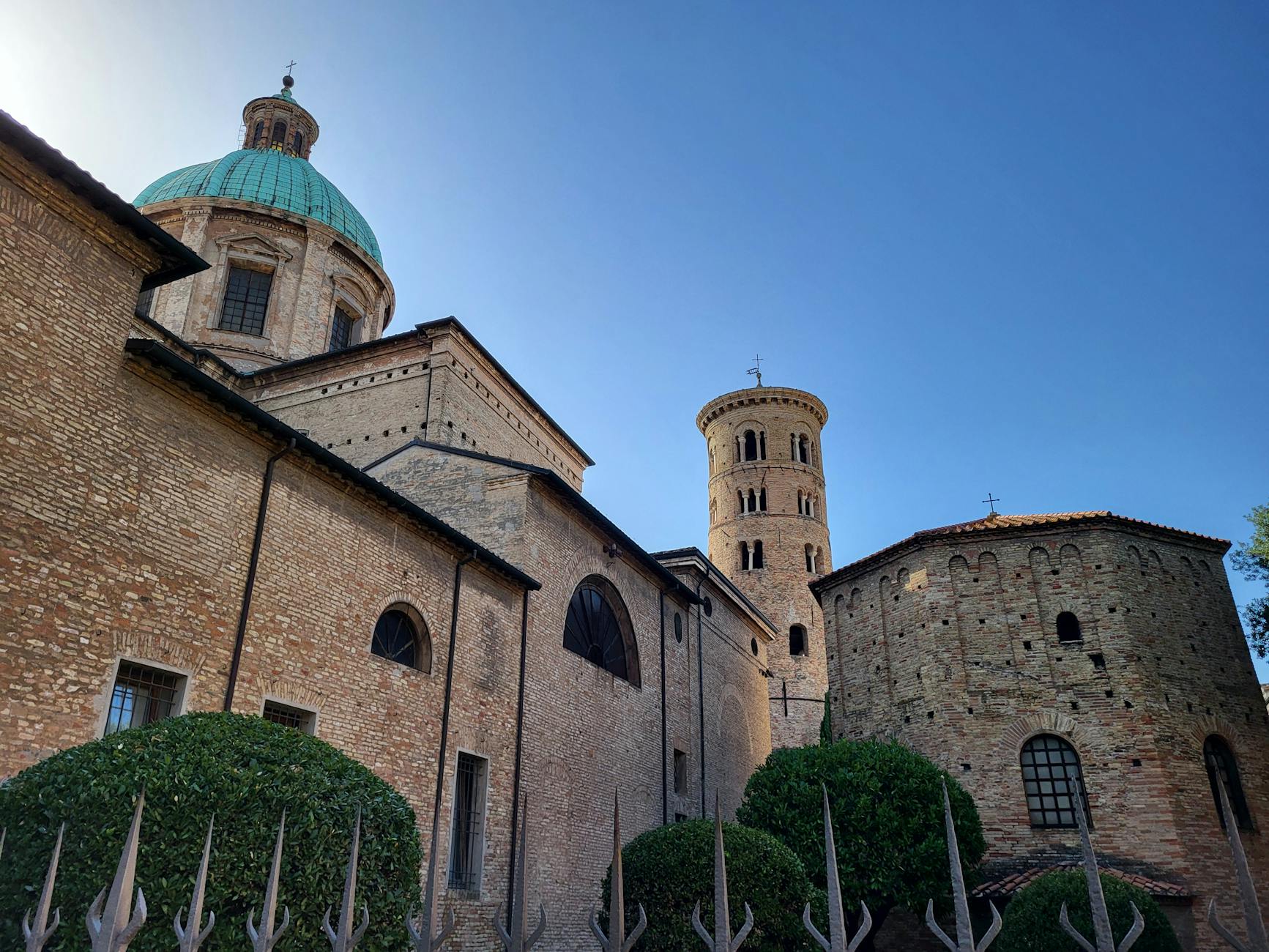
Roman Foundations
castle
c. 31 BCE
Augustus Builds a War Harbor
Emperor Augustus chooses the marshlands south of Ravenna for one of Rome's two great naval bases: Classis, a port capable of sheltering 250 warships. A canal links the harbor to the Po delta, and a city that had been a backwater of pilings and fog becomes an imperial asset. The strategic logic is simple — the lagoon is nearly impossible to assault by land. That same logic will define Ravenna's fate for the next thousand years.
Capital of the Dying Empire
gavel
402
An Emperor Flees to the Swamp
With Alaric's Visigoths tearing through northern Italy, Emperor Honorius abandons Milan and transfers the entire Western Roman court to Ravenna. The decision is purely defensive — Milan sits exposed on the Lombard plain, while Ravenna hides behind miles of impassable marsh. It is a retreat disguised as a relocation, and it makes this modest Adriatic city the capital of an empire in freefall.
person
c. 425
Galla Placidia, Empress in All but Name
Kidnapped by Visigoths, married to a barbarian king, widowed, returned, and now ruling the Western Empire as regent for her six-year-old son Valentinian III — Galla Placidia governs from Ravenna for over a decade. She commissions the small cross-shaped mausoleum that bears her name, its ceiling a field of deep lapis blue scattered with gold stars. Fifteen centuries later, the light inside still feels like entering a reliquary. She is never actually buried there — her body rests in Rome — but the building remains the oldest and most intimate of Ravenna's mosaic wonders.
gavel
476
The Last Emperor Is Deposed
On September 4, the Germanic general Odoacer deposes Romulus Augustulus — a teenager with an absurdly grandiose name — and sends him into comfortable exile near Naples. No one in Ravenna weeps for the boy. The Senate dispatches the imperial regalia to Constantinople. Historians will later call this the fall of the Western Roman Empire, though at the time it feels less like a collapse than a formality. Ravenna remains the seat of power, now under a barbarian king.
Ostrogothic Kingdom
person
493
Theodoric's Banquet Betrayal
After a three-year siege that Ravenna's marshes made unbreakable, the Ostrogoth king Theodoric and the defender Odoacer agree to share power. At a reconciliation banquet on March 15, Theodoric draws his sword and kills Odoacer personally, reportedly remarking on the quality of the dead man's bones. It is the beginning of a 33-year reign that will transform Ravenna into one of the most magnificent cities in the Mediterranean — a golden age built on a murder at dinner.
church
c. 500
A Palace Church Rises on the Via Regia
Theodoric builds Sant'Apollinare Nuovo as his personal palace chapel. Its nave walls carry long processional mosaics — Virgins approaching the Madonna, Martyrs advancing toward Christ — flanking earlier panels that depict Theodoric's palace and the port of Classis. These are rare documentary images of a vanished world: the king's colonnade, the harbor with its ships. When the Byzantines take the city decades later, they will scrub Theodoric's image from the palace mosaic but leave the architecture intact. The ghosts of erased figures are still faintly visible.
castle
c. 520
A 300-Tonne Dome, Carved Whole
Theodoric's mausoleum rises on the northern edge of the city — a two-story rotunda of pale Istrian limestone, capped by a single monolithic dome weighing roughly 300 tonnes. No one knows how it was quarried, transported, or lifted into place. The building has no mosaics, no gilding, nothing Byzantine about it — just raw stone and engineering audacity. It is the only surviving monument of its kind from the barbarian kingdoms, and it stands as an assertion that Theodoric's Goths could build to rival Rome.
person
524
Boethius Writes in Chains
The Roman philosopher Boethius — consul, senator, master of Theodoric's offices — is arrested on charges of treason and correspondence with Constantinople. Awaiting execution in a prison near Pavia, he writes The Consolation of Philosophy, a dialogue between himself and Lady Philosophy that will become one of the most copied, translated, and quoted books of the next millennium. Theodoric has him bludgeoned to death. The golden age curdles: within two years, Theodoric himself is dead, and his kingdom is unraveling.
Byzantine Golden Age
church
547
San Vitale Blazes with Gold
On April 19, Archbishop Maximian consecrates the Basilica of San Vitale, seven years after Belisarius captured Ravenna for Constantinople. The octagonal interior erupts with gold-ground mosaics — but two panels flanking the altar seize the eye and never release it: Emperor Justinian on one side, Empress Theodora on the other, each surrounded by courtiers, each staring directly at the viewer across fifteen centuries. Neither ever set foot in Ravenna. The mosaics are political theology made permanent — authority projected through tesserae of glass and gold across a thousand miles of sea.
church
549
A Transfiguration in Green and Gold
Two years after San Vitale, the Basilica of Sant'Apollinare in Classe is consecrated five kilometers south, at the site of Augustus's old naval base. The apse mosaic replaces the figure of Christ with a jeweled cross floating in a gold sky above a green paradise where sheep graze among flowers. It is the most serene image in all of Ravenna — theological abstraction rendered as landscape. The harbor outside is already silting up. Within a century, the sea will be a memory here.
gavel
584
Ravenna Rules Byzantine Italy
With Lombard warbands controlling most of the peninsula, Constantinople creates the Exarchate of Ravenna — a military-civilian governorship unprecedented in Roman administrative history. The Exarch commands both the army and the civil service, a fusion of powers that previous emperors had always kept separate. Ravenna becomes the administrative capital of a shrinking Byzantine enclave, an island of Greek-speaking imperial authority surrounded by Germanic kingdoms. The arrangement will last 167 years.
Medieval Ravenna
swords
751
The Exarchate Falls
Lombard King Aistulf captures Ravenna in June, ending 167 years of Byzantine rule and extinguishing Constantinople's presence in northern Italy for good. The consequences ripple far beyond the city walls: without a Byzantine protector, Pope Stephen II turns to the Franks for help — a desperate gambit that will reshape European power for centuries. Ravenna's long tenure as an imperial capital is over. It will never govern an empire again.
castle
774
Charlemagne Copies the Masterpiece
After conquering the Lombard kingdom, Charlemagne visits Ravenna and is stunned by San Vitale's octagonal geometry. He orders his palace chapel at Aachen built on the same plan — same proportions, same ambulatory, same vertigo of interior space. He also removes Theodoric's equestrian statue and ships it north. It is the sincerest and most consequential flattery in architectural history: the defining monument of the Carolingian Renaissance is a copy of a building in a silted-up Adriatic backwater.
person
1321
Dante Dies in Exile
On the night of September 13, Dante Alighieri dies in Ravenna at age 56, returning from a diplomatic mission to Venice through the malarial marshes of the Po Delta. He has lived here three years under the protection of Guido Novello da Polenta, finishing Paradiso in a city whose mosaics — those vast gold heavens inside San Vitale and Galla Placidia — may have shaped his vision of divine light. Florence, the city that condemned him to burn, immediately demands his bones. Ravenna refuses. It has refused every request since — for seven hundred years.
Venetian & Papal Rule
gavel
1441
Venice Takes the City
The da Polenta lords, who sheltered Dante and ruled Ravenna for over two centuries, lose power as Venice absorbs the city into its mainland empire. The Venetians reshape the Piazza del Popolo, raising twin columns topped with statues of Saints Vitale and Apollinare — a conscious echo of the famous columns in Venice's Piazzetta. Ravenna gains access to Venetian trade networks but becomes a provincial footnote in the Serenissima's ledger books.
swords
1512
The Bloodiest Battle of the Italian Wars
On Easter Sunday, April 11, French forces under the 23-year-old Gaston de Foix smash a Spanish-papal army outside Ravenna's walls in one of the deadliest engagements Europe has seen in centuries — perhaps 10,000 to 20,000 dead in a single day. Gaston himself is killed in the moment of victory, cut down while pursuing fleeing Spaniards. The victorious French army sacks the city. Ravenna recovers slowly and passes back to the Papal States, where it will remain for nearly three centuries of quiet obscurity.
church
1519
The Monks Hide Dante's Bones
Pope Leo X authorizes Florence to reclaim Dante's remains at last. When Florentine envoys open the tomb, they find it empty. Franciscan monks at San Francesco have spirited the bones into a hole in the monastery wall, hidden behind a false panel. Florence's commissioned tomb in Santa Croce remains a cenotaph — an elaborate monument to an absence. The bones will stay concealed for 346 years.
Risorgimento
person
1819
Byron Follows His Lover to Ravenna
Lord Byron arrives in Ravenna in December, trailing the 19-year-old Countess Teresa Guiccioli. He moves into the Palazzo Guiccioli, fills it with monkeys, foxes, birds, and a wolf, and enters the most productive phase of his career — Don Juan, Sardanapalus, Cain, all written here. He rides daily through the coastal pinewoods, visits Dante's tomb, and stores weapons for the Carbonari revolutionaries in his basement. He calls the city 'the most dreary I have seen' but cannot leave. The pines, the mosaics, the conspiracy — something holds him nearly two years.
swords
1849
Anita Garibaldi Dies in the Marshes
On August 4, Anita Garibaldi — pregnant, burning with malaria — dies in a farmhouse at Mandriole, south of Ravenna, during the desperate retreat following the fall of the Roman Republic. Her husband Giuseppe barely escapes the Austrian dragnet, hidden by sympathetic locals in the same marshes and pine forests that once protected emperors. Anita becomes one of the Risorgimento's great martyrs. A monument to her stands in Ravenna today.
United Italy
church
1865
Dante's Bones Found in a Wall
During renovation work at the former Franciscan monastery beside San Francesco, workmen break through a wall and find a wooden box containing human remains. Inside: the bones hidden by monks in 1519, with a Latin inscription confirming their identity. The discovery electrifies the nation, arriving just in time for the 600th anniversary of Dante's birth. Italy's greatest poet is ceremonially reinterred in Ravenna. Florence sends olive oil for the tomb's eternal lamp — a gesture of contrition that continues to this day.
World Wars
swords
1944
Canadian Troops Liberate Ravenna
On December 4–5, soldiers of the 1st Canadian Corps — Royal Canadian Hussars among them — fight their way across the Lamone and Montone rivers against fierce German resistance and enter Ravenna. The city's mosaic monuments survive the war largely intact, though Allied bombing has damaged the rail junction and surrounding neighborhoods. A Commonwealth war cemetery with 956 graves now stands outside the city, a quiet Canadian corner in the Romagna flatlands.
Modern Ravenna
music_note
1990
Ravenna Festival Is Born
Under the artistic vision of Cristina Mazzavillani Muti, the Ravenna Festival launches as an international celebration of opera, classical music, and dance, staged in the city's basilicas and historic spaces. The acoustics inside San Vitale during a summer concert — sound reverberating off gold mosaic under an octagonal dome — are unlike anything else in Italy. The festival grows into one of the country's most prestigious cultural events, held annually in June and July.
public
1996
UNESCO Crowns Eight Monuments
The 'Early Christian Monuments of Ravenna' — all eight of them, from Galla Placidia's mausoleum to Sant'Apollinare in Classe — are collectively inscribed as a World Heritage Site. The citation recognizes Ravenna as the supreme example of early Christian and Byzantine mosaic art in Western Europe. Tourism surges. A city that spent centuries as a provincial afterthought begins to reclaim its place in the European imagination.
castle
2019
An Old Sugar Factory Becomes a Museum
The Classis Ravenna Museum opens inside a restored Eridania sugar factory at Classe, telling the story of Augustus's ancient naval port through interactive archaeology. Amphorae from Spain, glass from the Aegean, coins from across the Mediterranean — the objects reconstruct a cosmopolitan harbor city that vanished when the Adriatic retreated. It is one of the largest archaeological museums in Emilia-Romagna and among the most undervisited major museums in Italy.
local_fire_department
2023
The Floods Return to the Lowlands
In May, catastrophic flooding strikes Emilia-Romagna — the worst in decades. Rivers overflow across the region; Ravenna province, low-lying and laced with waterways, is among the hardest hit. At least 15 people die across the region, thousands are evacuated, and damages reach hundreds of millions of euros. The same geography that once made Ravenna impregnable — marshes, rivers, proximity to the sea — now makes it dangerously vulnerable to a warming climate.