Place
Ravenna
Italy Updated Mar 2026
The gold hits you first. Step inside the Basilica of San Vitale in Ravenna, Italy, and the entire apse erupts in sixth-century mosaic — Emperor Justinian stares back at you across fifteen hundred years, his retinue frozen in glass and gold tesserae that shift color as the morning light moves. This small, flat, unprepossessing city on the Adriatic plain was once the capital of the Western Roman Empire, then an Ostrogothic kingdom, then the seat of Byzantine power in Europe — and the mosaics from each era survive in a concentration found nowhere else on earth.
- Attractions
- 15
- Audio
- 4 h 48 min
- Trip length
- 2-3 days
- Best season
- Spring & Autumn (May, September)
Why Ravenna
Built from cited sources · see the method · How we make our guides →
Eight UNESCO-listed monuments cluster within walking distance of each other, most of them intimate enough that you can stand close enough to see individual tesserae — the thumbnail-sized chips of colored glass, stone, and gold leaf that Byzantine craftsmen pressed into wet plaster between the fifth and sixth centuries. The Mausoleum of Galla Placidia, no bigger than a garden shed, contains a deep-blue ceiling scattered with golden stars that has moved visitors to silence since roughly 430 AD. San Vitale's imperial portraits of Justinian and Theodora rank among the greatest artworks in the Western tradition. And Sant'Apollinare in Classe, five kilometers south through an ancient pine forest, holds an apse mosaic of the Transfiguration so luminous it seems to generate its own light.
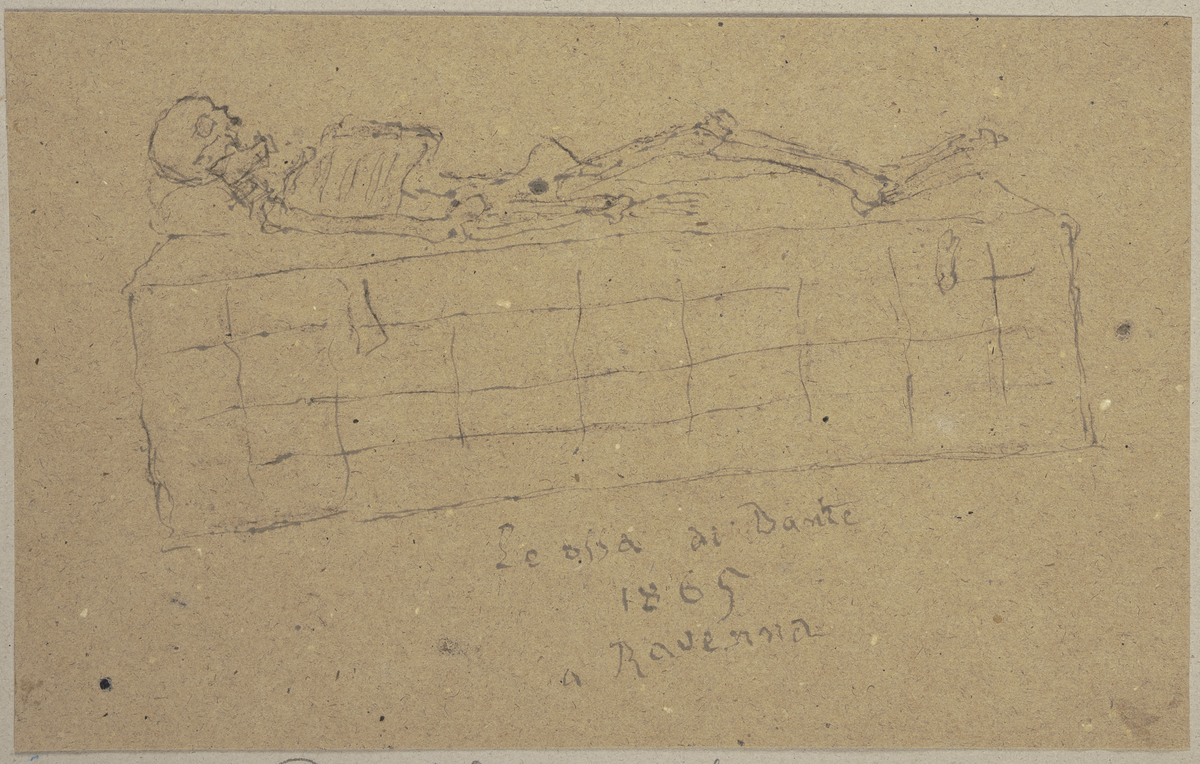
But Ravenna is not a museum. Dante Alighieri died here in 1321, and Florence still hasn't gotten his bones back — his modest tomb on Via Dante Alighieri burns an oil lamp lit with Florentine olive oil, delivered annually in a ceremony of quiet municipal guilt. The Basilica di San Francesco next door has a permanently flooded crypt where goldfish swim over submerged Roman mosaics. Artisans in workshops along Via Cavour still cut and set tesserae by hand, trained at schools whose graduates work on Vatican commissions. The mosaic tradition in Ravenna is not heritage; it is a living craft with an unbroken lineage.
The city sits at the crossroads of Romagnol peasant cooking and Adriatic seafood — piadina flatbread filled with runny squacquerone cheese at roadside kiosks, cappelletti in broth on Sunday, brodetto fish stew at canal-side restaurants near the old port. Ravenna is flat enough to cover entirely by bicycle, quiet enough that you can hear your own footsteps in the nave of Sant'Apollinare Nuovo, and confident enough in what it has that it doesn't bother competing with Florence or Venice for attention. It simply waits for you to show up and look.
The Mosaic Capital
Eight UNESCO-listed monuments hold the finest Byzantine mosaics outside Istanbul — gold-backed emperors in San Vitale, a midnight-blue starfield ceiling in Galla Placidia, and long processions of saints in Sant'Apollinare Nuovo. The craft is still alive: artisan studios on Via Cavour produce mosaics for Vatican commissions today.Dante's Final City
Dante Alighieri died here in 1321, and Florence has never gotten his bones back. His neoclassical tomb burns an eternal oil lamp, while nearby San Francesco — where his funeral was held — hides a flooded crypt where goldfish swim over submerged Roman mosaics.Ancient Pinewoods & Wetlands
The Pineta di Classe is the ancient umbrella-pine forest Dante wrote into Purgatorio. Flat cycle paths thread through it to the coast, and the lagoons north of town host flamingo colonies and flooded alder forests reachable by kayak.Romagna at the Table
This is piadina country — warm flatbread filled with squacquerone cheese and rocket, eaten standing at a piadineria counter. Pair it with local Sangiovese at Ca' de Ven, a 15th-century palazzo with vaulted ceilings that doubles as the city's most atmospheric wine bar.
Places to Visit
Not every monument, just the ones we'd walk you past ourselves.
-
Basilica of Sant'Apollinare in Classe Nestled in the serene locality of Classe, just a few kilometers south of Ravenna, Italy, the Basilica of Sant’Apollinare in Classe stands as a monumental…
-
Basilica of Sant'Apollinare Nuovo The Basilica of Sant’Apollinare Nuovo in Ravenna, Italy, stands as a remarkable testament to early Christian and Byzantine art and architecture, drawing…

-
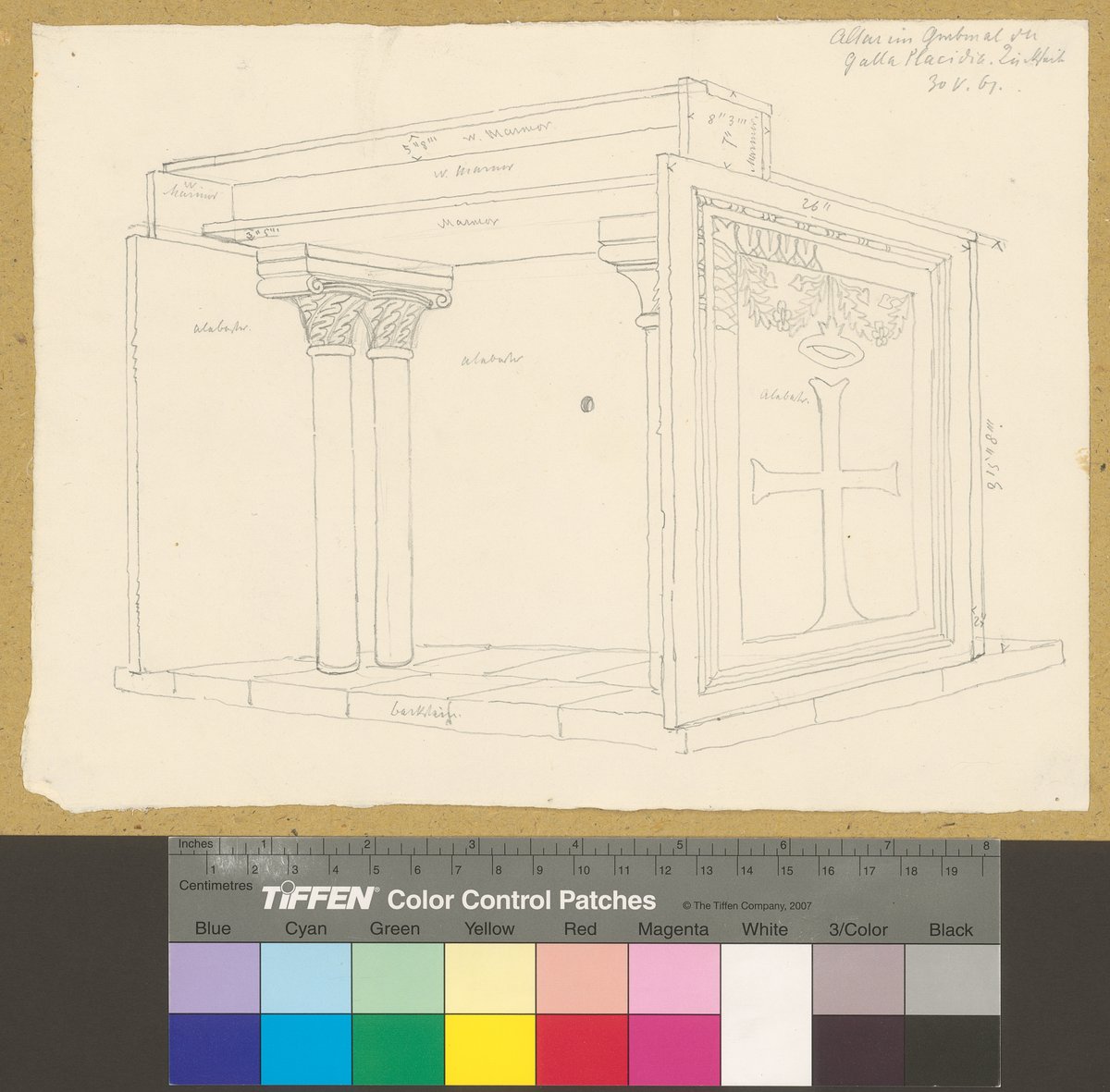
Mausoleum of Galla Placidia Nestled in the historic city of Ravenna, Italy, the Mausoleum of Galla Placidia stands as a captivating monument that bridges the grandeur of the late Roman…
-
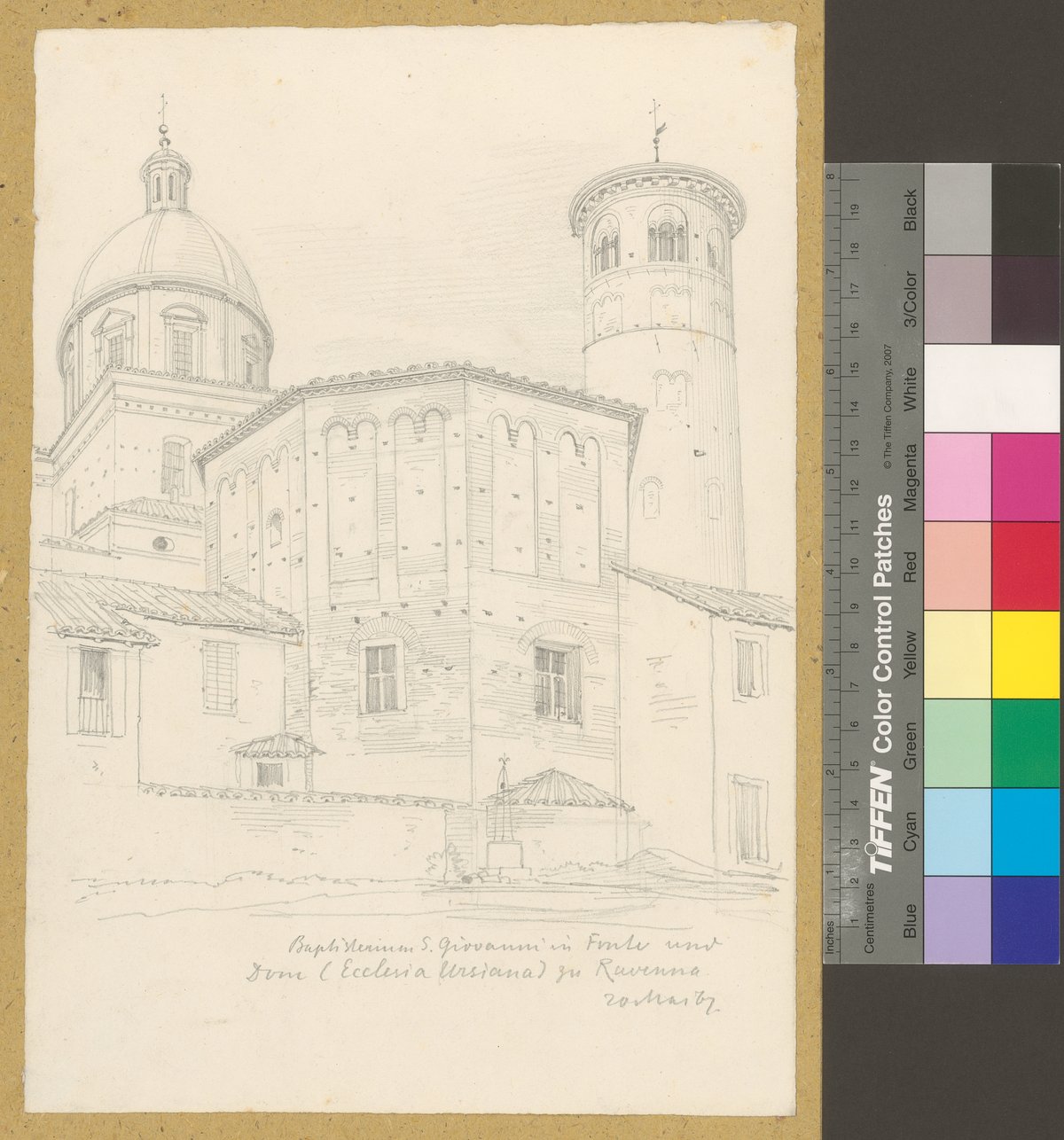
Ravenna Cathedral Ravenna Cathedral, officially known as the Metropolitan Cathedral of the Resurrection of Our Lord Jesus Christ (Cattedrale metropolitana della Risurrezione di…
-
Basilica Di San Francesco The Basilica di San Francesco in Ravenna, Italy, stands as a remarkable monument that encapsulates centuries of religious devotion, artistic heritage, and…

- Basilica of San Vitale The Basilica of San Vitale in Ravenna, Italy, stands as a remarkable monument of early Christian and Byzantine art and architecture, captivating visitors with…
- Archbishop'S Chapel, Ravenna Nestled in the historic heart of Ravenna, Italy, the Archbishop’s Chapel—also known as Cappella Arcivescovile or the Chapel of St.
- Early Christian Monuments of Ravenna Nestled in the Emilia-Romagna region of northeastern Italy, Ravenna stands as a beacon of early Christian and Byzantine art, celebrated worldwide for its…
- Arian Baptistry Nestled in the historic city of Ravenna, Italy, the Arian Baptistery stands as a remarkable testament to the religious, artistic, and political intricacies of…
Neighborhoods
Where to wander, by quarter — each with its own rhythm.
Centro Storico
The historic core radiates outward from Piazza del Popolo, where twin Venetian columns erected in 1483 still support marble statues of the city's patron saints. This is where the UNESCO monuments concentrate — San Vitale, Galla Placidia, the Neonian Baptistery, and Sant'Apollinare Nuovo all sit within a fifteen-minute walk of each other. The piazza itself is the nerve center of aperitivo culture: locals fill the café terraces from six o'clock onward, Spritz or Sangiovese in hand. Via Corrado Ricci leads past Ca' de Ven, a fifteenth-century palazzo with frescoed ceilings that serves what many consider the city's best piadina alongside pours of local wine.Via Dante & San Francesco Quarter
The streets around Via Dante Alighieri and the Basilica di San Francesco form a literary-historical pocket with a strange, meditative quality. Dante's neoclassical tomb sits in a small garden; the eternal lamp inside burns Florentine oil as a centuries-old act of municipal penance. Next door, San Francesco's flooded crypt — visible through a glass floor — is one of Ravenna's most surreal sights, goldfish drifting over fifth-century mosaics beneath a few feet of groundwater. The Museo Dantesco nearby holds the urn that once contained Dante's bones, smuggled away during the Napoleonic era. Quieter and more contemplative than the main tourist axis.Darsena
Ravenna's old inland port, about a kilometer east of the center, is the city's emerging creative district. Former industrial warehouses line the canal — the Artificerie Almagià, a vast converted factory, now hosts contemporary theater, electronic music, and experimental art. Street art covers the port walls. Aperitivo bars and seafood restaurants favored by the university crowd have colonized the waterfront, and the working commercial port remains visible from the quayside, lending the area a gritty authenticity that the mosaic quarter doesn't have. This is where young Ravennati actually spend their evenings.Via Cavour & the Mosaic Workshops
The streets around Via Cavour and its side lanes form the heart of Ravenna's living mosaic tradition. Walk slowly here and peer into workshop windows: you'll see artisans cutting tesserae and pressing them into plaster using techniques essentially unchanged since the sixth century. Studios like those of master mosaicist Giovanni Guerrini open by appointment; others sell finished pieces. The Accademia di Belle Arti and several private schools offer half-day workshops where visitors can try the craft themselves. Small mosaic 'repairs' to cracked pavement — playful street-art interventions by local artists — dot the sidewalks if you know to look down.Classe
Five kilometers south of the center, the suburb of Classe was once the Roman imperial harbor — Classis — where Augustus stationed his Adriatic fleet. The Basilica of Sant'Apollinare in Classe, consecrated in 549 AD, stands here almost alone in flat farmland, its round campanile visible from a distance. The apse mosaic of the Transfiguration is among the finest in existence, and on most days you'll have the nave nearly to yourself. The Classis Ravenna Museum, opened in 2019 inside a restored sugar factory, covers the city's entire history with exceptional English-language displays and a scale model of the vanished Roman port. The bike ride from the center runs through the Pineta di Classe — ancient umbrella pines that Dante described in Purgatorio.Marina di Ravenna & Porto Corsini
The beach settlement ten kilometers east of the center is where Ravenna meets the Adriatic. In summer, stabilimenti balneari (beach clubs) line the sand and some double as evening bars. But the real draw is the seafood: canal-front restaurants near Porto Corsini, where fishing boats tie up, serve brodetto and grilled catch-of-the-day to fishermen's families and those who know to come. No English menus, handwritten daily specials, and lunch service only at the most authentic spots. Reachable by bike on flat, dedicated paths in about forty minutes.Rocca Brancaleone & Parco Teodorico
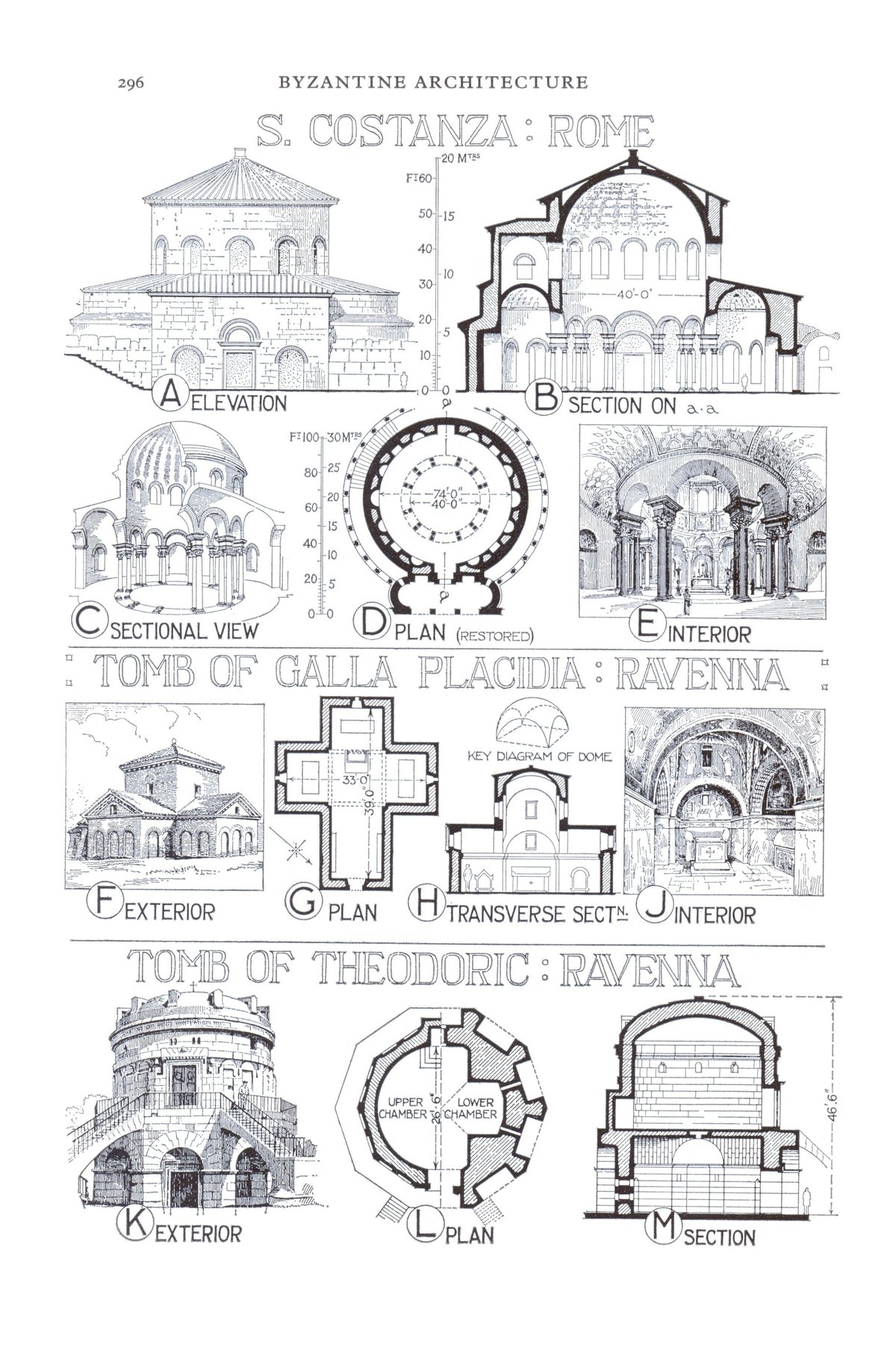
The northeastern edge of the center is defined by the fifteenth-century Venetian fortress of Rocca Brancaleone, whose interior has been converted into a public park where Ravennese families picnic on weekends. The ramparts offer the best elevated views over the city's low skyline. During the Ravenna Festival, the courtyard hosts outdoor concerts. Nearby, the Mausoleum of Theodoric — a unique two-story Ostrogothic structure capped by a single 300-tonne monolithic dome of Istrian limestone — sits in its own small park, a compelling monument to the barbarian king who made Ravenna his capital in 493 AD.Piazza Kennedy & Mercato Coperto
The less-photographed second square of Ravenna's center is where local daily life plays out with minimal tourist interference. The Mercato Coperto on Piazza Andrea Costa — the city's main covered market — is the place to buy squacquerone DOP, Mora Romagnola salumi, fresh cappelletti, and piadina from kiosk counters where locals eat standing up, flatbread wrapped in paper. Weekend farmers' markets bring producers from the Romagnol countryside. The surrounding streets along Via IV Novembre hold the city's workaday shops, good coffee bars, and the kind of piadina kiosks with lunchtime queues that tell you everything you need to know.
Plan your trip
Before you go
- Getting There
- Bologna Guglielmo Marconi Airport (BLQ) is the main gateway — take the People Mover to Bologna Centrale, then a regional train to Ravenna (75 min, roughly €8–12). Rimini Federico Fellini Airport (RMI) is closer but seasonal Ryanair only; direct trains run in under an hour for about €5–7. Ravenna's own train station sits 10 minutes' walk from San Vitale and has frequent regional connections to Bologna, Ferrara, and Rimini.
- Getting Around
- No metro or tram — you won't need them. The historic center is compact and dead flat, so cycling is genuinely the best way to move. Rent a bike near the station for €8–15/day and you can reach Sant'Apollinare in Classe (5 km south) via a dedicated pine-forest cycle path. START Romagna buses cover the city and coast; single rides cost about €1.50–2 from a tabaccheria. Buy tickets before boarding.
- Climate & Best Time
- Ravenna sits on the Po Valley plain: summers are hot and humid (30–31°C in July–August), winters cold and foggy (5–8°C highs, persistent nebbia December–February). The sweet spots are May and September — warm enough for cycling to the coast, uncrowded at the monuments, and with the best light through Galla Placidia's selenite windows. June–July brings the prestigious Ravenna Festival if you want concerts inside candlelit San Vitale.
- Language & Currency
- English works at monument ticket desks, hotels, and centro storico restaurants, but fades at tabaccherie, market stalls, and neighborhood bars. A few words of Italian — buongiorno, per favore, il conto — go further here than in Rome or Florence. Cards are accepted at most restaurants and all Ravenna Antica sites, but carry €50–80 cash for bus tickets, espresso, and piadina stands.
- Tickets & Passes
- The essential purchase is the Ravenna Antica 5-monument combined ticket (roughly €11.50) covering San Vitale, Galla Placidia, Sant'Apollinare Nuovo, the Neonian Baptistery, and the Archbishop's Chapel — valid 7 days. Book Galla Placidia's timed slot online in advance, especially April–June, when a €2 supplement applies. State-managed sites like Theodoric's Mausoleum and the Museo Nazionale run separate tickets (€4–8) and are often free the first Sunday of each month.
03 Top tickets in Ravenna.
Book ahead
Curated from places in this city. Same price as official sites.

Basilica Of San Vitale
Guided Tour of Mosaic Tiles in Ravenna
★4.8
from €28

Basilica Of San Vitale
Ravenna, the Most Beautiful Mosaics in the City of Paradise
★4.9
from €171

Mausoleum Of Galla Placidia
Ravenna: Mosaics and Highlights Guided Tour with Admission Ticket
★4.9
from €59

Basilica Of San Vitale
Wonderful Ravenna, visit 3 UNESCO sites with a local guide on a private tour
★5.0
from €280

Basilica Of Sant'Apollinare Nuovo
Ravenna Pass
★4.2
from €14.50

Mausoleum Of Galla Placidia
From Bologna or Ravenna Guided tour of the Mosaics in Ravenna
★4.5
from €60
Prices shown are indicative — final pricing and availability are confirmed at checkout. Audiala may receive a commission from bookings made via these links.
Capital of Empires That Refused to Die
From Augustus's war harbor to Dante's last refuge — 2,500 years in mosaic and marshland
- c. 31 BCE
Augustus Builds a War Harbor
Emperor Augustus chooses the marshlands south of Ravenna for one of Rome's two great naval bases: Classis, a port capable of sheltering 250 warships. A canal links the harbor to the Po delta, and a city that had been a backwater of pilings and fog becomes an imperial asset. The strategic logic is simple — the lagoon is nearly impossible to assault by land. That same logic will define Ravenna's fate for the next thousand years.
- 402
An Emperor Flees to the Swamp
With Alaric's Visigoths tearing through northern Italy, Emperor Honorius abandons Milan and transfers the entire Western Roman court to Ravenna. The decision is purely defensive — Milan sits exposed on the Lombard plain, while Ravenna hides behind miles of impassable marsh. It is a retreat disguised as a relocation, and it makes this modest Adriatic city the capital of an empire in freefall.
- c. 425
Galla Placidia, Empress in All but Name
Kidnapped by Visigoths, married to a barbarian king, widowed, returned, and now ruling the Western Empire as regent for her six-year-old son Valentinian III — Galla Placidia governs from Ravenna for over a decade. She commissions the small cross-shaped mausoleum that bears her name, its ceiling a field of deep lapis blue scattered with gold stars. Fifteen centuries later, the light inside still feels like entering a reliquary. She is never actually buried there — her body rests in Rome — but the building remains the oldest and most intimate of Ravenna's mosaic wonders.
- 476
The Last Emperor Is Deposed
On September 4, the Germanic general Odoacer deposes Romulus Augustulus — a teenager with an absurdly grandiose name — and sends him into comfortable exile near Naples. No one in Ravenna weeps for the boy. The Senate dispatches the imperial regalia to Constantinople. Historians will later call this the fall of the Western Roman Empire, though at the time it feels less like a collapse than a formality. Ravenna remains the seat of power, now under a barbarian king.
- 493
Theodoric's Banquet Betrayal
After a three-year siege that Ravenna's marshes made unbreakable, the Ostrogoth king Theodoric and the defender Odoacer agree to share power. At a reconciliation banquet on March 15, Theodoric draws his sword and kills Odoacer personally, reportedly remarking on the quality of the dead man's bones. It is the beginning of a 33-year reign that will transform Ravenna into one of the most magnificent cities in the Mediterranean — a golden age built on a murder at dinner.
- c. 500
A Palace Church Rises on the Via Regia
Theodoric builds Sant'Apollinare Nuovo as his personal palace chapel. Its nave walls carry long processional mosaics — Virgins approaching the Madonna, Martyrs advancing toward Christ — flanking earlier panels that depict Theodoric's palace and the port of Classis. These are rare documentary images of a vanished world: the king's colonnade, the harbor with its ships. When the Byzantines take the city decades later, they will scrub Theodoric's image from the palace mosaic but leave the architecture intact. The ghosts of erased figures are still faintly visible.
Show the full timeline (25 moments)
- c. 520
A 300-Tonne Dome, Carved Whole
Theodoric's mausoleum rises on the northern edge of the city — a two-story rotunda of pale Istrian limestone, capped by a single monolithic dome weighing roughly 300 tonnes. No one knows how it was quarried, transported, or lifted into place. The building has no mosaics, no gilding, nothing Byzantine about it — just raw stone and engineering audacity. It is the only surviving monument of its kind from the barbarian kingdoms, and it stands as an assertion that Theodoric's Goths could build to rival Rome.
- 524
Boethius Writes in Chains
The Roman philosopher Boethius — consul, senator, master of Theodoric's offices — is arrested on charges of treason and correspondence with Constantinople. Awaiting execution in a prison near Pavia, he writes The Consolation of Philosophy, a dialogue between himself and Lady Philosophy that will become one of the most copied, translated, and quoted books of the next millennium. Theodoric has him bludgeoned to death. The golden age curdles: within two years, Theodoric himself is dead, and his kingdom is unraveling.
- 547
San Vitale Blazes with Gold
On April 19, Archbishop Maximian consecrates the Basilica of San Vitale, seven years after Belisarius captured Ravenna for Constantinople. The octagonal interior erupts with gold-ground mosaics — but two panels flanking the altar seize the eye and never release it: Emperor Justinian on one side, Empress Theodora on the other, each surrounded by courtiers, each staring directly at the viewer across fifteen centuries. Neither ever set foot in Ravenna. The mosaics are political theology made permanent — authority projected through tesserae of glass and gold across a thousand miles of sea.
- 549
A Transfiguration in Green and Gold
Two years after San Vitale, the Basilica of Sant'Apollinare in Classe is consecrated five kilometers south, at the site of Augustus's old naval base. The apse mosaic replaces the figure of Christ with a jeweled cross floating in a gold sky above a green paradise where sheep graze among flowers. It is the most serene image in all of Ravenna — theological abstraction rendered as landscape. The harbor outside is already silting up. Within a century, the sea will be a memory here.
- 584
Ravenna Rules Byzantine Italy
With Lombard warbands controlling most of the peninsula, Constantinople creates the Exarchate of Ravenna — a military-civilian governorship unprecedented in Roman administrative history. The Exarch commands both the army and the civil service, a fusion of powers that previous emperors had always kept separate. Ravenna becomes the administrative capital of a shrinking Byzantine enclave, an island of Greek-speaking imperial authority surrounded by Germanic kingdoms. The arrangement will last 167 years.
- 751
The Exarchate Falls
Lombard King Aistulf captures Ravenna in June, ending 167 years of Byzantine rule and extinguishing Constantinople's presence in northern Italy for good. The consequences ripple far beyond the city walls: without a Byzantine protector, Pope Stephen II turns to the Franks for help — a desperate gambit that will reshape European power for centuries. Ravenna's long tenure as an imperial capital is over. It will never govern an empire again.
- 774
Charlemagne Copies the Masterpiece
After conquering the Lombard kingdom, Charlemagne visits Ravenna and is stunned by San Vitale's octagonal geometry. He orders his palace chapel at Aachen built on the same plan — same proportions, same ambulatory, same vertigo of interior space. He also removes Theodoric's equestrian statue and ships it north. It is the sincerest and most consequential flattery in architectural history: the defining monument of the Carolingian Renaissance is a copy of a building in a silted-up Adriatic backwater.
- 1321
Dante Dies in Exile
On the night of September 13, Dante Alighieri dies in Ravenna at age 56, returning from a diplomatic mission to Venice through the malarial marshes of the Po Delta. He has lived here three years under the protection of Guido Novello da Polenta, finishing Paradiso in a city whose mosaics — those vast gold heavens inside San Vitale and Galla Placidia — may have shaped his vision of divine light. Florence, the city that condemned him to burn, immediately demands his bones. Ravenna refuses. It has refused every request since — for seven hundred years.
- 1441
Venice Takes the City
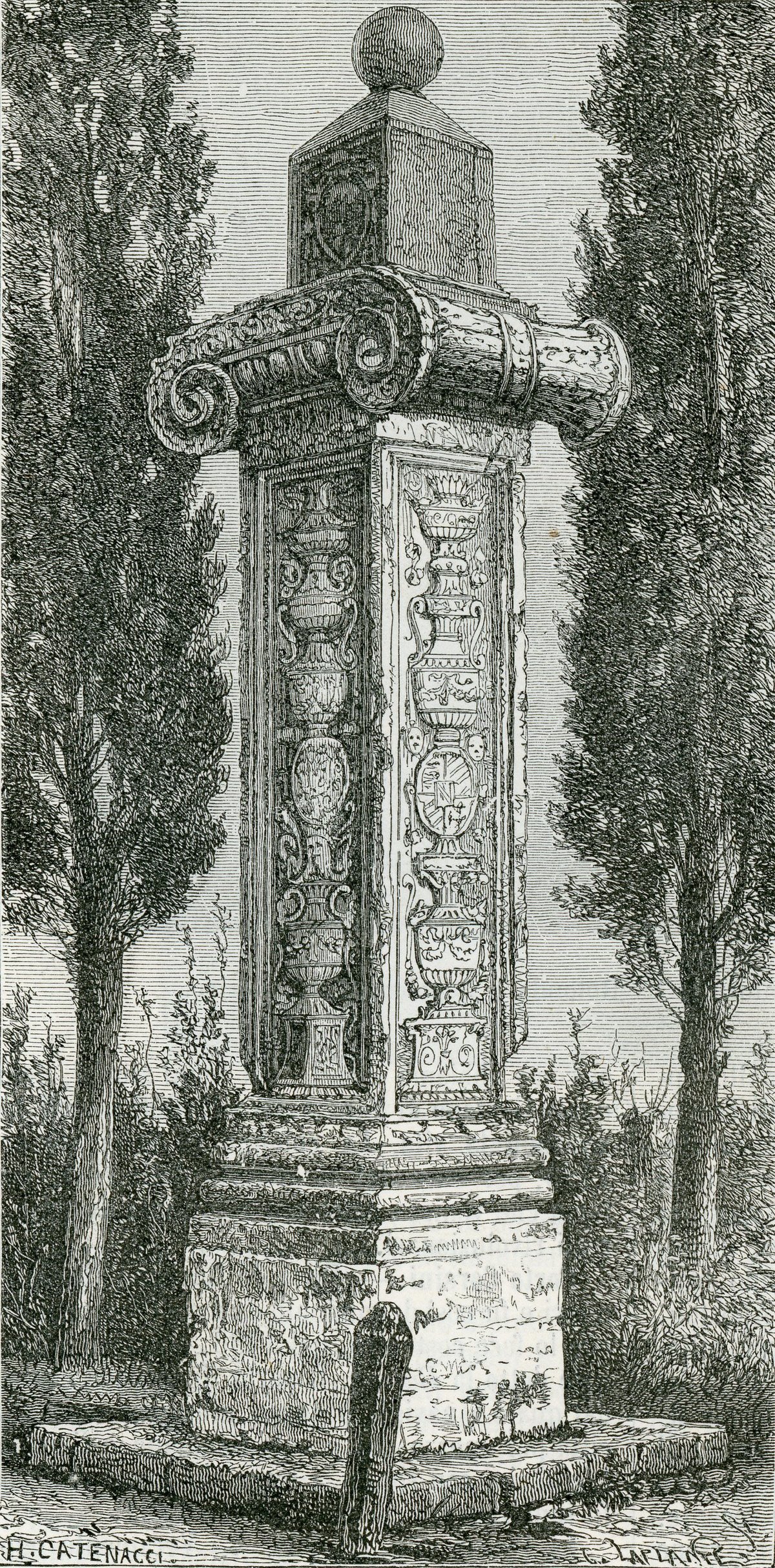
The da Polenta lords, who sheltered Dante and ruled Ravenna for over two centuries, lose power as Venice absorbs the city into its mainland empire. The Venetians reshape the Piazza del Popolo, raising twin columns topped with statues of Saints Vitale and Apollinare — a conscious echo of the famous columns in Venice's Piazzetta. Ravenna gains access to Venetian trade networks but becomes a provincial footnote in the Serenissima's ledger books.
- 1512
The Bloodiest Battle of the Italian Wars
On Easter Sunday, April 11, French forces under the 23-year-old Gaston de Foix smash a Spanish-papal army outside Ravenna's walls in one of the deadliest engagements Europe has seen in centuries — perhaps 10,000 to 20,000 dead in a single day. Gaston himself is killed in the moment of victory, cut down while pursuing fleeing Spaniards. The victorious French army sacks the city. Ravenna recovers slowly and passes back to the Papal States, where it will remain for nearly three centuries of quiet obscurity.
- 1519
The Monks Hide Dante's Bones
Pope Leo X authorizes Florence to reclaim Dante's remains at last. When Florentine envoys open the tomb, they find it empty. Franciscan monks at San Francesco have spirited the bones into a hole in the monastery wall, hidden behind a false panel. Florence's commissioned tomb in Santa Croce remains a cenotaph — an elaborate monument to an absence. The bones will stay concealed for 346 years.
- 1819
Byron Follows His Lover to Ravenna
Lord Byron arrives in Ravenna in December, trailing the 19-year-old Countess Teresa Guiccioli. He moves into the Palazzo Guiccioli, fills it with monkeys, foxes, birds, and a wolf, and enters the most productive phase of his career — Don Juan, Sardanapalus, Cain, all written here. He rides daily through the coastal pinewoods, visits Dante's tomb, and stores weapons for the Carbonari revolutionaries in his basement. He calls the city 'the most dreary I have seen' but cannot leave. The pines, the mosaics, the conspiracy — something holds him nearly two years.
- 1849
Anita Garibaldi Dies in the Marshes
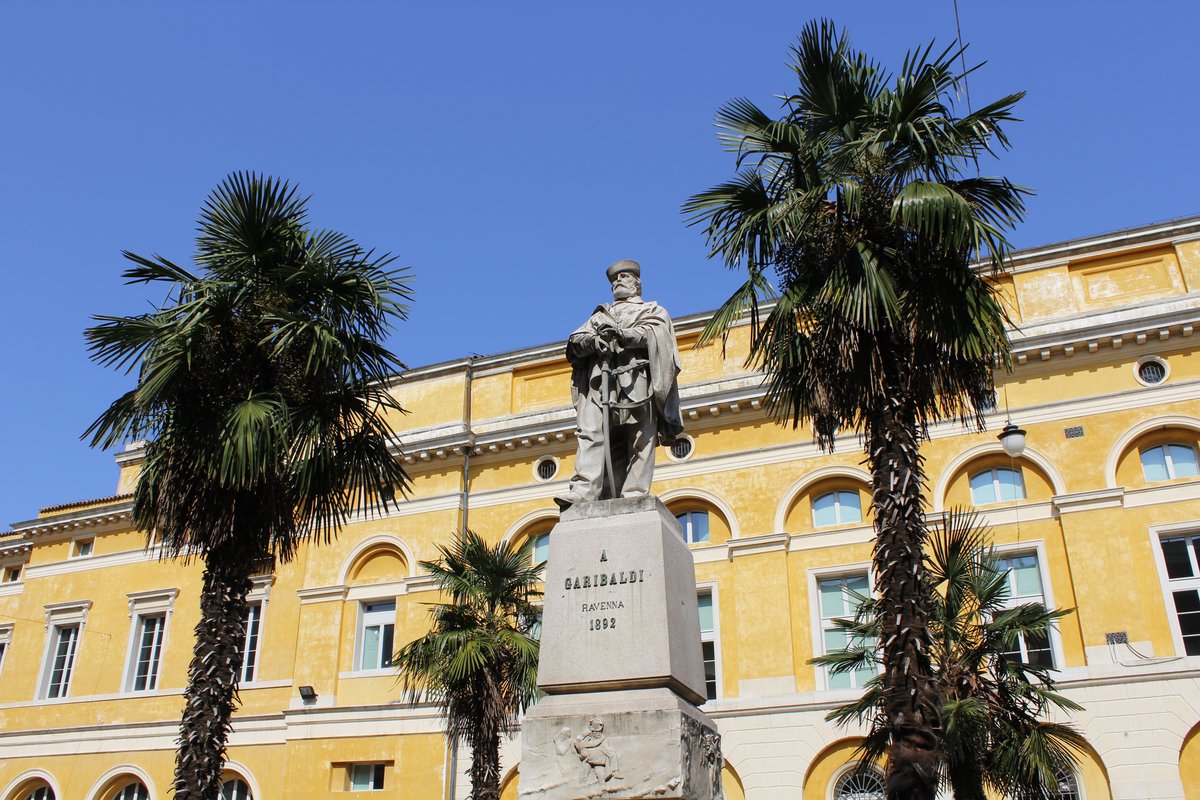
On August 4, Anita Garibaldi — pregnant, burning with malaria — dies in a farmhouse at Mandriole, south of Ravenna, during the desperate retreat following the fall of the Roman Republic. Her husband Giuseppe barely escapes the Austrian dragnet, hidden by sympathetic locals in the same marshes and pine forests that once protected emperors. Anita becomes one of the Risorgimento's great martyrs. A monument to her stands in Ravenna today.
- 1865
Dante's Bones Found in a Wall
During renovation work at the former Franciscan monastery beside San Francesco, workmen break through a wall and find a wooden box containing human remains. Inside: the bones hidden by monks in 1519, with a Latin inscription confirming their identity. The discovery electrifies the nation, arriving just in time for the 600th anniversary of Dante's birth. Italy's greatest poet is ceremonially reinterred in Ravenna. Florence sends olive oil for the tomb's eternal lamp — a gesture of contrition that continues to this day.
- 1944
Canadian Troops Liberate Ravenna
On December 4–5, soldiers of the 1st Canadian Corps — Royal Canadian Hussars among them — fight their way across the Lamone and Montone rivers against fierce German resistance and enter Ravenna. The city's mosaic monuments survive the war largely intact, though Allied bombing has damaged the rail junction and surrounding neighborhoods. A Commonwealth war cemetery with 956 graves now stands outside the city, a quiet Canadian corner in the Romagna flatlands.
- 1990
Ravenna Festival Is Born
Under the artistic vision of Cristina Mazzavillani Muti, the Ravenna Festival launches as an international celebration of opera, classical music, and dance, staged in the city's basilicas and historic spaces. The acoustics inside San Vitale during a summer concert — sound reverberating off gold mosaic under an octagonal dome — are unlike anything else in Italy. The festival grows into one of the country's most prestigious cultural events, held annually in June and July.
- 1996
UNESCO Crowns Eight Monuments
The 'Early Christian Monuments of Ravenna' — all eight of them, from Galla Placidia's mausoleum to Sant'Apollinare in Classe — are collectively inscribed as a World Heritage Site. The citation recognizes Ravenna as the supreme example of early Christian and Byzantine mosaic art in Western Europe. Tourism surges. A city that spent centuries as a provincial afterthought begins to reclaim its place in the European imagination.
- 2019
An Old Sugar Factory Becomes a Museum
The Classis Ravenna Museum opens inside a restored Eridania sugar factory at Classe, telling the story of Augustus's ancient naval port through interactive archaeology. Amphorae from Spain, glass from the Aegean, coins from across the Mediterranean — the objects reconstruct a cosmopolitan harbor city that vanished when the Adriatic retreated. It is one of the largest archaeological museums in Emilia-Romagna and among the most undervisited major museums in Italy.
- 2023
The Floods Return to the Lowlands
In May, catastrophic flooding strikes Emilia-Romagna — the worst in decades. Rivers overflow across the region; Ravenna province, low-lying and laced with waterways, is among the hardest hit. At least 15 people die across the region, thousands are evacuated, and damages reach hundreds of millions of euros. The same geography that once made Ravenna impregnable — marshes, rivers, proximity to the sea — now makes it dangerously vulnerable to a warming climate.
Who lived here
-
Poet · 1265–1321
Dante Alighieri
Died and buried here
Exiled from Florence in 1302, Dante spent his final three years in Ravenna under the protection of Guido Novello da Polenta, finishing Paradiso in a city whose gold mosaics must have felt like rough drafts of the paradise he was describing. He died on September 14, 1321, returning from a diplomatic mission to Venice, and was buried beside the church of San Francesco. Florence has been asking for his bones back ever since — Ravenna has refused every time, and the quiet neoclassical tomb with its eternally lit oil lamp remains the city's most emotionally loaded ten minutes.
-
King of the Ostrogoths · c. 454–526
Theodoric the Great
Ruled from Ravenna 493–526
Theodoric arrived in Ravenna in 493 over the body of Odoacer — literally, having killed him at a banquet — and then governed Italy with such administrative sophistication that historians still argue whether to call him a barbarian. He built Sant'Apollinare Nuovo, the Arian Baptistery, and raised his own mausoleum from a single 300-tonne block of Istrian limestone. His 33-year reign is still called Ravenna's golden age, which makes the irony of him executing Boethius, the greatest philosopher of the era, all the more difficult to explain.
-
Empress, Imperial Regent · c. 388–450
Galla Placidia
Ruled from Ravenna; commissioned her mausoleum here
Daughter of one emperor, sister of another, mother of a third — Galla Placidia's biography tests the limits of the dynastic genre. She commissioned the mausoleum bearing her name around 425 AD, filling it with the deepest blue ceiling mosaic you will ever stand under, a field of gold stars pressing down in near-darkness. She didn't actually end up buried there — she died in Rome and was interred in Constantinople — but the building took her name anyway, and it has held it for sixteen centuries.
-
Byzantine Emperor · 482–565
Justinian I
Reconquered Italy; commissioned San Vitale
The emperor who reconquered Italy and made Ravenna the capital of the Byzantine Exarchate never once set foot in the city. His famous mosaic portrait in San Vitale — gold-robed, frontal, expressionless — was commissioned to make it look as if he had, an act of imperial projection across 2,000 kilometers. It worked more durably than most actual visits: 1,500 years later, his face is still the first thing you see when you enter the apse, staring down at tourists from a ceiling he never stood beneath.
-
Byzantine Empress · c. 500–548
Theodora
Depicted in the companion mosaic at San Vitale
Former circus performer, daughter of a bear-keeper, eventually the most powerful woman in the medieval Mediterranean — Theodora also never visited Ravenna, but her mosaic in San Vitale is arguably more arresting than her husband's. She stands in full imperial regalia, flanked by her court, offering a jeweled chalice, her eyes locked directly on yours across fifteen centuries. Procopius, who despised her and wrote a secret history cataloguing her vices, still couldn't make her less magnetic.
-
Poet · 1788–1824
Lord Byron
Lived in Ravenna 1819–1821
Byron arrived in Ravenna in 1819 chasing Teresa Guiccioli, a local noblewoman half his age, and stayed two years — one of his most productive stretches. He wrote cantos III through V of Don Juan here, visited Dante's tomb repeatedly, and noted that no one in the city seemed to find his presence particularly remarkable. 'I have been familiar with ruins too long to dislike desolation,' he wrote; Ravenna, with its collapsed empires and surviving gold, suited him exactly.
-
Philosopher, Statesman · c. 477–524
Boethius
Served at Theodoric's court in Ravenna; executed here
Boethius served Theodoric the Great as Master of Offices — effectively prime minister of Italy — and was rewarded with a treason accusation and execution. He wrote The Consolation of Philosophy while awaiting death, producing one of the most widely read books of the entire Middle Ages, a meditation on fortune's wheel written by a man whose wheel had just broken. That it was written for a man killed by the very king whose court he had served gives the argument a sharpness no philosophical distance can blunt.
Where to Eat
Where locals actually book dinner — not the tourist menus.
Insider tips
Small things that change how the city treats you.
Book Galla Placidia Early
The Mausoleum of Galla Placidia requires timed entry in peak season and sells out — book online via ravennantica.org before you arrive, especially May through August.Morning Light, Always
The gold tesserae in San Vitale were set at deliberate angles to catch raking light — go at opening (9:00) on a sunny morning and the apse glows in a way that afternoon visitors simply don't see.Rent a Bike
Ravenna is flat and compact; Sant'Apollinare in Classe (5 km south), the Darsena canal district, and Marina di Ravenna are all reachable by bike — this is how locals actually move around the city.Use the Combined Ticket
The 'Cinque Monumenti' ticket (~€11.50) covers San Vitale, Galla Placidia, the Neonian Baptistery, the Archbishop's Chapel, and Sant'Apollinare Nuovo — buy it at any of the five sites to avoid queuing at each one separately.Walk One Block Further
The restaurants immediately adjacent to San Vitale are tourist traps; walk one block in any direction and prices drop, menus are shorter, and the clientele is local.Piadina at a Kiosk
Locals eat piadina standing up at a chiosco — look for the kiosks near the Mercato Coperto on Piazza A. Costa; a serious one uses lard (strutto), not olive oil, and will have a queue.Don't Skip Classe
Sant'Apollinare in Classe (5 km south) has the most spectacular apse mosaic in Ravenna and almost no tourists; the ride through the ancient Pineta di Classe pine forest — the same forest Dante described in Purgatorio — is reason enough on its own.Come in May or September
May and September are the local sweet spot — good weather, the Ravenna Festival is on or just ending, and summer crowds haven't arrived or have just left; July and August bring heat and long queues at Galla Placidia.
Frequently asked
Is Ravenna worth visiting?
Yes — unambiguously. Eight UNESCO World Heritage Sites sit within a single walkable city center, and the 6th-century mosaics in San Vitale and Sant'Apollinare Nuovo are among the finest surviving works of art in Western civilization, not just Italy. Dante is buried here. Lord Byron lived here. It's a city that quietly contains more history per square kilometer than almost anywhere in Europe.
How many days do you need in Ravenna?
Two days is enough to see all eight UNESCO monuments plus Dante's tomb and the Domus dei Tappeti di Pietra. Three days lets you add Sant'Apollinare in Classe, the Classis museum, an evening in the Darsena district, and a bike ride through the Pineta di Classe — which is the version locals would recommend.
How do you get to Ravenna from Bologna?
Train from Bologna Centrale takes about 1 hour 15 minutes; from Ferrara it's around 45 minutes. Ravenna has no major airport — the nearest are Bologna (BLQ) and Rimini (RMI). The city center is compact enough to walk or cycle once you arrive; renting a bike from the station is the local move.
Is Ravenna expensive to visit?
Affordable by Italian standards. Dante's tomb is free; the Arian Baptistery and Rocca Brancaleone park are also free or near-free. The five-monument combined ticket is around €11.50. A trattoria lunch with pasta and wine runs €15–22 per person. The main budget item is accommodation, which is more limited than in Bologna or Florence.
When is the Ravenna Festival?
The Ravenna Festival runs June through July and features international-caliber classical music, opera, and dance — including concerts held inside San Vitale itself. Founded in 1990 and long associated with conductor Riccardo Muti, it's a genuinely world-class event in a small city; headline concerts sell out months in advance. Check ravennafestival.org for the annual program.
Can you do Ravenna as a day trip from Bologna?
Technically yes — the train takes just over an hour each way. But a day trip means you'll be rushing the mosaics and skipping Classe entirely, and you'll miss the city at the quieter hours (early morning in San Vitale, evening aperitivo in the Darsena) when it's most itself. One night is significantly better than none.
Is Ravenna safe for tourists?
Yes — it's a quiet, mid-sized Italian university city with a very low crime rate. The historic center is walkable at night; the Darsena area is slightly grittier but not unsafe. Standard Italian urban precautions apply: watch bags in crowded areas and don't leave valuables visible in a parked car.
What food is Ravenna known for?
Ravenna sits between inland Romagna and the Adriatic coast, so the food pulls in both directions: cappelletti in brodo and passatelli (Romagnol egg-pasta tradition) compete for table space with brodetto di pesce (local Adriatic fish stew) and fresh clams. Piadina — the Romagnol griddled flatbread with squacquerone cheese and prosciutto — is the daily staple. The local wine is Sangiovese di Romagna, lighter and rougher than its Tuscan cousin, very cheap locally.
All Places to Visit.
35 places to discover
Place
Basilica of Sant'Apollinare in Classe
Place
Basilica of Sant'Apollinare Nuovo
Place
Mausoleum of Galla Placidia
Place
Archbishop'S Chapel, Ravenna
Place
Early Christian Monuments of Ravenna
Place
Arian Baptistry
Place
Ravenna Cathedral
Place
Basilica Di San Francesco
Place
Mausoleum of Theodoric

Place
Baptistry of Neon
Place
Dante Alighieri'S Tomb
Place
Civitas Classis
Place
Stadio Bruno Benelli
Place
Pala De André

Place
Teatro Comunale Dante Alighieri
Place
Port of Ravenna

Place
Eurowheel
Place
Biblioteca Del Museo Ornitologico E Di Scienze Naturali
Place
Casa Capra
Place
Casa Del Monte Di Pietà
Place
Casa Fabri
Place
Casa Zabberoni
Place
Colonna Dei Francesi
Place
Monument to Pier Paolo D'Attorre
Place
Monumento a Giuseppe Garibaldi
Place
Monumento Ad Anita Garibaldi
Place
Museo Dantesco
Place
Palazzo Comunale
Place
Palazzo Dei Rasponi Del Sale
Place
Palazzo Guaccimanni
Place
Porta Nuova Dei Veneziani
Place
Quadrarco Di Braccioforte

Place
Ravenna Airport
Place
Torre Civica
Pick up where you left off
Saved and recently read places — kept on this device only.
Photo credits (1)
- Alberto Z — Pexels License (https://www.pexels.com/license/) — Source: https://www.pexels.com/photo/28275625/
Photos may have been resized or cropped.