Introduction
Porta Felice is one of Palermo’s most significant historical landmarks, serving as a majestic gateway between the city’s ancient heart and the Mediterranean Sea. Erected across five decades (1582–1637), the gate stands at the seaward end of Via Vittorio Emanuele (formerly Cassaro), symbolizing the city’s openness, resilience, and cultural richness. Commissioned by Spanish Viceroy Marcantonio Colonna and named after his wife, Donna Felice Orsini, Porta Felice is both an architectural masterpiece and a living testament to Palermo’s layered history (Comune di Palermo; sicile-sicilia.net).
This comprehensive guide details Porta Felice’s history, architecture, visiting hours, ticket information, accessibility, and nearby attractions—offering all you need to plan your visit and appreciate this iconic monument.
- History and Construction Timeline
- Architectural Features and Artistic Details
- Urban Role and Symbolic Significance
- Restoration and Preservation
- Visiting Porta Felice: Hours, Tickets & Accessibility
- Nearby Attractions
- Travel Tips and Practical Information
- Frequently Asked Questions (FAQ)
- Conclusion
- References
History and Construction Timeline
Porta Felice’s origins date back to 1582, when Spanish Viceroy Marcantonio Colonna commissioned its construction to mark the ceremonial entrance to Palermo from the sea. The gate was named after his wife, Felice Orsini—a reflection of the era’s blend of personal dedication and political symbolism (Comune di Palermo).
The project experienced several interruptions due to political and financial difficulties. Work resumed in 1602 under architect Mariano Smiriglio, who infused late Renaissance and emerging Baroque styles into the design. The final construction phase, overseen by Vincenzo Tedeschi, concluded in 1637, resulting in a structure that elegantly bridges Renaissance order with Baroque grandeur (sicile-sicilia.net).
Architectural Features and Artistic Details
Dual Facades and Stylistic Dialogue
Porta Felice is renowned for its dual façades:
-
Seaward Façade: Clad in luminous marble, this side is richly ornamented with columns, niches, balustrades, and heraldic emblems. The addition of two fountains in 1642 further enhanced its grandeur. Designed to impress visitors arriving by sea, it reflects Baroque exuberance (evendo.com; L’Eco della Verità).
-
City-Facing Façade: More restrained, this side employs Renaissance and late Mannerist motifs—classic pilasters, aedicules, and ovoid windows—harmonizing with the city’s historic urban fabric (Comune di Palermo).
Sculptural and Heraldic Details
Porta Felice is adorned with:
- Heraldic Shields: Displaying coats of arms of the Spanish monarchy and the Colonna family, affirming the gate’s political associations.
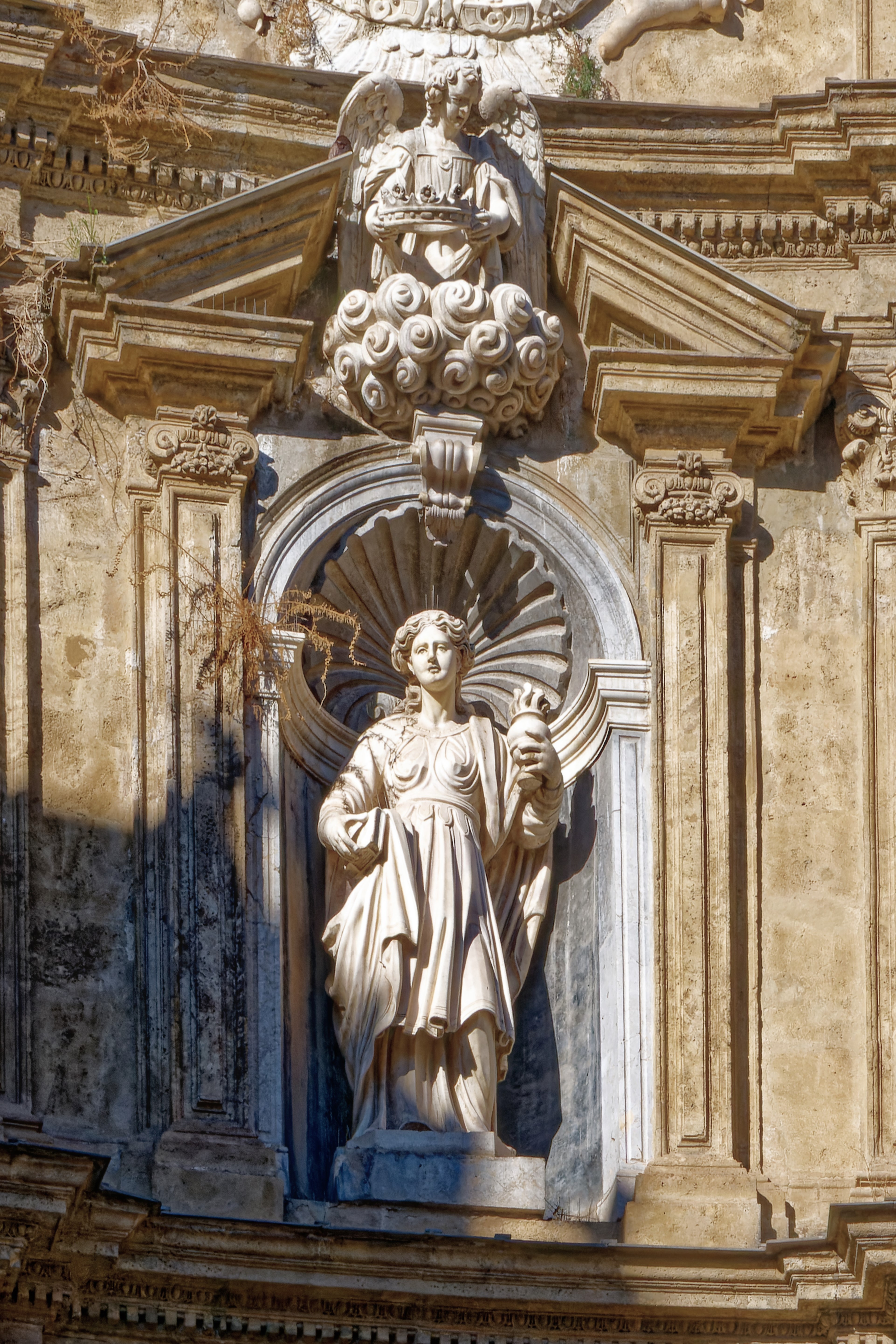
- Statues of Santa Ninfa and Santa Cristina: The seaward-facing statues symbolize the city’s spiritual guardianship (wikipedia.org).
- Allegorical Reliefs: Festooned with floral, grotesque, and maritime motifs, reflecting Palermo’s prosperity and cultural openness (evendo.com).
Urban Role and Symbolic Significance
Gateway to the City and the Sea
Strategically positioned at the eastern end of Via Vittorio Emanuele, Porta Felice is more than a decorative entrance—it is an urban threshold linking Palermo’s historic core to the Mediterranean. Its twin, Porta Nuova, anchors the opposite end near the Norman Palace, forming a monumental axis through the old town (italyscapes.com; theorangebackpack.nl).
Social and Civic Life
For centuries, Porta Felice played a central role in Palermo’s public rituals:
- Aristocratic Promenades: The gate was the starting point for evening strolls along the Marina during the 18th and Belle Époque eras.
- Religious Processions: Most notably, the Festino di Santa Rosalia—Palermo’s major annual festival—culminates at Porta Felice with grand processions, music, and fireworks (Italia.it; palermoantica.com).
Integration with Green and Public Spaces
Porta Felice’s immediate proximity to the Foro Italico and Villa Giulia gardens enhances its role as a connector between Palermo’s urban core and recreational waterfront (cooltourismical.com).
Restoration and Preservation
Porta Felice has faced wartime destruction and natural deterioration—most notably, the right pylon was heavily damaged during World War II. Restoration campaigns, particularly in the postwar decades, have preserved much of its original structure and decorative features, though not all elements (such as the planned obelisks) were completed (palermoantica.com; Comune di Palermo).
Today, Porta Felice stands as a protected monument, symbolizing both Palermo’s historical resilience and its commitment to preserving cultural heritage.
Visiting Porta Felice: Hours, Tickets & Accessibility
- Visiting Hours: Porta Felice is an open-air monument, accessible 24/7. For the most atmospheric experience and best photography, visit early in the morning or late in the afternoon (Sicile-Sicilia).
- Tickets: There is no entrance fee; access is entirely free.
- Accessibility: The area around Porta Felice is pedestrian-friendly and mostly flat, suitable for wheelchairs and strollers. Some nearby streets have cobblestones, so comfortable footwear is recommended.
- Guided Tours: Many Palermo walking tours include Porta Felice. Booking a tour provides in-depth historical context (evendo.com).
- Location: Piazza Santo Spirito, 90133 Palermo, Italy. Easily reached on foot from the city center, or via public transport from Palermo Centrale station (about 1.5 km).
Nearby Attractions
Porta Felice’s location makes it a natural hub for exploring Palermo’s historic and cultural highlights:
- Foro Italico: Expansive seafront promenade ideal for walks and panoramic views.
- La Cala: Picturesque harbor area, perfect for a leisurely stroll or waterfront dining (One World Beyond Borders).
- Kalsa District: Historic neighborhood with Arab-Norman architecture, vibrant street art, and lively markets.
- Villa Giulia: Palermo’s serene public park, ideal for relaxation (Trivago).
- Piazza Marina and Garibaldi Garden: Home to Europe’s largest ficus tree.
- Palermo Cathedral, Norman Palace, Palazzo Abatellis: All within walking distance, offering further insights into Palermo’s layered history.
Travel Tips and Practical Information
- Best Times to Visit: Spring and autumn offer pleasant weather. Early morning and late afternoon visits provide soft lighting for photos and a tranquil atmosphere.
- Festivals: If visiting in July, experience the Festino di Santa Rosalia, when Porta Felice becomes the focal point of city-wide celebrations (Italia.it).
- Amenities: Cafés, restaurants, and shops abound in the Kalsa district and along Via Vittorio Emanuele. There are no dedicated facilities at the monument itself.
- Accommodation: Hotel Porta Felice & Spa and other nearby hotels offer convenient lodging options.
Frequently Asked Questions (FAQ)
Q: Is there an entrance fee to visit Porta Felice?
A: No, Porta Felice is a public monument and free to visit at any time.
Q: What are Porta Felice’s opening hours?
A: The gate is accessible 24/7; for safety and ambiance, visit during daylight or early evening.
Q: Are guided tours available?
A: Yes, many local operators include Porta Felice in their historical walking tours.
Q: Is the area around Porta Felice wheelchair accessible?
A: Yes, the monument is accessible, though some cobblestone streets nearby may require caution.
Q: How do I get there by public transport?
A: Palermo Centrale station is 1.5 km away; several city buses stop nearby.
Listen to the full story in the app
Your Personal Curator, in Your Pocket.
Audio guides for 1,100+ cities across 96 countries. History, stories, and local insight — offline ready.
Audiala App
Available on iOS & Android
Join 50k+ Curators
Sources
- verified
- verified
- verified
- verified
- verified
- verified
- verified
- verified
Last reviewed: