Plan and listen to Santa Caterina A Formiello with Audiala.
Audio guide in your pocket, itinerary in your browser. Built for the way you actually visit.
Introduction: History and Cultural Significance
Santa Caterina a Formiello, standing just beyond the ancient Aragonese walls near Porta Capuana, is a prime example of Naples’ Renaissance and Baroque heritage. Founded in the late 15th century, the church weaves together layers of religious devotion, noble patronage, and artistic achievement. Originally managed by the Celestine Order and subsequently by the Dominican Congregation of Lombardy, it reflects the city’s shifting spiritual and civic dynamics (donight.it; Visit Naples).
Architecturally, the church is notable for its pioneering Renaissance dome—one of Naples’ first—designed under the influence of Romolo Balsimelli, and for its harmonious Latin cross plan. Over centuries, it evolved with Baroque embellishments from artists like Luigi Garzi and Paolo De Matteis, creating a vibrant fusion of styles (renatoprosciutto.com; Wikipedia).
Religiously, Santa Caterina a Formiello is revered as the sanctuary of the Martyrs of Otranto—813 Christians martyred in 1480, whose relics are enshrined within. This narrative of sacrifice and faith adds a layer of solemnity, making the church a significant pilgrimage destination (Fodor’s; Touring Club Italiano).
Today, its cloisters host contemporary exhibitions and community events, reinforcing its role as a living monument in Naples’ vibrant urban fabric (Visit Naples; Eventbrite).


Origins and Early Development
Santa Caterina a Formiello traces its roots to the late 15th century, when a modest church dedicated to Saint Catherine of Alexandria stood just outside Naples’ city walls. Managed by the Celestine Order, its strategic location near the Bolla aqueduct (the “formi”—hence “Formiello”) underscores its importance in both spiritual and civic life (renatoprosciutto.com).
In 1499, King Frederick of Aragon granted the site to the Dominicans of the Reformed Congregation of Lombardy, initiating a significant expansion and architectural transformation (Wikipedia).
Dominican Custodianship and Noble Patronage
The Dominicans, renowned for their scholarship and influence during the Counter-Reformation, oversaw the construction of the present church beginning around 1510. The project received patronage from Naples’ nobility, notably the Acquaviva d’Atri, Sanseverino di Bisignano, and Spinelli di Cariati families. The Spinelli family’s involvement was so significant that they secured a dedicated chapel within the presbytery (Wikipedia; renatoprosciutto.com).
Architectural Evolution
Renaissance Foundation
The church’s design, attributed to Antonio Fiorentino della Cava and executed by Romolo Balsimelli, embodies Renaissance ideals: a Latin cross plan, harmonious proportions, and an innovative dome—Naples’ first of its kind. The adjoining cloister, completed in 1514, features double arcades with Ionic capitals, exemplifying early 16th-century Neapolitan architecture (Wikipedia).
Baroque Embellishments
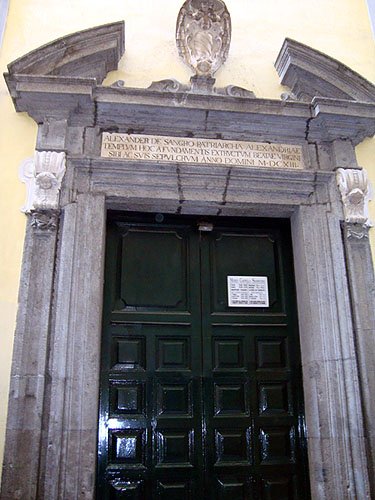
The 17th and 18th centuries saw extensive Baroque enhancements. Architect Francesco Antonio Picchiatti redesigned the portal (1655–1659), while Luigi Garzi’s frescoes (1695–1697) and Paolo De Matteis’s dome painting (1712) enriched the interiors with vibrant narratives from the lives of Saint Catherine and Naples’ patron saints (donight.it; Wikipedia).
Religious and Civic Significance
The Martyrs of Otranto
Santa Caterina a Formiello houses the relics of the Martyrs of Otranto—813 Christians who were executed in 1480 for refusing to renounce their faith. Their remains, enshrined in a side chapel, have made the church a pilgrimage destination and a powerful symbol of spiritual resilience (Fodor’s; Touring Club Italiano).
Dominican Intellectual Hub
In the 17th century, the complex included a renowned pharmacy, a rich library, and a cabinet of curiosities, underpinning the Dominicans’ role in Neapolitan intellectual and artistic life (donight.it).
Artistic and Architectural Highlights
- Façade: Renaissance sobriety with a Baroque marble portal (Picchiatti, 1659). The sculpted figure of Saint Catherine stands above the entrance (Itinerari della Campania).
- Interior: Latin cross plan, single nave, and side chapels adorned with 16th–18th-century art.
- Dome: Frescoed by Paolo De Matteis, depicting Madonna, Saint Catherine, and local saints.
- Chapels: The Spinelli family chapel with late 16th-century tombs; fifth chapel on the left features Giacomo del Po’s cycle of Saint Catherine’s life (Wikipedia).
- Frescoes: Luigi Garzi’s “Martyrdom and Marriage of Saint Catherine of Alexandria” (1695–1697) on the counterfaçade; Borremans’ scenes of Saint Dominic (1708–1709) in the vault.
- Cloisters: The large Renaissance cloister (1514) features double arcades with Ionic capitals.
Monastic and Industrial Transformations
After the Dominican period, the monastery was suppressed in 1806 and repurposed as the Lanificio Borbonico (Bourbon Wool Factory) during the Bourbon era (VistaViva). Since the 20th century, the site has emerged as a hub for contemporary art and community events—home to the Made in Cloister Foundation and Lanificio 25—demonstrating its ongoing relevance (Visit Naples).
Visiting Santa Caterina a Formiello: Practical Information
Opening Hours & Tickets
- Monday–Saturday: 8:30 AM – 8:00 PM
- Sunday: 9:00 AM – 1:30 PM (Masses held three times)
- Admission: Free (donations welcome). Tickets may be required for special exhibitions or guided tours (Visit Naples).
Accessibility
The main nave and most chapels are accessible for visitors with mobility impairments. Some areas of the cloister and crypt may have steps or uneven surfaces.
Guided Tours & Events
Guided tours—often in multiple languages—can be arranged in advance or on-site. Audio guides are also available (Eventbrite). The cloisters frequently host exhibitions, concerts, and workshops.
Travel Tips & Nearby Attractions
- How to Get There: Ten-minute walk from Napoli Centrale (Piazza Garibaldi); accessible by metro (Line 1 or 2) and city buses.
- Nearby Sites: Porta Capuana, Castel Capuano, San Giovanni a Carbonara.
- Amenities: Cafés, restaurants, and shops are located around Piazza Enrico de Nicola.
Frequently Asked Questions (FAQ)
What are the visiting hours?
Monday to Saturday: 8:30 AM – 8:00 PM; Sunday: 9:00 AM – 1:30 PM.
Is there an admission fee?
Entry is free, though donations are welcome. Tickets may be needed for special events or exhibitions.
Are guided tours available?
Yes, guided and audio tours are available. Booking in advance is recommended for groups.
Is the church accessible for visitors with disabilities?
The main nave and chapels are largely accessible; some historic areas may have limited access.
What is the best way to reach the church?
By foot from Naples Central Station or via buses to Piazza Garibaldi. The area is well connected to the city’s public transport network.
Listen to the full story in the app
The whole Santa Caterina A Formiello,
told well.
Audio guides for 1,100+ cities across 96 countries. History, stories, and local insight — offline ready.
Verified, and shown.
Researched and written by the Audiala editorial team from historical records, architectural archives, and local expertise.
Researched from Wikidata, Wikipedia & official sources · fact-checked · How we make our guides →