Introduction
San Gottardo in Corte, nestled in the heart of Milan near the iconic Duomo, is a remarkable testament to the city’s medieval heritage, architectural innovation, and artistic legacy. Originally commissioned in the early 14th century by Azzone Visconti as a private chapel for the ruling family, the church presents a captivating blend of Lombard Gothic style with later Renaissance and Neoclassical influences. Its famed octagonal bell tower, designed by Francesco Pecorari, houses Milan’s first public clock—a medieval technological marvel that once regulated the city’s daily life. Inside, visitors encounter treasures such as the tomb of Azzone Visconti, Giottesque frescoes, and neoclassical artworks, making San Gottardo in Corte a living museum of Milanese history and art. Today, as part of the Grande Museo del Duomo di Milano, the church welcomes visitors for contemplation, guided tours, and special cultural events, offering a unique opportunity to explore Milan’s lesser-known yet profoundly significant historical sites. (corvinus.nl; Duomo Milano; Evendo)
Origins and Early History
San Gottardo in Corte was constructed between 1330 and 1336 as a palatine chapel annexed to the Palazzo Reale, commissioned by Azzone Visconti, Lord of Milan. The church’s name, “in Corte,” refers to its original location within the inner court of the city’s power center. Azzone dedicated the church to Saint Gotthard of Hildesheim, invoking the saint’s protection against gout, an illness he personally suffered. The church thus reflects both the spiritual aspirations and the dynastic ambitions of the Visconti family, serving as a symbol of their intertwined secular and religious authority during a period of Milanese political ascendancy. (corvinus.nl)
Architectural Features and Innovations
Lombard Gothic Masterpiece
San Gottardo in Corte exemplifies Lombard Gothic style, evident in its pointed arches, ribbed vaults, and vertical emphasis. The church features a single nave divided into three bays, terminating in a semi-octagonal apse—an arrangement that ensures both clarity and grandeur in the liturgical space. The vestibule, with its Ionic columns, introduces a classical note that would be echoed in later renovations. (Google Arts & Culture; The Art Post Blog)
The Bell Tower and the First Public Clock
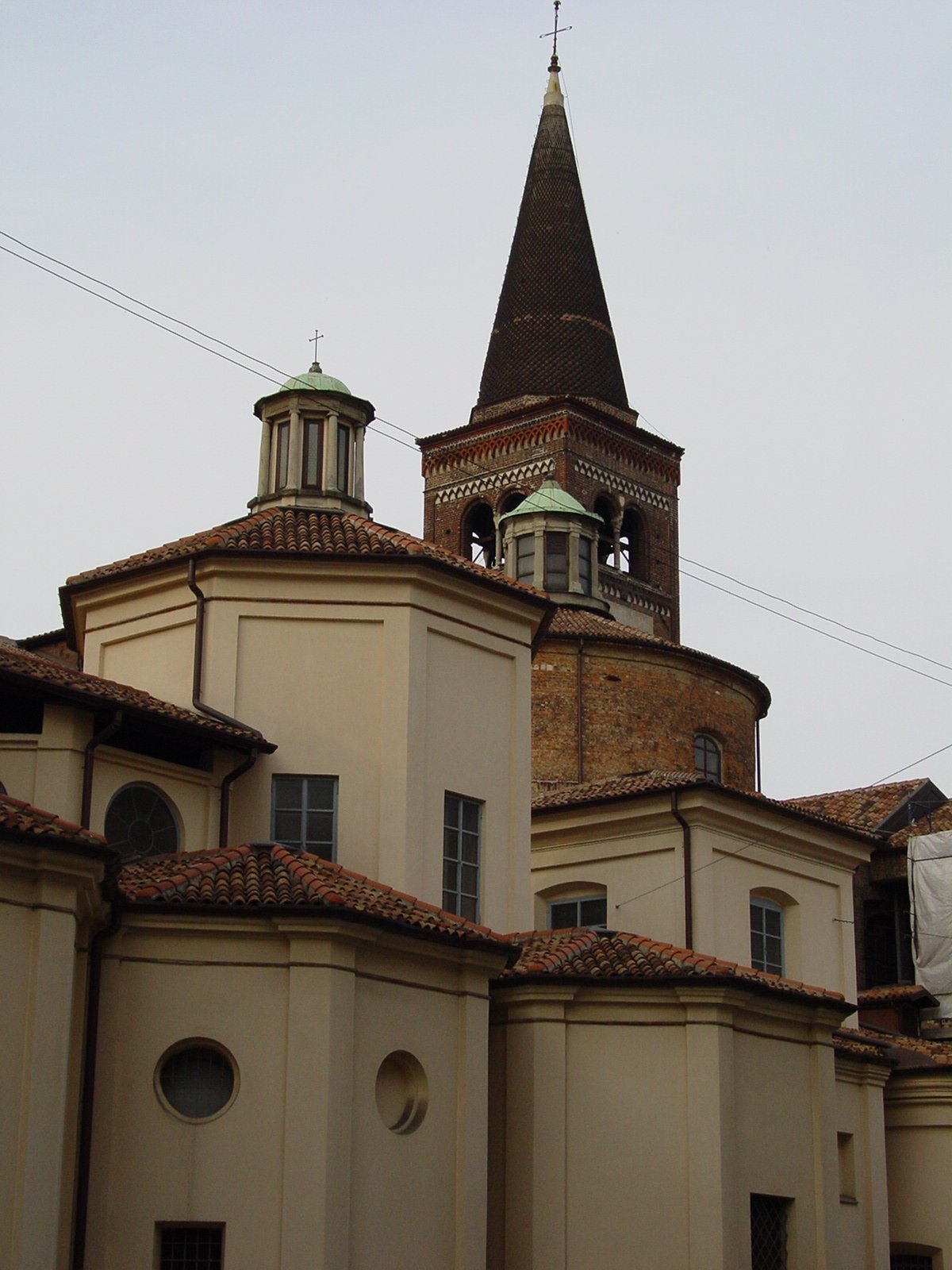
The octagonal bell tower, designed by Francesco Pecorari, is a defining feature of the church and the city’s skyline. Constructed from red brick with white marble inlays, it was the first in Milan to house a public mechanical clock—installed in the 14th century—earning it the moniker “campanile delle ore.” This innovation transformed urban life, marking the passage of time for both civic and commercial activities. Atop the tower, a statue of the Archangel Michael presides, symbolizing protection and invitation. (Triphobo)
Renaissance and Neoclassical Elements
Subsequent centuries saw the church’s interior transformed, most notably during the late 18th-century Neoclassical renovation led by Giuseppe Piermarini, famed architect of La Scala. These interventions introduced pastel-colored walls, classical columns, and harmonious decorative schemes that blend seamlessly with the Gothic structure, reflecting the evolving artistic tastes of Milan. (Duomo Milano)
Artistic Heritage
Medieval and Renaissance Masterpieces
-
Tomb of Azzone Visconti: Crafted by Giovanni di Balduccio, this marble sarcophagus stands beside the altar, depicting Azzone Visconti in repose, surrounded by figures representing Milan’s subject cities and allegorical scenes of power and piety. (Google Arts & Culture)
-
Giottesque Crucifixion Fresco: Attributed to the school of Giotto, this fresco was relocated inside in the 20th century for preservation. It stands as one of the earliest and most significant examples of the Giottesque style in Lombardy, with expressive figures rendered in lapis lazuli and gold leaf.
-
Altarpieces and Paintings: The main apse features an altarpiece by Giovanni Battista Crespi (Cerano) depicting Saint Charles Borromeo. Side chapels house works by Giuliano Traballesi and Martin Knoller, reflecting neoclassical trends, while modern pieces such as the "Madonna dei Dispersi" by Romano Rui add contemporary devotional layers. (Duomo Milano)
-
Stained Glass Windows: Vibrant 20th-century windows illustrate the histories of Benedictine and Dominican orders, complementing the church's spiritual ambiance.
Transformations Through the Centuries
The church underwent significant modifications over time. The 18th-century Neoclassical renovation by Piermarini replaced much of the original Gothic interior with elegant classical forms. The bell tower was restored in 1887 by Luca Beltrami, preserving its medieval character. In the 20th century, the church was integrated into the Grande Museo del Duomo di Milano, ensuring preservation and public access as part of Milan’s broader cultural heritage network. (Wikipedia)
Visiting Information
Opening Hours
- Tuesday to Sunday: 10:00 AM – 6:00 PM (last entry at 5:30 PM)
- Closed: Mondays and public holidays
- It is recommended to check the official Duomo Museum website for up-to-date information, especially during special events or restoration periods.
Tickets and Accessibility
- Admission: General entry is approximately €5; reduced tickets (students, seniors) are available for €3; children under 12 enter free.
- Combined Tickets: Entry may be included in the Duomo Museum ticket (approx. €15), which also grants access to other nearby sites.
- Purchase: Tickets can be bought on-site or online via the Museo del Duomo website.
- Accessibility: The church is wheelchair accessible, with ramps and accessible restrooms. Staff are available to assist visitors with special needs.
Guided Tours and Special Events
- Guided Tours: Available in multiple languages; advance booking is recommended through the official website.
- Special Events: The church periodically hosts concerts, temporary exhibitions, and cultural programs. Photography without flash is permitted; please respect religious services.
Getting There and Nearby Attractions
- Location: Via Francesco Pecorari, 2, Milan—just behind Palazzo Reale and a short walk from Piazza del Duomo.
- Metro: Duomo station (Lines M1 and M3) is a 5-minute walk.
- Tram/Bus: Tram lines 3 and 15; bus lines 61 and 94 serve the area.
- Nearby Sites: Duomo di Milano, Palazzo Reale, Museo del Novecento, and Galleria Vittorio Emanuele II are all within easy walking distance.
- Dining: Numerous cafés and restaurants nearby offer local specialties.
Frequently Asked Questions (FAQ)
Q: What are the opening hours of San Gottardo in Corte?
A: Tuesday to Sunday, 10:00 AM to 6:00 PM; last entry at 5:30 PM. Closed Mondays.
Q: How much does admission cost?
A: General admission is around €5, with reductions for students and seniors. Children under 12 are free.
Q: Are guided tours available?
A: Yes, guided tours can be booked online or at the entrance, and are available in several languages.
Q: Is the church accessible for visitors with disabilities?
A: Yes, ramps and accessible facilities are provided.
Q: Is photography allowed?
A: Yes, non-flash photography is permitted, except during religious services.
Q: How do I reach the church?
A: The church is easily accessible on foot from the Duomo metro station and is well connected by tram and bus.
Listen to the full story in the app
Your Personal Curator, in Your Pocket.
Audio guides for 1,100+ cities across 96 countries. History, stories, and local insight — offline ready.
Audiala App
Available on iOS & Android
Join 50k+ Curators
Sources
- verified
- verified
- verified
- verified
- verified
- verified
Last reviewed: