Introduction
The Roman Walls of Milan are vital relics of the city’s ancient heart, reflecting its transformation from a Celtic settlement to Mediolanum, a foremost city of the Western Roman Empire. Built initially in the late Republican era and substantially expanded under Emperor Maximian in the late 3rd century AD, these fortifications provided both defense and a stately statement of Milan’s political and economic ascendancy. Today, fragments of the walls, ancient gates, and integrated archaeological sites connect modern Milan to its imperial past, inviting visitors to explore the city’s layered urban heritage.
This comprehensive guide details the history and architecture of the Roman Walls of Milan, practical visitor information including hours and ticketing, accessibility, travel tips, and local insights. Plan your exploration with confidence, whether you are a dedicated history enthusiast or a curious traveler.
For authoritative background and updates, consult the Archaeological Museum of Milan, World History Edu, and Italia.it.
Historical Evolution of the Roman Walls
Origins and Early Development
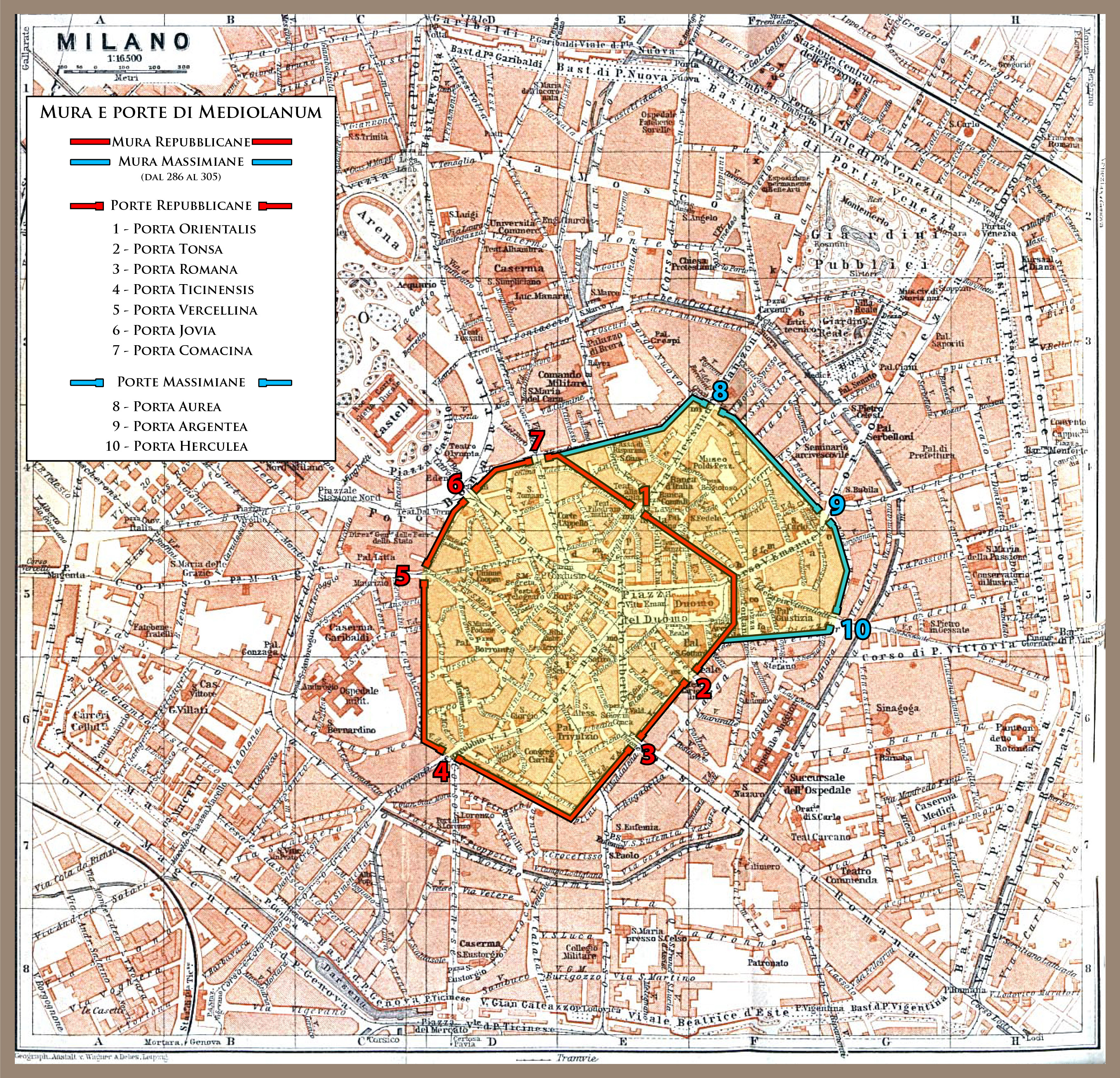
Milan’s first defensive structures appeared after its Romanization in 222 BC, following the conquest of the Celtic Insubres. The city’s early walls, constructed after Milan was granted municipium status in 49 BC, formed a near-square enclosure about 700 meters per side. These fortifications included six primary gates—Porta Romana, Porta Ticinese, Porta Vercellina, Porta Orientale, Porta Jovia, and Porta Cumana—serving critical military and commercial roles (Britannica).
Imperial Expansion
With Milan’s elevation as capital of the Western Roman Empire (286–402 AD), Emperor Maximian oversaw massive wall extensions, incorporating the new imperial palace, circus, and other monumental buildings. The circuit’s perimeter expanded to over 4 kilometers, reinforced with gateways, towers, and bastions, reflecting the city’s strategic and symbolic prominence (worldhistoryedu.com).
Urban Influence and Legacy
The Roman walls shaped the trajectory of Milan’s urban planning. Streets radiated from the main gates, a pattern that persists in modern neighborhoods and toponyms. In subsequent centuries, these fortifications formed the base for medieval and Renaissance defenses, influencing the Cerchia dei Navigli canal system and Milan’s distinctive street grid (italyastheromansdid.it).
Architectural Features and Construction
Materials and Techniques
Roman engineers used local river stones, bricks, and lime mortar, constructing walls with an opus caementicium (Roman concrete) core for durability. The walls stood several meters high and thick, integrating:
- Vaulted walkways for defender mobility
- Advanced drainage systems to prevent erosion
- Robust gates with iron elements for controlled access
Gates and Towers
Major gates marked the start of key Roman roads:
- Porta Ticinese: Southern exit toward the Navigli and Pavia. The present structure sits on Roman foundations (Italia.it).
- Porta Romana: Southeast gate, rebuilt over centuries but retaining its ancient roots.
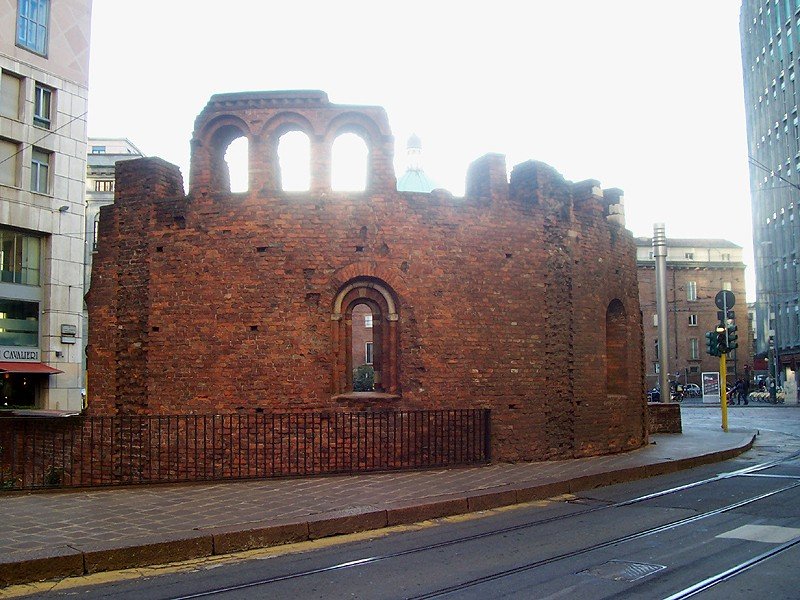
- Porta Vercellina: Northwest, with visible wall remnants on Via San Giovanni sul Muro.
- Defensive towers: Regularly spaced, some later integrated into medieval or Renaissance buildings.
Enduring Urban Impact
Medieval and Modern Adaptation
As Milan evolved, the Roman wall circuit guided the expansion of medieval ramparts, canal rings (Cerchia dei Navigli), and modern boulevards. Street names like Corso di Porta Ticinese and Corso di Porta Romana preserve their legacy (italyastheromansdid.it).
Heritage Conservation
While much of the circuit has disappeared, several sections are preserved in museums or incorporated into modern structures. Notable conservation efforts include the Archaeological Museum of Milan (Corso Magenta 15), which houses raised wall segments, models, and mosaics (mapcarta.com).
Visiting the Roman Walls
Key Sites and Museum Locations
- Via San Giovanni sul Muro: Wall fragments near Porta Vercellina.
- Archaeological Museum of Milan: Original Roman masonry, artifacts, and interpretive exhibits.
- Largo Corsia dei Servi: Site of relocated Herculean baths remains.
- Via Brisa: Foundations of the imperial palace.
- Porta Ticinese and Porta Romana: Surviving gates and vibrant neighborhoods.
- Colonne di San Lorenzo: Sixteen Roman columns, a major ancient monument.
Visiting Hours and Tickets
- Outdoor Sites: Wall remains and gates (Porta Ticinese, Porta Romana, Via San Giovanni sul Muro) are accessible at all times, free of charge.
- Archaeological Museum of Milan: Open Tuesday–Sunday, 9:00 AM–5:30 PM; closed Mondays. Adult tickets ~€5, discounts for youth and free entry on the first Sunday of each month (milanmuseum.it).
- Crypt of San Sepolcro: Check church hours; small fee or donation may apply.
Accessibility
Most outdoor fragments are accessible on foot and suitable for visitors with mobility concerns. The Archaeological Museum is wheelchair accessible, but some sites may have steps or uneven surfaces.
How to Get There
- Metro: Lines M1, M2, and M3 serve the city center and sites near the walls.
- Trams/Buses: Multiple lines connect directly to historical districts.
- Walking: Self-guided walking tours are recommended for exploring the circuit and adjacent attractions.
Guided Tours and Nearby Attractions
Local operators offer guided tours focusing on Milan’s Roman and early Christian history, combining the walls, Archaeological Museum, Colonne di San Lorenzo, and more. Noteworthy nearby sites include the Duomo, Sforza Castle, and the Basilica of Sant’Ambrogio (nomads-travel-guide.com).
Travel Tips for Visitors
- Best Seasons: Spring (April–June) and autumn (September–October) offer mild weather and fewer crowds.
- Photography: Early morning and late afternoon provide optimal lighting.
- Combine Visits: Pair the Roman Walls with Milan’s other historical landmarks for a full cultural itinerary.
- Special Events: Look for heritage exhibitions and guided walks during Milan’s festivals.
Frequently Asked Questions (FAQ)
Q: Are the Roman Walls of Milan free to visit?
A: Outdoor remains and gates are free. Museum and special sites require tickets.
Q: What are the visiting hours for the walls and museums?
A: Outdoor sites are accessible any time. The Archaeological Museum is open Tuesday to Sunday, 9:00 AM–5:30 PM.
Q: Are guided tours available?
A: Yes, guided Roman heritage tours can be booked online or locally.
Q: Are the sites accessible for visitors with mobility challenges?
A: Most outdoor sites and the Archaeological Museum are accessible; check specific locations for details.
Q: How can I reach the Roman Walls using public transport?
A: Metro lines M1, M2, and M3, plus trams and buses, serve the city center and historical sites.
Discover More
Enhance your journey through Milan’s history with the Audiala app—offering curated audio tours, interactive maps, and up-to-date information on the Roman Walls and more. Follow us on social media and explore related articles for inspiration on Milan’s best cultural and historical attractions.
Listen to the full story in the app
Your Personal Curator, in Your Pocket.
Audio guides for 1,100+ cities across 96 countries. History, stories, and local insight — offline ready.
Audiala App
Available on iOS & Android
Join 50k+ Curators
Sources
- verified
- verified
- verified
- verified
- verified
- verified
Last reviewed: