Plan and listen to Casa Del Mantegna with Audiala.
Audio guide in your pocket, itinerary in your browser. Built for the way you actually visit.
Introduction
The Casa del Mantegna in Mantua, Italy, stands as a testament to the creative genius and architectural vision of Andrea Mantegna (1431–1506), one of the leading painters of the Italian Renaissance. Built in the late 15th century, this extraordinary residence fuses classical architectural concepts with Renaissance humanism, most famously through its innovative cubic structure enclosing a circular atrium open to the sky. Today, Casa del Mantegna is not only a preserved monument but also a vibrant cultural center, offering exhibitions and events that celebrate Mantua’s remarkable heritage (Roderick Conway Morris; TheEuroRoadTrip.eu; Wikipedia; Provincia di Mantova; in-lombardia.it).
This guide provides a detailed overview of the Casa del Mantegna, highlighting its history, architectural features, practical visiting information, and its essential role within Mantua’s network of historical sites.
Andrea Mantegna: Life and Impact
Andrea Mantegna (1431–1506) was a pioneering artist, renowned for his mastery of perspective, deep classical scholarship, and innovative approach to both painting and architecture. Born near Padua, he became known for his archaeological knowledge and artistic skill. In 1460, he was invited by Ludovico III Gonzaga to the Mantuan court, an event that marked the beginning of Mantua’s transformation into a Renaissance cultural hub. Mantegna’s presence attracted other luminaries, including Leonardo da Vinci, and elevated the city’s artistic status (Roderick Conway Morris; TheEuroRoadTrip.eu).
History and Architecture of Casa del Mantegna
Vision and Construction
Casa del Mantegna was conceived in the 1470s as both the artist’s home and workshop. The design—a nearly perfect square enveloping a central circular courtyard—reflects the Renaissance fascination with harmony, geometry, and classical antiquity. The cubic exterior is austere, while the interior atrium, open to the sky, creates a dramatic play of light and space. The house’s proportions are thought to follow mathematical and musical harmonics, and its “circle within a square” layout directly references the domus of ancient Rome (Wikipedia; Hidden Architecture; in-lombardia.it).
Construction began in 1476 after Mantegna received land from Ludovico III Gonzaga. Despite financial difficulties and a lengthy building process, the Mantegna family moved in around 1496. The building’s geometric rigor and symbolic elements—like the inscription “AB OLYMPO” and the repeated use of circles and squares—embody both Renaissance ideals and Mantegna’s personal and artistic ambitions (Roderick Conway Morris; Wikipedia).
Architectural Highlights
- Façade: Simple brick, punctuated by a double oak door and symmetrical windows.
- Courtyard: Central cylindrical atrium, open to the sky, with traces of original frescoes and acanthus motifs. Each of the four sides features an arched doorway, and the eight windows follow the curvature of the courtyard (Standard.co.uk).
- Interior: Rooms arranged in a circular sequence around the courtyard, serving as living quarters, studios, and display areas for Mantegna’s collections. Notable features include coffered ceilings, painted friezes, and the artist’s bedroom with his coat of arms and the Gonzaga emblem (Wikipedia).
Restoration and Modern Cultural Role
After Mantegna’s death, the house changed hands numerous times, underwent significant modifications, and fell into disrepair before being restored in the 20th century (Mantova Notizie). In the 1940s, a major restoration campaign uncovered much of the original structure, despite damage and threats from World War II. Since reopening to the public in 1974 (with further improvements in 1999), Casa del Mantegna has been managed by the Province of Mantua (Provincia di Mantova; in-lombardia.it).
Today, the house is a dynamic cultural venue, hosting:
- Temporary and permanent art exhibitions
- Lectures, workshops, and book presentations
- Collaborative initiatives with other Mantuan museums and UNESCO programs
- Educational programs and guided tours for schools and groups
Entry is free, and the building is an essential stop for art lovers, students, and visitors seeking to understand Mantua’s Renaissance legacy (Mantova Notizie; Google Arts & Culture).
Visiting Casa del Mantegna: Hours, Tickets, and Practical Info
Opening Hours
Visiting hours can vary depending on current exhibitions and events. The most common schedule is:
- Monday: 8:30–12:30, 14:30–17:00
- Tuesday, Wednesday, Friday: 8:30–12:30
- Thursday: 8:30–17:00
- Saturday and Sunday: 10:00–12:30, 15:00–18:00
- Closed: Tuesday and Wednesday afternoons
Always check the official website or in-lombardia.it for up-to-date hours.
Admission and Tours
- Admission: Free of charge.
- Guided tours: Can be reserved by calling +39 0376 360506. Tours are primarily in Italian; English tours available on request (mantova.com).
Accessibility and Facilities
- Accessibility: Ground floor and main exhibition areas are accessible to visitors with limited mobility; some upper areas may have limitations.
- Restrooms: Available on-site.
- Infopoint Mantova: For maps, event details, and assistance (in-lombardia.it).
Visitor Experience and Nearby Attractions
Best Times to Visit
Visit on weekdays for a quieter experience. Early mornings and late afternoons are generally less crowded. Special events such as Mantua’s Festivaletteratura may attract larger audiences (wild-about-travel.com).
Guided Tours and Photography
Guided tours are highly recommended for deeper context. Photography is allowed for personal use without flash or tripods; restrictions may apply during exhibitions.
Events and Cultural Programming
Casa del Mantegna offers a lively calendar of events, including rotating art exhibitions, retrospectives, and collaborations with other Mantuan institutions (mantovauno.it).
Nearby Sites
Enhance your cultural itinerary by visiting these nearby Mantua landmarks:
- Palazzo Te (7-minute walk): A masterpiece of Renaissance architecture.
- Palazzo Ducale: Home to Mantegna’s famed Camera degli Sposi frescoes.
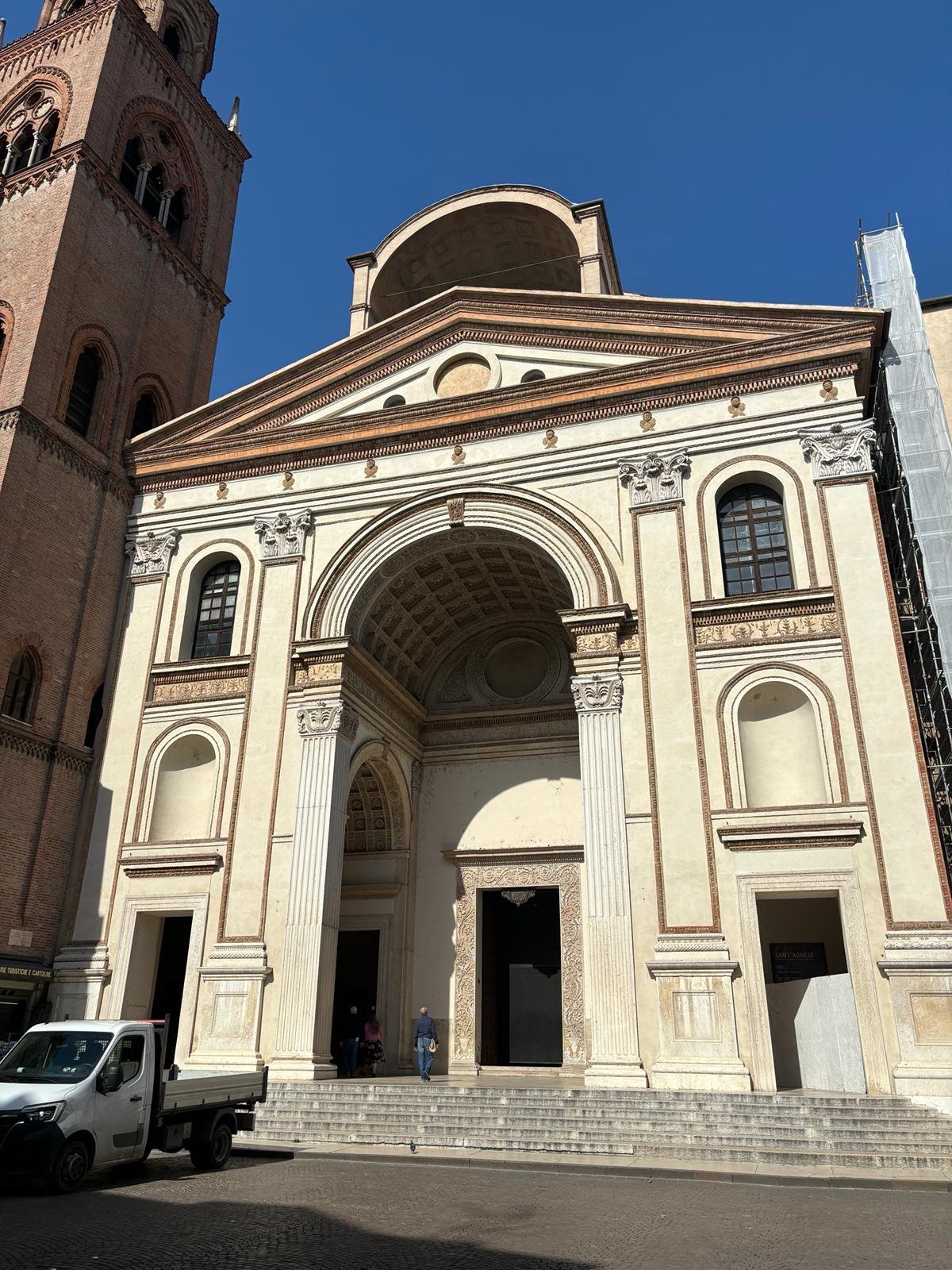
- Basilica di Sant’Andrea, Rotonda di San Lorenzo, Teatro Bibiena: Key historical and architectural sites.
- Mantua’s Renaissance squares: Piazza Sordello, Piazza Erbe, Piazza Mantegna, Piazza Broletto (thegeographicalcure.com).
Food and Accommodation
Enjoy local cuisine at restaurants such as Il Cigno – Trattoria dei Martini or Carlo Govi Ristorante (thetravelfolk.com). Stay at boutique hotels and B&Bs like Palazzo Castiglioni or Hotel Casa Poli.
FAQs
Is there an admission fee for Casa del Mantegna?
No, entry is free.
How can I book a guided tour?
Call +39 0376 360506; English tours are available upon request.
Are there facilities for visitors with disabilities?
Main exhibition areas are accessible; some portions may have limitations.
What is the best time to visit to avoid crowds?
Weekdays, early mornings, and late afternoons.
Is photography allowed?
Yes, for personal use without flash or tripods.
Where is it located?
Via Giovanni Acerbi, 47, 46100 Mantua (MN), Italy.
Listen to the full story in the app
The whole Casa Del Mantegna,
told well.
Listen to sourced travel stories with local history and practical context — ready offline.

Verified, and shown.
Researched and written by the Audiala editorial team from historical records, architectural archives, and local expertise.
Built from cited sources · see the method · How we make our guides →