An introduction.
Researched by the Audiala editorial team from historical records, architectural archives, and local expertise.
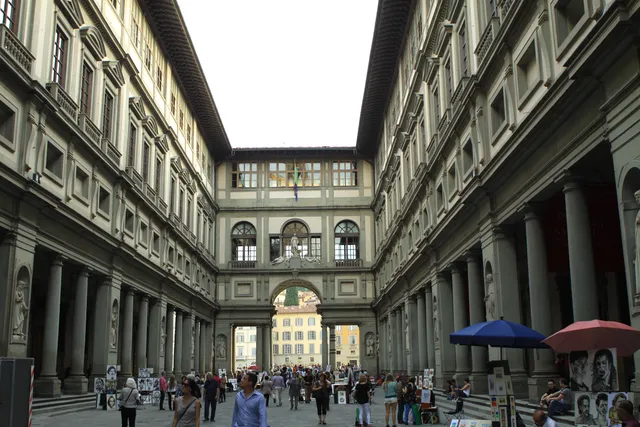
WWhy does Perseus With the Head of Medusa in Florence, Italy, feel less like a hero's trophy and more like a public threat? That unease is exactly why you should come: Benvenuto Cellini's bronze turns myth into politics, and once you notice that, Piazza della Signoria stops being a postcard and starts talking back. Today, under the wide arches of the Loggia dei Lanzi, Perseus lifts Medusa's severed head above the stone pavement while tourists drift in from the Uffizi, footsteps clicking on the square and camera shutters snapping in the open air.
The setting matters. The Loggia was built between 1376 and 1382 as a covered stage for civic ceremony, and it still sits beside Palazzo Vecchio, Florence's city hall, where power has never fully moved out.
Cellini's statue arrived here in 1554, and it was never just decoration. The Uffizi's own interpretation frames Perseus as a Medici manifesto, a bronze warning that Cosimo I could cut off discord as cleanly as the hero cuts off Medusa's head.
Look at it in late afternoon, when the light slides across Perseus's polished torso and sinks into the dark bronze around Medusa's hair, and the whole group feels unstable in the best way. You visit for the virtuoso casting, yes, but you stay because the sculpture still argues with the square around it.
01 What to see.
Perseus in the Left Bay
Cellini’s bronze Perseus doesn’t greet you politely; he steps out of the left bay of the Loggia dei Lanzi like a public threat, dark against pale stone, arm raised with Medusa’s head as if the argument in Piazza della Signoria has just turned violent. Commissioned by Cosimo I de’ Medici in 1545 and placed here in 1554, the figure still works exactly as intended when you stand slightly below him and look toward Palazzo Vecchio, because the whole pose reads as a political message before it reads as mythology.
Walk behind the statue. The crowd in front usually doesn’t. On the nape of Perseus’ head, the helmet and hair form what multiple sources identify as Cellini’s hidden self-portrait, a sly signature tucked into bronze; once you’ve seen it, the sculpture stops being only a hero with a trophy and becomes a brag from one of Florence’s most difficult geniuses.
The Pedestal and the Stone Theater Around It
Most people look up, take the decapitation scene, and leave. Stay with the base instead: the marble pedestal carries a whole second drama, with small mythological bronzes and a relief of Perseus and Andromeda, conceived with the precision of jewelry and meant to reward anyone patient enough to crouch, circle, and look close.
The setting does half the work. This loggia, built between 1376 and 1382, was a civic stage before it became an open-air sculpture gallery, and you can feel that history in the cool shade under the vaults, the slap of footsteps on stone, the echo of many languages, and the sudden brightness of the piazza beyond the arches; Perseus feels less like a museum object than a man caught forever in the moment after a very public act.
Circle the Loggia, Then Climb Above It
Start at the Medici lions on the steps, move into the left bay for Perseus, then keep going instead of stopping where everyone else stops. Giambologna’s Rape of the Sabine Women twists through the right bay like a stone flame, the Roman matrons along the back wall cool the temperature of the whole space, and from behind Perseus you get the view Cellini cared about: his bronze victor facing the civic heart of Florence.
Finish high if you can. The Uffizi terrace above the loggia gives you the overlooked angle, where the sculpture group stops being isolated masterpieces and turns back into part of the city’s stage set. One practical detail matters now: from 23 January 2026, the Uffizi says entry into the interior of the loggia requires a free on-site ticket, though the works remain visible from the piazza day and night.
02 In pictures.


Plan and listen to Perseus With The Head Of Medusa with Audiala.
Audio guide in your pocket, itinerary in your browser. Built for the way you actually visit.
Tickets & tours.
These are guided options from our partners — same price as booking direct.
Prices are indicative — final pricing and availability are confirmed at checkout. Audiala may earn a commission from bookings made through these links.
03 Visitor logistics.
The practical scaffolding for a good visit — kept short.
Getting There
Perseus stands under the Loggia dei Lanzi on Piazza della Signoria, 1 minute from Palazzo Vecchio and about 3 minutes on foot from the Uffizi entrance. From Santa Maria Novella station, expect a 20-25 minute walk through the historic center, or take a bus toward the center and get off near Piazza San Firenze or Porta Rossa, then walk 5-7 minutes over stone streets polished smooth as old cutlery.
Opening Hours
As of 2026, the statue is visible all day because it stands in the open-air Loggia dei Lanzi rather than inside a ticketed room. The practical catch is crowding, not a locked door: concerts, civic events, police barriers, or maintenance can tighten access around the loggia without much warning.
Time Needed
Give it 10-15 minutes if you only want a careful look at Cellini's bronze and pedestal. Allow 30-45 minutes if you want to read it properly with the rest of Piazza della Signoria, because the square is the argument and Perseus is one sentence in it.
Cost & Tickets
As of 2026, seeing Perseus in the Loggia costs nothing; it is part of the square, not a separate paid stop. Save your money for the Uffizi if you want the museum context, or for a lampredotto near Mercato Nuovo, which will teach you more about Florence than an overpriced piazza coffee.
04 Tips for visitors.
Small things that change the day.
Go Early Late
See it early in the morning or late in the evening, not at midday when tour groups pack the square shoulder to shoulder. The bronze reads better then too: raking light sharpens Perseus's muscles and leaves Medusa's body in a colder shadow.
Photo Rules
Handheld photos are fine, but flash, selfie sticks, tripods, stands, drones, and professional gear are banned under Uffizi rules for the Loggia. If you want the cleanest shot, stand a little off-axis so Perseus rises against the arcade rather than a wall of raised phones.
Museum Manners
Treat the Loggia like a museum without walls: don't climb, lean on bases, picnic under the statues, or set drinks down on the stone. This is where Florence staged public power in the 1500s, and the place still expects a little discipline.
Crowd Watch
The real risk here is pickpocketing in the crush, especially on weekends and around the Palazzo Vecchio wedding traffic. Keep your phone in a front pocket and skip any café pitch that depends on you sitting down before you've seen the prices.
Eat Off Square
Skip lunch on Piazza della Signoria unless you specifically want Rivoire for chocolate or Gucci Osteria for a splurge. For budget and local flavor, walk 4-6 minutes to Schiacciateria De' Neri 18r on Via dei Neri or to Nencioni Orazio at Mercato Nuovo for lampredotto.
Read The Square
Don't look at Perseus as a lone masterpiece. Turn your head and read it with Palazzo Vecchio, the Loggia, and the other statues around it, because Cosimo I placed this bronze here as public propaganda, not private decoration.
Where to Eat
Don't Leave Without Trying
Vinaino Fiorenza
local favoriteOrder: The Tuscan antipasti board paired with local Chianti—cured meats, pecorino, and bruschetta showcase why Florentines keep coming back. The wine list punches above its weight for the price.
This is where locals actually eat, not tourists hunting Instagram moments. Nearly 1,900 reviews at 4.8 stars tells you everything—honest Tuscan food, serious wine, and prices that won't wreck your budget.
Ristorante Enoteca EZIO
local favoriteOrder: Order the house wine and whatever seasonal pasta special is on the board—these places live or die by doing one thing brilliantly, and Ezio nails it.
A perfect 5-star rating from a tight group of repeat customers means this is a neighborhood gem where quality matters more than volume. Intimate, unpretentious, and steps from the Piazza della Signoria.
Caffeteria La Signoria
cafeOrder: Start with a proper Italian espresso and a cornetto (croissant) for breakfast, then return for an aperitivo and light lunch—this is how Florentines actually use a cafe.
A local's cafe that stays open from breakfast through evening aperitivo hour, with a perfect rating and a location just steps from the Uffizi. No tourist markup, just solid Italian cafe culture.
Leonardo Boutique
quick biteOrder: Grab a freshly baked focaccia or schiacciata (Florentine flatbread) for a quick, authentic snack that beats any tourist sandwich by a mile.
A genuine artisan bakery rather than a chain pastry shop—this is where you grab breakfast like a Florentine, not like someone following a guidebook.
Dining Tips
- check Lunch (pranzo) is the main meal in Florence—eat your biggest meal between 12:30–2:00 PM when restaurants serve their best dishes.
- check Dinner (cena) typically starts at 8:00 PM; arriving before 7:30 PM may find kitchens not yet in full swing.
- check Water is free but not usually served automatically—ask for 'acqua del rubinetto' (tap water) to save money, or order bottled.
- check Tipping is not obligatory but rounding up or leaving 5–10% is appreciated for good service.
- check Many small local restaurants close between lunch and dinner service (roughly 3:00–6:00 PM).
Restaurant data powered by Google
05 Cellini's Gamble in Bronze
Benvenuto Cellini was exactly the kind of man Florence rewards and exhausts: a goldsmith with a sculptor's ambition, a memoirist with a talent for self-mythology, and a court artist who needed one work large enough to silence his rivals. Perseus became that wager.
Documented sources show that Cosimo I de' Medici commissioned the bronze in 1545, when the duke was reshaping Piazza della Signoria into a theater of Medici control. For Cellini, the stake was personal. If he failed at monumental bronze in the most political square in Florence, he would remain a brilliant craftsman; if he succeeded, he could stand beside Michelangelo in metal.
The Statue That Looks Triumphant Because Failure Came First
At first glance, Perseus seems to tell a simple story: a Renaissance master cast a mythic hero, the Medici installed it in the Loggia, and Florence gained one more masterpiece. Tourists usually stop at the raised arm, the slack body of Medusa, the swagger.
But something doesn't add up. Why is the figure so tense, almost wiry, instead of serenely victorious, and why did Cellini write about the work with the panic of a man fighting for his life? The answer sits behind the polished surface: this commission was a public test under Cosimo I, and Cellini knew that a failed casting in bronze on this scale could ruin him in front of the entire city.
According to Cellini's own account, the turning point came during the pour, when the metal threatened to seize and the mold seemed close to disaster; the story goes that he fed the furnace with household pewter to keep the bronze flowing. Documented sources confirm the commission in 1545 and the statue's placement in 1554, even if the famous kitchen-metal rescue belongs partly to maker's legend. Once you know that, Perseus stops looking like easy triumph. He looks like a man holding his own survival over Florence's political stage.
Early Life and Vision
Legacy and Influence
Listen to the full story in the app
The whole Perseus With The Head Of Medusa,
told well.
Audio guides for 1,100+ cities across 96 countries. History, stories, and local insight — offline ready.

06 Frequently asked.
The questions travellers send us most about Perseus With The Head Of Medusa.
Is Perseus with the Head of Medusa worth visiting?
Yes, especially if you read it as public theater instead of a lone artwork. Cellini's bronze was commissioned in 1545 and set in the Loggia dei Lanzi in 1554, right in Florence's political core beside Palazzo Vecchio. Stand under the arches and you get the full effect: dark bronze against pale stone, crowd noise bouncing off the vaults, and a Medici power statement still staring across the square.
How long do you need at Perseus with the Head of Medusa?
Give it 20 to 30 minutes if you want more than a quick photo. The front view takes two minutes; the real visit starts when you circle the base, look for Cellini's self-portrait hidden in the back of Perseus's head, and study the pedestal reliefs and small mythological figures. Stretch it to 45 minutes if you're reading the whole loggia as one sculptural argument.
How do I get to Perseus with the Head of Medusa from Florence?
Go to Piazza della Signoria and walk into the Loggia dei Lanzi beside the Uffizi. Perseus stands in the left bay of the loggia, so once you reach Palazzo Vecchio and the square's open arcade, you are effectively there. This is central Florence, more a matter of finding the right corner of the historic center than taking a separate trip.
What is the best time to visit Perseus with the Head of Medusa?
Early morning or late afternoon works best. Before 10 a.m. the loggia is easier to read without the square turning into a wall of phones, and late light gives the bronze more depth instead of flattening it into a dark shape. Evening has its own pull because the sculpture stays visible from the piazza, with the arches holding sound and shadow around it.
Can you visit Perseus with the Head of Medusa for free?
Yes, but with a catch. You can still see Perseus for free from Piazza della Signoria at any hour, yet since January 23, 2026, entering the interior of the Loggia dei Lanzi requires a free on-site ticket. So the view costs nothing; stepping fully inside now takes one extra move.
What should I not miss at Perseus with the Head of Medusa?
Don't stop at the frontal decapitation pose. Walk behind the statue to find the self-portrait Cellini hid in Perseus's helmet and hair, then study the marble pedestal, which works like a second sculpture with mythological bronzes and an Andromeda relief. And look outward toward Palazzo Vecchio, because the statue was built to argue with the square, not just decorate it.
Verified, and shown.
Researched and written by the Audiala editorial team from historical records, architectural archives, and local expertise.
Official city tourism page for the Loggia dei Lanzi; location, civic history, open-air museum role, and practical visitor context.
Official Italian city page for Piazza della Signoria; square context and civic setting.
UNESCO listing used for the historic-center context of Florence.
Regional tourism page used for the loggia's dates, sculpture layout, and visitor orientation.
Italian cultural-heritage catalog record used for the loggia's construction dates and architecture.
Reference source for the loggia's history and architectural character.
Italian cultural-heritage record for Cellini's Perseus; commission date and object history.
Reference source used for the sculpture's Mannerist context and 1554 placement.
Article used for the commission date, placement date, and visual reading of the sculpture.
Object record used for Minerva on the pedestal, inscriptions, and dated expenditure notes.
Travel listing used as supporting evidence for the accepted 1554 installation date.
Official Uffizi video used for the loggia's civic role, political reading of Perseus, visibility, and visitor experience.
Italian page focused on Perseus; used for 1554 placement, technical casting notes, and close-looking details.
City-oriented guide used for sculpture placement inside the loggia and architectural details.
Official video used for the Roman female statues at the back of the loggia.
Article used for the hybrid Gothic and early-classical reading of the loggia.
Guide used for design details such as arches, capitals, and façade decoration.
Art-history source used for the bronze casting, political sightline, and public-program reading of the statue.
Object record for the Andromeda relief on the pedestal; used for dating and material details.
Field recording used for the acoustic character of the loggia.
Article used for the hidden self-portrait on the back of Perseus's head.
Article used to support the hidden self-portrait detail.
Local article used to support the self-portrait detail on the back of the statue.
Object record for Mercury on the pedestal; used for the miniature bronze program and dated notes.
Object record for Danae on the pedestal; used for the miniature bronze program and dated notes.
Object record used for the pedestal ensemble and dated expenditure note for Jupiter and Minerva.
Report used for restoration-revealed gilding and arabesque details.
Photography guide used for light conditions, angle advice, and close-up viewing suggestions.
Travel article used for seasonal crowd and comfort patterns in Florence.
Travel page used for the early-morning timing tip.
Official tourism platform listing used for guided-tour availability around Piazza della Signoria and the loggia.
Audio-guide source used for third-party interpretation options.
Travel-audio source used for third-party interpretation options.
Official Italian notice announcing the free-ticket system for entering the loggia from January 23, 2026.
Biographical reference used to support the 1545 commission date.
Italian guide used for the 1554 placement date and the loggia's sculpture layout.
Italian Wikipedia entry used for naming conventions around the sculpture.
Article used to contrast Perseus with Neptune's local nickname.
Official Italian page for the loggia; used for local naming and context.
Italian regional page used for naming variants and local context.
Local advice page used for resident attitudes toward overtouristed areas and where Florentines go instead.
Local news report used for overtourism context and resident fatigue.
Municipal museum page used for the 2025 contemporary-sculpture controversy in Piazza della Signoria.
News report used for debate around contemporary sculpture in the square.
News report used for the racist vandalism case tied to the 2025 public-art debate.
Municipal culture page used for the feminist reinterpretation of the loggia and Medusa.
City youth portal item used for 2025 youth-orchestra programming under the loggia.
City youth portal item used for 2025 youth-orchestra programming under the loggia.
News item used for the announced 2025 Corri La Vita finish at the loggia.
Official city page used for the square's civic identity and present-day role.
Official page used for Palazzo Vecchio's civic role beside the square.
Local guide used for square atmosphere, civic-wedding spillover, and neighborhood texture.
Official business page used for nearby coffee and food recommendations on Via dei Neri.
Official page used for the Porcellino market context near the square.
Official page used for nearby lampredotto recommendations.
Local report used for present-day crowd-theft and police-context notes in central Florence.
Local news report used for a 2025 police incident in Piazza della Signoria.
City campaign page used for behavior framing and respect for Florence as a living city.
City campaign page used for respectful visitor conduct.
Regional food page used for lampredotto as a Florentine street-food specialty.
Restaurant page used for Via dei Neri food-corridor context.
Regional food page used for ribollita and local cuisine context.
Regional recipe page used for chicken-liver cooking references in Florentine food culture.
Regional food guide used for broader Florentine dish recommendations.
Official visitor rules used for conduct, flash, selfie-stick, and tripod restrictions.
Official visiting-rules page used for museum-style behavior expectations.
Official notice used for drone restrictions.
Official services page used for commercial photography and filming authorization.
Restaurant listing used for the nearby budget food recommendation.
Restaurant listing used for the nearby coffee and brunch recommendation.
Official site used for the historic cafe recommendation on Piazza della Signoria.
Lifestyle guide used for context on Rivoire's atmosphere and identity.
Michelin listing used for the splurge dining option on the square.
Michelin listing used for the splurge dining option away from the square.
Official event page used for interpretive performance and living-heritage storytelling at the loggia.
Museum page used for the piazza's role as a site for contemporary art and public argument.
Museum page used for Palazzo Vecchio's continued civic function.
Official English notice for the free-ticket access rule beginning on January 23, 2026.
Official page used for the annual Fiorita memorial rite in Piazza della Signoria.
Municipal culture page used for the details of La Fiorita.
City youth portal item used for the 2025 Marzocco coronation.
Report used to support the return of the Marzocco coronation ritual.
Municipal notice used for the Marzocco ceremony and civic-tradition framing.
Official event page used for the Befana descent from the loggia on January 6, 2026.
Official notice used to confirm the January 6, 2026 Befana event and temporary closure.
Festival site used for the history of the youth-orchestra festival founded in 1999.
Municipal culture page used for the youth-orchestra festival as living heritage.
Municipal culture page used for the 2025 international youth-orchestra festival opening.
Official events page used for 2025 festival dates and the setting under the loggia.
City youth portal item used for the 2025 festival opening.
City youth portal item used for later 2025 festival performances under the loggia.
Official Italian event page used for the 2019 educational performance about the loggia statues.
Official page used for the Via della Pergola site linked to Cellini's casting tradition.
Official page used for contemporary artistic activity connected to the Cellini-casting site.
Local article used for the enduring lore around Cellini's hidden self-portrait.
Museum-shop page used for the casting story retold from Cellini's memoir tradition.
Museum-store page used for the casting story and Perseus's afterlife in public memory.
Italian museum page used for contemporary-art intervention history in Piazza della Signoria.
Travel-history article used for the unconfirmed exact unveiling date of April 27, 1554.
News report used for the 2013 restoration-start date, treated as single-source.
Official ministry notice used for the November 12, 2020 extraordinary-maintenance announcement.
Researched from Wikidata, Wikipedia & official sources · fact-checked · How we make our guides →