Introduction
Why would a republic build a grand stage for democracy and then fill it with statues celebrating the man who destroyed it? The Loggia dei Lanzi stands at the corner of Piazza della Signoria in Florence, Italy — three soaring arches open to the sky, sheltering some of the most famous sculptures on earth, all of them free to see. It is the rare place where a casual stroll through a public square puts you face-to-face with Renaissance masterpieces that most cities would lock behind glass and a thirty-euro ticket.
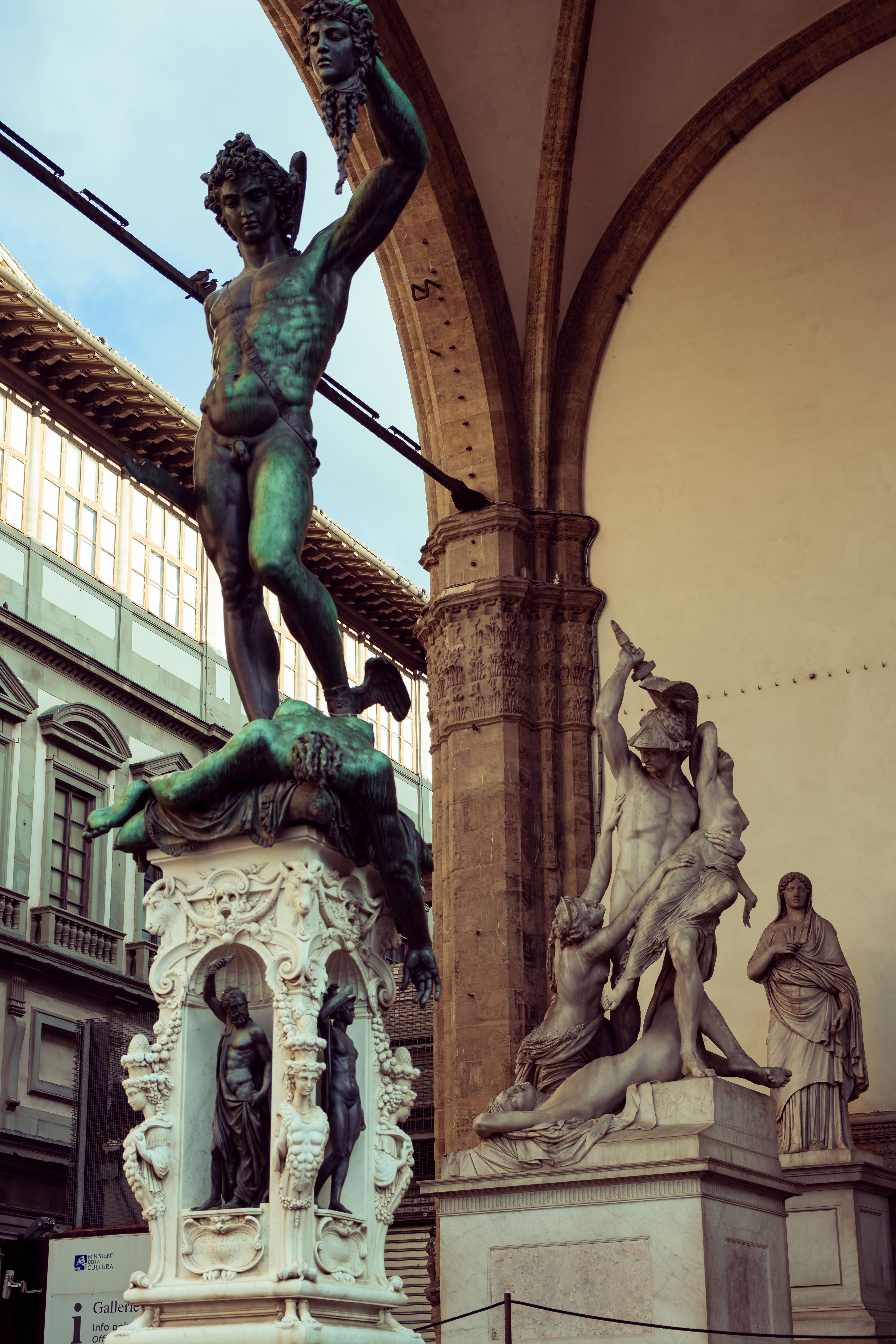
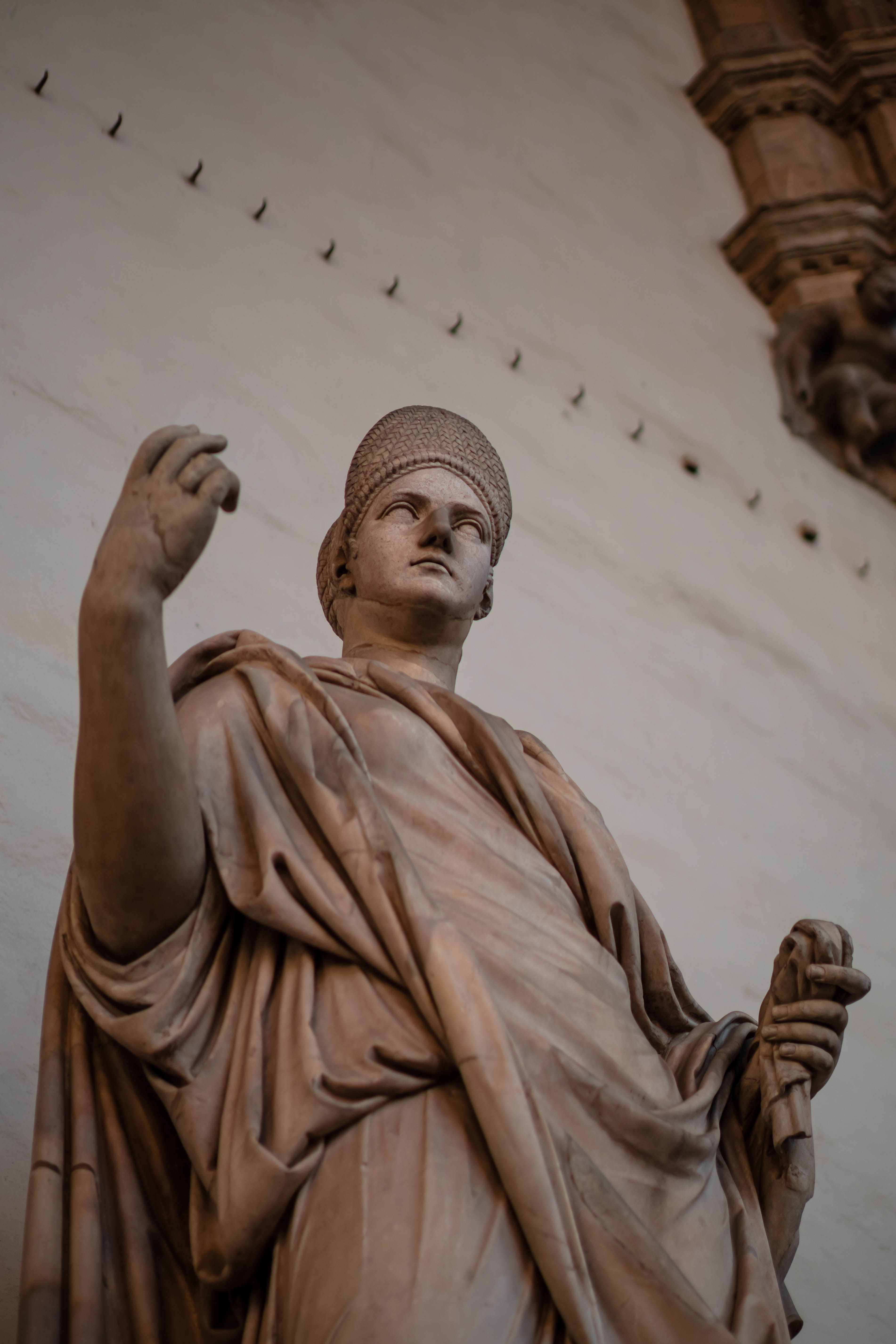
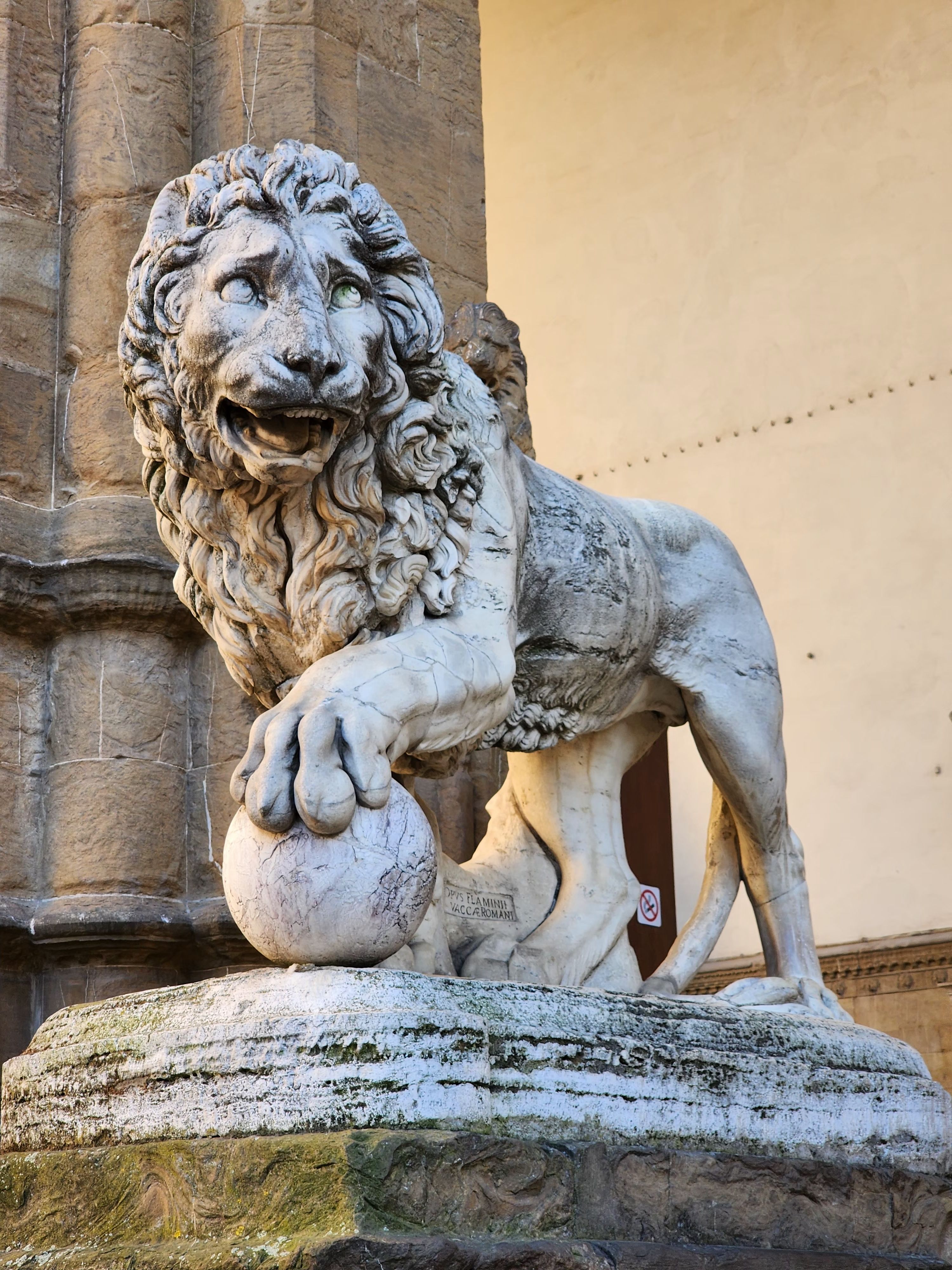
What you see today is an open-air gallery of marble and bronze: Giambologna's spiraling Rape of the Sabine Women, Cellini's ferocious Perseus with the Head of Medusa, six ancient Roman matrons lining the back wall, and a pair of stone lions guarding the steps — one genuinely Roman, the other a 1598 copy so good that most visitors can't tell the difference. Pigeons settle on Hercules. Tourists sit on the steps and eat gelato in the shadow of decapitated Medusa. The contrast between the violence of the art and the laziness of the afternoon is part of the point.
But the Loggia wasn't built for art. It was built for politics — for the swearing-in of magistrates, for the ceremonies of a fiercely independent republic. The sculptures came later, placed here deliberately by the Medici dynasty to overwrite the building's original meaning. Every statue is a political statement disguised as an aesthetic one. Understanding that changes what you're looking at.
The arches themselves sit roughly ten meters tall, wide enough to frame the entire piazza beyond them. Step under the vault and the noise of the square softens. The stone is cool even in August. Light falls differently here — filtered, angled, catching the bronze patina of Perseus in a way that makes the severed head in his hand gleam. It's a space that feels both public and sacred, which is exactly the tension its builders intended.
What to See
Perseus with the Head of Medusa
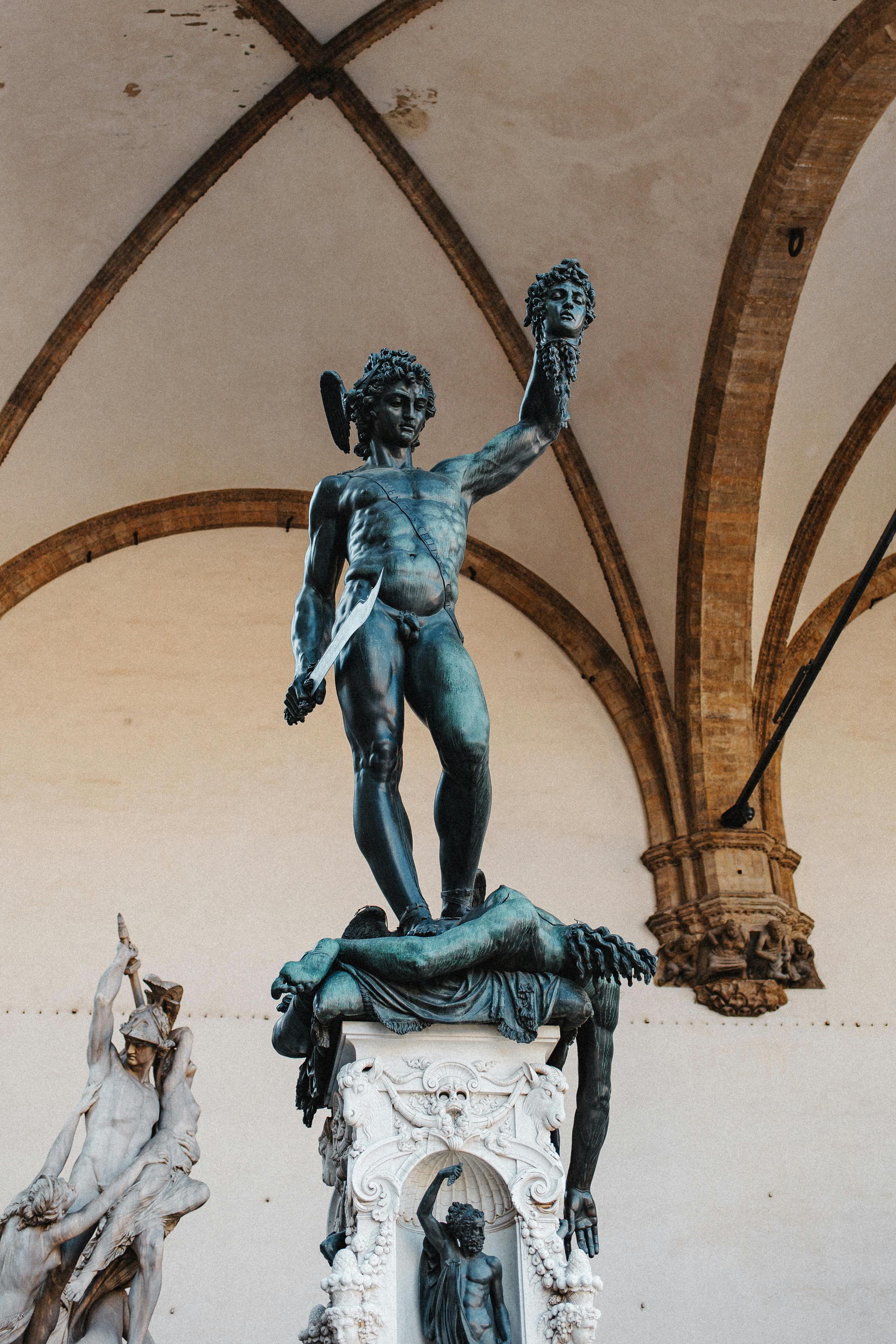
Benvenuto Cellini spent nine years — 1545 to 1554 — casting this bronze figure, and the story of its making is almost as dramatic as the myth it depicts. When the molten bronze began to solidify too quickly during the final pour, Cellini reportedly threw his household pewter into the furnace to keep the metal flowing. The result is a figure that looks wet with violence: Perseus stands on Medusa's crumpled body, her severed head raised high, blood rendered in bronze ribbons streaming from the neck. Most visitors photograph the front and move on. Don't. Walk behind the statue and look at the back of Perseus's helmet — pressed into the metal is a small, craggy face. That's Cellini's secret self-portrait, his signature smuggled into immortality. He also carved his name across the strap on Perseus's chest, just in case anyone doubted who pulled off the most ambitious bronze cast of the sixteenth century.
Rape of the Sabine Women
Giambologna carved this from a single block of marble in 1583, and the block was enormous — the finished group stands over four meters tall, roughly the height of a double-decker bus. Three intertwined figures spiral upward: a young man lifting a woman while an older man crouches beneath them. The composition has no front. That was the point. Giambologna designed it as the first major European sculpture meant to be experienced in the round, and if you only glance at it from one angle you've missed the entire argument the work is making. Walk slowly around the pedestal and watch how the bodies seem to rotate, each step revealing a new tension between limbs. Art historians call this the figura serpentina — the serpentine figure — and standing here, circling it, you understand the term in your legs before you understand it in your head. The marble catches light differently on each side; in late afternoon, the west-facing flesh almost glows warm.
The Architecture Itself
People treat the Loggia as a frame for its sculptures. Fair enough — but the frame was radical in 1382. Benci di Cione and Simone di Francesco Talenti built three wide, rounded arches at a time when Florence was still thinking in pointed Gothic. Those arches, each spanning roughly eight meters, essentially whispered the Renaissance into existence a generation before Brunelleschi got to work on the Duomo dome. Look up at the façade's trefoils: Agnolo Gaddi placed allegorical figures of the four cardinal virtues there — Fortitude, Temperance, Justice, Prudence — because this was originally a civic building where the Gonfaloniere of Justice was sworn in. The two marble lions flanking the steps look like twins, but only the right one is a genuine Roman original. The left is a 1598 copy by Flaminio Vacca, and once you know, you can see the difference in how the mane falls.

After Dark: The Loggia by Night
Come back after dinner. The Loggia is open around the clock, free, and after about 10 p.m. the daytime crowds dissolve. Floodlights throw sharp shadows across the sculptures, and the stone vaulting overhead traps a pocket of cool, quiet air — noticeably cooler than the piazza outside, even in July. Perseus looks genuinely menacing under artificial light; the Sabine Women seem to move. Sit on the wide steps facing the square and you'll have the Palazzo Vecchio's crenellated tower rising directly ahead, lit gold against the dark sky. This is one of the few places in Florence where you can sit among Renaissance masterpieces at midnight without paying a euro or fighting for space. Bring a gelato. Nobody will stop you.
Photo Gallery
Explore Loggia Dei Lanzi in Pictures

The Loggia dei Lanzi stands as a masterpiece of open-air Renaissance architecture in the heart of Florence's Piazza della Signoria.
Gunnar Klack · cc by-sa 4.0

The historic Loggia dei Lanzi stands prominently in Florence's Piazza della Signoria, showcasing its iconic arches and Renaissance sculptures to visitors.
Joalpe · cc by-sa 4.0

The historic Loggia dei Lanzi in Florence, Italy, stands as a magnificent open-air gallery showcasing world-renowned Renaissance sculptures.
Carlo Raso from Naples, Italy · public domain

The iconic Loggia dei Lanzi stands as a masterpiece of Renaissance architecture in the heart of Florence, Italy, surrounded by a lively public square.
Txllxt TxllxT · cc by-sa 4.0

The Loggia dei Lanzi is a stunning open-air gallery in Florence, Italy, showcasing historic Renaissance architecture and famous marble statues.
Francesco Bini · cc by-sa 4.0

A vibrant scene in Florence's Piazza della Signoria, featuring the iconic Loggia dei Lanzi and the medieval Palazzo Vecchio.
Nelson Pérez · cc by-sa 3.0

The Loggia dei Lanzi stands as a masterpiece of open-air Renaissance architecture, housing famous sculptures in the heart of Florence, Italy.
Zairon · cc by 4.0

The historic Loggia dei Lanzi stands as a masterpiece of Renaissance architecture in the heart of Florence, Italy, showcasing iconic sculptures to visitors.
rene boulay · cc by-sa 3.0

The historic Loggia dei Lanzi in Florence, Italy, stands as a masterpiece of Renaissance architecture, showcasing famous outdoor sculptures in the Piazza della Signoria.
No machine-readable author provided. Sailko assumed (based on copyright claims). · cc by-sa 2.5

The Loggia dei Lanzi stands as a magnificent open-air gallery in Florence, Italy, showcasing iconic Renaissance sculptures under its grand arches.
Ricardalovesmonuments · cc by-sa 4.0

The iconic Loggia dei Lanzi stands as a masterpiece of Renaissance architecture in the heart of Florence, Italy, housing famous classical sculptures.
Txllxt TxllxT · cc by-sa 4.0

The historic Loggia dei Lanzi stands prominently in a bustling piazza in Florence, Italy, showcasing its grand arches and famous Renaissance sculptures.
Freepenguin · cc by-sa 3.0
On the façade above the arches, look closely at the trefoil roundels — each contains a relief figure representing one of the four cardinal virtues (Fortitude, Temperance, Justice, Prudence), carved by Agnolo Gaddi in the 14th century. Most visitors walk straight past them, eyes fixed on the sculptures below.
Visitor Logistics
Getting There
The Loggia sits on the south edge of Piazza della Signoria, roughly a 7-minute walk from the Cattedrale di Santa Maria del Fiore — head south via Via dei Calzaiuoli, Florence's main pedestrian artery. No metro exists in the city; ATAF bus lines C1, C2, and C3 stop within 200 meters. Driving into the historic center is effectively impossible — the ZTL (restricted traffic zone) bans non-resident vehicles, so park at Villa Costanza or Parcheggio Sant'Ambrogio and walk or bus in.
Opening Hours
As of 2026, the Uffizi Galleries require a free mandatory ticket to enter the Loggia, obtained on-site at distribution points near the entrance. Access hours are controlled by security staff and generally align with daylight piazza hours, though the exact schedule can shift seasonally. The sculptures were historically viewable at midnight — that era appears to be over, at least for stepping onto the platform itself.
Time Needed
A focused walk-through of the major sculptures — Perseus with the Head of Medusa, Giambologna's Rape of the Sabine Women, the Medici lions — takes 15 to 20 minutes. If you want to read the inscriptions, study the trefoil reliefs of the four cardinal virtues overhead, and circle Giambologna's marble from every angle (it was designed for exactly that), budget 45 minutes to an hour.
Accessibility
The Loggia sits on a raised stone platform accessed by a short flight of steps — there is no ramp or elevator. The historic stone flooring inside is uneven in places. Wheelchair users can view the sculptures from the piazza level, but reaching the platform itself presents a real barrier.
Cost & Tickets
As of 2026, entry is free but requires a mandatory ticket distributed on-site — you cannot book it online. The system exists to cap crowds (sometimes at around 50 people inside at once), so expect a brief wait during peak hours. No audio guide is provided at the Loggia itself, but several third-party apps cover the sculptures in detail.
Tips for Visitors
Arrive Before Nine
By mid-morning the piazza is shoulder-to-shoulder and the free ticket queue grows. Show up before 9:00 AM and you'll have near-private access to Cellini's Perseus — the morning light raking across the bronze is worth the early alarm.
Watch Your Pockets
Piazza della Signoria is one of Florence's worst pickpocket hotspots. Clipboard-wielding "petition" collectors work in pairs — one distracts, the other lifts your wallet. Keep bags zipped and in front of you, especially in the queue.
No Eating Inside
Security guards enforce a strict no food or drink policy under the arches. Finish your gelato before you step onto the platform — they will turn you away.
Leave the Tripod
Photography is welcome but tripods are discouraged during busy hours and drones are flatly banned across Florence's historic center without a municipal permit. A phone or handheld camera is all you need.
Eat Off the Square
Skip the tourist-menu restaurants ringing the piazza. I Fratellini, a two-minute walk away on Via dei Cimatori, serves standing-room panini and wine for under €5. For a proper sit-down Tuscan meal — ribollita, bistecca — try Trattoria Antico Fattore a block south.
Combine with the Uffizi
The Loggia shares a wall with the Uffizi Gallery. See the outdoor sculptures first (free), then walk next door for the indoor collection — you'll arrive with your eye already calibrated to Renaissance proportion and drama.
Where to Eat
Don't Leave Without Trying
Vinaino Fiorenza
local favoriteOrder: The panini here are exceptional—locals queue for the lampredotto (Florentine tripe sandwich) and schiacciata with quality cured meats. Pair with house wine for an authentic quick lunch.
Nearly 1,900 reviews speak to Vinaino's cult status among Florentines. This is where locals actually eat, not tourists—a proper wine bar and sandwich counter that's been perfecting its craft for years.
Ristorante Enoteca EZIO
local favoriteOrder: Order by the glass from their curated wine selection and pair with seasonal antipasti and Tuscan cheeses. The intimate setting makes this ideal for an evening aperitivo.
A perfectly-rated enoteca that captures the Florentine tradition of serious wine and simple, quality food. Small and genuine, this is where you'll find locals unwinding after work.
Caffeteria La Signoria
cafeOrder: Start with espresso and cornetto in the morning, or order cantucci (traditional almond biscuits) with Vin Santo as an afternoon treat. Light pastries and coffee are flawless.
A true neighborhood café steps from the Loggia, perfect for observing real Florentine life. Morning espresso here tastes better than anywhere else—that's not nostalgia, that's fact.
Leonardo Boutique
quick biteOrder: Grab fresh schiacciata (Tuscan flatbread) and seasonal pastries. The bread here is made daily with traditional methods—perfect for a morning breakfast or picnic lunch.
A small artisanal bakery that represents Florence's commitment to quality bread-making. Everything is baked fresh; this is where you taste the difference between real Tuscan bread and tourist-trap alternatives.
Dining Tips
- check Florence's historic markets—Mercato Centrale di San Lorenzo (built 1870–1874) and Mercato di Sant'Ambrogio (built 1873)—are essential for food lovers. The ground floor of Mercato Centrale features traditional produce and meat; the upper floor has artisanal food stalls and restaurants.
- check Lunch is typically 12:00–14:30; dinner starts around 19:30–20:00. Many restaurants close between lunch and dinner service.
- check Traditional Florentine dining emphasizes simplicity and quality ingredients—expect seasonal menus, not year-round consistency.
- check Wine culture is central to Florentine meals. House wine (vino della casa) is affordable and excellent; ask the staff for recommendations by the glass.
Restaurant data powered by Google
Historical Context
A Stage That Changed Its Script
For over six centuries, the Loggia dei Lanzi has served the same basic function: it is a stage. What has changed, repeatedly and dramatically, is who controls the performance. Built between 1376 and 1382 as the civic heart of the Florentine Republic, it was the place where elected officials stood before the people to take their oaths. Within two centuries, the Medici had repurposed it as a showcase for dynastic power. By the nineteenth century, it carried inscriptions marking Italy's unification. Today, it operates as a managed open-air museum — free entry, but with ticketed access to control the crowds since early 2026.
The architecture tells the story of that continuity. Designed by Benci di Cione and Simone di Francesco Talenti, the Loggia's three round arches were Gothic in their moment but read as proto-Renaissance now — wider and more generous than anything the pointed-arch tradition would have permitted. The structure was built to hold a crowd and face a piazza. That hasn't changed. Only the crowd's reason for gathering has.
Cellini's Gamble: The Night the Furniture Burned
Most visitors assume the Perseus with the Head of Medusa was always destined for glory — a masterpiece by a famous sculptor, commissioned by a powerful duke. The surface story is clean: Benvenuto Cellini cast the bronze between 1545 and 1554, Duke Cosimo I de' Medici paid for it, and it was unveiled to universal admiration. A triumph.
What doesn't add up is the risk. Cosimo doubted the sculpture could be cast at all. The pose — Perseus standing on Medusa's crumpled body, one arm raised, the severed head dripping bronze snakes — defied the technical limits of sixteenth-century foundry work. Cellini's rivals at court whispered that it couldn't be done. According to Cellini's own autobiography, the bronze alloy began to cool and solidify during the pour, threatening to ruin years of work in a single night. Cellini, already burning with fever, ordered his assistants to throw his household pewter plates, pots, and furniture into the furnace to raise the temperature. Around two hundred pieces went in. The metal liquefied again. The pour succeeded.
The revelation isn't just the drama — it's the politics. Perseus holds Medusa's head aloft: a hero slaying a monster. But in the Piazza della Signoria, where the Republic had been crushed by the Medici just a generation earlier, the meaning was unmistakable. Perseus was Cosimo. Medusa was the Republic. The sculpture was placed in the Loggia — the very spot where republican officials had once taken their oaths — as a permanent declaration that the old order was dead. When you stand beneath those arches now and look up at Perseus, you're not just seeing a bronze. You're seeing a political execution monument, installed in the building it was designed to silence.
What Changed: From Parliament to Gallery
The Loggia's original function died with the Republic. After the Medici consolidated power in the 1530s, the space was systematically stripped of its democratic associations. Cosimo I began placing sculptures in the arches — each one a statement of dynastic authority. In 1583, Bernardo Buontalenti converted the roof into a terrace where Medici princes could watch ceremonies in the piazza below, literally elevating the rulers above the civic space the building once served. By the eighteenth century, the Loggia held barometers and thermometers for public scientific education — a function as far from republican oath-taking as you can get. The name itself shifted: originally the Loggia della Signoria (after the governing body), it became the Loggia dei Lanzi after German mercenary pikemen — Landsknechts — camped under its arches in 1527, a detail that erased the building's civic identity in favor of a military anecdote.
What Endured: The Stage Remains
And yet the Loggia has never stopped being a place where Florence presents itself to the world. The architecture still frames the piazza. The arches still draw people in from the open square. The sculptures have changed — Cellini's Perseus replaced the Republic's ceremonies, Giambologna's Sabine Women arrived in 1583 — but the act of public display is constant. Even the 2026 introduction of free ticketed entry preserves the paradox: the Loggia is simultaneously a controlled museum and an open public space, visible to anyone walking through the piazza. High up on the façade, four medallions by Agnolo Gaddi still depict the Cardinal Virtues — Fortitude, Temperance, Justice, Prudence — the moral aspirations of the Republic that built the Loggia, surviving six centuries of regime change directly above the statues that were meant to replace them.
Scholars still debate whether the Loggia's design originated with Andrea Orcagna, who died nearly a decade before construction began in 1376, or whether the credited architects Benci di Cione and Simone di Francesco Talenti created an entirely new plan — no original drawings survive to settle the question. Separately, the six female statues along the back wall are catalogued as Roman, but they have been so heavily restored over the centuries that some art historians suspect they are essentially early-modern fabrications dressed up as antiquities.
If you were standing on this exact spot on April 27, 1554, you would see a crowd pressing against the steps of the Loggia, necks craned upward. A cloth drops. Cellini's bronze Perseus catches the morning light for the first time — the severed head of Medusa raised high, bronze snakes writhing. The crowd goes quiet before the applause starts, because they understand what they're looking at: their dead Republic, held up by the hand of Medici power. The smell of the piazza is horse dung and spring dust. Somewhere behind you, a man who remembers the old government turns away.
Listen to the full story in the app
Your Personal Curator, in Your Pocket.
Audio guides for 1,100+ cities across 96 countries. History, stories, and local insight — offline ready.
Audiala App
Available on iOS & Android
Join 50k+ Curators
Frequently Asked
Can you visit the Loggia dei Lanzi for free? add
Yes, entry is free — but since January 2026, you need a free ticket obtained on-site to get in. The Uffizi Galleries, which manage the Loggia, introduced this system to cap the number of visitors inside at any one time and protect sculptures like Cellini's Perseus and Giambologna's Rape of the Sabine Women. Expect a short wait during peak hours, but you won't pay a cent.
How long do you need at the Loggia dei Lanzi? add
A focused visit takes 15 to 20 minutes; a thorough one, closer to 45 minutes. The difference depends on whether you simply admire the major bronzes or actually circle Giambologna's Rape of the Sabine Women — the first European sculpture designed to be viewed from every angle — and hunt for Cellini's tiny self-portrait hidden on the back of Perseus's helmet.
What should I not miss at the Loggia dei Lanzi? add
Don't leave without finding Benvenuto Cellini's secret self-portrait, carved into the back of Perseus's helmet — most visitors never turn around to look. The Perseus with the Head of Medusa itself is the centerpiece, but also look up at the facade trefoils by Agnolo Gaddi depicting the four cardinal virtues — they're the last surviving remnants of the building's original republican identity. And the two Medici lions flanking the steps aren't twins: the right one is a genuine Roman sculpture, the left a 1598 copy by Flaminio Vacca.
What is the best time to visit the Loggia dei Lanzi? add
Before 9 AM or after sunset. In the morning, the piazza is relatively quiet and the light under the arches is cool and even — ideal for photography. At night, the sculptures are dramatically lit and the crowds thin to almost nothing, turning the Loggia into something closer to the private gallery the Medici intended it to be.
Is the Loggia dei Lanzi worth visiting? add
It's one of the few places on earth where you can stand inches from Renaissance masterpieces — bronze and marble that cost fortunes and careers to create — without a ticket, a queue, or a glass barrier. Cellini's Perseus alone, cast in 1554 after the sculptor famously melted his own furniture to keep the furnace alive, would be the star of any museum on the planet. The fact that it sits in the open air, a two-minute walk from the Cattedrale di Santa Maria del Fiore, makes it absurdly easy to visit.
How do I get to the Loggia dei Lanzi from Florence city center? add
If you're near the Duomo, walk south for about five minutes — it sits on the southwest corner of Piazza della Signoria, right next to the Palazzo Vecchio. Florence has no metro, but the C1, C2, and C3 bus lines stop near the piazza. Don't drive: the historic center is a restricted traffic zone (ZTL), and fines arrive by post months later.
Why is it called the Loggia dei Lanzi? add
The name comes from the Landsknechts — German mercenary pikemen known in Italian as lanzichenecchi — who were stationed under its arches around 1527. Before that, it was simply the Loggia della Signoria, named for its role as the civic stage where the Republic's leaders were sworn in. Some older sources call it the Loggia dell'Orcagna, after the artist Andrea Orcagna, but records show he died nearly a decade before construction began in 1376.
What sculptures are in the Loggia dei Lanzi in Florence? add
The two headliners are Benvenuto Cellini's bronze Perseus with the Head of Medusa (completed 1554) and Giambologna's marble Rape of the Sabine Women (1583), carved from a single block taller than two people stacked. You'll also find Giambologna's Hercules and the Centaur, six ancient Roman female statues along the back wall — though scholars debate how much of them is genuinely Roman — and the pair of Medici lions guarding the steps, one Roman original and one Renaissance copy.
Sources
-
verified
Wikipedia — Loggia dei Lanzi
Construction dates, architects, naming history, Medici lions, facade details, and inscriptions.
-
verified
Virtual Uffizi — History of the Loggia dei Lanzi
Architectural style, original civic purpose, Buontalenti terrace modifications, and Landsknecht naming origin.
-
verified
Uffizi Galleries — Official Notice on Free Ticket
2026 ticketing policy requiring free on-site tickets for entry.
-
verified
UNESCO World Heritage Centre — Historic Centre of Florence
World Heritage listing context for the Piazza della Signoria and surrounding structures.
-
verified
Arte.it — Loggia della Signoria o dei Lanzi
Calendar inscription details and confirmation of construction dates.
-
verified
Conosci Firenze — La Loggia dei Lanzi
Scholarly debate on Orcagna attribution and Medici lion provenance.
-
verified
Firenze Curiosità (Blog)
19th-century restoration by Pasquale Poccianti and Medici-era terrace context.
-
verified
Florence for Free
Details on Cellini's hidden self-portrait and signature on Perseus, and Giambologna's serpentine composition.
-
verified
Discover Tuscany — Access Regulations
Crowd control measures and visitor capacity limits at the Loggia.
-
verified
Firenze Post — Crowd Management
Reporting on the 50-person cap and security measures inside the Loggia.
-
verified
Fondo Ambiente Italiano (FAI)
Confirmation of construction dates and civic function of the Loggia.
-
verified
Dooid.it
Landsknecht naming origin and transformation from civic to exhibition space.
-
verified
AbstrART Firenze
Artistic context and architect attribution details.
-
verified
Traditional Building Magazine
Material details including Verona marble, Carrara marble, and lumachelle limestone.
-
verified
Martinaway
Local folklore including the ghost of Baldaccio d'Anghiari.
-
verified
UffiziFirenze.it
Historical detail on 19th-century scientific instruments and Feldherrnhalle connection.
Last reviewed: