Introduction
Why does Florence's most famous statue stand in a place that began as a hospital ward, not a palace or a cathedral? At the Galleria dell'Accademia in Florence, Italy, that mismatch is the reason to come: you visit for Michelangelo's David, of course, but you stay for the strange intimacy of seeing a civic colossus inside rooms built for study, care, and discipline. Today the air carries that museum mix of cool stone, varnished wood, and hushed shoe-scrape, then the Tribuna opens and David rises under the skylight like a figure who has just stepped forward from the marble.
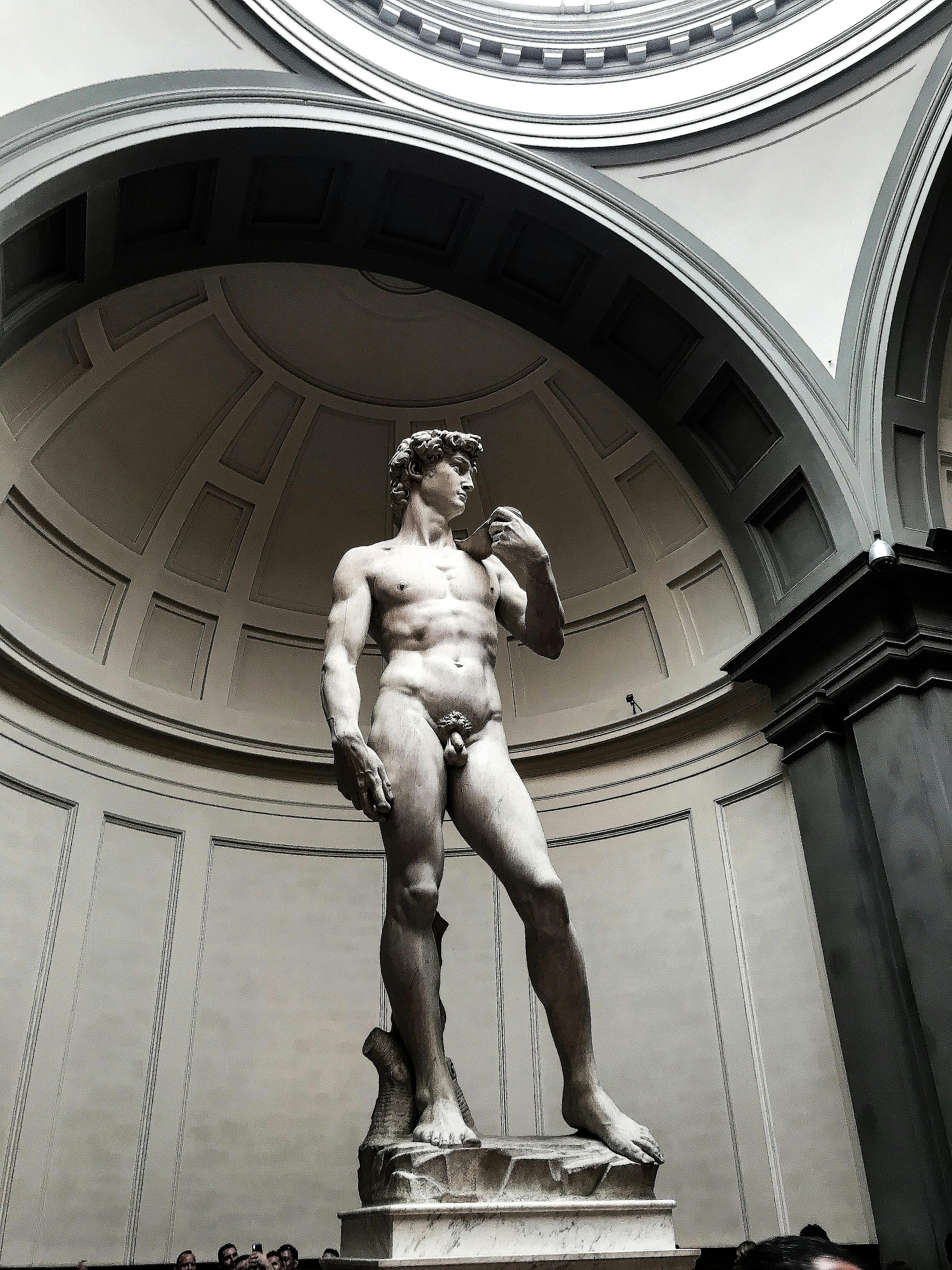
Most people arrive thinking this is a one-work museum. Fair enough. David alone earns the queue, especially once you notice that the statue's hands and head run slightly large, a clue that records suggest he was first carved for a cathedral buttress, not for eye-level inspection in a gallery.
But the Accademia does something better than spectacle. It teaches your eye. The unfinished Prisoners still show Michelangelo's point chisel and toothed gradina tracks, the plaster casts keep their measuring marks like fingerprints of 19th-century craft, and the devotional panels remind you that Florence made art for prayer long before it made art for crowds.
And the building itself keeps the argument honest. Grand Duke Pietro Leopoldo founded the museum here in 1784 as a teaching collection inside the former Hospital of San Matteo and the convent of San Niccolo di Cafaggio, so what you walk through now is not a neutral white box but a place with old institutional bones, a few minutes from Florence Cathedral (Duomo) and the civic theater of Piazza della Signoria.
FLORENCE: 10 places TOURISTS DON’T KNOW | Florence hidden gems
Giulia Explains ItalyWhat to See
Michelangelo's David in the Tribune
The surprise is scale: Michelangelo's David rises 5.17 meters high, about as tall as a two-storey house, yet the first thing that hits you isn't size but tension. Under Emilio De Fabris's 19th-century skylight, the marble catches cold white light across the neck, the veins of the right hand, the carved pupils, and you understand why a statue commissioned in 1501 for 400 ducats ended up remaking Florence's political self-image instead of sitting on a cathedral buttress near Florence Cathedral (Duomo).
The Gallery of the Prisoners
Most visitors rush this corridor because they can already see David at the far end. Don't. Four unfinished Michelangelo figures, cut between 1525 and 1530 for the tomb of Pope Julius II, seem to drag themselves out of the stone block by block; tool marks, rasp scratches, and the faint traces of a bow drill on Atlas catch the light like fresh wounds, and the whole passage feels less like a hallway than a lesson in how sculpture is fought for, not simply made.
Stay for the rooms everyone else skips
The museum gets smarter once you stop treating it as a one-statue errand. Start in the Hall of the Colossus with Giambologna's plaster model for the Rape of the Sabines and Perugino's signed Assumption, then slip into the chalky Gipsoteca, where plaster casts turn the air studio-pale, and finish among the Medici instruments, where ebony, ivory, and mother-of-pearl replace marble and the silence gives way to recorded sound; after the crush of Uffizi Gallery, this sequence feels almost conspiratorial.
Videos
Watch & Explore Galleria Dell'Accademia
FLORENCE: 10 places TOURISTS DON’T KNOW | Florence hidden gems
A look inside Michelangelo's 'secret room' | BBC Global
In the corridor before David, study the Prisoners' shoulders and legs from the side. You can still see Michelangelo's chisel marks and the rough stone he never fully cut away, as if the figures are still trying to escape.
Visitor Logistics
Getting There
Via Ricasoli 58/60 sits a 5-minute walk north of Florence Cathedral (Duomo) and about 15 minutes on foot from Santa Maria Novella station via Via de' Cerretani, Piazza del Duomo, and Via Ricasoli. Bus 14 from SMN takes about 12 minutes, and lines 6, 11, 13, 14, 21, 23, 31, and C1 stop near Battisti or San Marco; from the Uffizi Gallery, bus 23 or C1 to San Marco works well.
Opening Hours
As of 2026, the museum opens Tuesday to Sunday from 08:15 to 18:50, with last entry at 18:20, and it stays closed on Mondays. Free-entry days confirmed for 2026 include 25 April, 2 June, 4 November, and the first Sunday of each month; the museum also posts occasional evening openings on its rolling calendar.
Time Needed
Give yourself 45 to 60 minutes if you're coming mainly for David and Michelangelo's Prisoners, though security can eat 15 to 20 of those minutes in busy months. A full visit with the painting rooms, the musical instruments, and the plaster-cast galleries needs 75 to 90 minutes, which feels about right for a place built around one marble celebrity and a lot of quieter surprises.
Accessibility
Wheelchair access is available throughout the museum, and visitors with certified disabilities receive free entry along with one companion. Elevators reach the upper-floor collections, wheelchairs can be borrowed at the entrance in limited numbers, and the only real nuisance is the surrounding cobblestone, uneven in patches like badly laid loaves of bread.
Cost & Tickets
As of 2026, the standard ticket is €16, with a €4 online booking fee, so most official reservations land at €20 total; EU visitors aged 18 to 25 pay €2, and under-18s enter free. From 15 March 2026, a 48-hour Accademia plus Bargello ticket costs €26, while the 72-hour six-museum pass costs €38, and both make more sense than paying third-party resellers an extra €10 to €15 for the same slot.
Tips for Visitors
Best Slot
Book the 08:15 entry on a Wednesday or Thursday if you want David with a little breathing room and fewer phone screens glowing in front of him. After 17:00 also works, but the museum closes at 18:50, so you trade thinner crowds for a tighter clock.
Photo Rules
Photography is allowed, but flash, tripods, selfie sticks, and drones are not. Staff watch the David hall closely, so don't count on sneaking a bright shot under that lantern-like dome of light.
Skip Fake Sellers
Ignore anyone outside offering 'skip-the-line' tickets or last-minute deals; Via Ricasoli attracts resellers the way sugar pulls ants. Buy through the official museum site or B-ticket, then expect security screening anyway, usually 15 to 20 minutes in peak season.
Bag Strategy
Large backpacks and suitcases won't get in, and the museum's free cloakroom is meant for small and medium bags, not full travel luggage. If you're arriving from the station, leave big cases at SMN first unless you enjoy discovering rules at the metal detector.
Eat Nearby
For a quick, cheap bite, Pugi on Piazza San Marco does solid schiacciata and pizza al taglio, while Gelateria Carabè almost next door on Via Ricasoli handles the post-David sugar fix for about the price of a city bus ticket. If you want a proper lunch, Trattoria Mario on Via Rosina is the move for ribollita and bistecca at mid-range prices, while La Ménagère on Via de' Ginori suits a slower, pricier meal.
Pair It Well
Skip the idea that the museum begins and ends with one famous nude. Pair the visit with Florence Cathedral (Duomo) or Brunelleschi'S Dome if you want Florence at its most theatrical, or head to the Uffizi Gallery only if you've kept enough attention in reserve for another dense few hours.
Where to Eat
Don't Leave Without Trying
I' Girone De' Ghiotti
quick biteOrder: The 'Discordia' or the 'Gulosa' on their signature thin, crispy schiacciata bread.
This is the spot for a quintessential Florentine lunch; the bread is perfectly crispy and the fillings are generous, making it worth the inevitable queue.
Taverna Dei Servi Firenze
local favoriteOrder: Ossobuco alla Fiorentina or the homemade Gnocchi in Gorgonzola sauce with walnuts.
A perfect, relaxed retreat after visiting the Accademia; the staff are incredibly attentive and the value for authentic, home-cooked pasta is hard to beat.
Osteria La Dolce Vita Firenze
local favoriteOrder: The Florentine steak is world-class, followed by the truffle ravioli.
This is a warm, hospitable spot that feels like a true 'dolce vita' experience, thanks to professional service and some of the best steak and pesto gnocchi in the city.
Melaleuca Florence Bakery +Bistrot | Brunch & Specialty Coffee
cafeOrder: The cinnamon rolls are legendary, and their tacos are a fresh, flavorful surprise.
A quaint, vibrant spot that perfectly balances traditional bakery skills with a modern brunch flair—ideal for a morning coffee with a view.
Dining Tips
- check Visit the Mercato di Sant’Ambrogio (Mon-Sat, 7:00 a.m. – 2:00 p.m.) for an authentic look at local produce and cheese.
- check The Mercato Centrale ground floor is open Mon-Fri 7:00 a.m.–2:00 p.m. and Saturday 7:00 a.m.–5:00 p.m.
- check Florence's food culture is deeply rooted in butcher-driven traditions and hearty, seasonal market fare.
- check The Cascine Market is held every Tuesday morning (7:00 a.m. – 2:00 p.m.).
Restaurant data powered by Google
History
A Museum That Never Stopped Teaching
The Accademia's deepest continuity is not worship but training the eye. Records show the museum was founded in 1784 by Grand Duke Pietro Leopoldo as a teaching collection for the Academy of Fine Arts, and that purpose still clings to the rooms: students once came here to copy, measure, compare, and argue; visitors do much the same now, even if they call it sightseeing.
That thread runs older than the museum itself. Most scholars trace it back to 1563, when Cosimo I de' Medici founded the Accademia delle Arti del Disegno, the institutional ancestor behind Florence's formal culture of drawing, and today's workshops, music programs, and school visits keep that old Florentine habit alive: art is not just displayed here, it is practiced, tested, and passed on.
The Statue Everyone Comes For, and the Lesson Hiding Around It
At first glance, the Galleria dell'Accademia looks like a temple built for one masterpiece. Tourists stream toward David, cameras ready, and the usual story says the museum exists to glorify Michelangelo's genius. Surface story, tidy enough.
Then the rooms start arguing back. Why would a supposed shrine to one perfect statue keep unfinished Prisoners, old plaster teaching models, and whole ranks of devotional paintings from suppressed churches? Why does David stand in a museum founded in 1784, when the statue itself left Piazza della Signoria only in 1873? Those dates don't sit neatly together.
The hidden truth is that Pietro Leopoldo wanted more than a treasure house. Records show he turned the former Hospital of San Matteo and convent into a teaching museum for the Academy of Fine Arts, a place where artists learned by confronting originals, and that educational mission later absorbed David rather than the other way round. The turning point came when Florence moved the statue indoors in 1873 to protect it after 369 years outside, and architect Emilio De Fabris then gave it a skylit tribune; what was at stake for him personally was large, because he had spent his career trying to give Florence worthy settings for its symbols, including the facade of the Duomo.
Once you know that, the building changes in front of you. David stops being an isolated celebrity and becomes the loudest voice in a long lesson about how Florence teaches form, civic pride, and technical skill, from gold-ground panels to plaster casts to the marble giant at the end of the axis.
What Changed
Almost everything material changed. The site began as the Hospital of San Matteo and the convent of San Niccolo di Cafaggio; then records show it became an academy museum in 1784, expanded through the suppressions of churches and convents in the late 18th century and again under Napoleon in 1810, and turned into an international magnet after David arrived in 1873. The crowd today is different too: fewer apprentices with charcoal on their fingers, more timed-entry visitors comparing photos from the Uffizi Gallery and Loggia Dei Lanzi.
What Endured
The function that endured is instruction. First it trained painters and sculptors; now it also trains ordinary visitors to slow down, compare surfaces, and notice process. That continuity shows up most clearly in the unfinished Michelangelos, where the stone still carries the marks of work interrupted, and in the museum's present-day drawing, music, and accessibility programs, which keep the Accademia less like a mausoleum and more like a public school for looking.
The Palestrina Pieta, brought to the Accademia in 1939, remains an open argument. Long attributed to Michelangelo, it is now treated by many scholars as doubtful or workshop-related, so one of the museum's most emotionally charged sculptures still carries a question mark beside the master's name.
If you were standing on this exact spot on 31 July 1873, you would hear the grind of wheels, shouted orders, and the low gasp of a Florentine crowd as David enters the Accademia inside a wooden cage. Dust hangs in the summer heat while men inch 5.5 tons of marble forward, section by section, after a journey from Piazza della Signoria. The air smells of timber, sweat, and street grit, and everyone knows they are watching Florence move one of its civic gods indoors.
Listen to the full story in the app
Your Personal Curator, in Your Pocket.
Audio guides for 1,100+ cities across 96 countries. History, stories, and local insight — offline ready.
Audiala App
Available on iOS & Android
Join 50k+ Curators
Frequently Asked
Is Galleria dell'Accademia worth visiting? add
Yes, especially if you want to see the original David rather than the copy in Piazza della Signoria. The museum rewards more than a statue run: you walk past Michelangelo's unfinished Prisoners, where chisel marks still catch the light, then into Emilio De Fabris's skylit Tribune, a bright stage built for one 5.17-meter giant, roughly the height of a two-story room.
How long do you need at Galleria dell'Accademia? add
Most people need 75 to 90 minutes for a satisfying visit. If you're here mainly for David and the Prisoners, 45 to 60 minutes can work, but the musical instruments rooms and the Bartolini plaster gallery change the rhythm of the museum in a way many visitors regret skipping.
How do I get to Galleria dell'Accademia from Florence? add
From central Florence, the easiest move is to walk. The museum sits at Via Ricasoli 58/60, about 10 minutes north of the Duomo and about 15 minutes from Santa Maria Novella station; bus 14 also runs from the station area, and San Marco is the handiest stop if you don't want to cross the center on foot.
What is the best time to visit Galleria dell'Accademia? add
The best time is the first entry at 8:15 am on a weekday, or late afternoon after 5:00 pm if you only care about the Michelangelo rooms. Summer crowds thicken the sound in the David hall fast, while late autumn and winter usually give you more breathing room and a better chance to notice how the skylight shifts across the marble.
Can you visit Galleria dell'Accademia for free? add
Yes, on certain days, though free rarely means quiet. Official 2026 free-entry dates include April 25, June 2, November 4, and the first Sunday of each month, and under-18s also enter free; on those free Sundays, advance booking is not available, so expect a line that can stretch your patience before you reach the metal detector.
What should I not miss at Galleria dell'Accademia? add
Don't miss the slow approach to David through the Gallery of the Prisoners. Stop at the start of the corridor first, let the statue appear at the far end, then look closely at Atlas and the Young Slave for drill and chisel traces, and save ten extra minutes for the Musical Instruments Museum, where Medici court sound survives in wood, ivory, and strings.
Sources
-
verified
Galleria dell'Accademia di Firenze - Visit
Official visitor information used for opening hours, late-access limits, audio guides, free-entry policy, and the main visit route through the museum.
-
verified
Galleria dell'Accademia di Firenze - The Galleria
Official museum history used for the 1784 foundation, the 1873 transfer of David, and the layered identity of the building.
-
verified
Galleria dell'Accademia di Firenze - Tickets
Official ticketing information used for current pricing and combined-ticket context.
-
verified
Galleria dell'Accademia di Firenze - David by Michelangelo
Official artwork page used for details about David's scale, commission history, and visual features.
-
verified
UNESCO World Heritage Centre - Historic Centre of Florence
Used for the wider historic context of Florence and the museum's place inside the UNESCO-listed city core.
-
verified
Accademia.org - History
Used as a secondary source for the museum's historical development, including the Tribune and David's move into the gallery.
-
verified
Accademia.org - Hall of the Prisoners
Used for the staged approach to David and the experiential importance of the Prisoners corridor.
-
verified
Accademia.org - Tribune
Used for the layout and viewing experience inside David's skylit hall.
-
verified
Accademia.org - Museum Halls
Used for quieter sections of the museum and overall room-by-room visitor flow.
-
verified
Galleria dell'Accademia di Firenze - Atlas by Michelangelo
Used for close-looking details on unfinished Michelangelo surfaces and tool traces.
-
verified
Galleria dell'Accademia di Firenze - Young Slave
Used for visible chisel-mark details on the unfinished Prisoners.
-
verified
Galleria dell'Accademia di Firenze - Collections
Used for the Musical Instruments Museum and the broader range of collections beyond David.
-
verified
Rome2Rio - Santa Maria Novella to Galleria dell'Accademia
Used for practical transit guidance from Florence's main rail station.
-
verified
MachuPicchu.org - Accademia Gallery Tickets Skip-the-Line Tips Florence 2026 Complete Booking Guide
Used for timing estimates, crowd patterns, and practical visit duration guidance.
Last reviewed: