Cathedral nave step-free; dome climb 463 steps, not accessible
Best season
Spring (April-May) or late September
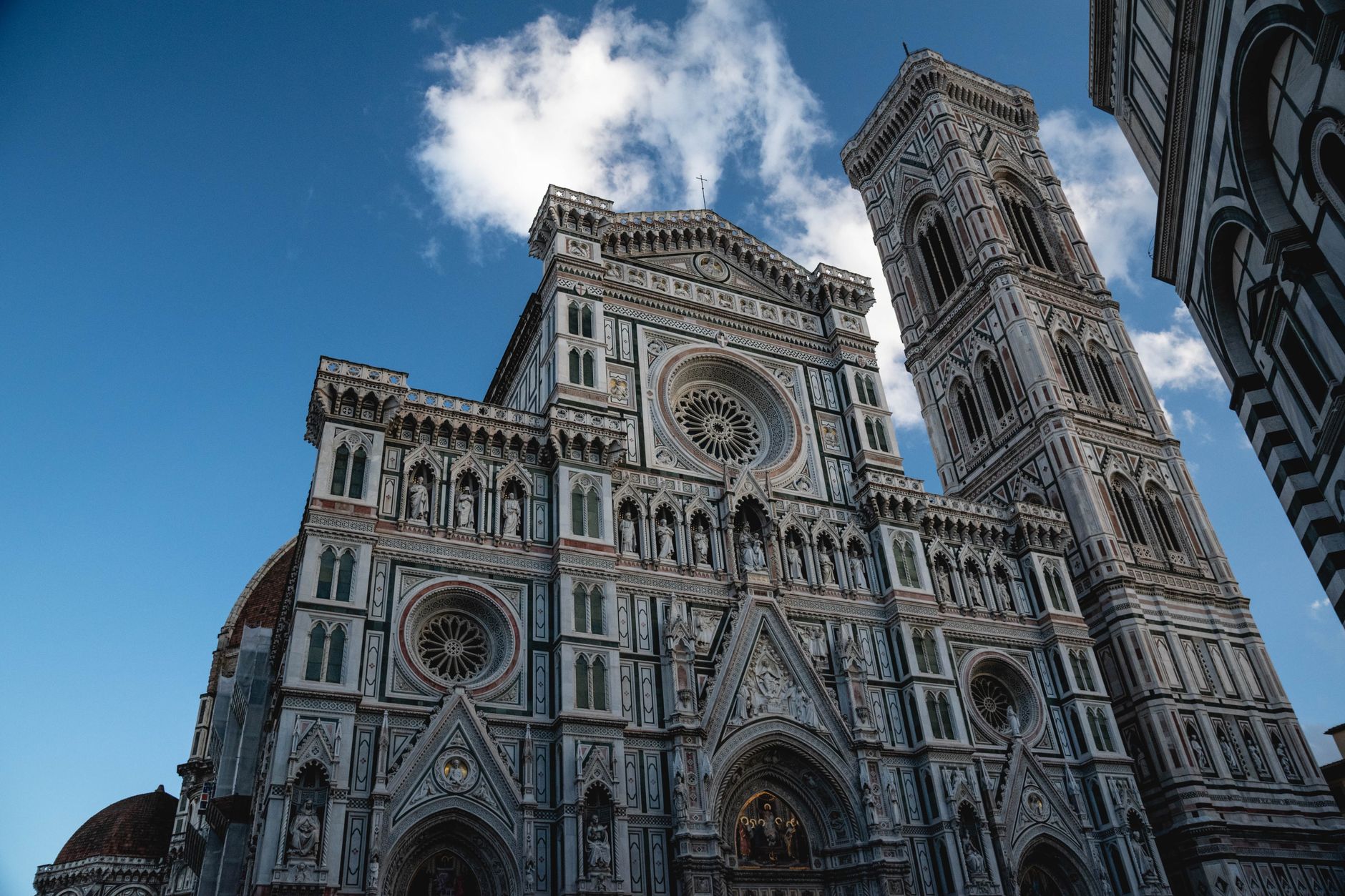
Why did Florence's cathedral stand for three hundred years with a bare brick face? Santa Maria del Fiore — the Duomo of Florence, Italy — wears a polychrome marble façade so confidently medieval that almost every visitor assumes it is. It isn't. The front you photograph was finished in 1887, four years after its architect died. Come for the dome that rewrote what masonry could do; stay for a building whose every surface argues with itself across six centuries.
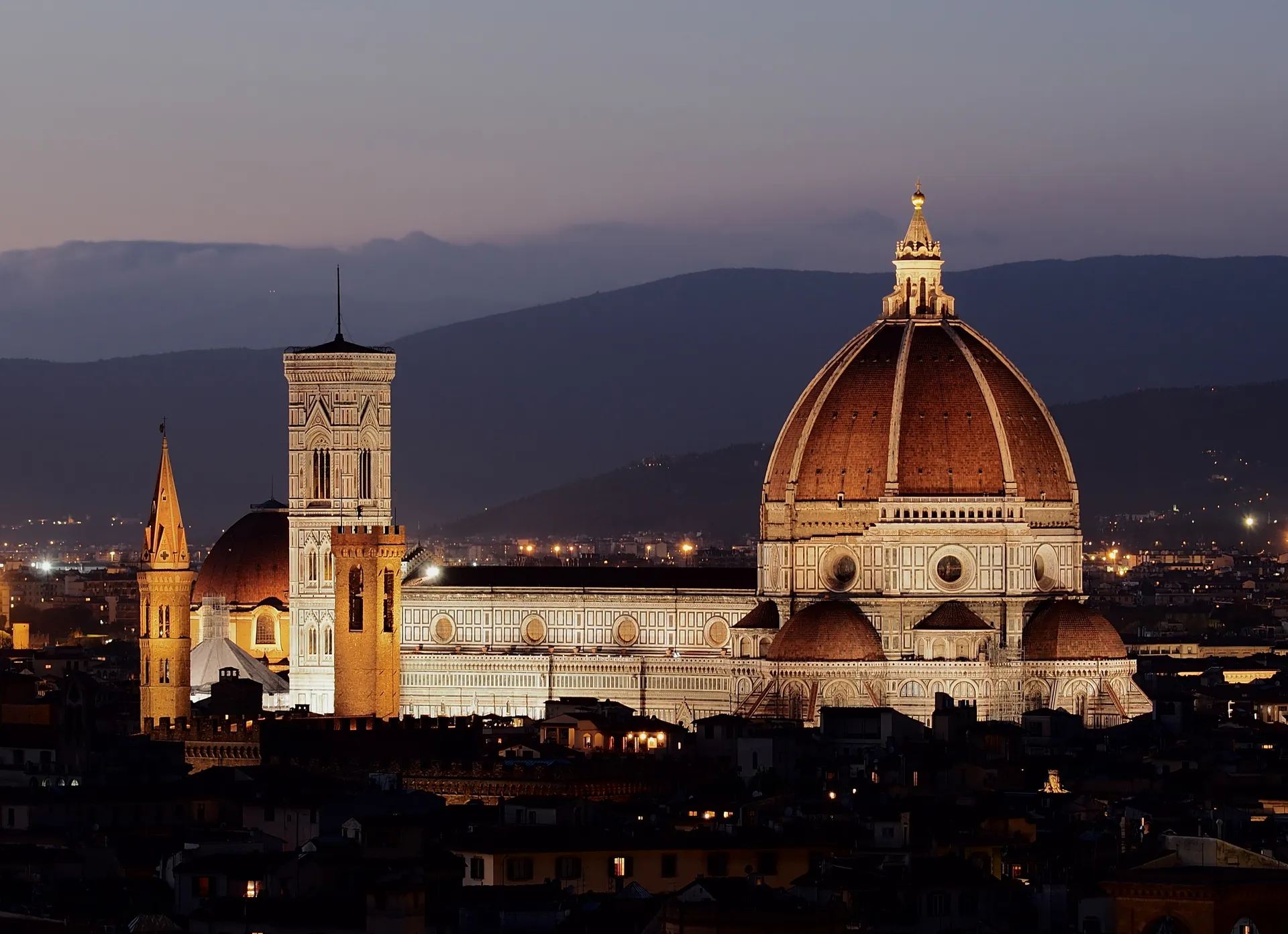
Step into Piazza del Duomo and the scale lands before the detail. The cathedral is 153 metres long, the nave reaches 90 metres of clear height under Brunelleschi's dome, and the marble cladding — green from Prato, pink from Maremma, white from Carrara — runs from pavement to lantern in a single chromatic logic. Footsteps echo on the cosmatesque floor. Outside, the queue for the dome curls around the apse.
Look up and the geometry does the work no photograph captures: an octagonal drum with a self-supporting double shell rising 116 metres, still the largest masonry dome ever built. Records show no Florentine building since has been allowed to exceed it. The skyline rule is unwritten. It has held for nearly six hundred years.
The Duomo is also a working cathedral, not a museum with a ticket gate bolted on. Mass is sung in Latin with Gregorian chant on Sunday mornings; the patronal feast of San Giovanni on 24 June still ends with fireworks over the Arno. Florentines like to say the city doesn't preserve history — it lives it. Stand under the lantern at noon and you'll see what they mean.
Researched by the Audiala editorial team from historical records, architectural archives, and local expertise.
What to see
Brunelleschi's Dome — climbing inside the engineering
463 steps spiral up between two shells of brick and stone, and somewhere around step 200 you realise you're walking inside the structural trick that made this dome possible. Run a hand along the wall. Those diagonal courses laid in herringbone pattern are what let Filippo Brunelleschi raise a 45.5-metre vault without wooden centring in 1420 — a problem that had stumped the city for decades after Arnolfo di Cambio sketched the impossible hole in 1296.
The passage gets tight. Hot in August, cold in January, and scratched all over with pilgrim graffiti going back centuries. Halfway up you emerge onto a narrow gallery at the base of the inner shell, where Vasari and Zuccari's Last Judgment fresco fills the cupola at arm's reach — devils, saved souls, trumpets, the whole apocalyptic cast staring down from a few metres away.
Then the final squeeze to the lantern. 360 degrees of terracotta rooftops, the Arno bending south, the hills toward Fiesole. See the full story on the Brunelleschi's Dome page before you book — the 72-hour Brunelleschi Pass covers it.
Giotto's Campanile — the better view of the dome
Photographers argue this is the smarter climb. 414 steps, three loggia levels with paired Gothic windows, and from the top you photograph the dome itself — climbers visible like ants on the lantern, Brunelleschi's red-tiled octagon filling the frame. From the dome you can't see the dome. Obvious, once someone says it.
Giotto started the bell tower in 1334, the year he was made capomastro, and died three years later on 8 January 1337 with only the lower band built. Andrea Pisano and Francesco Talenti finished it by 1359, but the tri-colour marble cladding — Carrara white, Prato green, Maremma pink — keeps the design coherent across three architects and twenty-five years.
Go at the first slot of the morning. The marble takes light beautifully around 9am, the queues haven't compressed yet, and the climb is easier on cool stone than on August-baked steps.
The crypt and the things most visitors miss
Most people queue for the dome and skip what's directly under their feet. The Crypt of Santa Reparata, excavated in 1965 and 1974, holds the foundations of the 5th-century basilica this cathedral replaced — Roman house walls, paleo-Christian floor mosaics, and Brunelleschi's tomb. He's the only architect granted burial inside. Cool, quiet, almost empty while three hundred people sweat their way up the dome above.
Then go outside and hunt the oddities. On the right bronze door (1903), find Giuseppe Cassioli's self-portrait — a man with a serpent strangling his neck, the sculptor's bitter joke about the debts that crushed him while finishing it. On the marble frame above, one Apocalypse angel makes the Italian gesto dell'ombrello — an unmistakable up-yours gesture, carved into a cathedral. Walk the south flank along Via dei Servi and count windows: six outside, two inside behind the first bays, because Talenti rebuilt the nave inside Arnolfo's older walls in 1356 without bothering to demolish them.
Finally, the white marble disc set into the piazza pavement northeast of the dome. It marks where Verrocchio's gilt copper ball fell after a lightning strike in winter 1600, shattering Paolo Uccello's Annunciation window — never replaced. The whole Florence historic centre rewards this kind of looking.
Plan your visit
Getting There
Piazza del Duomo sits inside Florence's pedestrian ZTL — no private cars. From Firenze Santa Maria Novella station walk 10 min east via Via de' Panzani and Via de' Cerretani; from Ponte Vecchio 8 min north via Via Roma; from Piazza della Signoria 5 min up Via dei Calzaiuoli. ATAF buses C2, 6, 14 and 23 stop nearby; verify current routes at ataf.net before travel.
Opening Hours
As of 2026, the cathedral nave opens 10:15–15:45, Brunelleschi's dome and Giotto's campanile 08:15–18:45, the Baptistery 08:30–19:30, and the Opera del Duomo Museum 08:30–19:00. The nave closes Sundays and religious holidays for mass only. Hours shift around the liturgical calendar — check duomo.firenze.it for your exact date.
Time Needed
Cathedral nave alone: 20–30 min. Cathedral plus Baptistery: about 1 hour. Add 1.5 h for the dome climb (463 steps), 1 h for the campanile (414 steps), and 1.5–2 h for the museum. The full complex runs 5–6 hours; the 3-day Brunelleschi Pass lets you split it across two mornings.
Cost & Tickets
Cathedral nave is free — no ticket, no booking, just queue at the west façade. Everything else (dome, campanile, baptistery, museum, Santa Reparata crypt) requires the combined Brunelleschi Pass at €30 adult in 2026, valid 3 calendar days with one timed dome slot. Audio guide €5, guided tours from €8. Buy only at tickets.duomo.firenze.it — fakes circulate in the piazza.
Accessibility
Wheelchair entrance is the south-side Porta dei Canonici, step-free with ramps; free wheelchairs wait at the cathedral and museum. Book the free accessibility pass ~30 days ahead for elevator access to the panoramic terrace. The dome (463 spiral steps) and campanile (414 steps) have no lift and no alternative route. Deaf visitors can request the AccessToOpera LIS video guide at the museum.
Tickets & tours.
These are guided options from our partners — same price as booking direct.
Prices are indicative — final pricing and availability are confirmed at checkout. Audiala may earn a commission from bookings made through these links.
Photo Gallery
Florence Cathedral's marble bell tower rises above a dense field of terracotta roofs. From this elevated view, the city stretches toward the Tuscan hills under soft daylight. · Alfred Franz on PexelsFlorence Cathedral rises above the terracotta rooftops of the city, with Brunelleschi’s dome and Giotto’s bell tower set against pale Tuscan hills. · Efrem Efre on PexelsFlorence Cathedral rises above the piazza with its patterned marble facade and Giotto's bell tower under a bright blue sky. The low angle makes the Duomo feel even taller. · Olivier Darny on PexelsFlorence Cathedral (Duomo) fills the frame with its green, pink, and white marble facade, rose window, and rows of sculpted saints. Warm daylight sharpens the Gothic details against a clear sky. · Keegan Everitt on PexelsFlorence Cathedral rises behind the patterned marble Baptistery in Piazza del Duomo. The clear daylight brings out the green, pink, and white geometry of the facade. · Mehmet Turgut Kirkgoz on PexelsFlorence Cathedral (Duomo) rises in white, green, and pink marble beneath Brunelleschi's red-tiled dome. Bright daylight sharpens the facade against a clear blue sky. · Simeon Maryska on PexelsFlorence Cathedral rises in white, green, and pink marble under night lighting, with Giotto's bell tower framed beside the facade. The close view emphasizes the Duomo's Gothic detail and layered geometry. · Ivan Dražić on Pexels
History
The Cathedral That Waited
On 9 September 1296, Cardinal Pietro Valeriana laid the first stone of a cathedral Florence didn't yet know how to finish. The design was Arnolfo di Cambio's, the patron was the Arte della Lana — the wool guild — and the ambition was civic before it was religious: outdo Pisa, outdo Siena, build something Rome could not ignore. Records show construction lurched forward in fits across 140 years, halted by Arnolfo's death in 1302, by Giotto's death in January 1337 with his campanile only a third built, by the Black Death of 1348.
By 1380 the nave was closed but the crossing gaped open to the sky. A 42-metre octagonal hole sat where a dome was supposed to be. Nobody alive knew how to span it.
The turning point
Brunelleschi's Wager
The official story most guides tell goes like this: in August 1418 the Arte della Lana announced a competition, Filippo Brunelleschi submitted a model, and on 7 August 1420 he began building the dome that completed the Renaissance. By 30 August 1436 it was done. Genius recognised, commission delivered, history made.
The detail that doesn't add up is the co-architect. Brunelleschi didn't win outright. The guild appointed Lorenzo Ghiberti — the same Ghiberti who had beaten him in the 1401 Baptistery doors competition — as equal coadjutor at equal pay. For a goldsmith with no built buildings to his name, asked to engineer the largest masonry vault since antiquity, sharing credit with his lifelong rival was the deepest cut imaginable. He was 43. He had spent two decades preparing for exactly this.
According to Vasari, Brunelleschi feigned illness for roughly ten days in 1423, retreated to bed, and watched. With sole responsibility, Ghiberti froze. Work stalled. The guild understood. Brunelleschi was reinstated as sole capomaestro. He never published his method, built a 1:1 brick test model in secret, and devised a self-supporting herringbone (spina di pesce) brick pattern that let masons lay each course without wooden centring below. He died on 15 April 1446, before the lantern was finished, and was buried inside the cathedral itself — an honour ordinarily reserved for saints. His tomb was rediscovered in the crypt in 1972.
Once you know about the feigned illness, the dome reads differently. Those concentric rings of brick aren't just engineering. They're a man refusing, for a third time, to lose to Lorenzo Ghiberti.
Easter Sunday, 1478: Blood at the Altar
On 26 April 1478, during High Mass under Brunelleschi's still-fresh dome, assassins attacked the Medici brothers at the elevation of the Host. Giuliano de' Medici, 24, was stabbed nineteen times on the cathedral floor by Francesco de' Pazzi, who wounded his own thigh in the frenzy. Lorenzo il Magnifico was slashed in the neck — by two priests, since the professional killers had refused to draw blood inside a church — and escaped into the north sacristy when Poliziano slammed the bronze doors shut. Pope Sixtus IV had backed the plot. Within hours, Archbishop Salviati was hanged in his robes from a Palazzo Vecchio window; Jacopo de' Pazzi was later exhumed and dumped in the Arno. The conspiracy meant to break the Medici. It made Lorenzo de facto ruler of Florence for sixteen more years.
The Façade Is Younger Than the Eiffel Tower
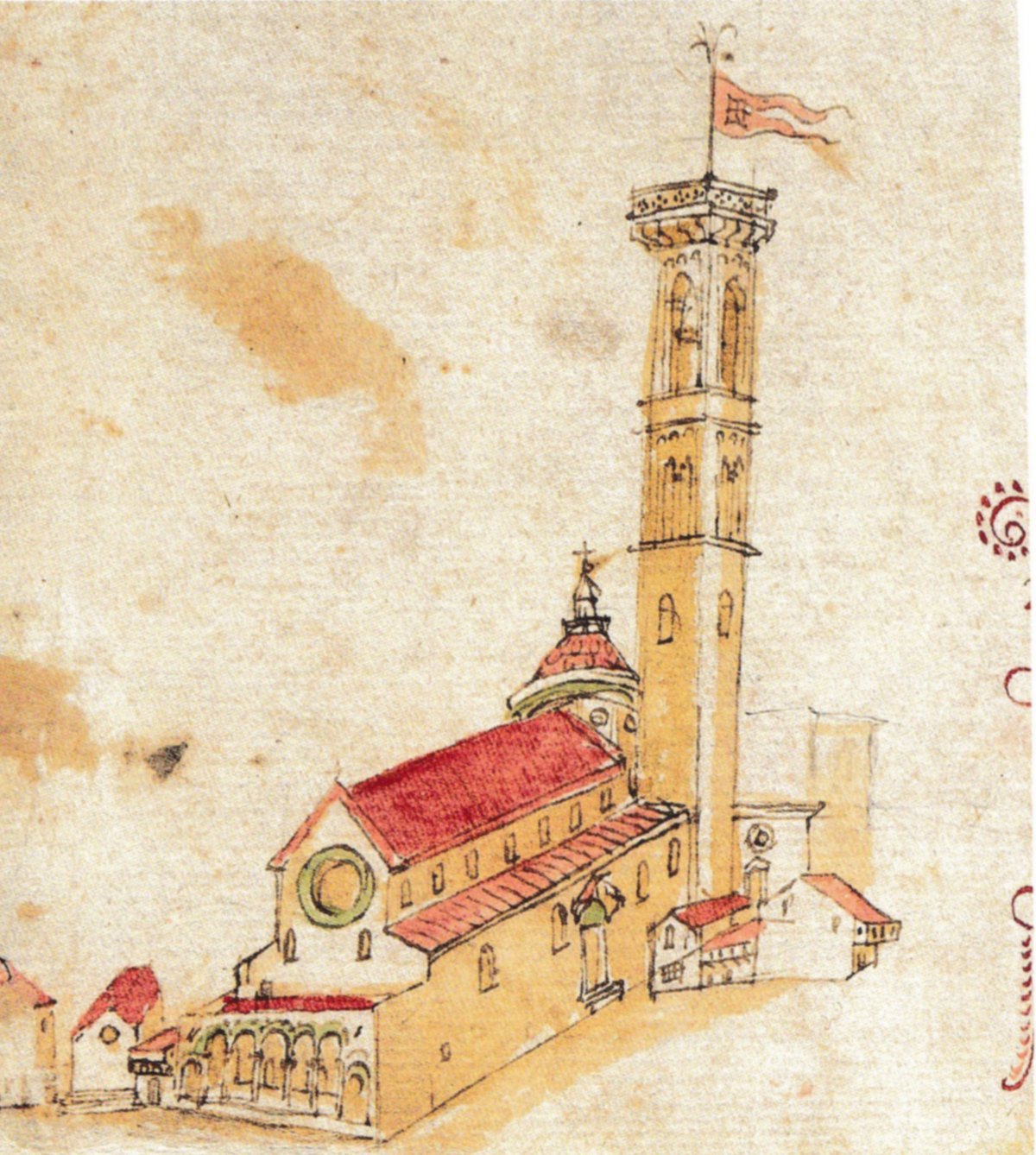
Arnolfo's partial 14th-century front was demolished in 1587 under Grand Duke Francesco I de' Medici, who wanted to start over and never did. For three hundred years the cathedral wore raw brick. The polychrome neo-Gothic face you see today was designed by Florentine architect Emilio De Fabris (1807–1883), funded partly by international subscription including the Anglo-Florentine community, and finished in 1887 — twenty-two years after Florence briefly served as capital of newly unified Italy. De Fabris died four years before completion and never saw his marbles set. Bernardino Poccetti's drawings from c. 1587, made just before demolition, remain the only visual record of what was lost.
Tips for visitors
Dress Code Enforced
Shoulders and knees must be covered — no tank tops, no shorts above the knee, no mini-skirts, hats off inside. Door staff turn people away; pack a thin scarf or shawl rather than buying an overpriced cover-up from piazza vendors.
Bags Must Be Deposited
Free bag deposit is mandatory for every ticket-holder entering the monumental complex — backpacks, daypacks, suitcases all go. Especially strict for the dome climb. Travel light on Duomo day or you'll lose your timed slot waiting at the deposit.
Bracelet Scam Hotspot
Piazza del Duomo and the Baptistery queue are Florence's number-one friendship-bracelet zone — someone grabs your wrist with string, then demands €10–20. Keep hands in pockets, ignore "do you speak English?" openers, and watch for distraction teams on bus lines 1 and 7. Real police never ask to inspect your wallet.
Photo Rules
Photos allowed inside the cathedral and museum, but no flash, no tripods, no selfie sticks anywhere in the complex. Save your shot for Vasari and Zuccari's Last Judgment fresco swirling under the dome — that's the visual payoff, not the austere nave.
Walk Two Streets For Food
Anything with table service on Piazza del Duomo runs €6–10 for an espresso. Walk five minutes: schiacciata at All'Antico Vinaio (Via dei Neri), lunch-only Tuscan at Trattoria Mario near San Lorenzo, or food-hall lampredotto upstairs at Mercato Centrale. Stand at the bar — al banco — for local coffee prices around €1.50.
Beat The Crowd
Be at the dome for the 08:15 opening or come back after 16:00 — the 10:30–13:00 window is shoulder-to-shoulder, worse during Easter and Christmas weeks. Dome timed entry is strict: arrive 10–15 min early or forfeit your slot, no refund.
Skip Nave, Prioritize Museum
The free cathedral interior is austere; 80% of the masterpieces live across the piazza at the Museo dell'Opera del Duomo — Ghiberti's original Gates of Paradise, Donatello's Mary Magdalene, Michelangelo's Pietà Bandini. Quieter than the nave queue and included in the Brunelleschi Pass.
Climb Caveats
463 narrow spiral steps, no return path mid-climb, no elevator. Skip the dome if you're claustrophobic, vertigo-prone, late in pregnancy, or have heart trouble — and don't bring kids under about 6. The campanile's 414 steps are wider but equally lift-free.
Where to Eat
local_dining
Don't Leave Without Trying
Bistecca alla fiorentinaLampredottoPappardelle al cinghialeSchiacciataTrippa alla fiorentinaRibollitaPecorino cheese
Trattoria Vecchia Griglia
local favorite
Traditional Tuscan Trattoria€€star4.9(1889)
Order: The coccoli with prosciutto and stracciatella is an absolute must-try experience.
This place feels like home; the staff treats you like family, and it’s widely considered to serve some of the best, most authentic food in all of Italy.
checkTipping is not required, but rounding up the bill or leaving 5–10% is appreciated for good service.
checkThe 'coperto' (cover charge) is standard in many restaurants and is usually included in the bill.
checkAlways carry cash when visiting food markets, as not every vendor accepts cards.
checkBe aware that market stalls are typically only open in the morning and wind down by 14:00.
checkExercise caution with cash transactions at markets to ensure you receive correct change.
Food districts:Santa Croce / Sant'AmbrogioOltrarnoSanto SpiritoSan Lorenzo / Mercato Centrale area
Restaurant data powered by Google
Watch & Explore Florence Cathedral (Duomo).
Explore Florence
43 Tips I Wish I Knew Before Visiting Florence, Italy
Camden David16 min196K
Explore Florence
Top Things to Do in Florence, Italy | ULTIMATE Things To Do and See Travel Guide
Sharing the Road11 min134K
Frequently asked
Is Florence Cathedral worth visiting?
Yes — it's the building that launched the Renaissance and the dome is still the largest masonry dome ever built. Entry to the nave is free, and even a 30-minute walk-through gets you Vasari's 3,600 m² Last Judgment fresco overhead and Paolo Uccello's counter-clockwise 1443 clock above the entrance. Pair it with the Brunelleschi Pass if you want the climb, the Baptistery, and the museum where the original Ghiberti doors and Michelangelo's Pietà Bandini live.
How long do you need at Florence Cathedral?
Budget 20–30 minutes for the nave alone, or 5–6 hours for the full complex. Cathedral plus Baptistery runs about an hour; add 1.5 hours for the 463-step dome climb, another hour for the 414-step campanile, and 1.5–2 hours for the Opera del Duomo museum. The 3-day Brunelleschi Pass lets you split it across two visits — sane choice in summer.
How do I get to Florence Cathedral from Santa Maria Novella station?
Walk. It's roughly 10 minutes east via Via de' Panzani then Via de' Cerretani — flat, signposted, faster than any bus. The whole piazza is ZTL pedestrian zone, so no taxis or private cars get close. ATAF lines C2, 6, 14, and 23 stop nearby if mobility is an issue.
Is entry to Florence Cathedral free?
Yes — the cathedral nave is free, no ticket or reservation needed, walk in via the main west façade door. Everything else is paid and timed: dome climb, Baptistery, Campanile, crypt, and Opera del Duomo museum bundle into the €30 Brunelleschi Pass valid 3 days. Audio guide for the cathedral is €5 extra.
What is the best time to visit Florence Cathedral?
Weekday mornings before 10:00 or late afternoon around 16:00, ideally April–May or October. Peak crush is 10:30–13:00 in summer and Easter/Christmas weeks, when the dome queue tops two hours. Winter mornings are nearly empty and the low sun lights the tri-color marble façade gold around 16:00.
What should I not miss at Florence Cathedral?
Three things most visitors walk past: Paolo Uccello's 24-hour counter-clockwise clock on the inner west wall (turn around when you enter), Brunelleschi's tomb in the Santa Reparata crypt downstairs, and the seven bare-brick sides of the dome's drum — Baccio d'Agnolo's unfinished marble gallery that Michelangelo mocked as a 'cricket cage.' Also find the small white marble disc on the pavement northeast of the dome marking where Verrocchio's gilded copper ball crashed down after a lightning strike in 1600.
What is the dress code for Florence Cathedral?
Shoulders and knees must be covered, hats off inside — staff turn people away at the door. No tank tops, no shorts above the knee, no mini-skirts, applies to men and women. Bring a scarf or shawl as backup; vendors outside sell cover-ups at tourist markup if you forget.
Can you climb Florence Cathedral dome without booking?
No — dome access is timed-entry only and must be booked online via tickets.duomo.firenze.it, often days ahead in summer. Arrive 10–15 minutes before your slot or you forfeit it. The climb is 463 narrow spiral steps with no elevator and no turnaround midway — skip if claustrophobic, late-pregnant, or have heart issues.
Sources & attribution17
Researched and written by the Audiala editorial team from historical records, architectural archives, and local expertise. Last updated April 2026.
Organizza la tua visita — Opera del Duomo — Confirms free walk-in entry to the cathedral nave with no reservation required, and ticket-holder entry via Porta del Campanile.
Florence Duomo from Michelangelo hill — Petar Milošević — CC BY-SA 4.0 (https://creativecommons.org/licenses/by-sa/4.0/) — Source: https://commons.wikimedia.org/wiki/File:Florence_Duomo_from_Michelangelo_hill.jpg
Alfred Franz — Pexels License (https://www.pexels.com/license/) — Source: https://www.pexels.com/photo/30910754/
Strictly necessary cookies keep the site working. Analytics (PostHog, Google Analytics) measures how each visitor uses our pages. Marketing loads YouTube videos and walking-route maps without a tap and lets Google Analytics set advertising cookies. We never sell your data. You can change this any time from the footer.
Privacy
Cookie preferences
Pick what you're okay with. You can change this any time from the footer.
Strictly necessary
Always on
Sign-in, language, navigation. Always on.
Product analytics
PostHog (EU) and Google Analytics record which pages you view and how you use them, under a random identifier stored in your browser. Helps us see which pages work and which need fixing. Google's ad personalisation stays off. No selling.
Marketing
Loads YouTube videos and the walking-route maps (OpenFreeMap) without a tap; without it, they load only when you tap them. If analytics is also on, Google Analytics may set advertising cookies. Ad personalisation stays off.