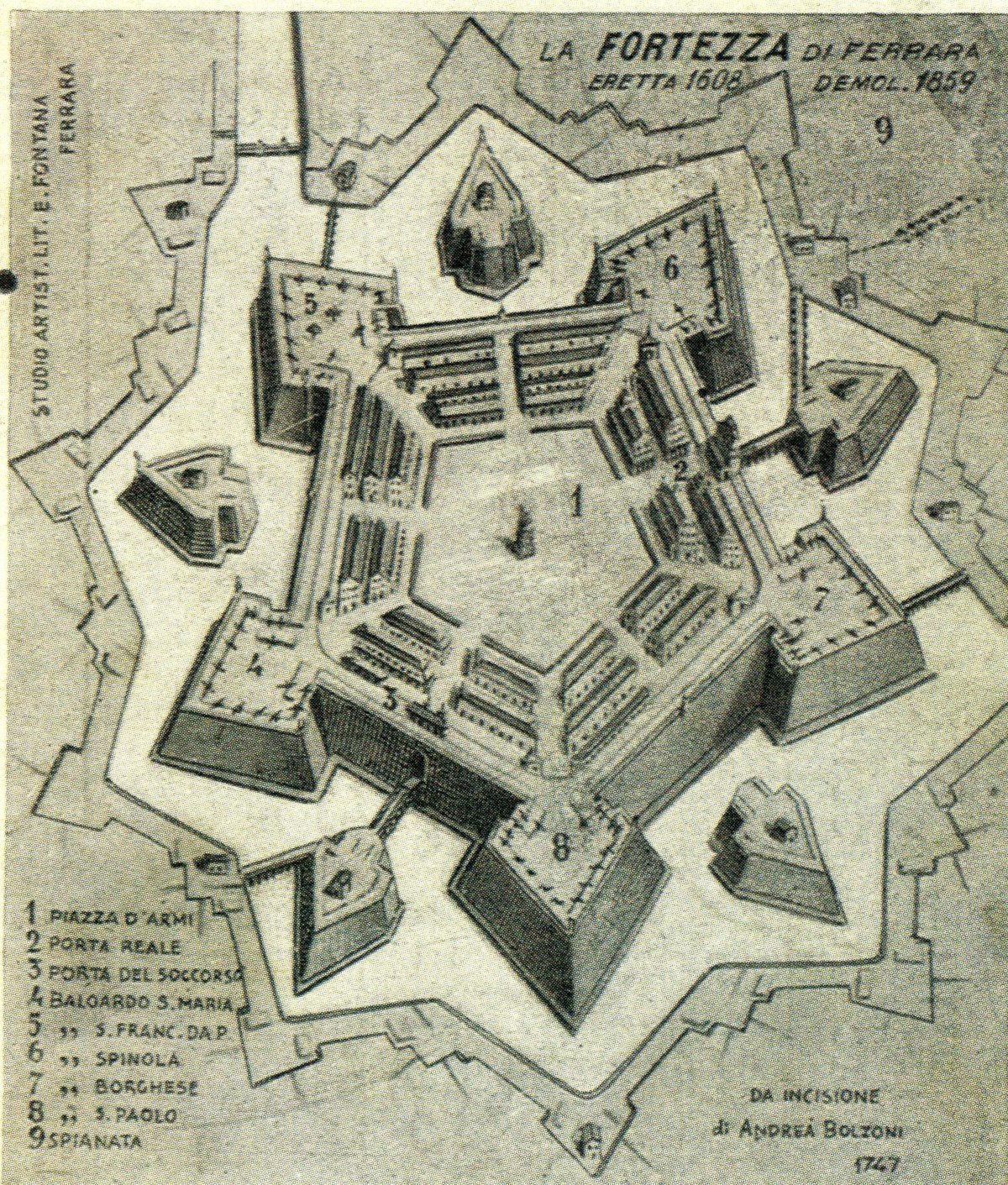
Origins and Construction
Constructed in 1583, the Baluardo di San Lorenzo was a key component in the Este family’s modernization of Ferrara’s defenses, reflecting the innovative “trace italienne” style of Renaissance military architecture. Designed to withstand the artillery advances of the time, the bastion features robust brickwork, angular projections, and is integrated into nearly 9 km of continuous city walls (FerraraInfo; Ferrara Terra e Acqua).
Evolution and Historical Context
The Baluardo di San Lorenzo was strategically positioned to defend the newly built Porta Paola, Ferrara's southern monumental gate. Over time, the bastion adapted to shifting political contexts—from the French occupation, which saw renamed city gates, to the unification of Italy, commemorated by nearby memorials. Despite wars and urban changes, the essential structure and function of the bastion remain intact, preserving a tangible link to Ferrara’s Renaissance and modern eras.
Architectural Features
Military Engineering
San Lorenzo exemplifies Renaissance advancements in fortification with its “arrowhead” design, sloped ramparts, and thick brickwork. The angular form allowed defenders maximum visibility and firing range while minimizing blind spots. The robust walls, sometimes several meters thick, could absorb and deflect cannon fire, while the bastion’s elevated walkways and sloping ramps facilitated rapid movement of troops and artillery (Ferrara Terra e Acqua).
Integration with City Walls
The Baluardo di San Lorenzo is one of several key bastions—alongside San Paolo, Sant’Antonio, and San Pietro—creating a continuous defensive circuit. The walls’ low profile and angular bastions were hallmarks of the “trace italienne” style, a major innovation in Renaissance military engineering.
Cultural and Contemporary Significance
Living Heritage
More than a historical relic, the Baluardo di San Lorenzo is a community hub, green space, and venue for cultural events. The bastion’s grassy terraces and surrounding parklands support a remarkable biodiversity, with over 240 species of plants and a range of native wildlife (Ferrara Terra e Acqua). Its elevated paths offer panoramic views of the city and countryside, making it a favorite spot for locals and visitors.
Restoration and Urban Renewal
As of 2025, the Baluardo di San Lorenzo is at the center of Ferrara’s urban renewal, accessibility, and heritage preservation projects, including the “Look Up! Ferrara” initiative. Recent works have stabilized the structure, improved safety, and enhanced accessibility, with new walkways designed for people with reduced mobility, cyclists, and families with strollers (Cronaca Comune; Telestense).
Visiting Hours and Ticket Information
- Hours The Baluardo di San Lorenzo and its surrounding parklands are open year-round, 24 hours a day.
- Admission Free public access; no tickets are required (Ferrara Terra e Acqua).
Please note that certain sections may be temporarily inaccessible during restoration work or special events. Check the official Ferrara tourism website or local information centers for current details.
Accessibility and Getting There
Location
The bastion is located on the southern edge of Ferrara’s historic center, at the beginning of the elevated walkway along Via Baluardi.
Transportation
- By Foot or Bicycle Easily reached via well-marked walking and cycling paths from the city center.
- By Car The Parcheggio Baluardo di San Lorenzo offers 240 parking spaces, operating 24/7, and is just 1.5 km from Piazza Ariostea.
- Public Transport Buses connect Ferrara’s train station (about 2 km away) with stops near the bastion.
Accessibility
Paths around the bastion are generally wide and gently sloped, suitable for wheelchairs and strollers. Some uneven surfaces remain due to the historic nature of the site. Restoration works are focused on improving accessibility for all visitors (Cronaca Comune).
On-Site Experience and Amenities
Atmosphere and Activities
Enjoy a blend of history and nature: stroll, cycle, or relax on the bastion’s grassy terraces. The elevated walkway offers panoramic views, and the parklands are ideal for birdwatching and quiet reflection.
Facilities
While the bastion itself has limited amenities, public restrooms, seating, and water fountains are available along the walls and in the city center. The nearby Porta Paola houses the Ferrara Walls Documentation Centre, providing maps and historical guidance (Inferrara).
Parking
- Baluardo di San Lorenzo Parking 240 spaces, 24/7 access.
- Other Lots Parcheggio Kennedy, Parcheggio Diamanti, and Parcheggio San Guglielmo are nearby; most operate 24 hours except during major events (Ferrara Summer Festival).
Events, Guided Tours, and Educational Initiatives
- Guided Tours Available through the Ferrara Walls Documentation Centre, especially during festivals and special events. Some tours require advance booking or a fee.
- Interactive Panels The “Teli Parlanti” campaign features multilingual panels explaining history and architecture.
- SmartMap Near Porta Paola, an interactive panel and QR codes offer accessible, bilingual historical content (Itinerari e Luoghi).
- Community Events The bastion hosts open-air markets, art installations, and festivals throughout the year.
Nearby Attractions and Suggested Itineraries
- Porta Paola A 1612 monumental gate, now home to the Documentation Centre.
- Castello Estense The city’s moated Renaissance castle, 1.5 km north.
- Palazzo dei Diamanti Renowned art gallery and architectural landmark.
- Ferrara Cathedral Romanesque masterpiece in the heart of the city.
- Lungo le mura estensi Full circuit of Ferrara’s walls, ideal for walking/cycling.
Suggested itinerary: Walk or cycle along the southern walls, visit the bastion and Porta Paola, then explore central Ferrara’s UNESCO sites.
Tips for Visitors
- Visit in spring or autumn for pleasant weather and lush scenery.
- Early morning or late afternoon provides ideal lighting for photography.
- Bring water and snacks, as on-site amenities are limited.
- Wear comfortable shoes for uneven paths.
- Respect posted signs, especially during restoration phases.
- Dispose of litter responsibly and supervise children.
- Check local event calendars for special markets or festivals.
- Use QR codes and download interactive maps for a richer experience.
Frequently Asked Questions (FAQ)
What are the visiting hours?
The site is open 24/7, year-round.
Is there an entrance fee?
No, access is free.
Is the site wheelchair accessible?
Yes—most paths are gently sloped and suitable for wheelchairs, though some uneven areas remain.
Are guided tours available?
Yes—offered especially during festivals and via the Documentation Centre; check for booking requirements.
When is the best time to visit?
Spring and autumn; early morning or late afternoon for the best atmosphere and light.
Where can I park?
At the dedicated Baluardo di San Lorenzo lot or other nearby city lots.
Are there nearby attractions?
Yes—Porta Paola, Castello Estense, Palazzo dei Diamanti, and Ferrara Cathedral.