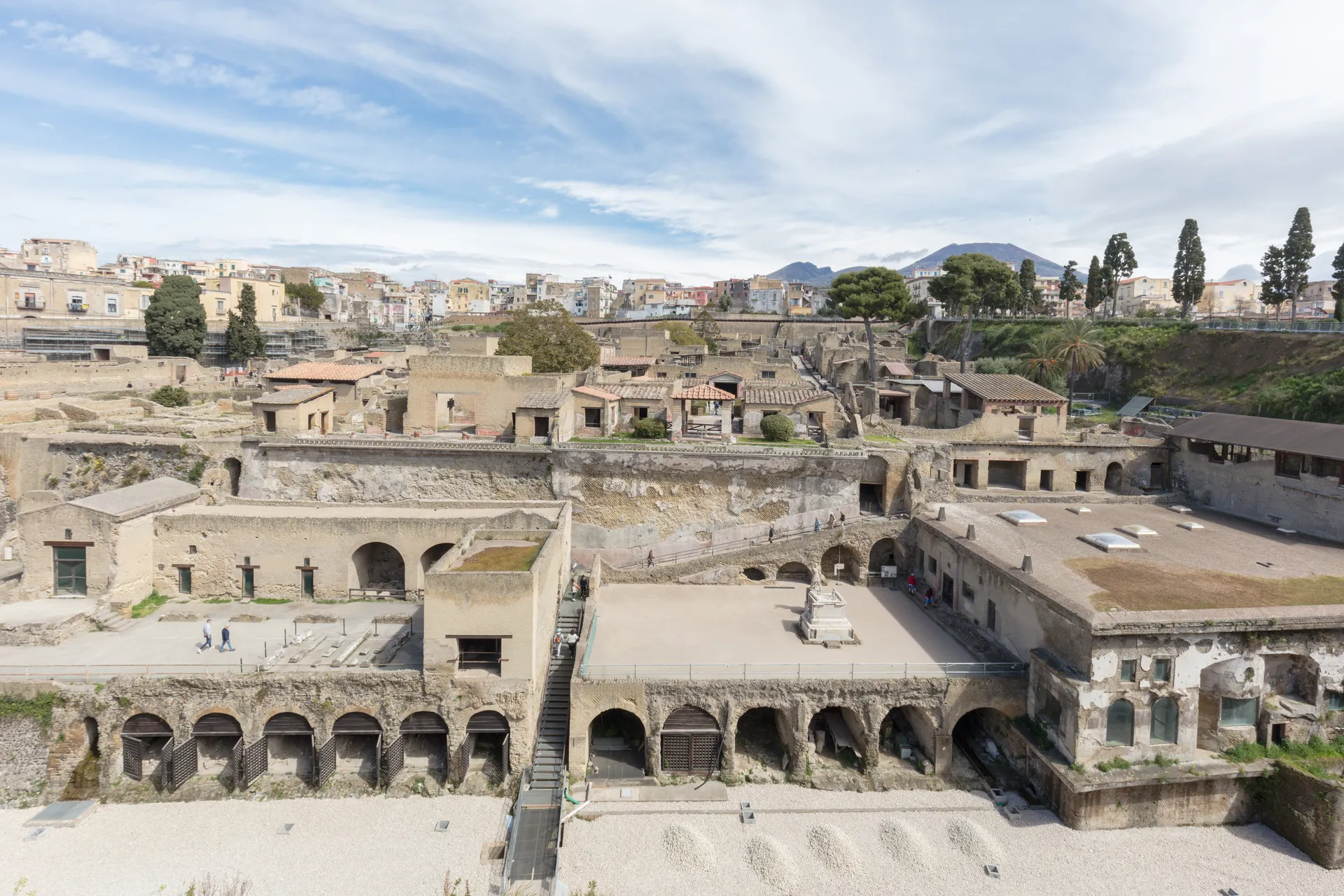
Why does Herculaneum still have wooden doors when Pompeii, twenty kilometres south, has none? The same volcano killed both towns on the same day in 79 AD, yet here in Ercolano, Italy, you can press your face against a 1st-century door frame and see the grain of the timber. Walk down into the excavated quarter and the streets feel almost sealed under glass — black tuff walls rising sheer above you, carbonized beams jutting from upper floors, the modern town pressing in at the rim like a crowd around a stage.
The answer is the difference between ash and fire. Pompeii drowned slowly under metres of pumice and lapilli. Herculaneum was hit by pyroclastic surges — superheated clouds at around 400°C that flash-cooked the town in seconds and then sealed it under up to 25 metres of pyroclastic rock, harder than concrete. That same heat that killed everyone instantly also carbonized wood, rope, food, and papyrus instead of burning them. Roof beams, beds, a baby's wooden cradle, a loaf of bread with the baker's stamp still visible — all of it survived because everything organic was turned to charcoal in a heartbeat.
Most of the ancient city is still under your feet. Roughly three-quarters of Herculaneum lies beneath the modern streets of Ercolano, untouched. What you can visit is a deep open pit at the edge of town: about 20 blocks of seaside resort where Rome's senators kept their summer villas. The richest house, the Villa of the Papyri, is only about a third dug out and holds a library of carbonized scrolls scholars are still reading.
Come for the wooden balcony of the Casa del Tramezzo di Legno, the mosaic of Neptune and Amphitrite still glittering in cobalt and gold, the 300 skeletons curled in the boat sheds where they died waiting for a rescue fleet. Stay for the unease — this is the most complete Roman town we will ever see, and the part you can walk through is the small part.
Researched by the Audiala editorial team from historical records, architectural archives, and local expertise.
What to see
The Boat Sheds (Fornici)
Twelve barrel-vaulted arches face an empty beach. Roughly 300 people crouched here on the night of the surge, waiting for rescue boats that never came. The pyroclastic blast killed them in seconds — fast enough that some skeletons still hold coins, keys, a baby clutched to a ribcage. The Ring Lady wears her gold rings on finger-bones you can see from two metres away.
Stand inside one fornix and your voice flattens against the tufa; the sea retreated 400 metres after the eruption, so the cool damp comes from drainage pumps, not surf. Few rooms in archaeology hit harder.
Casa di Nettuno e Anfitrite
Cobalt glass tesserae burn like a stained window in afternoon light. The mosaic of Neptune and Amphitrite sits in a summer triclinium, deliberately tilted so diners reclining on klinai saw the gods upright — forced perspective, 1st century AD. Egyptian-blue pigment, still vivid after 1,947 years.
Step next door. The shop's wooden shelving survived as black charcoal, amphorae racked where the owner left them on 24 August 79 AD. Carbonised hemp ropes coil on the counter. You're looking at a Tuesday morning that never finished.
Walk Cardo IV — eyes up
Cardo IV is the one street where you must look at the upper storeys. Herculaneum is the only Roman city where the second floor survived — carbonised window-grilles still hinged in their frames, the white-fir door of Casa del Gran Portale standing in its original architrave, grain countable up close.
End at Casa del Tramezzo di Legno. A wooden room-divider, two thousand years old, still partitions the atrium where the family last used it. Touch-distance behind glass. Nothing else like it exists in the Roman world.
Plan your visit
Getting There
Circumvesuviana from Napoli Garibaldi (Sorrento, Poggiomarino, or Torre Annunziata lines) to Ercolano Scavi — about 20 minutes. From the station it's a 10-minute downhill walk on Via IV Novembre, a straight shot through souvenir stalls to the entrance. Driving: A3 Napoli–Salerno, exit Ercolano, paid lots €5–10/day.
Opening Hours
As of 2026: 16 March–14 October daily 08:30–19:30 (last entry 18:00); 15 October–15 March daily 08:30–17:00 (last entry 15:30). Closed 1 January and 25 December. Casa del Bicentenario stays closed for restoration until 17 April 2026.
Time Needed
Two to three hours covers the headline houses, Forum Baths, and boat sheds. Three to four hours if you want every open domus, including the two reopened in March 2025 (Casa del Colonnato Tuscanico, Casa del Sacello di Legno). Half a day total — far more compact than Pompeii.
Cost & Tickets
Full ticket €16, EU 18–25 €2, family pass (2 adults + minors) €58. Free first Sunday of each month (on-site box office only, expect crowds), plus 25 April, 2 June, 4 November. Book through coopculture.it — ignore third-party sites still quoting €9–13.
Accessibility
Motor-disability access via the Cardo III ramp — flag staff at the entrance to arrange. Free entry for disabled visitors plus one companion. Main routes are passable but original basalt paving is uneven and most domus require steps; the approach from town is a long downhill (and a long uphill back).
Tickets & tours.
These are guided options from our partners — same price as booking direct.
Prices are indicative — final pricing and availability are confirmed at checkout. Audiala may earn a commission from bookings made through these links.
History
The Town That Burned Without Burning
Tradition holds that Hercules founded the city on his way back from Iberia, dragging Geryon's cattle across the bay. The archaeology is more sober: a Samnite settlement absorbed into Rome as a municipium after the Social War in 89 BC, then rebuilt as a seaside retreat for the senatorial class. By the 1st century AD, Herculaneum was richer per capita than Pompeii, smaller, quieter, with marble fountains and waterfront villas where Greek philosophers were kept on retainer.
Then came 62 AD, when an earthquake cracked the city, and 79 AD, when Vesuvius finished it. Records show the Forum Baths were still under restoration when the mountain blew. The traditional date is 24 August 79 AD, still used by UNESCO and the Italian state, though scholars now date the eruption to October based on autumn fruit, charcoal braziers and seasonal clothing found in the ruins.
The turning point
Piso, Philodemus, and the Library That Should Not Exist
The standard story of the Villa of the Papyri is the postcard one: a beautiful Roman holiday house with a nice library, dug up by Bourbon tunnellers in the 1750s, scrolls too charred to read, end of tale. The villa has 220 metres of beach frontage, peristyle gardens, bronze copies of Greek originals now in Naples — a rich man's seaside compound, frozen in carbon.
But the doubt is in the scrolls themselves. About 1,800 were recovered between 1752 and 1754, and once Father Antonio Piaggio's unrolling machine started prising them open in the 1750s, the contents turned out to be almost entirely Greek, almost entirely the working notes of one man — Philodemus of Gadara, a minor Epicurean philosopher. Why would a Roman senator's library hold the personal papers of a single Greek philosopher and almost nothing in Latin?
According to tradition, the villa belonged to Lucius Calpurnius Piso Caesoninus, consul in 58 BC and Julius Caesar's father-in-law. Cicero attacked him publicly for harbouring an Epicurean — the In Pisonem oration painted the villa as a den of Greek decadence. The revelation is that Cicero was probably right about what the villa was, and wrong about what it was for. Piso wasn't on holiday. He was running a philosophical salon, with Philodemus as resident intellectual, in a culture war over what Roman elite life should look like. The scrolls are Philodemus's drafts. Scholars including Richard Janko argue a separate Latin library — possibly with lost works of Virgil and Ennius — still lies in the unexcavated lower terraces, where digging stopped after 2007 funding cuts.
Knowing this changes the villa's silence. The peristyle is not a vacation pool deck. It's the courtyard of a think tank that lost its argument to history, and the most important books in it may still be down there in the dark, waiting for the Vesuvius Challenge scanners to read what no human hand can ever unroll.
From Looters' Tunnel to Open Pit
The site was rediscovered in 1709, when a well-digger struck the marble seats of the ancient theatre while sinking a shaft for Prince d'Elbeuf's villa. The prince promptly looted the statues and shipped them to Vienna. Systematic tunnelling began in 1738 under Charles of Bourbon, with Swiss engineer Karl Weber producing the first scientific plan of the Villa of the Papyri while breathing toxic air in pitch-black shafts. Open-air excavation began in 1828, paused after 1875, then resumed in 1927 under archaeologist Amedeo Maiuri, whose campaigns through 1958 exposed most of what you see today. UNESCO inscribed the site in 1997.
The 300 on the Beach
For two centuries, the absence of bodies was a puzzle — Herculaneum seemed empty, as if everyone had escaped. Then in 1980, archaeologist Giuseppe Maggi opened the 12 vaulted boat sheds along the ancient shoreline and found roughly 300 skeletons huddled inside, waiting for a rescue fleet that never landed. Pliny the Elder had sailed from Misenum to evacuate them; the wind that carried him over also drove the pyroclastic surge ashore. One skeleton, nicknamed il Soldato, wore a sword and tool belt — a Roman marine, suggesting a ship did briefly reach the beach before being beaten back. The surge hit at around 400°C and killed everyone in seconds.
Tips for visitors
Boat Sheds First
Head straight to the fornici at the bottom of the site — twelve arched shelters where 300+ residents died awaiting rescue, skeletons still arranged as Maiuri found them. Rushed visitors skip it; it's the most affecting spot in the park.
When to Show Up
Arrive at 08:30 opening for cool air and empty streets, or after 16:00 in summer for golden light on the frescoes. Weekdays in April–June or September–October are ideal; July–August bake the site hard with almost no shade.
Dress for Stone
Park rules require "abbigliamento decoroso" — no beachwear, no costumes. Practical kit matters more: closed sturdy shoes for uneven Roman paving, hat, sunscreen, and a full water bottle in summer since shade is scarce.
Photo Rules
Personal photos fine, but no flash inside frescoed rooms — pigments are 2,000 years old and direct light degrades them. Tripods and drones need an advance permit; selfie sticks are tolerated but awkward in narrow domus corridors.
Watch the Train
The Circumvesuviana Naples–Sorrento line is a known pickpocket route — keep bags in front, phones away. Outside the gates, ignore freelance "guides" and parking touts demanding €5–10 for spots they don't own; use signed lots or coopculture-booked guides only.
Eat on Corso Resina
No food inside the park. For mid-range, Casa Manco or Da Gennaro alle Ciammurre serve proper Neapolitan plates near the exit; for a splurge, Viva Lo Re at Corso Resina 261 occupies an 18th-century Vesuvian villa with a deep Lacryma Christi del Vesuvio list. Street pizza al portafoglio on Via IV Novembre handles budget.
Pair with MAV
Five minutes back toward the station sits the Museo Archeologico Virtuale — VR reconstructions of Herculaneum, Pompeii, and the Villa of the Papyri before the eruption. Pairs well after the ruins, when you've seen the bones and want the flesh back on.
Combo Ticket Math
If you're also doing Pompeii or Oplontis within three days, the combined Vesuvian sites pass beats single tickets. The Campania Artecard (including the Lite version) covers entry too — activate it at the on-site ticket office, not online.
Where to Eat
local_dining
Don't Leave Without Trying
Spaghetti al pomodoro (using San Marzano tomatoes)Maccheroni al ragùPasta e fagioliPizza napoletanaLacryma Christi del Vesuvio wineVesuvian apricots
Vitae Campania Winery
local favorite
Wine Bar & Light Fare€€star4.9(110)
Order: A charcuterie board paired with their Falanghina Frizzante.
It’s a true hidden gem just minutes from the ruins where the owner makes you feel like a guest in her home rather than a tourist. The perfect spot to unwind with local Vesuvius wines after a long walk through history.
Order: The traditional salsiccia e friarielli sandwich.
Don't let the name fool you; this is a fantastic spot for authentic local flavors served with genuine hospitality. It’s an incredibly welcoming place for solo travelers and those looking for a high-quality, hearty meal without the tourist-trap prices.
Order: Gnocchi al limone, even if it's not on the menu.
The staff, especially Anna, go above and beyond for their guests, even offering free luggage storage while you visit the ruins. Their food is hearty, flavor-forward, and feels like a warm embrace after a day of hiking.
Order: The four-course dinner with local wine pairings.
Set in a beautiful, modern space, this is the place for a romantic or special occasion dinner. It offers a refined, calm respite from the busy streets of the Naples region with service that feels like a well-choreographed performance.
checkLunch is typically served 12:30–14:30; arrive by 14:00 to ensure you get served.
checkDinner in Southern Italy starts later; expect to dine between 20:00 and 21:00.
checkTipping is not expected, but rounding up the bill by €1–2 is a kind gesture.
checkService is usually included in the bill as 'coperto' or 'servizio'.
checkOrder espresso after your meal; saving a cappuccino for the morning is the local custom.
checkUse bread to 'fare la scarpetta' (mop up your sauce) rather than eating it as an appetizer.
checkReservations are highly recommended for lunch near the archaeological site, especially on weekends.
Food districts:Corso Resina (main artery near the archaeological park)
Restaurant data powered by Google
Watch & Explore Herculaneum.
Deciphering the ancient scrolls of Herculaneum | 60 Minutes Archive
60 Minutes13 min1M
Pompeii vs Herculaneum: Which Will Blow You Away?
Travel Addicts Life14 min11K
The 300 Eruption Bodies Discovered in Herculaneum, Pompeii's Neighboring City
Discovery Future8 min144K
Frequently asked
Is Herculaneum worth visiting?
Yes — and arguably more rewarding than Pompeii if you only have time for one. Pyroclastic surges at 400°C carbonized rather than burned organic matter, so wooden doors, beds, shelves, ropes, and a baby's cradle survived in situ. Pompeii has none of this.
How long do you need at Herculaneum?
Plan 2–3 hours for the main site, 4 if you add the Antiquarium and the Bourbon theatre tunnels. The site is roughly a quarter the size of Pompeii but denser — multi-storey houses, intact upper floors, frescoes you can stand close to. Rushing it in 90 minutes means skipping the boat sheds, which is the emotional core.
How do I get to Herculaneum from Naples?
Take the Circumvesuviana train from Napoli Centrale (Garibaldi, lower level) to Ercolano Scavi — about 20 minutes on the Napoli–Sorrento, Napoli–Poggiomarino, or Napoli–Torre Annunziata line. From the station, walk roughly 10 minutes downhill on Via IV Novembre to the entrance. Watch your bags on the train — pickpockets work the Naples–Sorrento route.
What is the best time to visit Herculaneum?
Arrive at 08:30 opening or after 16:00 — cooler, quieter, and the late light rakes across the carbonized timbers. April–June and September–October are ideal; July–August is brutally hot with almost no shade in the open pit. First Sunday of the month is free but packed.
Can you visit Herculaneum for free?
Yes, on the first Sunday of every month and on 25 April, 2 June, and 4 November. Under-18s, disabled visitors plus one companion, EU teachers, ICOM members, and journalists also enter free year-round. Free Sundays only sell tickets at the on-site box office that morning — no online reservation.
How much is a ticket to Herculaneum?
Full admission is €16, reduced (EU 18–25) is €2, and a family pass for two adults plus minors is €58. Buy through coopculture.it or ercolano.cultura.gov.it; ignore third-party sites quoting €9–13 — those prices are stale.
What should I not miss at Herculaneum?
The 12 boat sheds on the ancient beach, where roughly 300 people died huddled together waiting for a rescue fleet that never reached shore. Then the Casa di Nettuno e Anfitrite mosaic in cobalt-blue glass paste, the carbonized wooden partition in Casa del Tramezzo di Legno, and the stucco warriors on the vault of the Forum Baths. The boat sheds sit at the bottom of the site — go there first if your energy is limited.
Is Herculaneum better than Pompeii?
Better preserved, smaller, less crowded — different rather than better. Pompeii buried under ash fall left body-shaped voids and a sprawling commercial city; Herculaneum's pyroclastic surge mineralized wood, food, and textiles in a wealthy seaside resort. Locals have a saying: Ercolano meglio conservato, Pompei più grande.
Sources & attribution16
Researched and written by the Audiala editorial team from historical records, architectural archives, and local expertise. Last updated April 2026.
ANSA — Two domus reopen at Herculaneum — March 2025 reopening of Casa del Colonnato Tuscanico and Casa del Sacello di Legno, and the Augustales custodian cold case.
Saved and recently read places — kept on this device only.
Photo credits (1)
Antigua ciudad de Herculano, Italia, 2023-03-27, DD 141 — Diego Delso — CC BY-SA 4.0 (https://creativecommons.org/licenses/by-sa/4.0/) — Source: https://commons.wikimedia.org/wiki/File:Antigua_ciudad_de_Herculano,_Italia,_2023-03-27,_DD_141.jpg
Strictly necessary cookies keep the site working. Analytics (PostHog, Google Analytics) measures how each visitor uses our pages. Marketing loads YouTube videos and walking-route maps without a tap and lets Google Analytics set advertising cookies. We never sell your data. You can change this any time from the footer.
Privacy
Cookie preferences
Pick what you're okay with. You can change this any time from the footer.
Strictly necessary
Always on
Sign-in, language, navigation. Always on.
Product analytics
PostHog (EU) and Google Analytics record which pages you view and how you use them, under a random identifier stored in your browser. Helps us see which pages work and which need fixing. Google's ad personalisation stays off. No selling.
Marketing
Loads YouTube videos and the walking-route maps (OpenFreeMap) without a tap; without it, they load only when you tap them. If analytics is also on, Google Analytics may set advertising cookies. Ad personalisation stays off.